

Thursday, September 18, 2025 (PNG Day 3)
A trip to the Highlands and the prospect of attending a sing-sing were major motivators driving us to sign up for this trip. Actually, it would be more accurate to say the annual cultural show was the impetus for ME to sign US up for this trip. Steve was less enthusiastic, given the distance and difficulty of reaching Papua New Guinea (PNG). He was also concerned about personal safety, especially after we heard, back in March 2024 at Misool, about a disturbing incident involving participants in a prior Alex trip to PNG. Eventually, Steve gave in, after we had a phone conference with Tanya on our drive to Death Valley in January.
On the way to Goroka, we stopped at the Kuk Early Agricultural Site, recognized by the World Health Organization as being notable for archaeological evidence of near-continuous crop cultivation for 7000, possibly up to 10,000, years, via garden bed mounding and drainage ditches.
On the way to visit the skeleton tribe, we encountered traffic snarled by a stand-off between rock-throwing tribes, keeping vehicles off a critical bridge on the way to Goroka. A 2011 book we listened to together in anticipation of this trip described tribal warfare as a way of life in New Guinea. The recommendation for Lost in Shangri-La by Mitchell Zuckoff came from our friend Eric (Eckes), who we met on a Tanya trip to Cuba in 2023. The sub-title describes it as “A True Story of Survival, Adventure and the Most Incredible Rescue Mission of World War II”. It is a gripping tale of a 1945 plane crash, with few survivors among a group of American service personnel into a little-known valley rimmed by daunting mountains, making rescue extraordinarily difficult.
![Lost in Shangri-La: A True Story of Survival, Adventure, and the Most Incredible Rescue Mission of World War II [Book]](data:image/svg+xml;base64,PHN2ZyB4bWxucz0iaHR0cDovL3d3dy53My5vcmcvMjAwMC9zdmciIHZpZXdCb3g9IjAgMCAxIDEiIHdpZHRoPSIxIiBoZWlnaHQ9IjEiIGRhdGEtdT0iaHR0cHMlM0ElMkYlMkZwYWNpZmljaGlzdG9yaWNwYXJrc2Jvb2tzdG9yZS5vcmclMkZjZG4lMkZzaG9wJTJGcHJvZHVjdHMlMkY0MDE4MzRfMTIwMHguanBnJTNGdiUzRDE1NjIxMjU4MTMiIGRhdGEtdz0iMSIgZGF0YS1oPSIxIiBkYXRhLWJpcD0iIj48L3N2Zz4=)
Engrossing true WW II story, which happened in what was then Dutch New Guinea, provides good background material on PNG in the 20th century.
We had dinner with Eric and his wife Margi in September. They described encountering spear-throwing tribes in PNG on opposite sides of a highway on their honeymoon 10 years before. The tribes interrupted the hostilities long enough to allow their vehicle to pass, after which the spear-throwing resumed.
When enough police had arrived to break up our rock-throwing stand-off, we made it to our destination, a series of performances by the Skeleton Tribe. They use ash and clay to coat their bodies to resemble skeletons.

Skeleton tribe skit in Papua New Guinea Highlands: A forest-dwelling monster menaces a hard-working pair of farmers.
Legend has it that after a group of hunters failed to reappear, a search party found a pile of skeletons in a cave in which a monster dwelt. To elude the monster and not fall victim to the same fate, they devised this ingenious disguise.

The monster menaces us! (Papua New Guinea Highlands)
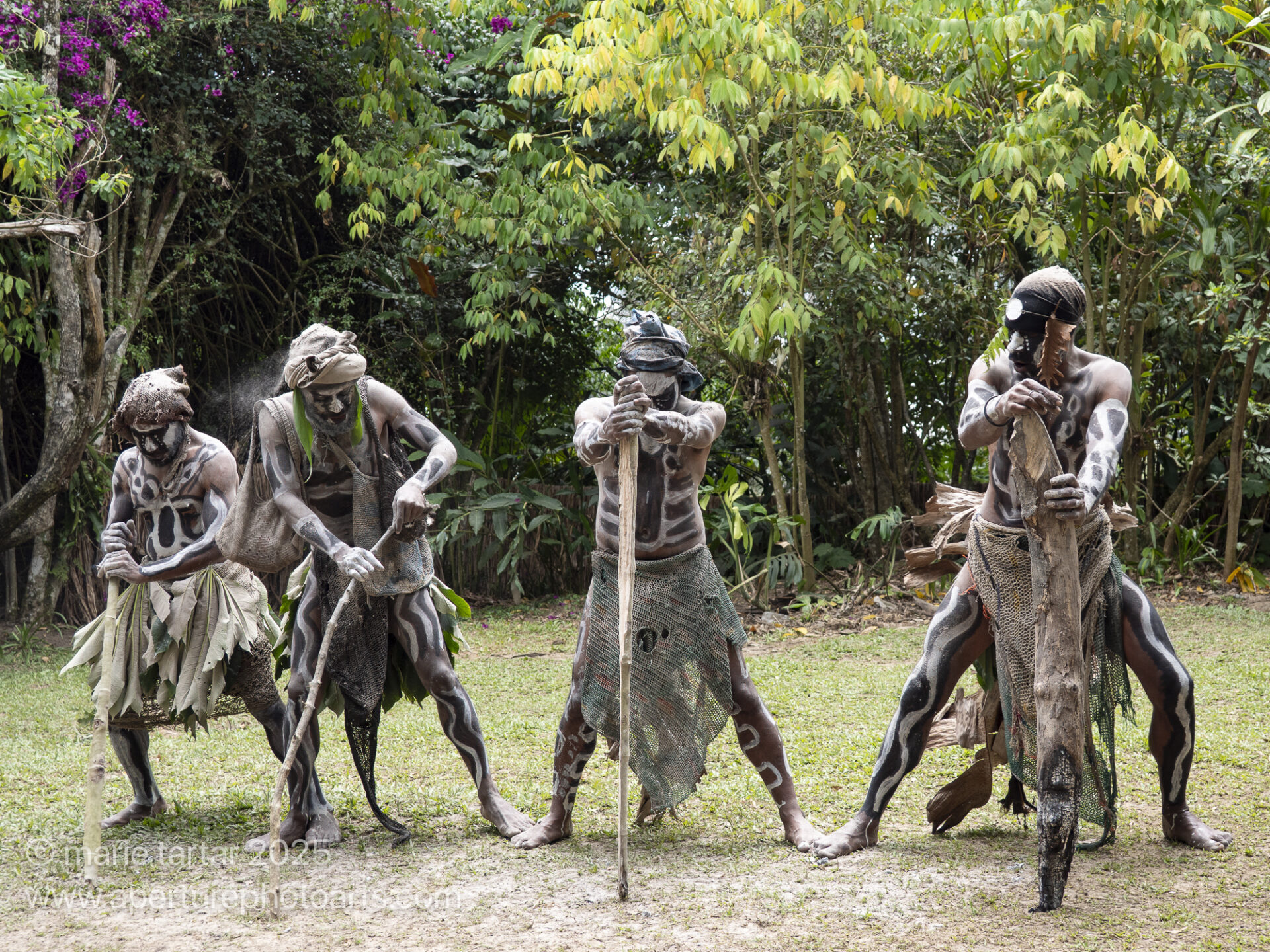
The Dustmen sway back and forth…

Before obscuring themselves in clouds of dust! (As a physician, I wonder about the effects of chronic exposure to this white dust on their lungs.)
I took a cue from Tanya at lunch, avoiding an unappealing sandwich in favor of a miniature banana. I think it is safe to say that, in general, one doesn’t venture to Papua New Guinea for the luxury of the accommodations or the cuisine.
We found Goroka thronged. Donna and Bill, Fletcher and John and Diane and Brian went with Tanya for the Asaro Mudmen performance in the afternoon. We were divided into two groups to have a more intimate experience and because one of the performances would involve a steep climb up into a cave.
The rest of us had dinner next door. Although we arrived at 6:30, the meal took over 2 hours to arrive. Once it did arrive, the chicken curry with white rice was tasty. Steve’s shepherd’s pie was a reasonable facsimile.
Friday, September 19, 2025 (PNG Day 4)
In the morning, we visited with Tommy, a friend of John’s.
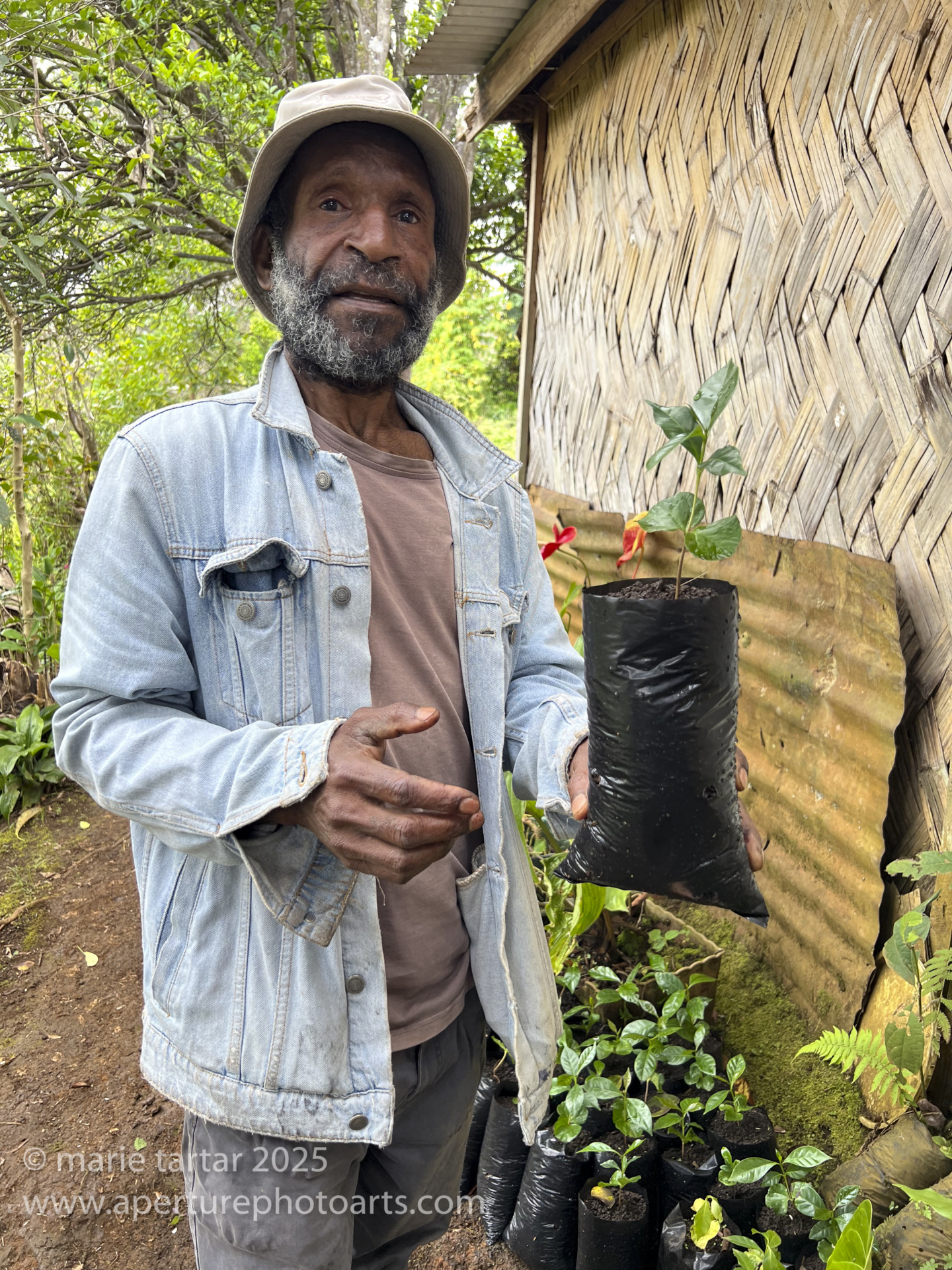
Tommy is experimenting with raising alternate crops, such as avocados.
They met in Australia during the 4-year period when Tommy lived in Brisbane. Initially, he was a telecommunications student and later worked in Australia. Tommy returned to his native village with the pandemic shut-down and began farming, as he had in his youth, assisting his parents. His village consists of many relatives. They raise taro, sweet potatoes, carrots, onions, lettuce, some for themselves and other products are taken by truck to Lae and then by boat to Pt Moresby to market. They were formerly coffee farmers.
Afterwards, we made a quick stop at the bilum market, where string and rope bags are sold, forming a colorful array.
Today was our (me, Steve , Greg, Robin, Gary, Kate and Barb) turn to visit the Asaro mudmen. There are myriad origin stories, but legend has it that villagers escaping an attack fled into the Asaro River, emerging coated in white river mud, frightening their oppressors into fleeing, believing them to be ghosts.
The climb up Mt. Gurupoka was steep. Some sections had eroded steps to negotiate. We could all tell it would be a tricky, slippery descent. Barb made it all the way to the cave entrance but declined to negotiate the crab-like maneuver required to surmount the narrow opening in the rock to actually enter the cave. Once inside, two mudmen silently menaced us.
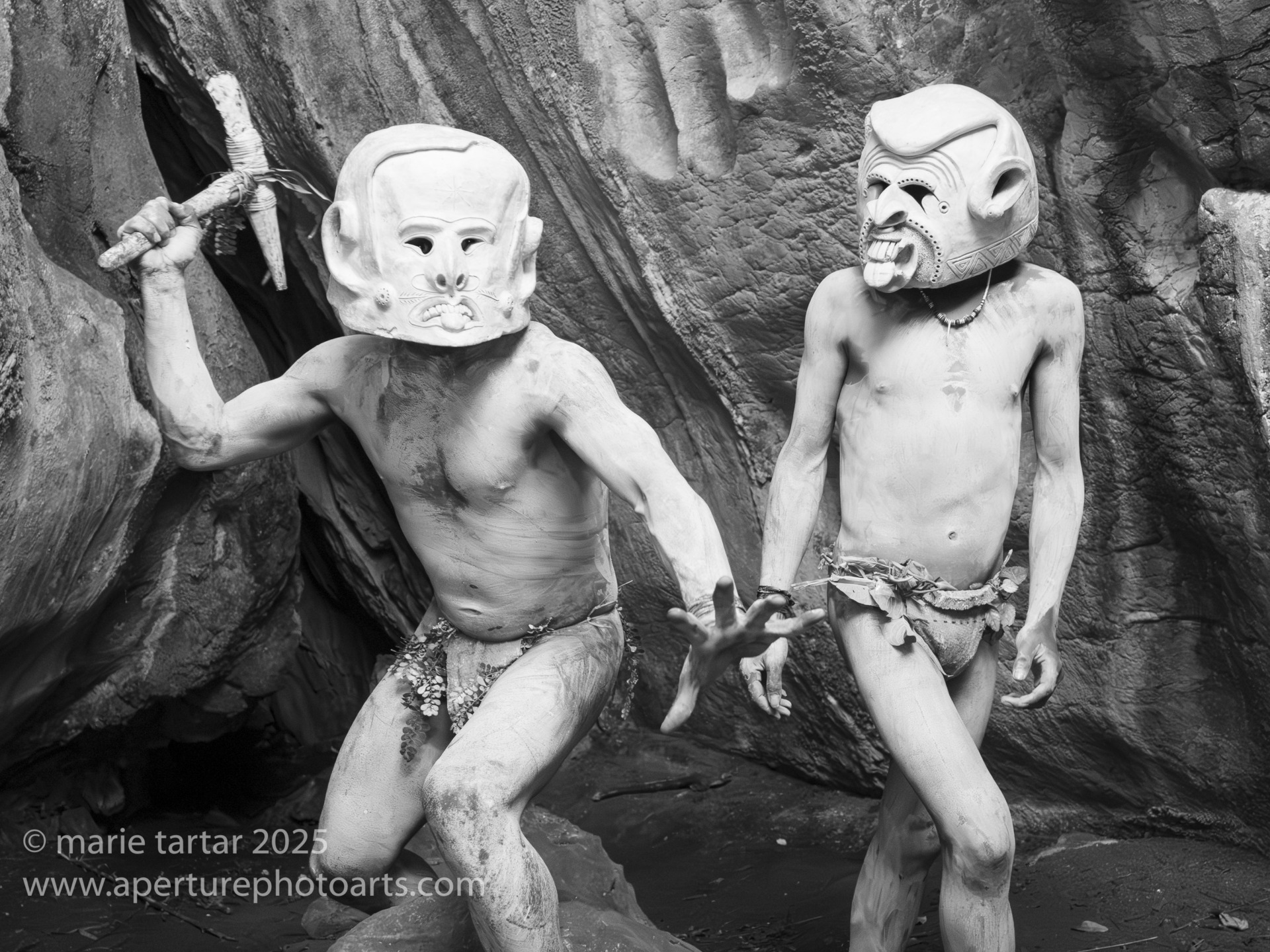
After a steep climb, we were silently menaced by these two Asaro Mudmen (Papua New Guinea Highlands). I took a page from Tanya’s processing-I think these monochromatic Mudmen in a gray cave look more graphic in black and white. You can be the judge (next image).
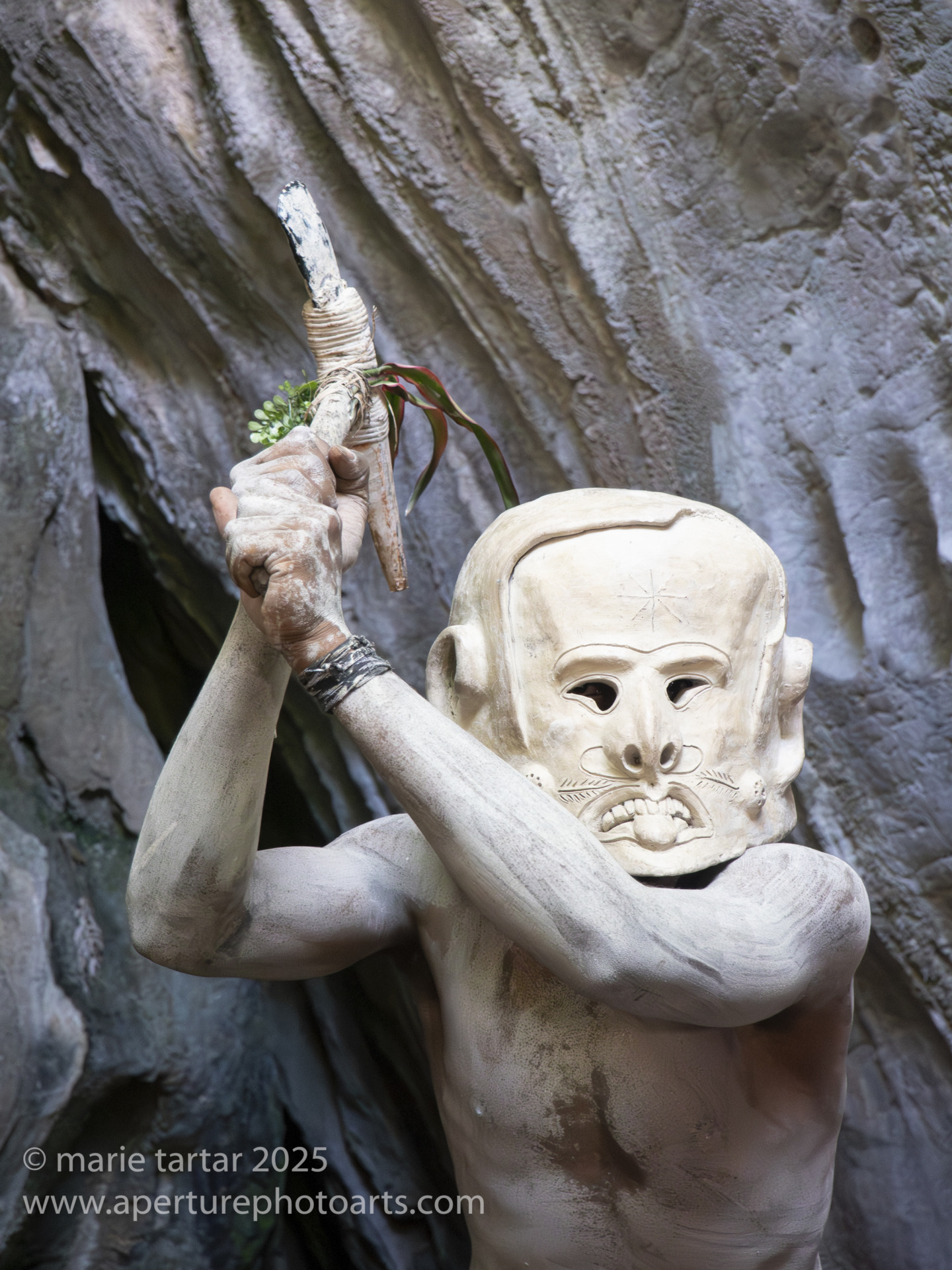
Asaro Mudman wears a heavy (and hot) clay mask to top off the clay-covered body.
On the way down, Gary slid enough to gash his elbow. Steve nearly slid into me but didn’t sustain any injury. The rain we could see approaching in the distance caught up to us when we had made it most of the way down. I was so hot at the time, I didn’t bother to dig my rain jacket out of the backpack, which was a mistake, as it rained hard enough to soak my white long-sleeved top. We were all a little chilly once down, waiting for our mudmen performance to begin.

The Asaro mudmen emerged from a thatch-roofed structure with eyes. Papua New Guinea Highlands.
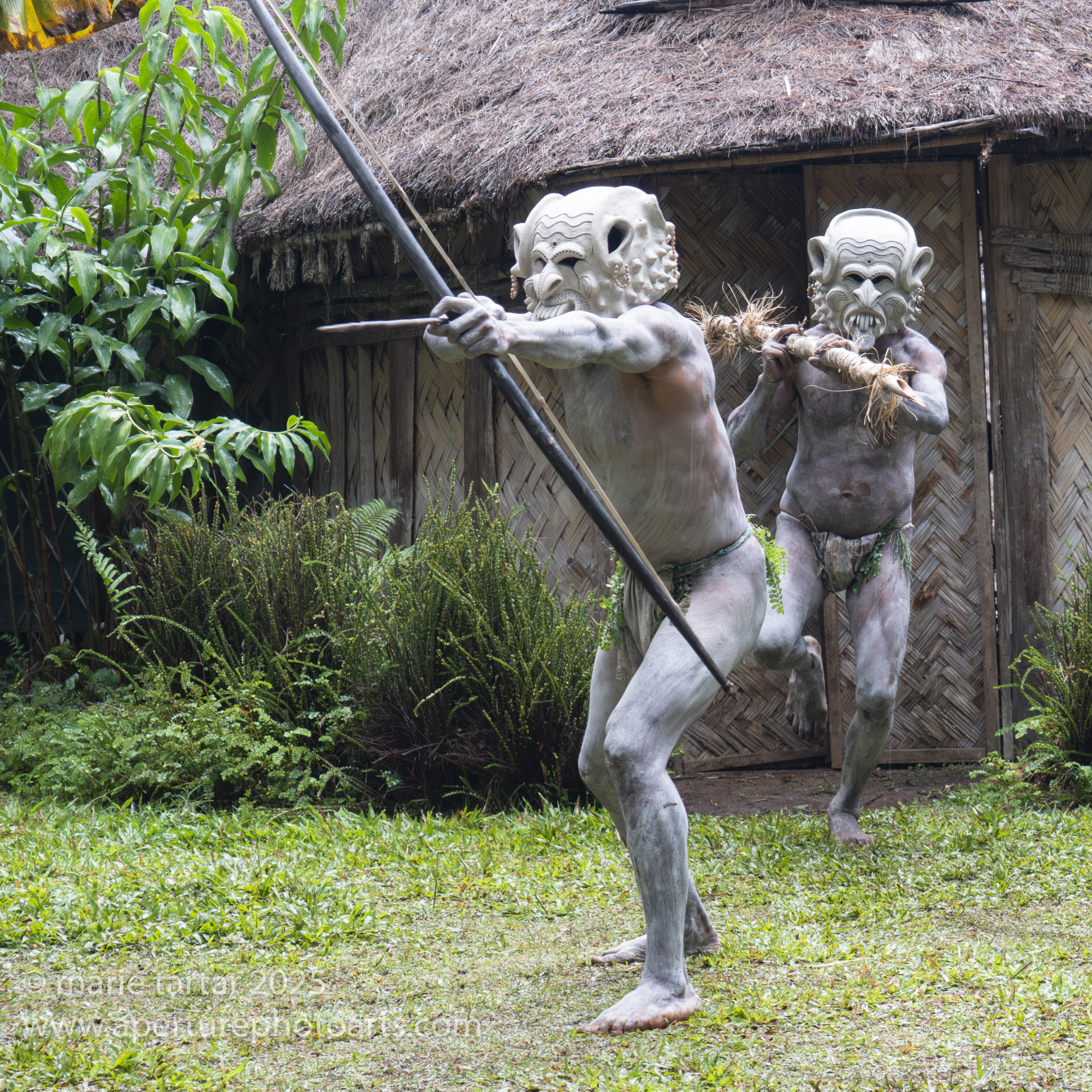
The Asaro mudmen’s appearance is intimidating.
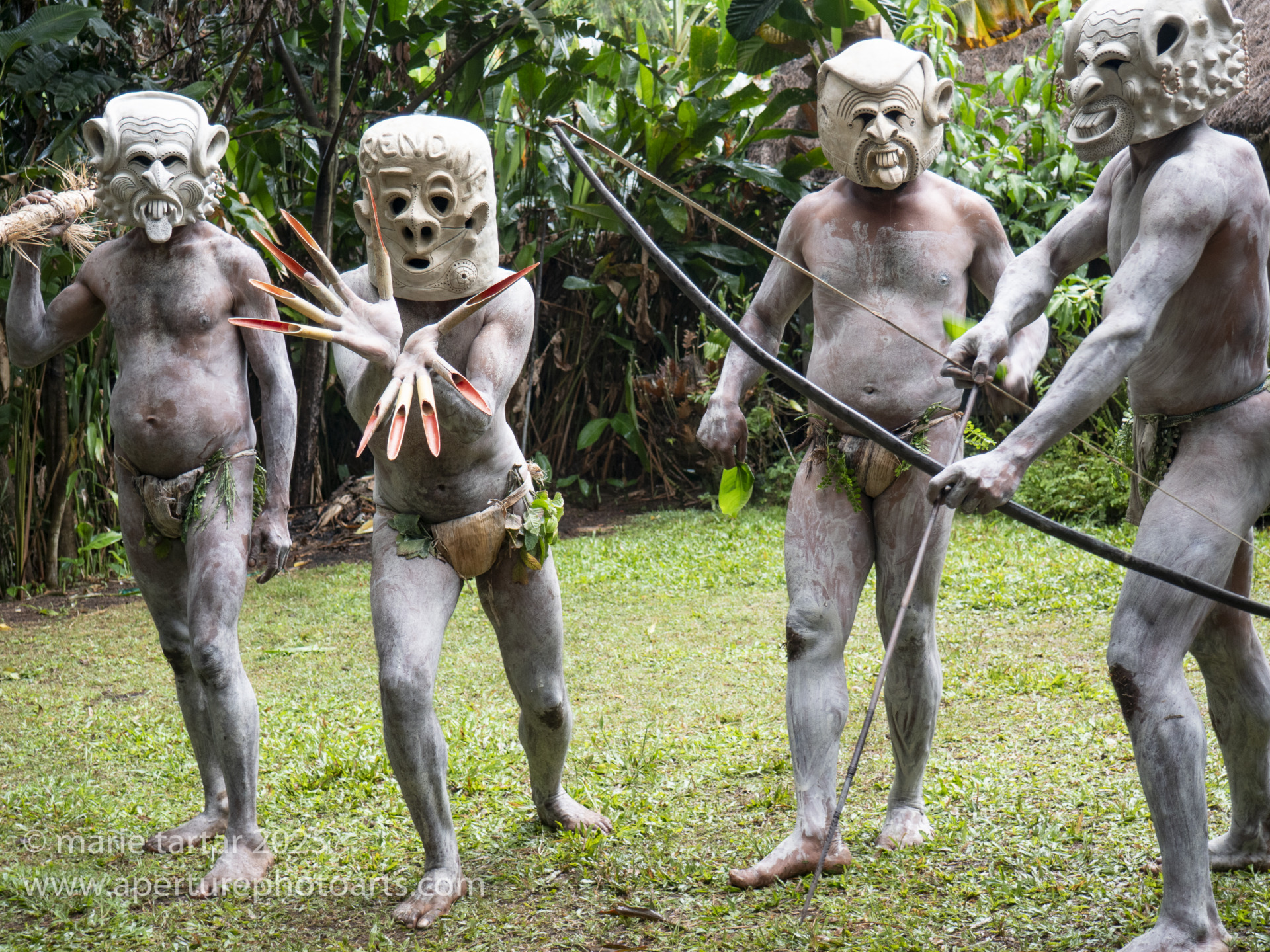
My favorite of the Asaro Mudmen’s threatening weapons: the clacking blood-red bamboo nails.
Thankfully, the rain let up for our mudmen performance, which was followed by the mokomoko victory dance. Five men were augmented with large woven penises, with their bodies painted with faces.
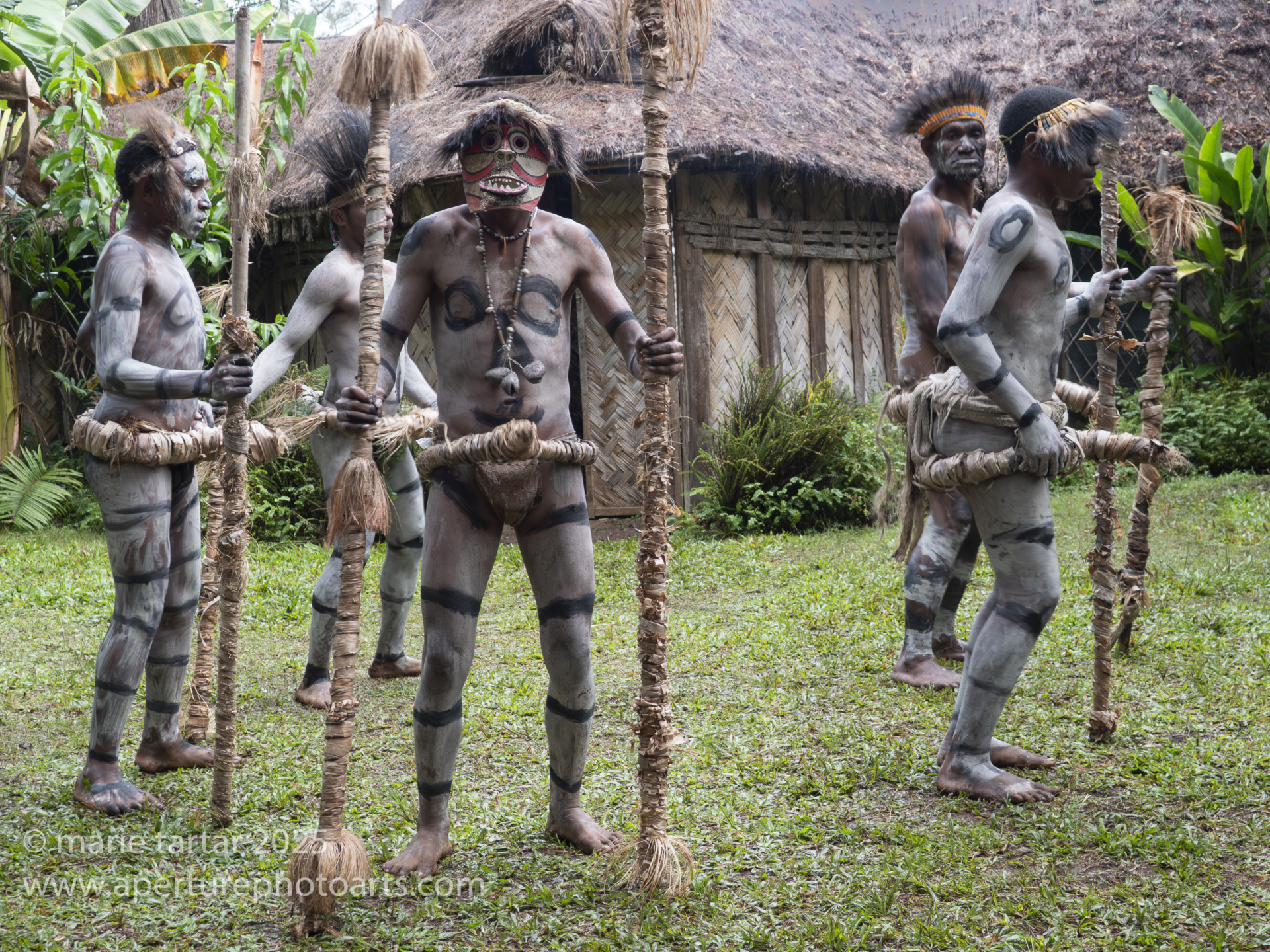
The mokomoko victory dance consisted of bouncing up and down, making their phallic woven “belts” shake. Papua New Guinea Highlands.
Our mumu dinner was steaming in the ground nearby. Our version of the national dish of PNG was chicken, accompanied by sweet potatoes (not as sweet as what we know as sweet potato), taro, plantains, broccoli, carrots and wild breadfruit (the phallic shoots of the tree Barb had dubbed the Dr. Seuss tree back at Rondon Ridge when we arrived).
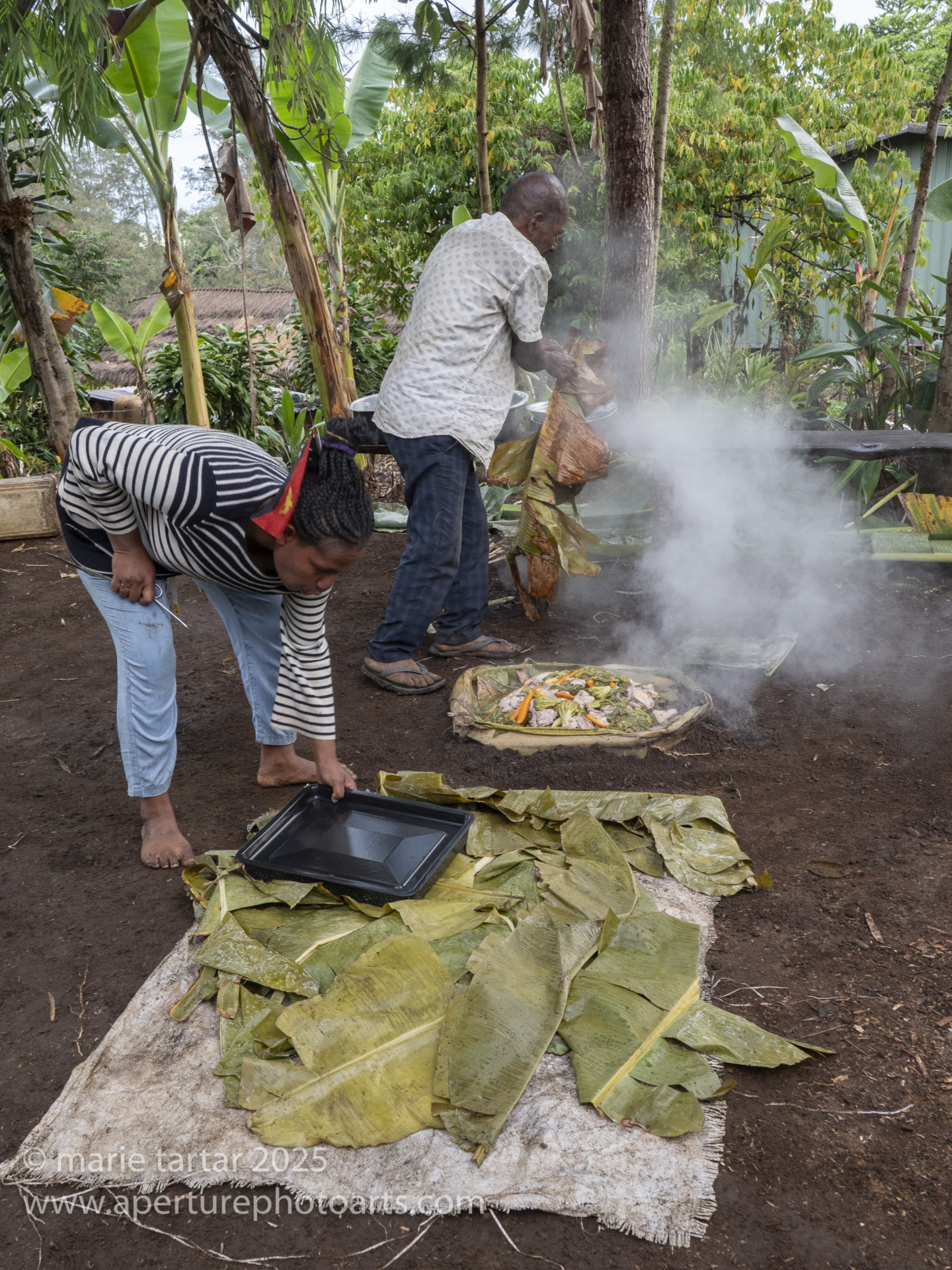
My favorite meal (mumu) in Papua New Guinea was cooked in the ground.
The final event was a quartet of women in matching skirts who sang a song about being widows.
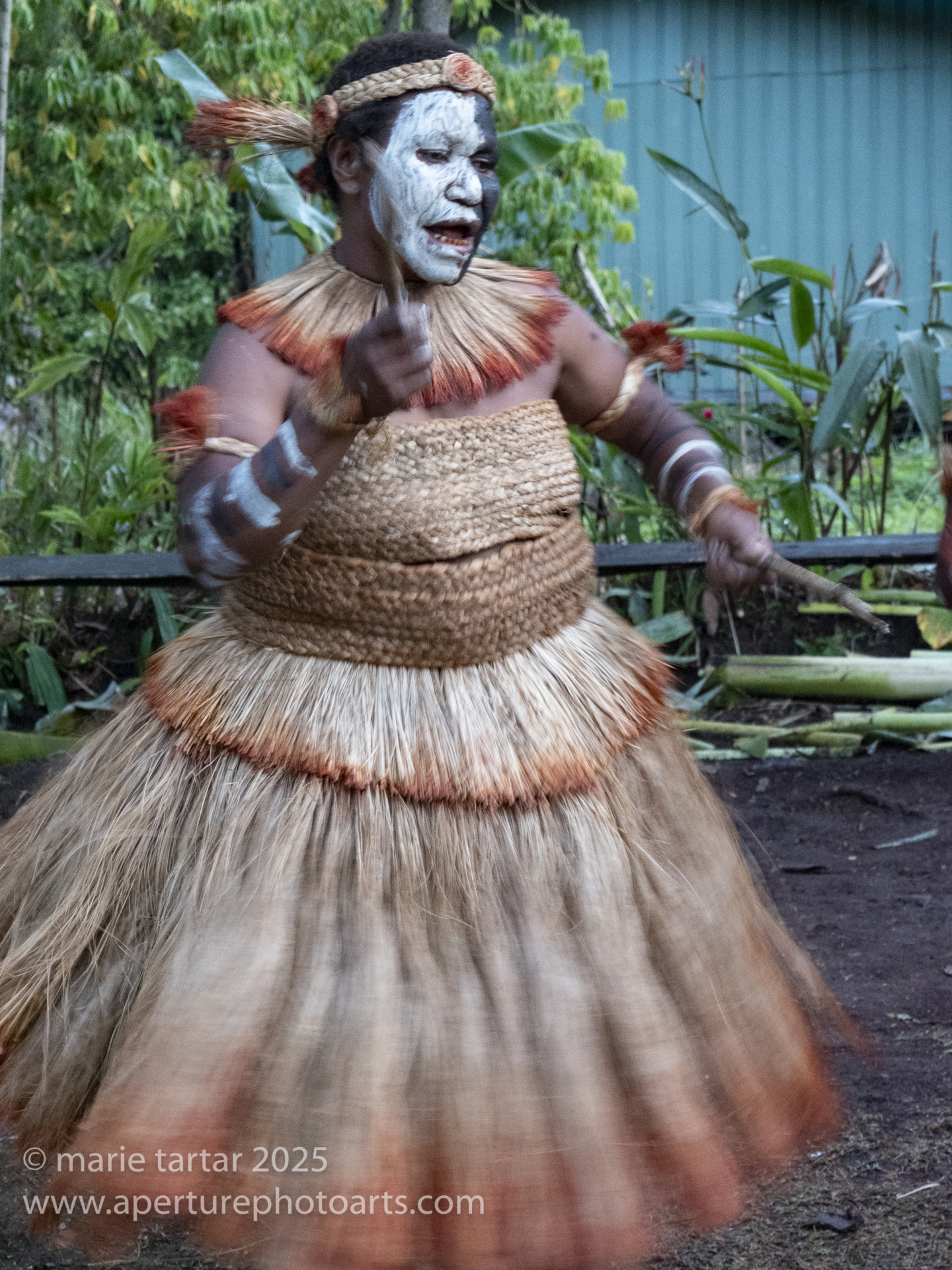
Janus face painted dancer, Papua New Guinea Highlands.
Saturday, September 20, 2025 (PNG Day 5)
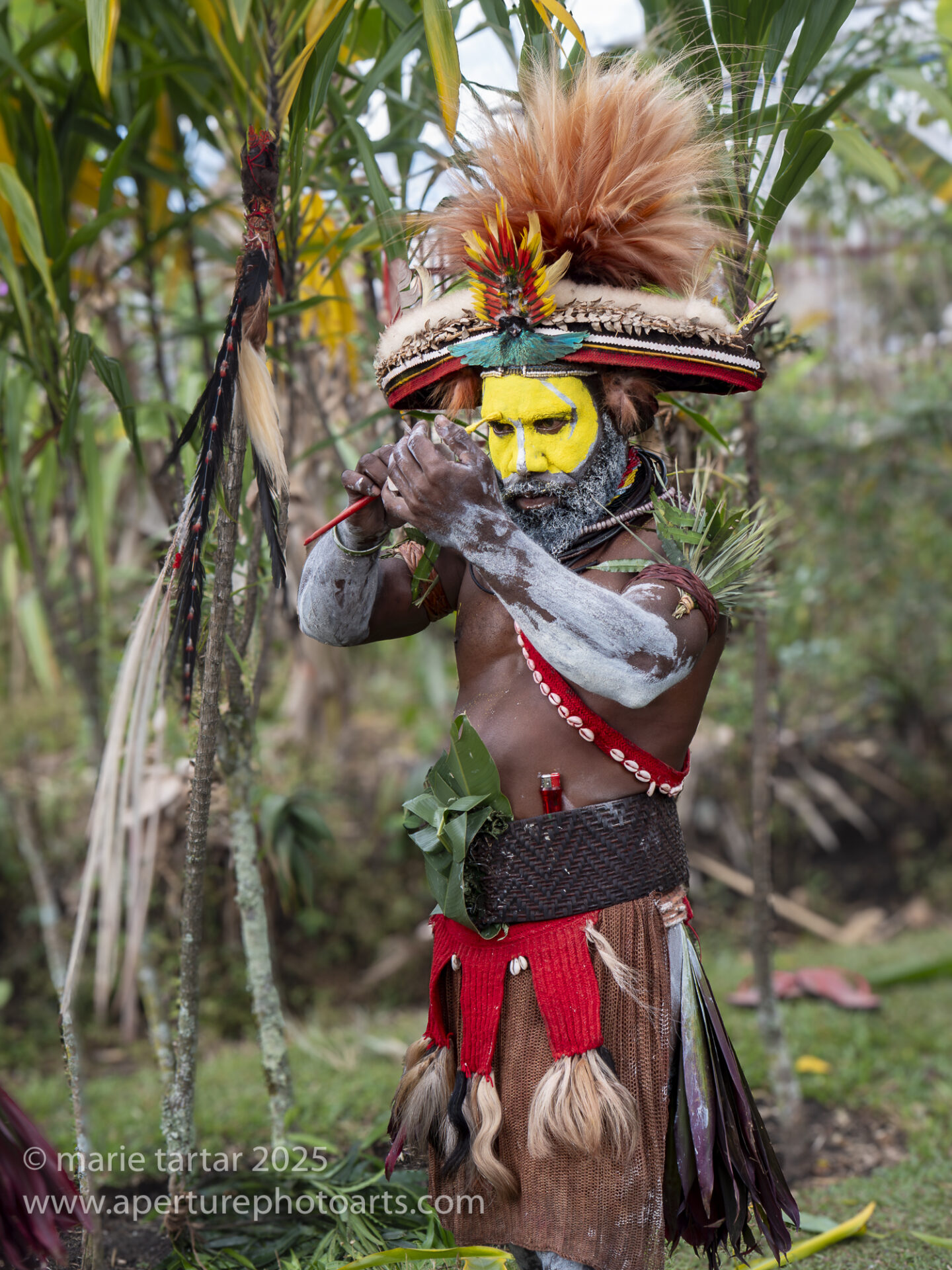
Huli wigman applying his face paint on the morning of the Goroka show. Their attire is dazzling, with bird feathers, beads, body and face painting complementing their helmet of hair, shaped and grown over the preceeding year.
Our first stop was at the McCarthy Museum. In the garden, Huli wigmen were embellishing their faces with vivid yellow, red and white paint.

Huli wigman prepping for the Goroka sing-sing: the featherwork on this headdress is astounding.
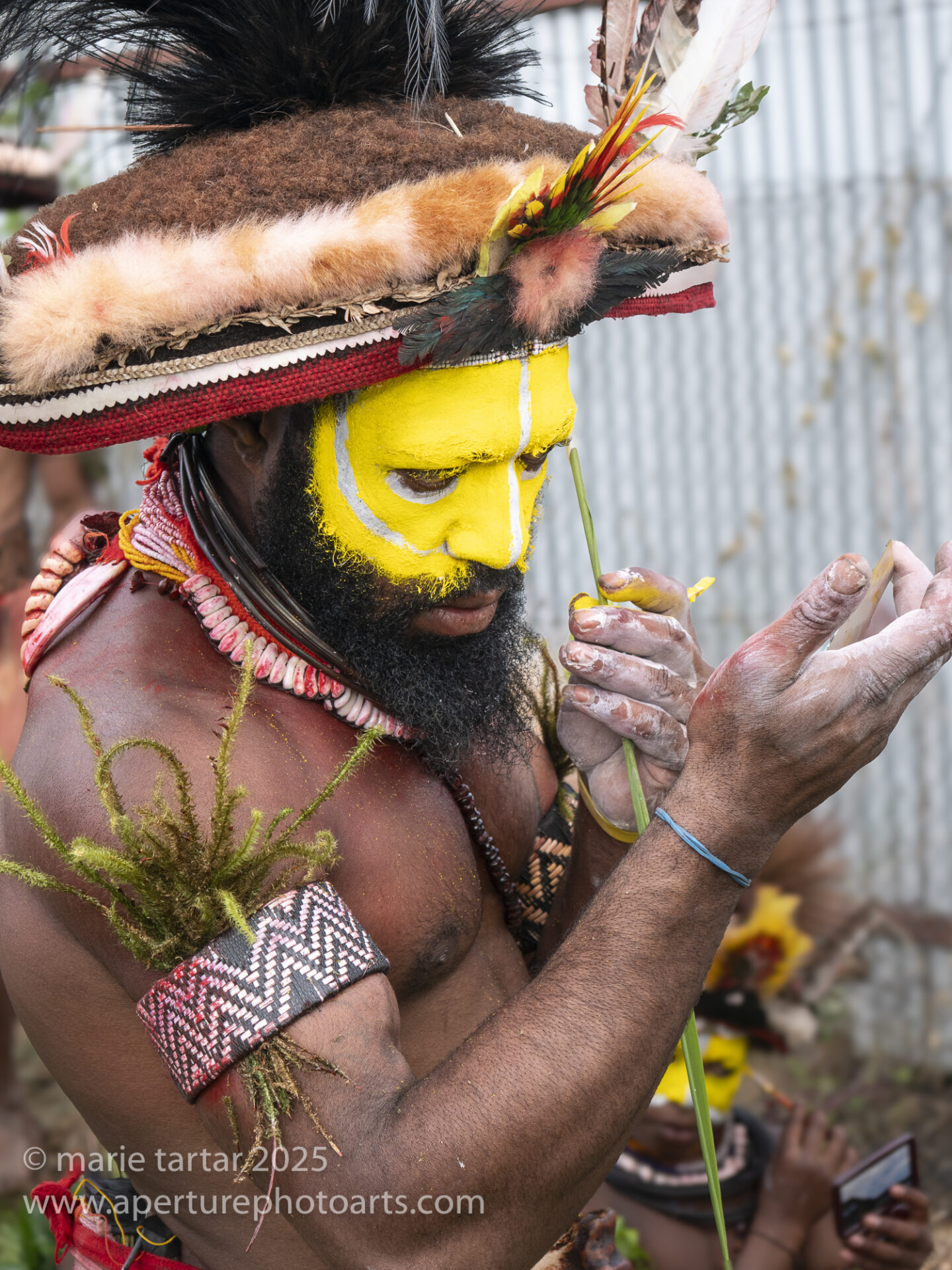
Finetuning the face decoration using a tiny mirror. The brown component of the headdress is this Huli wigman’s own hair, grown out and shaped.
Their headdresses were resplendent.
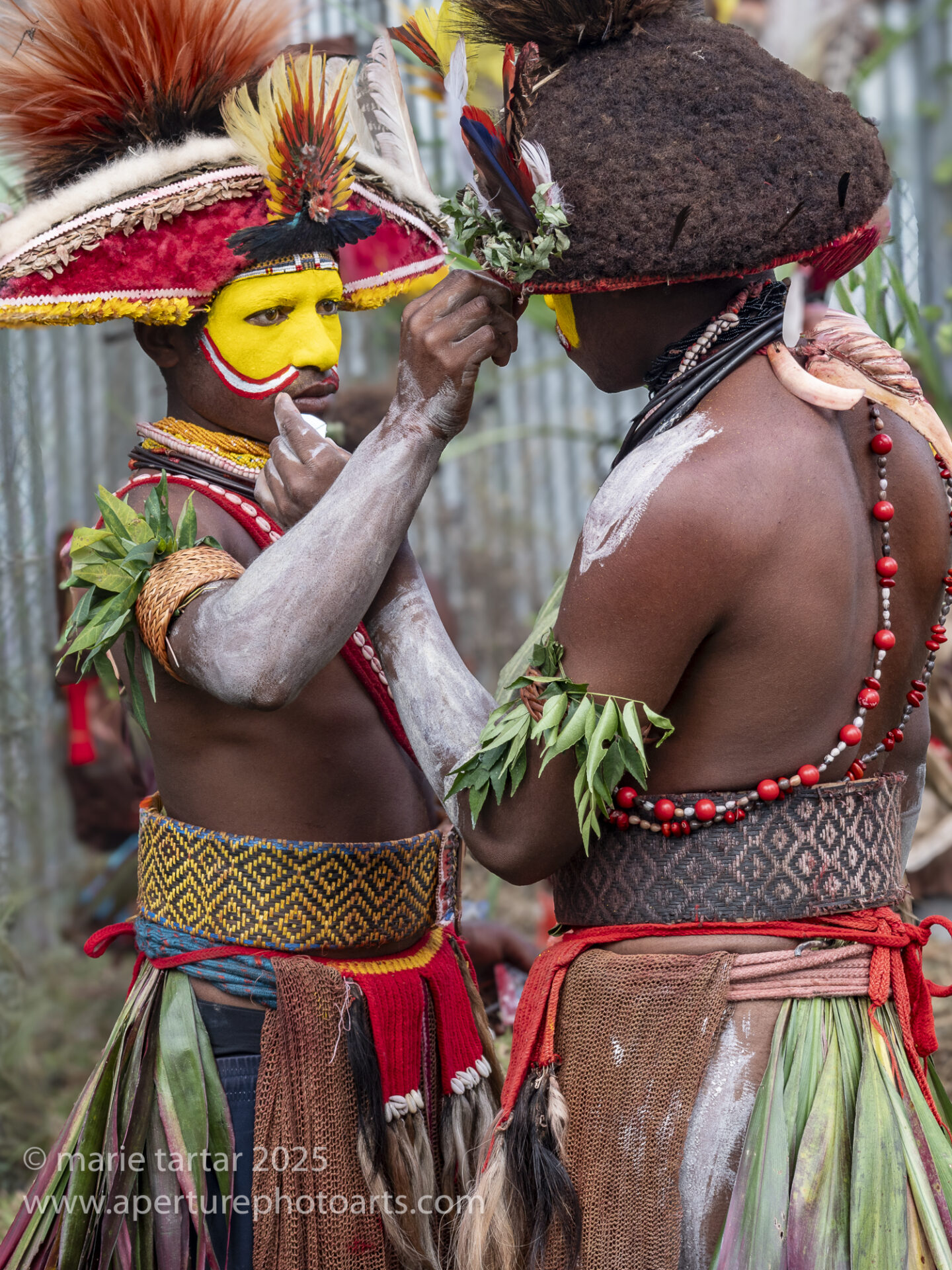
A pair of Huli wigman put the finishing touches on their intricate face paint decorations. Notice the hornbill beak at the nape of the wigman on the left’s neck.
As a rite of passage into manhood, they grow their hair for a year into a distinctive helmet-like shape, sleeping on neck supports to keep it from being distorted. After a year, the hair is cut off and a wigmaker uses it as the basis for a headdress, which is elaborately decorated with feathers and shells. The cassowary bird seems to be a favorite source for the colorful feathers which might be a central tuft or might be fitted along the swooping edges of the helmet. Even their backs are adorned, with the curved beak of a hornbill accentuating the nape of their necks.
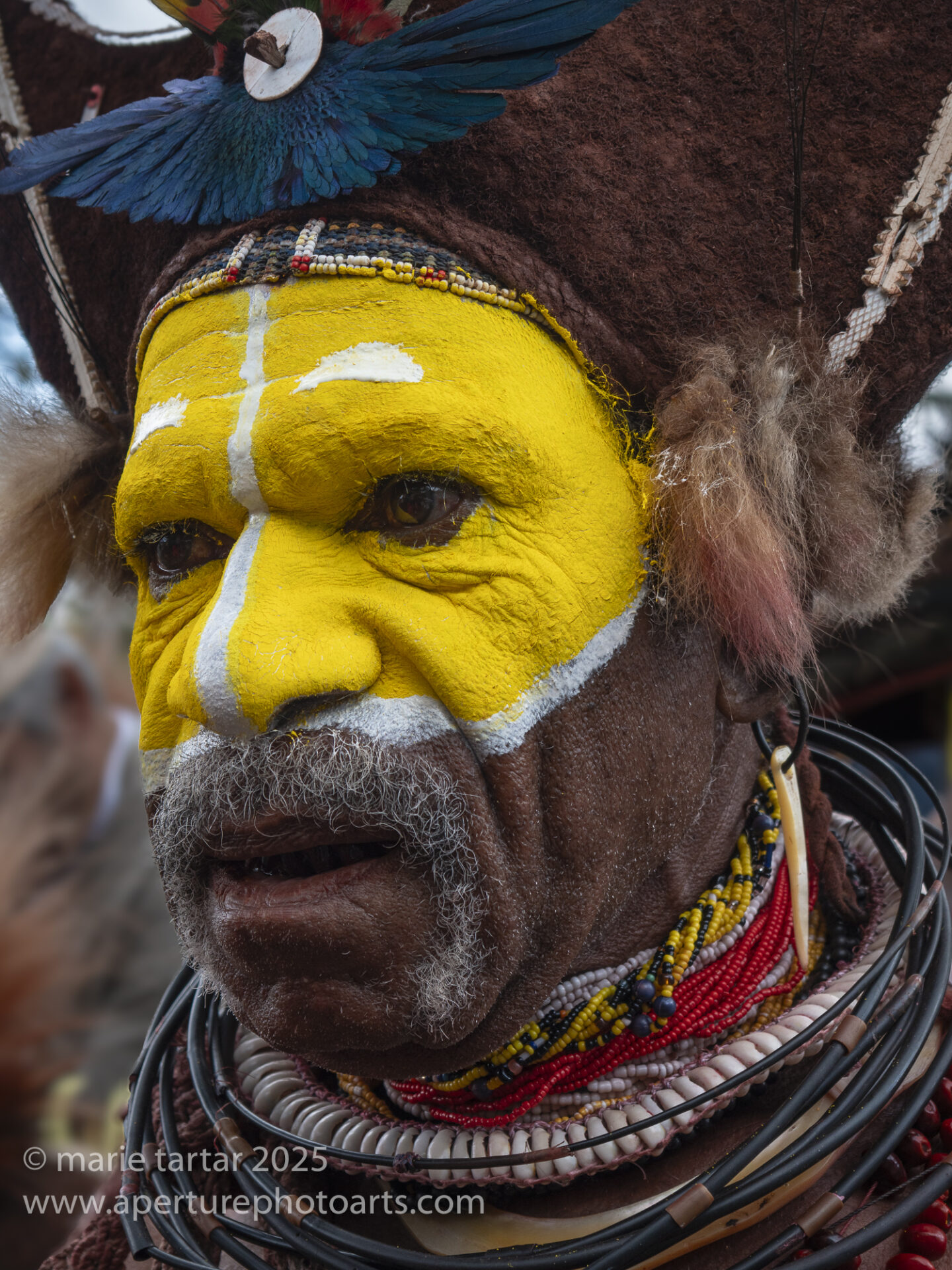
Beads and buttons and feathers and paint form the resplendent adornment of a Huli wigman.
Along the drive to the grounds of the Goroka Cultural Show we could see dancing groups on the side streets, approaching their grand entrances to the field.
We had VIP passes, and John quickly secured a space in the shaded grandstand for the group, complete with a cooler filled with bottles of water.
Out on the field, the meaning of the term “sing-sing” became clear. Provinces and villages from all over PNG send groups outfitted in traditional attire, singing and dancing in unison. As the field filled with more and more groups, the volume went up, as the clans seemed determined to be heard over others, demonstrating their arts just a few feet away.
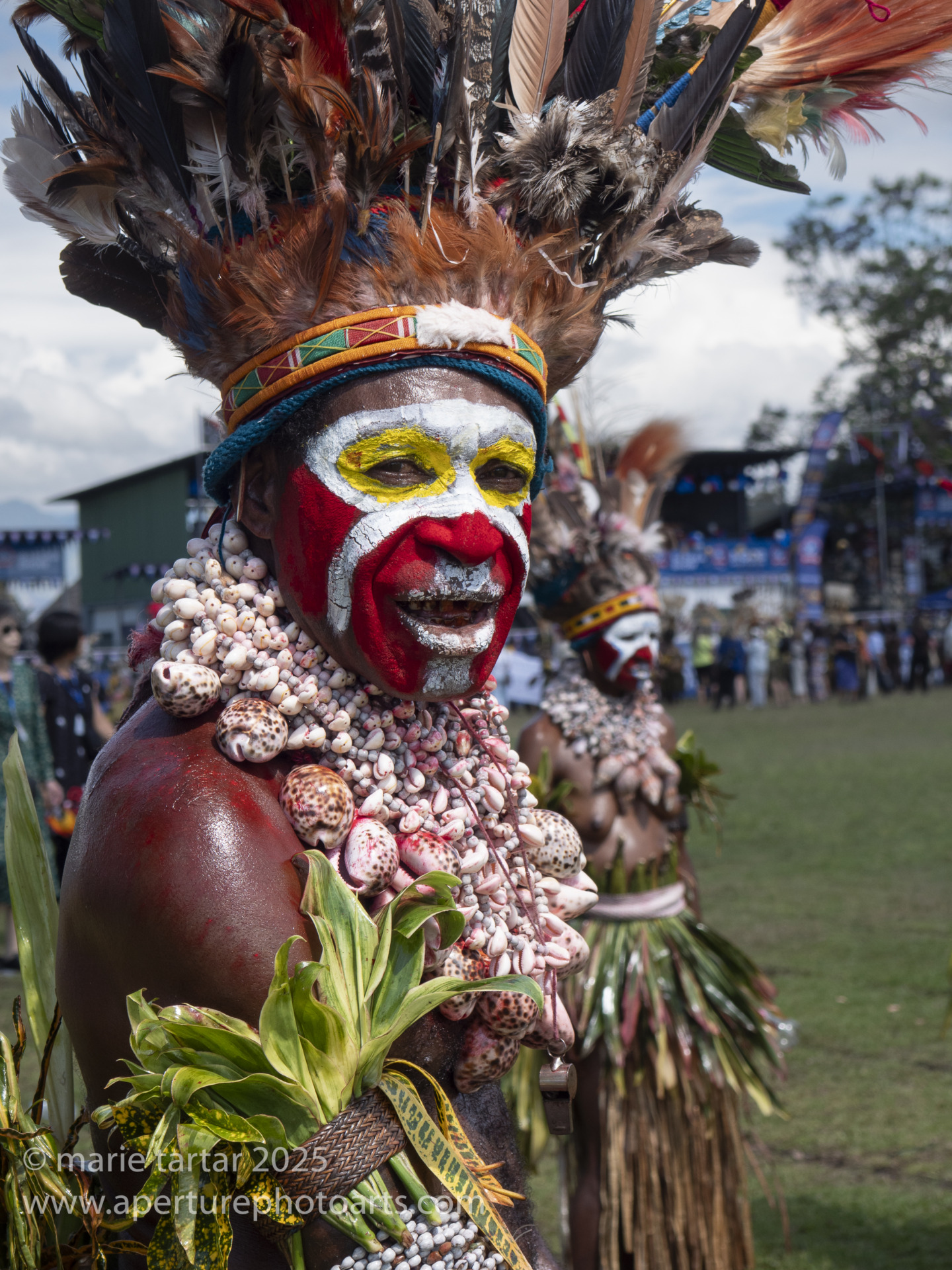
Resplendent participant in the Goroka show, Papua New Guinea Highlands.
Surprisingly, a couple of hours was more than sufficient. The sensory overload was overwhelming. It was sunny and warm as we marveled at the stamina of the dancers who kept up their jumping and singing for hours.
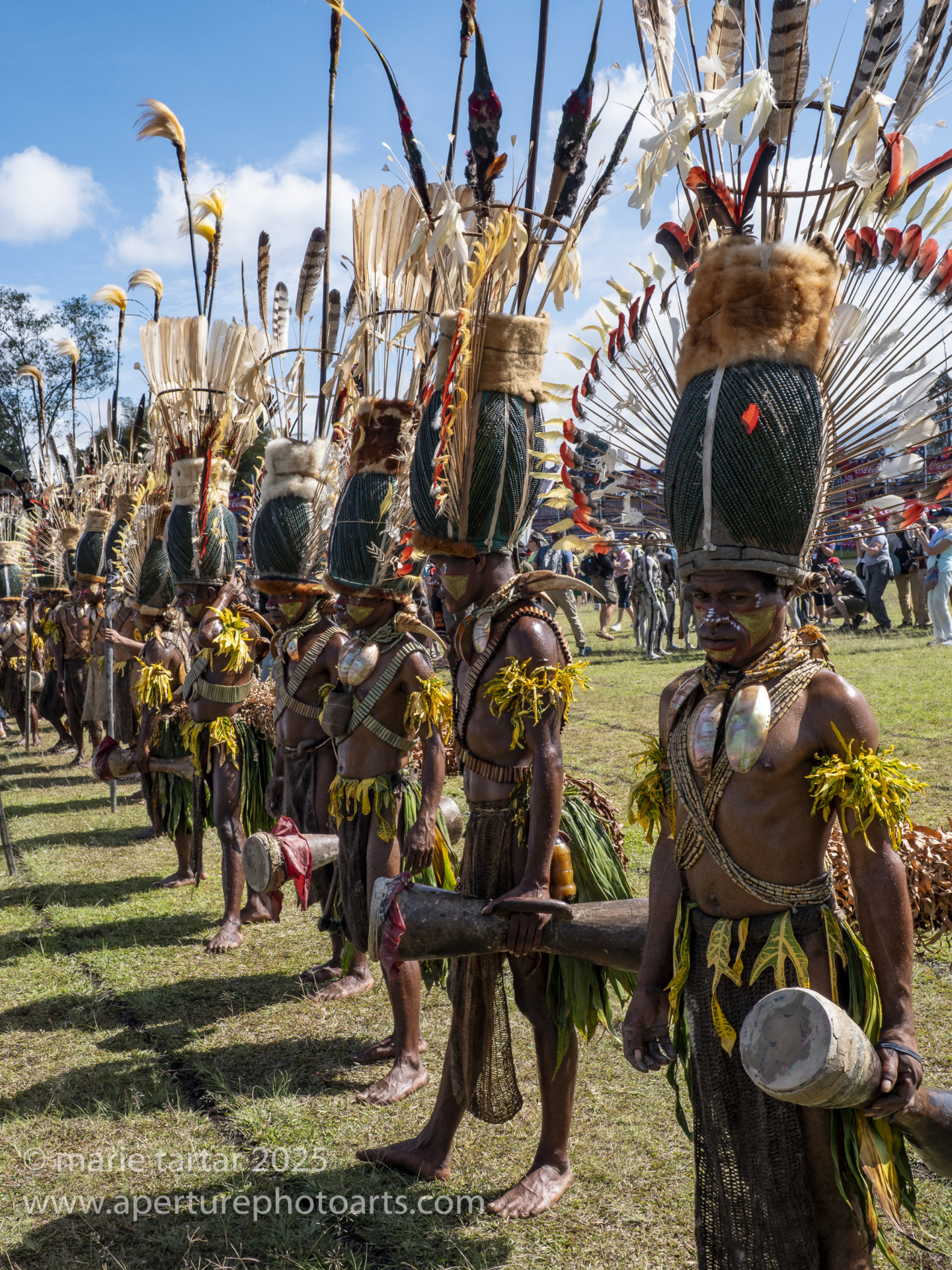
These headdresses! Maybe the tallest, widest, wildest of the headgear sported at the Goroka show, Papua New Guinea Highlands. I don’t know if the festival is always so spectacular or perhaps all stops were pulled out for PNG’s 50th anniversary of Independence?
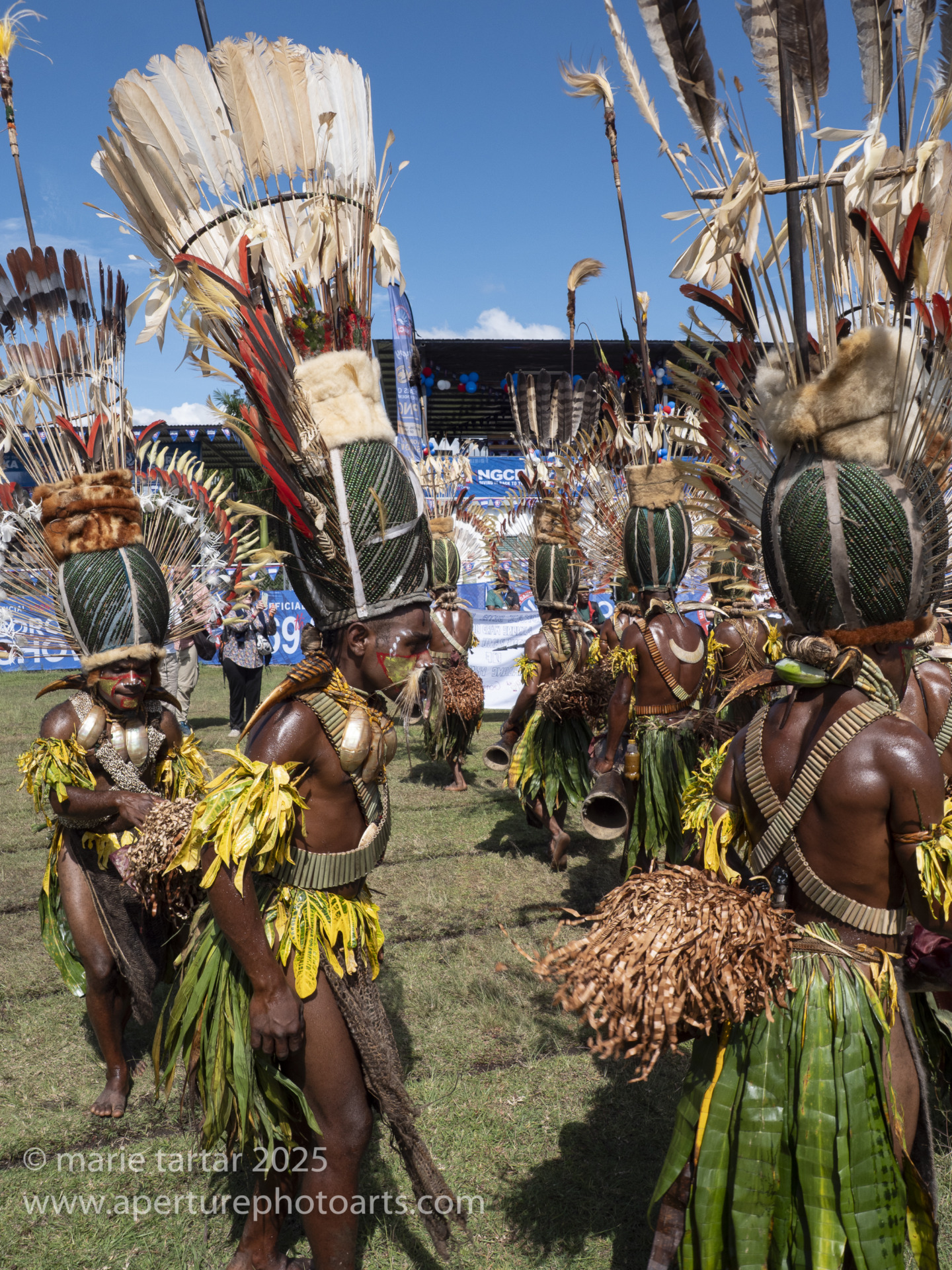
I had trouble keeping a cap (as in cap and gown) on my head during a recent ceremony, so I have no idea how this PNG tribe manages with these constructions!
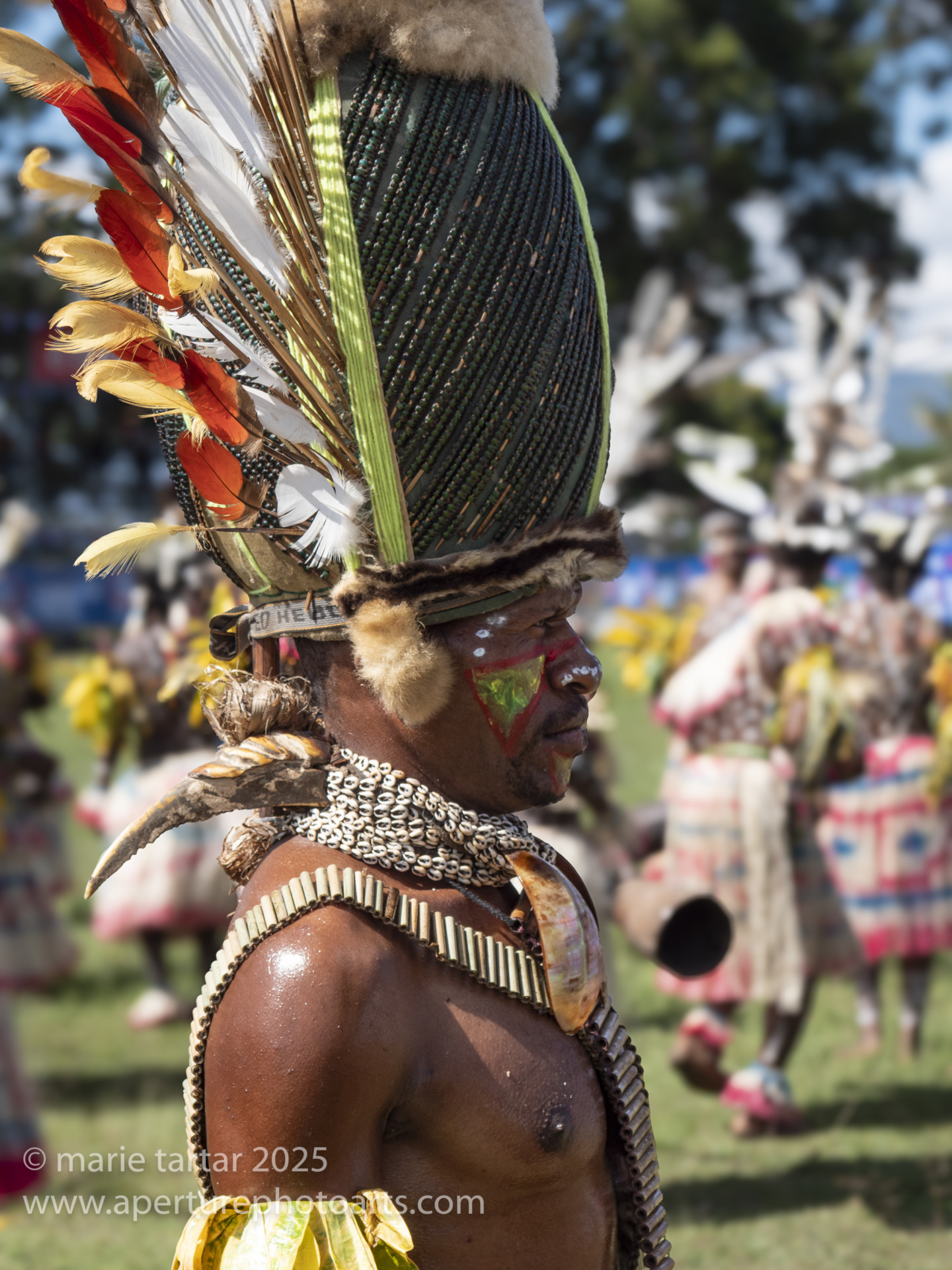
Those green “beads” in these spectacular helmets at the Goroka Show in PNG? According to John, our guide, they are beetles!

More color and movement in these swaying skirts, not to mention the foliage and beadwork!
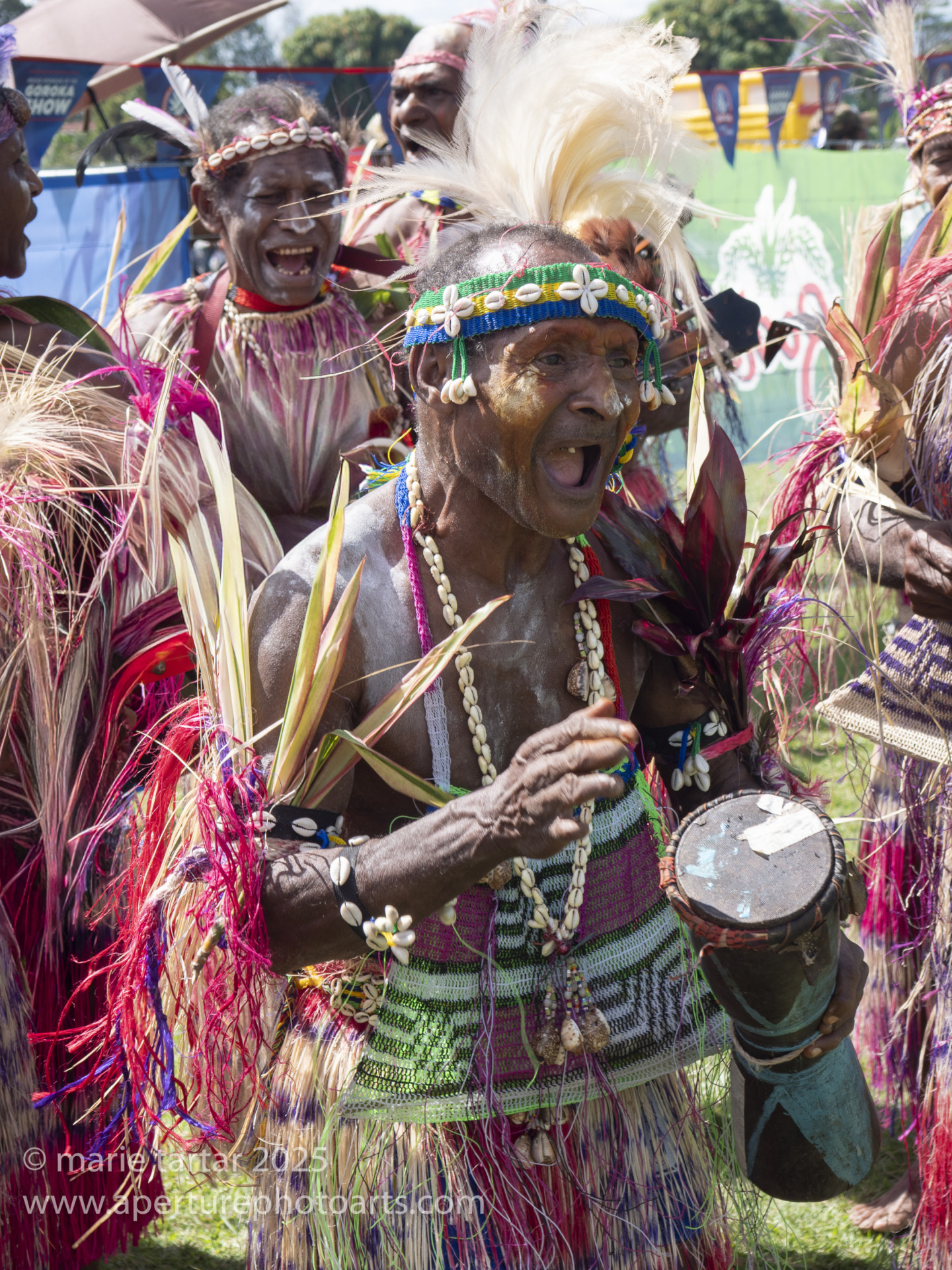
The joy of celebration of community, tradition and music is reflected in this Goroka show expression.
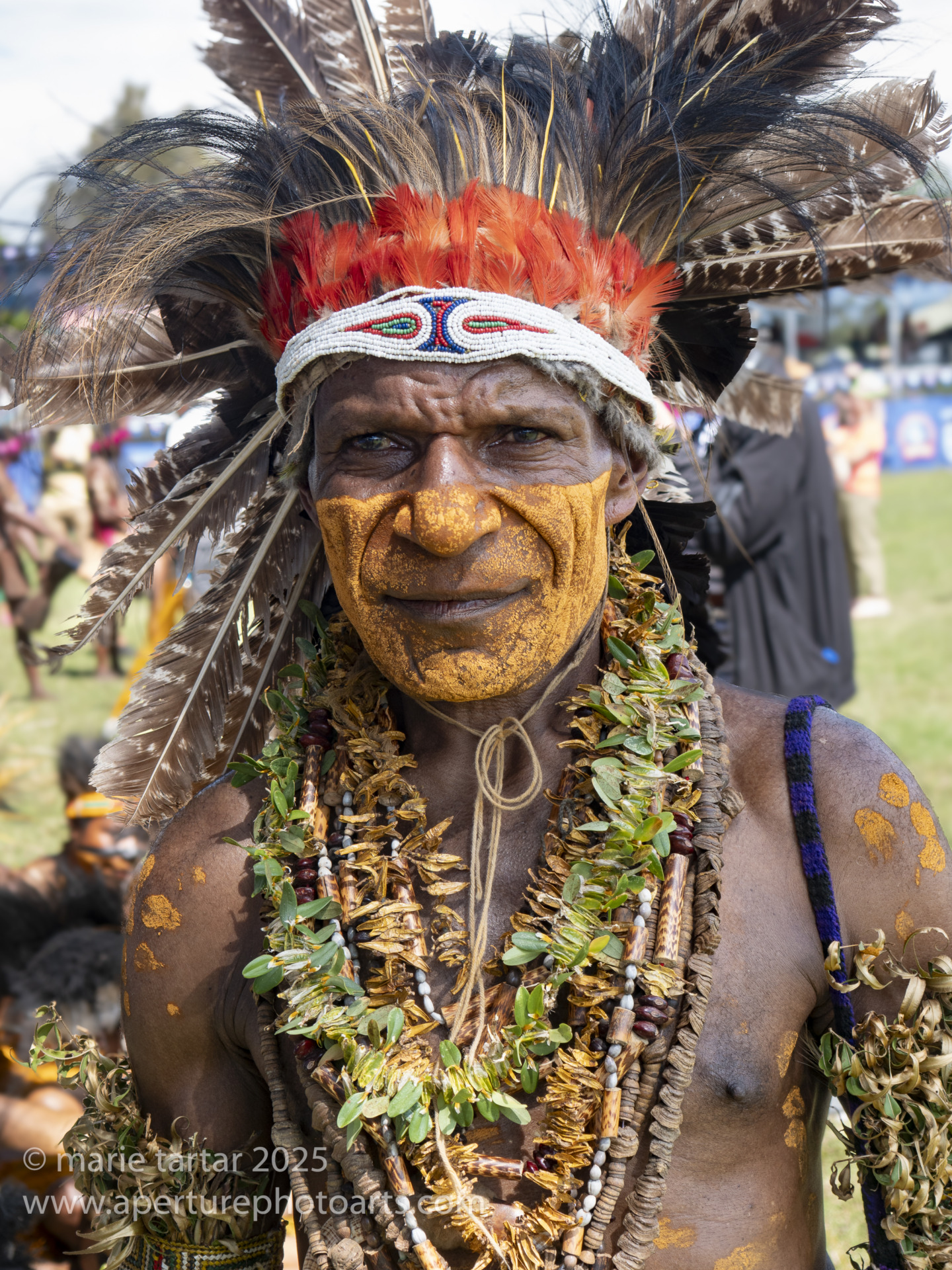
More bead and sed neacklaces, feather and beaded headdresses, with ocher face and body decoration (Goroka show, PNG).
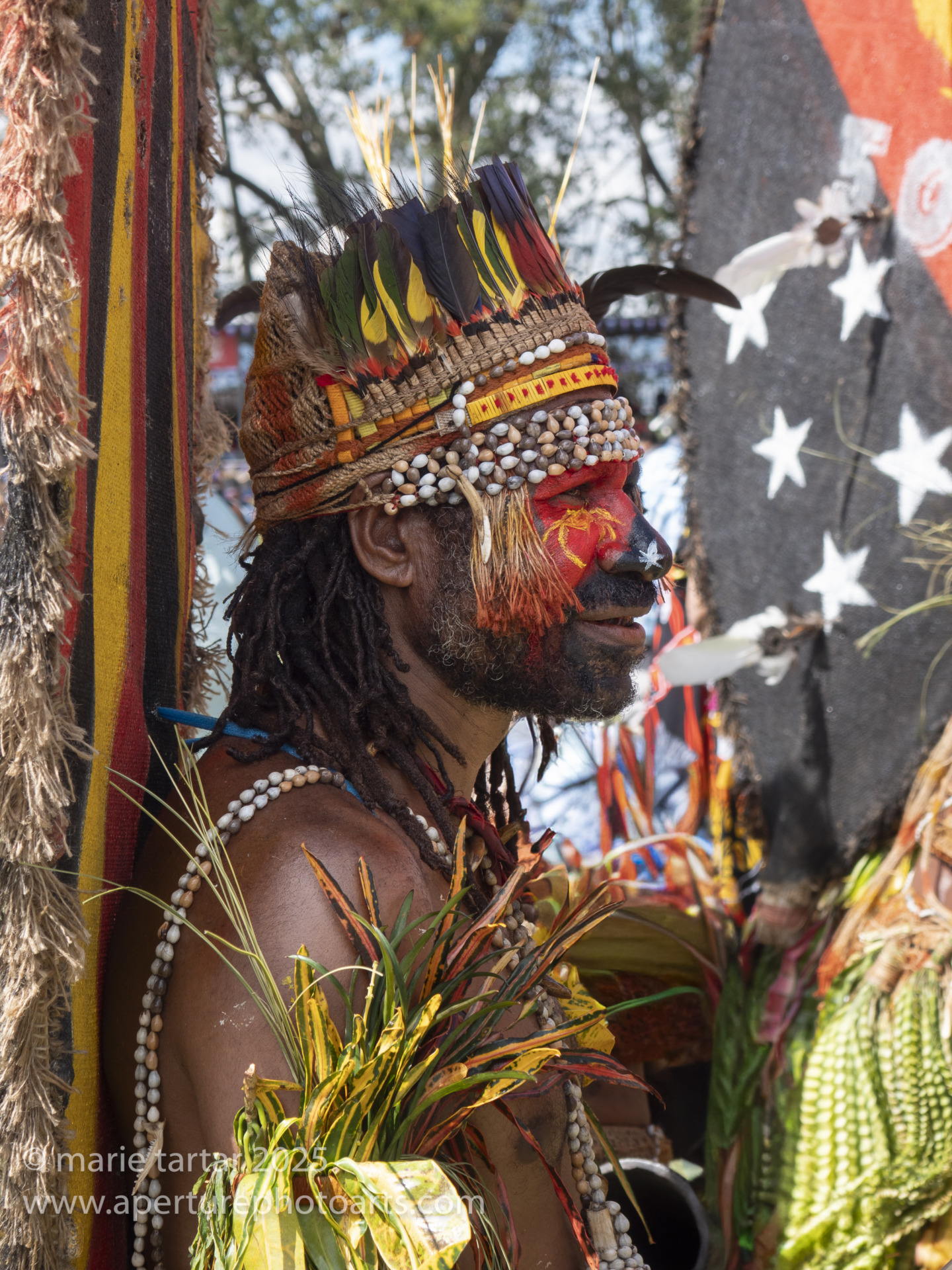
This Goroka show presenter incorporated into his face paint the colors and motifs of the national flag of Papua New Guinea, also seen on the large shield in the background. The flag features a yellow bird of paradise on a triangular red ground, with the stars of the Southern Cross on a black ground (below).

This design of the national flag of Papua New Guinea was adopted in 1971, after a nationwide design competition was won by 15 year old Susan Karike.
Next to the field, handicrafts were for sale. I had purchased a woven wall hanging that morning in the parking lot of Emmanuel Lodge (sadly, it was apprehended at the airport in Brisbane on the way home after the agent gave it a vigorous banging, yielding a tiny living bug). Greg admired a $2500 crocodile skull inlaid with shells. I resisted adding a bilum to my handbag and textile collections.
The floral displays in an adjacent structure offered a cool refuge to the unsheltered field and vendor displays.
Our flight to Port Moresby was delayed. After an aircraft swap, we arrived at the Sanctuary Hotel in time for dinner. By this time, it really did seem a sanctuary, especially in contrast to the barebones Emmanuel Lodge in Goroka (described in the trip info packet as not “a fancy hotel”).
We had a cute small visitor making the rounds of the rim of our sink which startled me: a small tree-frog. By the time I sent off its picture and asked Steve to initiate a relocation program, it disappeared, never to be seen again.
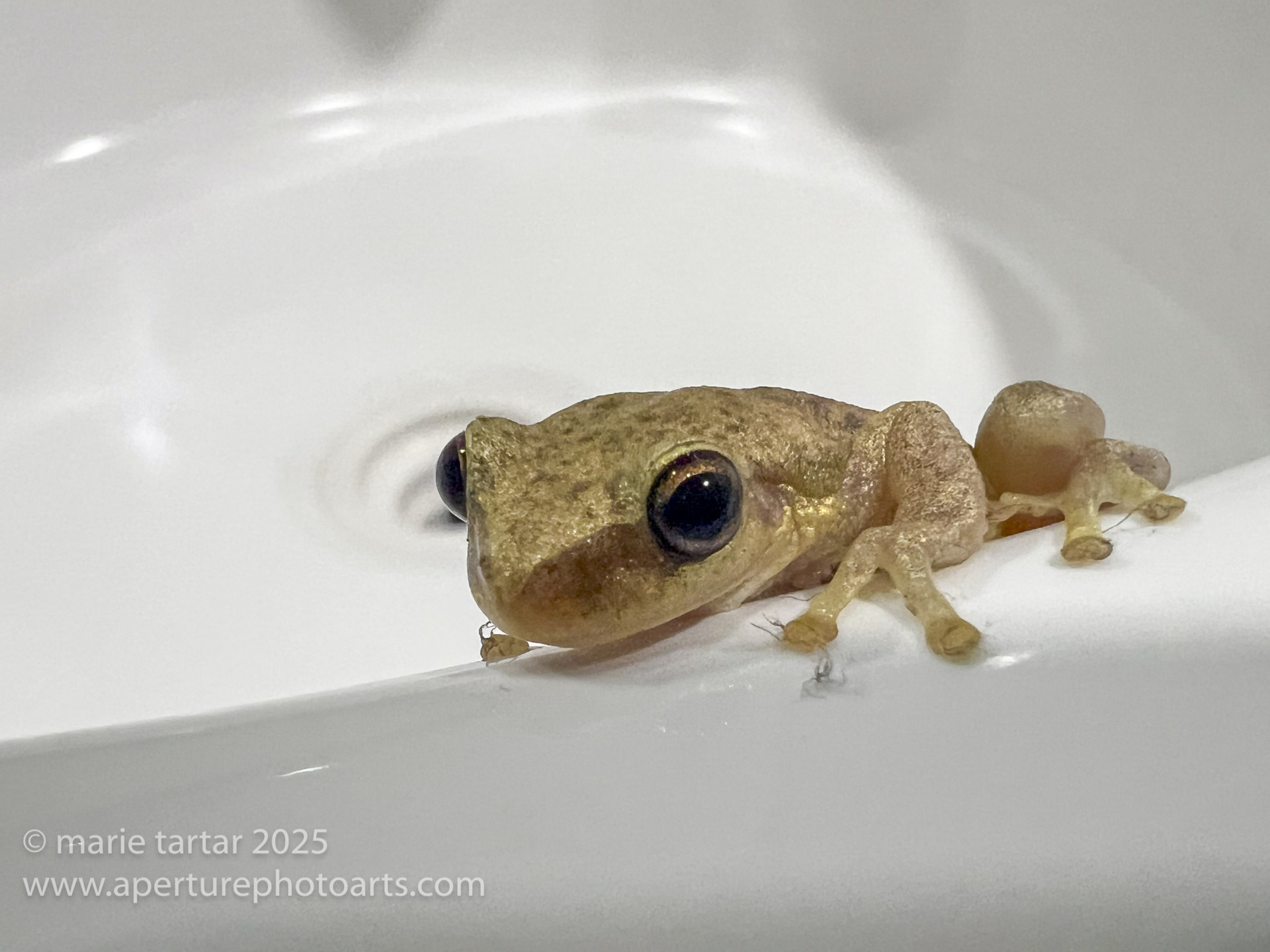
Back at the Sanctuary Hotel in Port Moresby, a small frog made a brief appearance in our bathroom sink and quickly disappeared.
Sunday, September 21, 2025 (PNG Day 6)
Steve spent our final minutes at the Sanctuary stroking the neck of the friendly cockatoo through its wire enclosure.
Kate was wearing the off-white cargo shorts which had mysteriously disappeared from the Emmanuel Lodge the day before. After asking a second time at reception, they reappeared, damp and inside out, as mysteriously as they had vanished. Delicious local passion fruit, which I had in our room, went missing as well. A vendor had shoved a bunch into our vehicle on the drive into Goroka.
Faustina helped facilitate our check-in at the Port Moresby airport, for a nominal tip, saving all of us with photo gear and overweight baggage potentially hundreds of dollars.
Walindi was a welcome respite, luxuriously appointed compared with our accommodations thus far. We built our underwater cameras and piled our dive gear into plastic bins waiting on the porch of our Bungalow (6). We were on to the more comfortable, diving portion of this trip to New Guinea, filled with a riot of colorful images and memories to rival reef scenes. Here’s a preview:

Skunk anemonefish, Kimbe Bay, Papua New Guinea.
Fabulous photography and descriptions. Despite visiting 160 countries, we never made it to Papua New Guinea. I know we would have enjoyed it immensely, as it has some of the same satiation of color and atmosphere that attracted us to countries. Thanks for sharing.
Wow, 160 countries! I think you are the record holder among our friends!
-Marie