

After birding in the Papua New Guinea Highlands and soaking in the colors and sights of the Goroka Show sing-sing, we were on to the diving, hoping the reefs of Kimbe Bay and the Bismarck Sea would rival these experiences. We flew from Port Moresby to Hoskins, landing us in a lovely oasis for an overnight before boarding the boat. Walindi Plantation was a most welcome respite from the more bare bones accommodations available in the Highlands. We boarded our live-aboard dive boat, MV Oceana, at Walindi after a very pleasant short stay.
Monday, September 22, 2025 (PNG Day 7, Walindi Plantation)
After breakfast, Miriam led Kate, Barb, Greg, Tanya, Steve and me on a 2-tank dive. It is always a relief to confirm on the first plunge of a dive trip that everything that traveled so many miles is in working order.
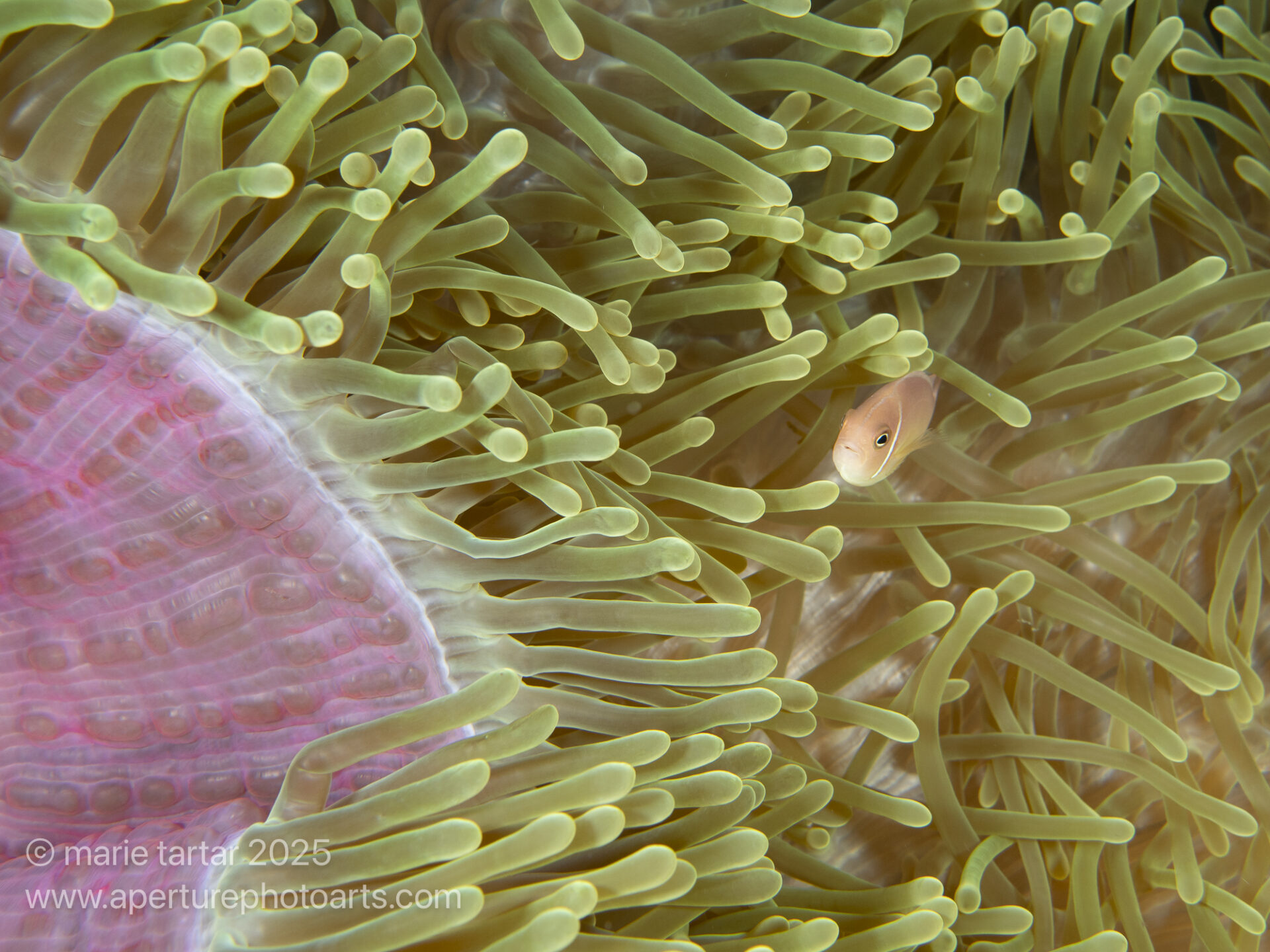
I set up for macro, but our Bradford Shoal dive site was really a wide angle site (83 ft, 55 min).

- Whoops, armed with a macro set-up at a wide-angle site, what else to do but warm up with (what else?) pink skunk anemonefish! Bradford Schoal, Kimbe Bay, PNG.

- It’s irrational how captivating I find batfish (aka spadefish). Bradford Schoal, Kimbe Bay, PNG.
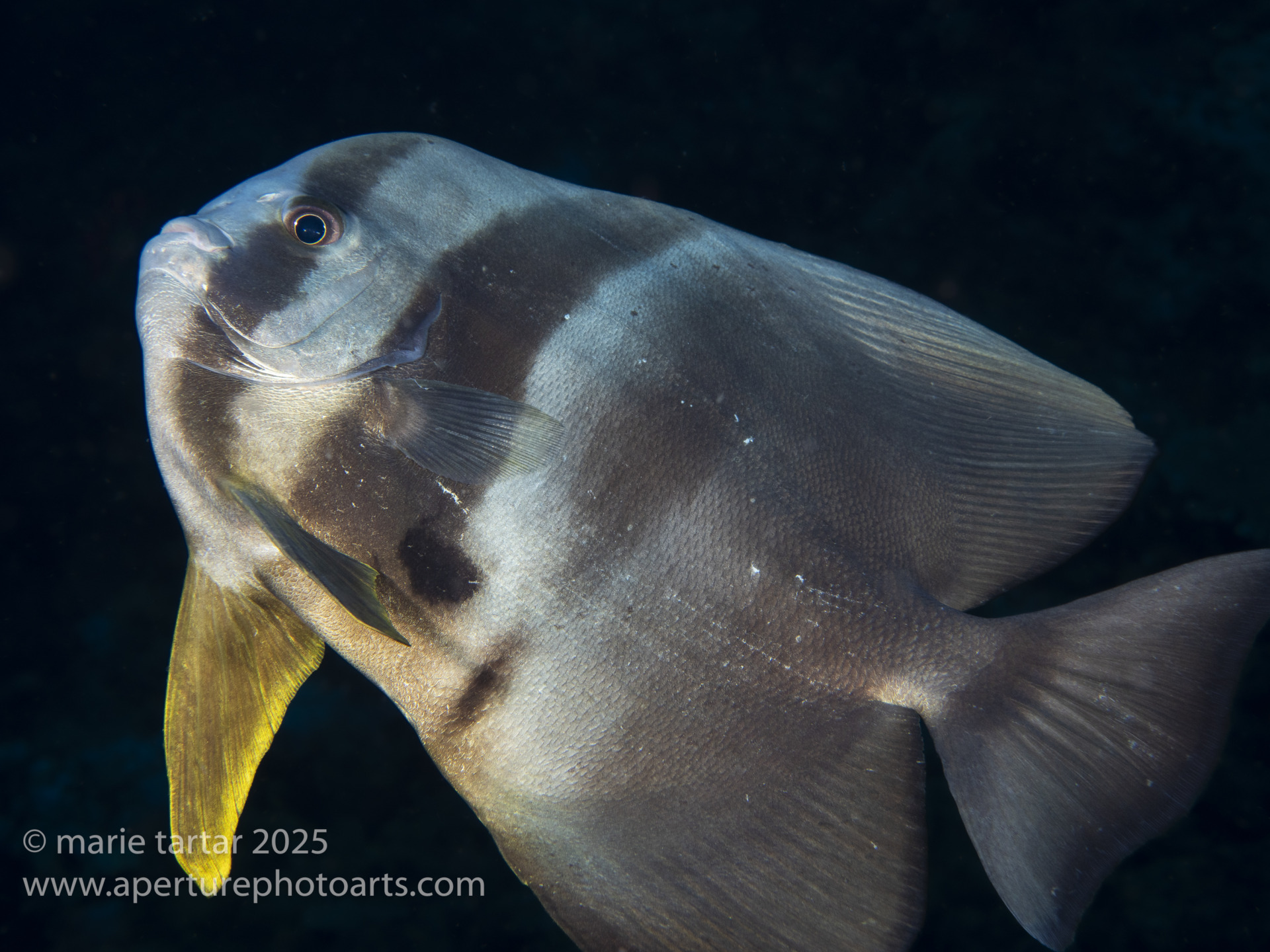
It is a double mound, with batfish sashaying in the saddle.
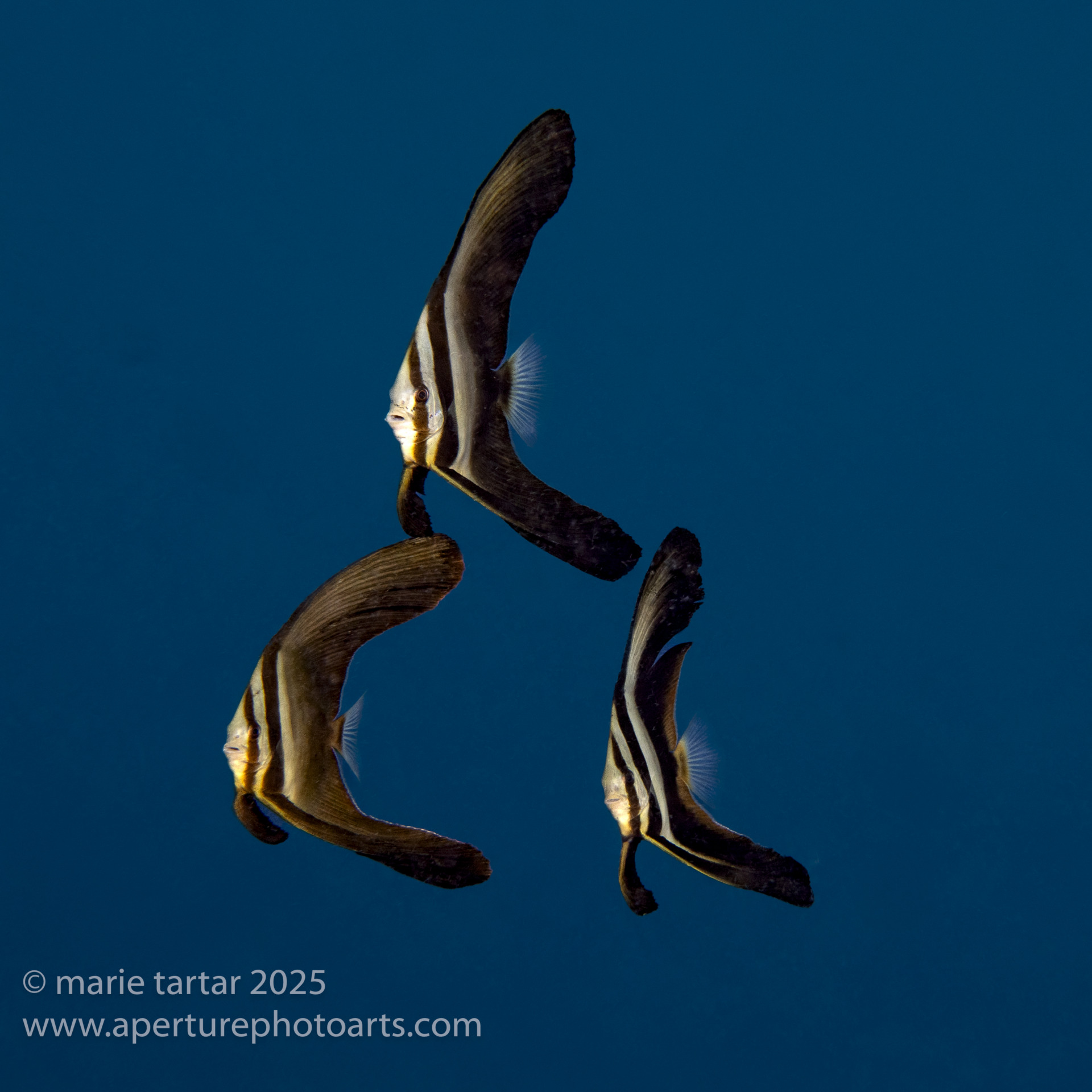
A large school of barracuda hung in the blue. A trio of juvenile batfish flounced around in the shallows.

- Juvenile batfish trio, Bradford Schoal, Kimbe Bay, PNG.
A large school of spinner dolphins rode our bow wave between the dives, as we made our way over to Cecily’s (named for the owner of Walindi), notable for tridacna clams and large attractive anemones. (67 ft, 70 min)

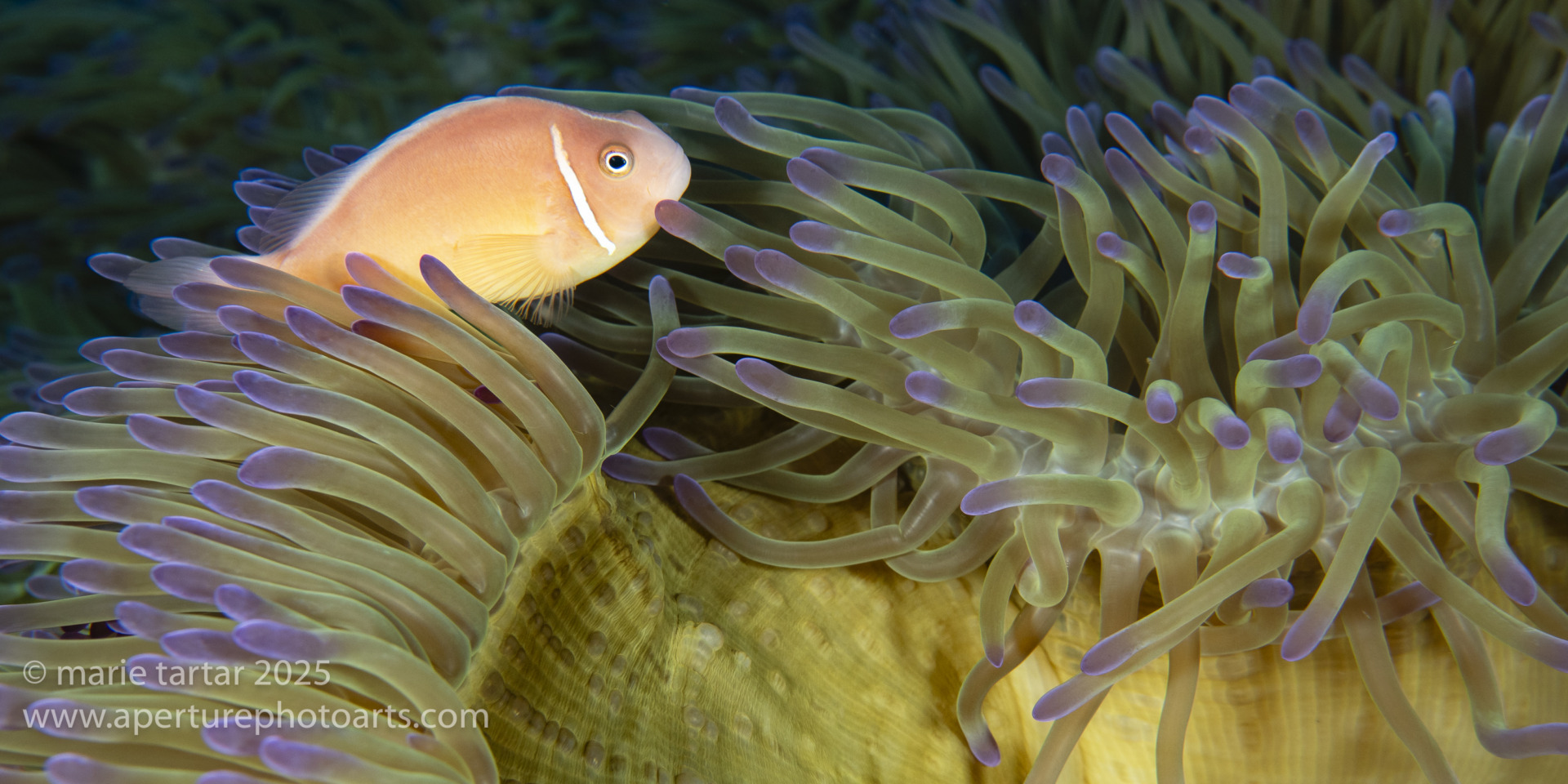
- Another gorgeous pink skunk anemonefish and host anemone, Bradford Schoal, Kimbe Bay, PNG.
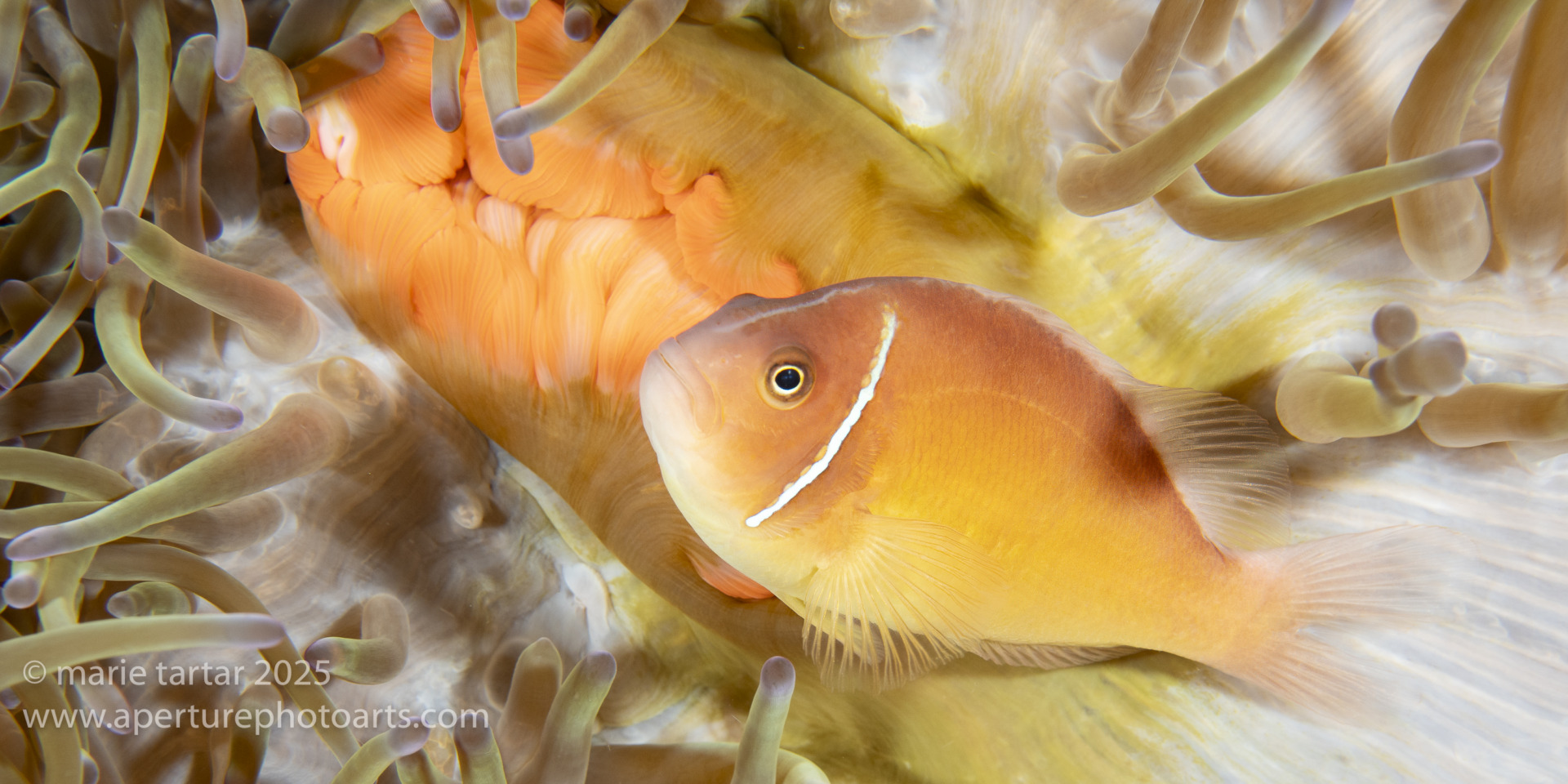

- And yet another dynamite color combination, Bradford Schoal, Kimbe Bay, PNG. Pink skunk anemonefish (Amphiprion perideraion).
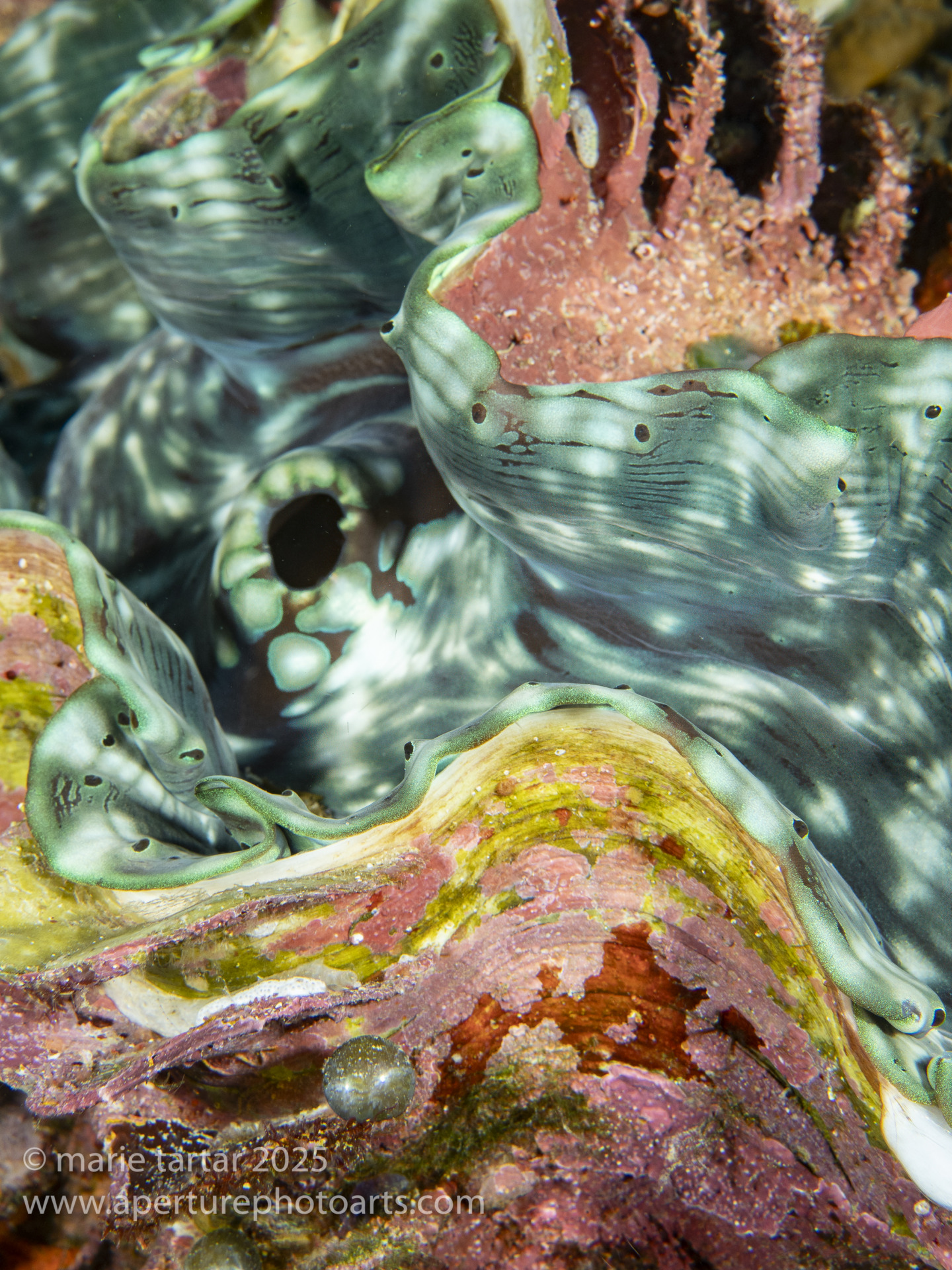
-

Tridacna (giant clam), Bradford Schoal, Kimbe Bay, PNG.
We had lunch of multiple frittata variants on board after our second dive. A green-appearing banana proved to be deliciously creamy.
We had a 4 pm check-out, so we didn’t have to pack until our return and there was ample time for a shower.
Torrential rain broke out around 4 pm, just after Steve headed down the path towards reception. It was pleasant hanging out another half hour sitting on the covered porch as the rain continued pouring unabated.
After we boarded the Oceana, Captain and part-owner Dan gave us a boat briefing before dinner of meat and bean tomato chili, with rice and chicory salad. Bruce Schafer joined us as the final member of the group. The additional 10 staff members were introduced.
Tuesday, September 23, 2025 (PNG Day 8, Oceana Day 1)
Steve had a bad night, up multiple times in the night with GI issues. He skipped the dive briefing and slept in. He didn’t feel up to diving all day. The rest of us rose for the 6:30 am dive procedure briefing.

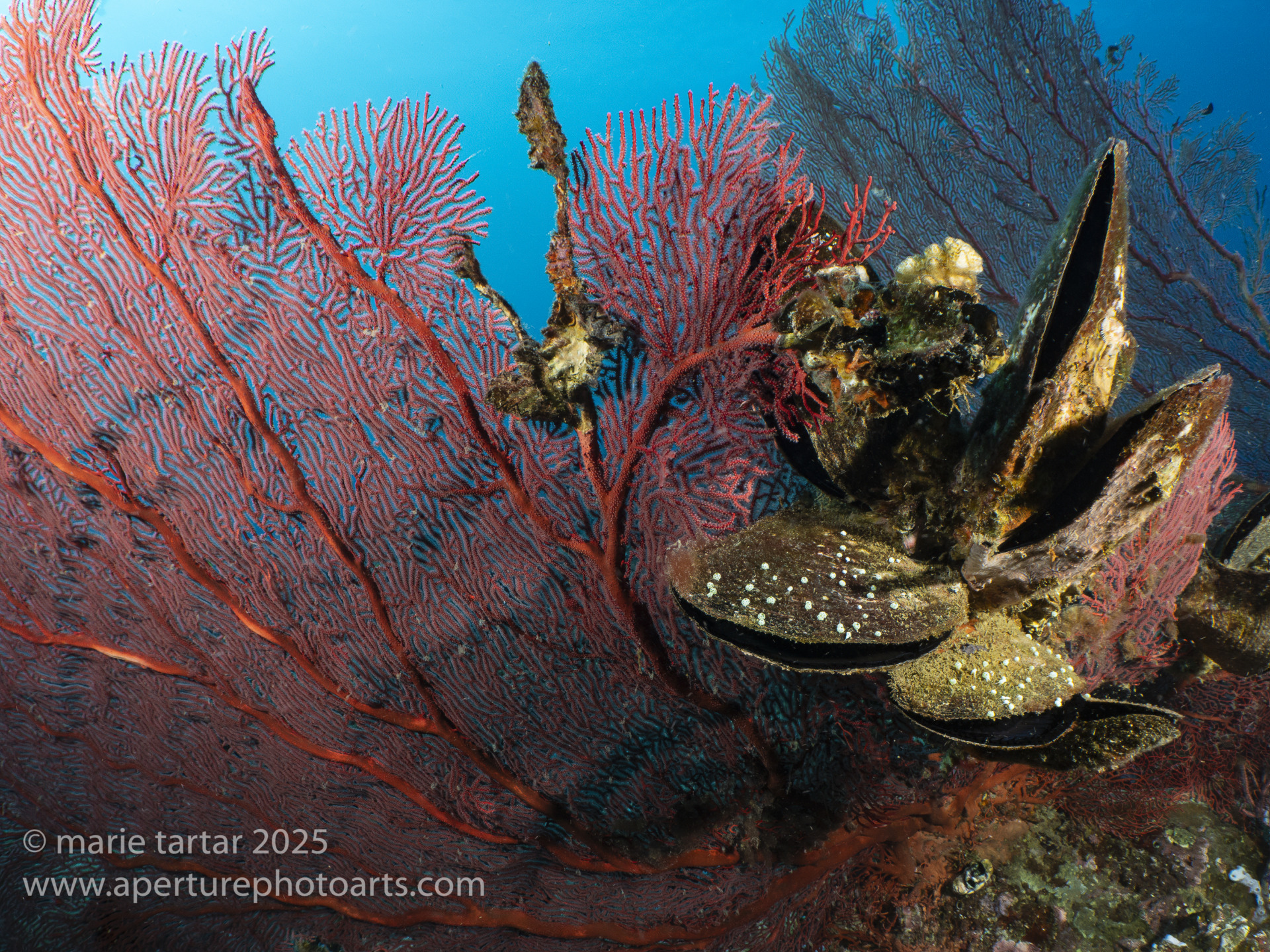
- A cluster of clams adorns a big red sea fan, Papua New Guinea.

- Sponge tableaux, Papua New Guinea.
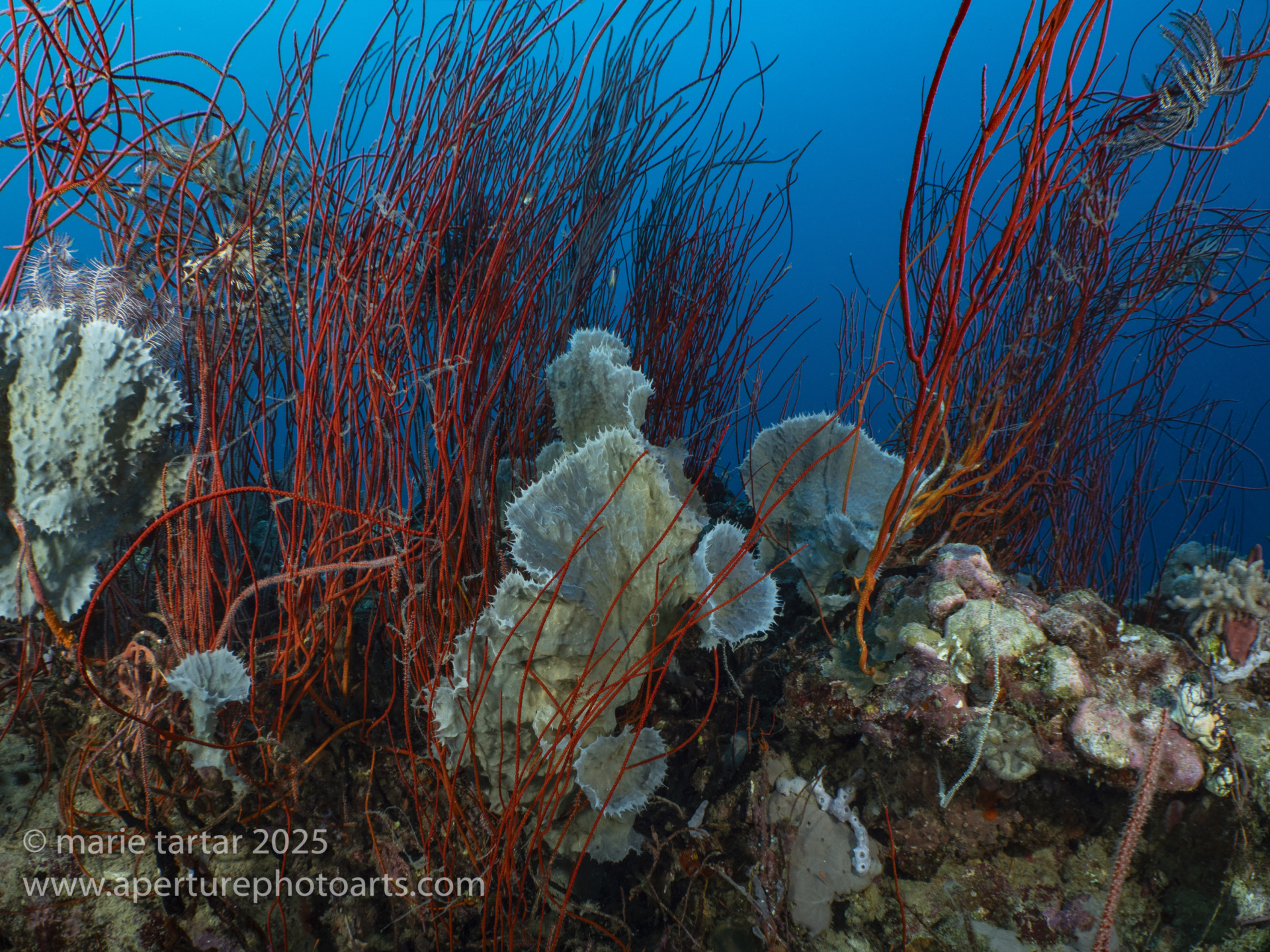
Vanessa’s (88 feet, 55 minutes) featured a long deep ridge studded with large fans, giant orange sponges, sculptural corals and whip corals.

- Colorful reef scene, with thickets of red whip gorgonians, Kimbe Bay, Papua New Guinea.

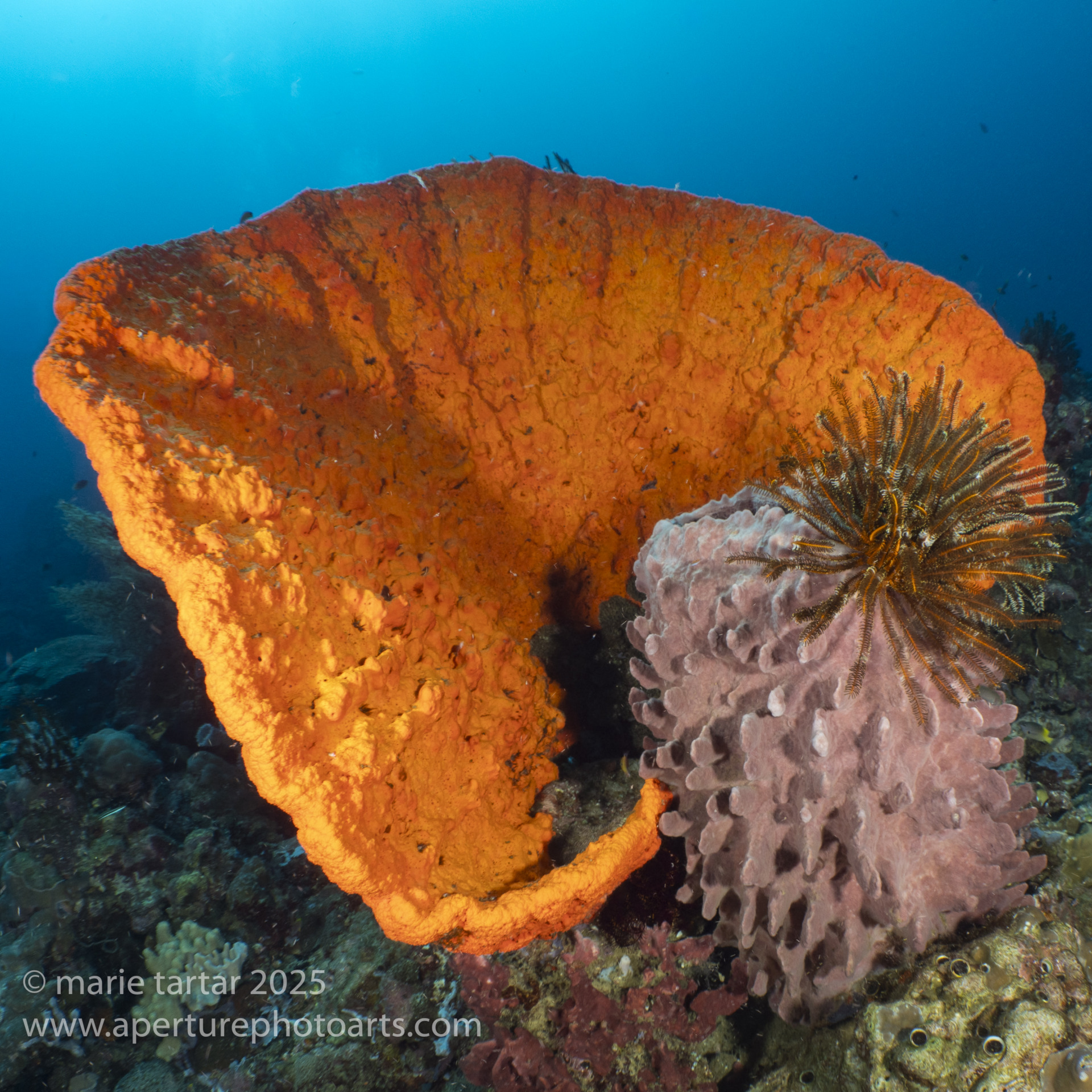
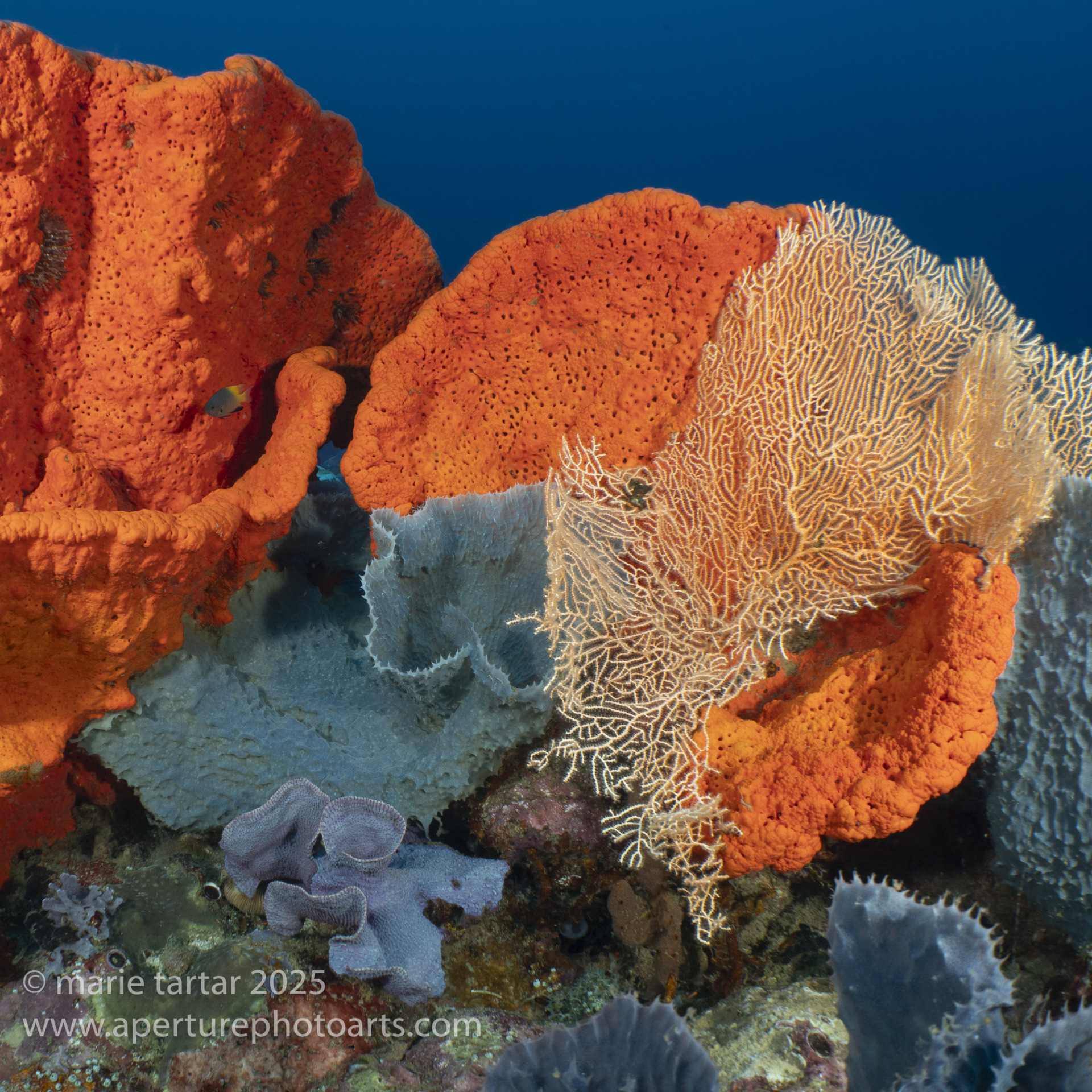
- These large orange sponges were spectacular (Agelas sp?), Kimbe Bay, Papua New Guinea.
The current picked up enough towards the end of the dive to do the safety stop on the line.
South Ema’s (115 feet, 63 min) was notable for a deep swim-through at 110 feet, decorated with a profusion of fans, whip corals, and orange sponges.
For lunch, we enjoyed a pumpkin soup, with fried rice, cabbage salad and fried chicken.
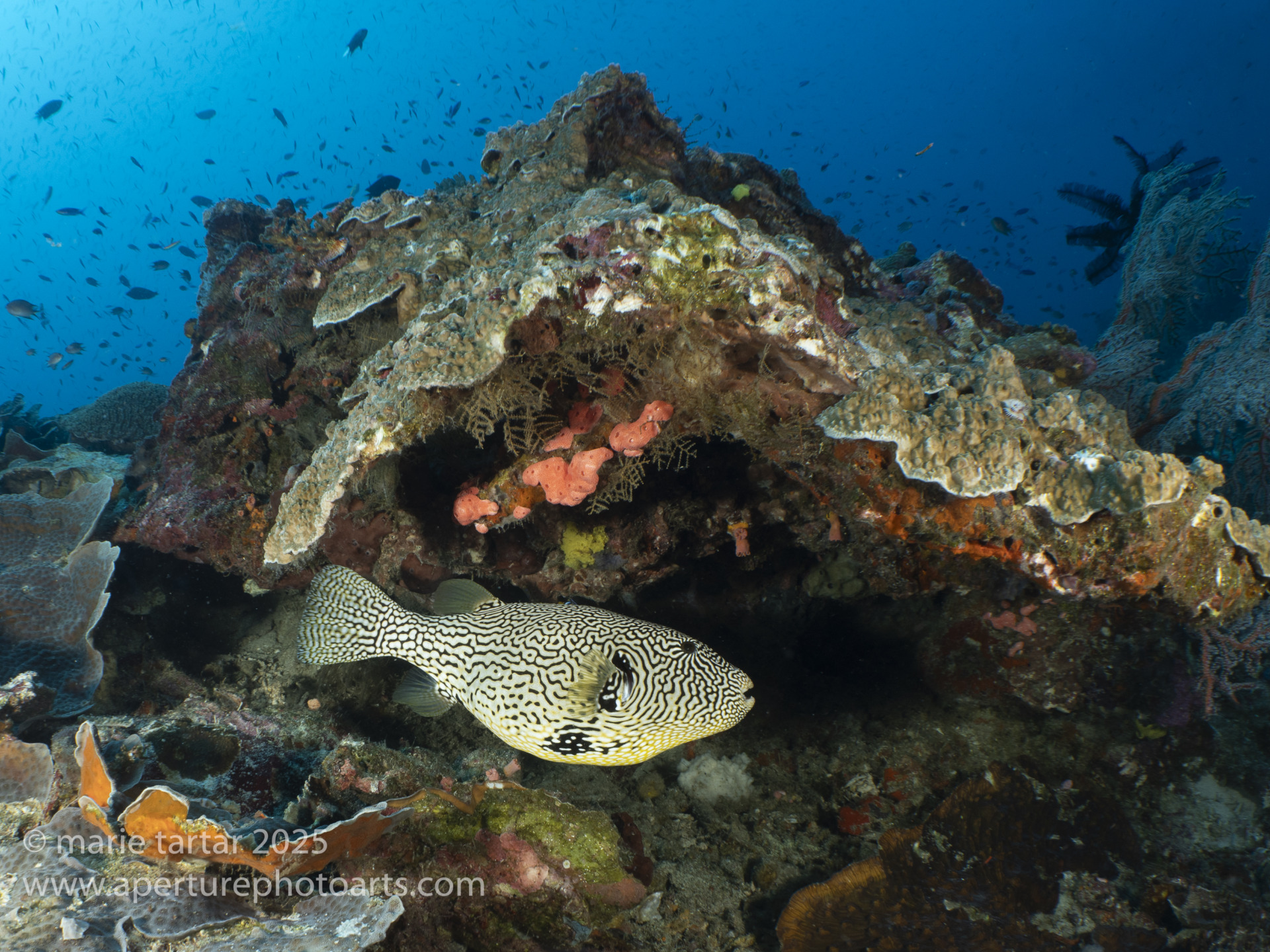
Our 3rd dive at Joelle’s, the water resembled a milky soup, presumably very nutritious and fishy. There was a loose aggregation of barracuda and a puffer under ledge. I headed up when my dive computer buzzed to indicate 5 minutes to deco. (91 ft, 59 min)

- Map puffer (aka scribbled pufferfish or scientifically, Arothron mappa), so called because of the dinctinctive markings recalling a topographical map. Papua New Guinea.

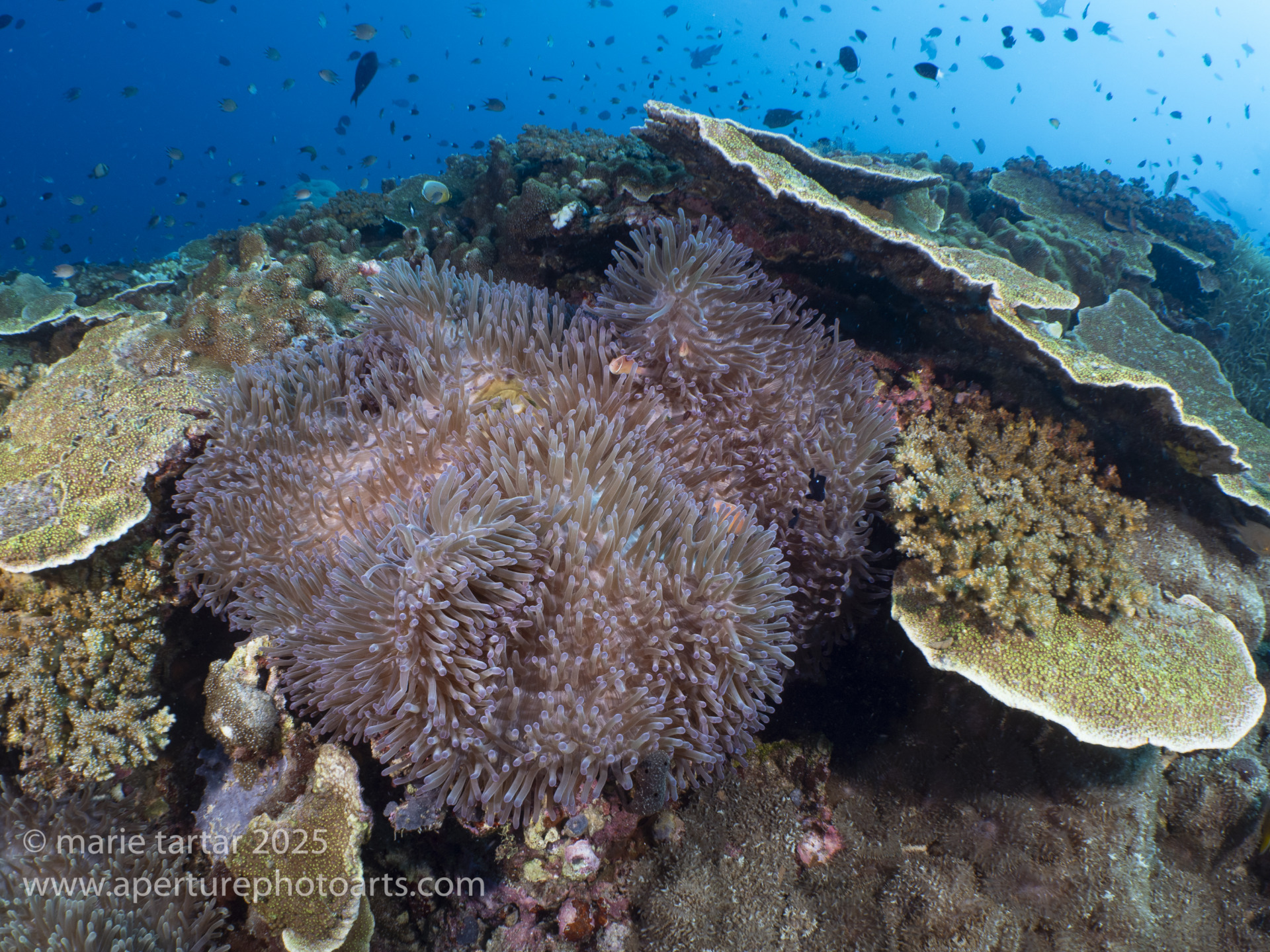
- A huge anemone nearly rivals these plate corals in size, Kimbe Bay, PNG.
Our night dive at Bradford, a bonfire dive, was a bust for me. (73 ft, 59 min), although at the trip-end slide shows, I could see others, particularly Bruce, had better capitalized on the dive.

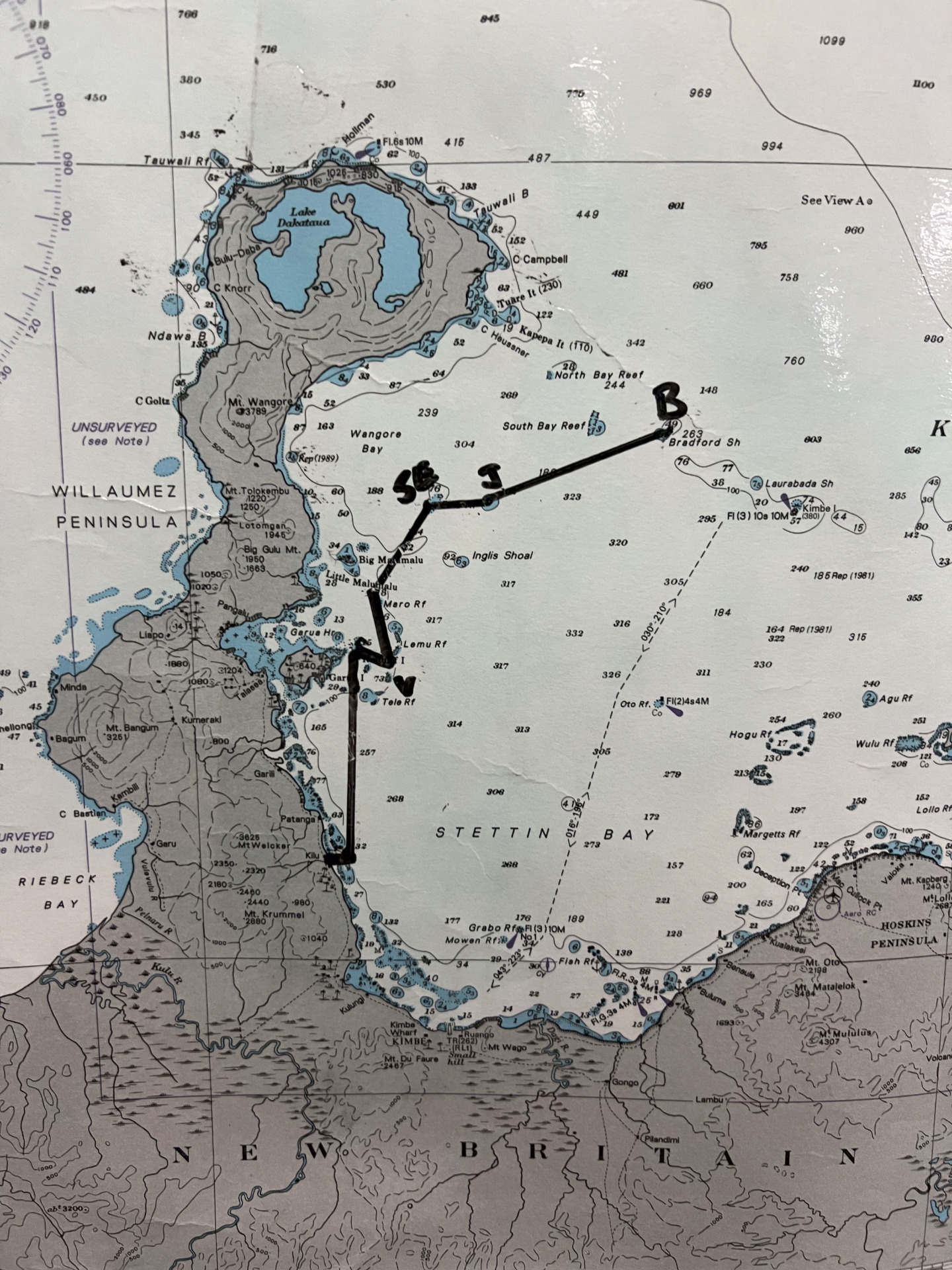
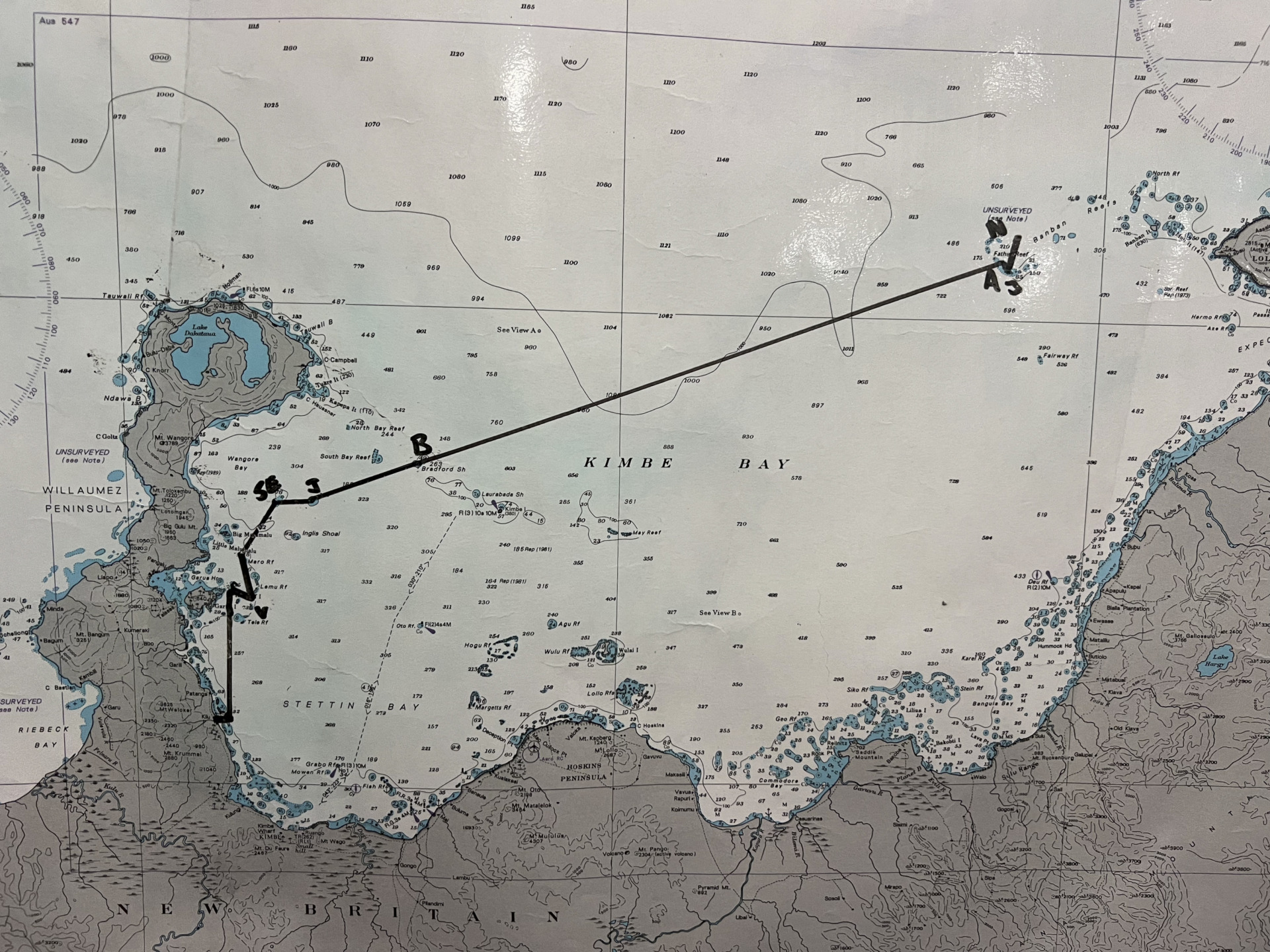
- Day 1 on board MV Oceana, with our dive sites (V=Vanessa’s, SE=South Ema, J=Joelle’s, B=Bradford)
Wednesday, September 24, 2025 (PNG Day 9, Oceana Day 2)
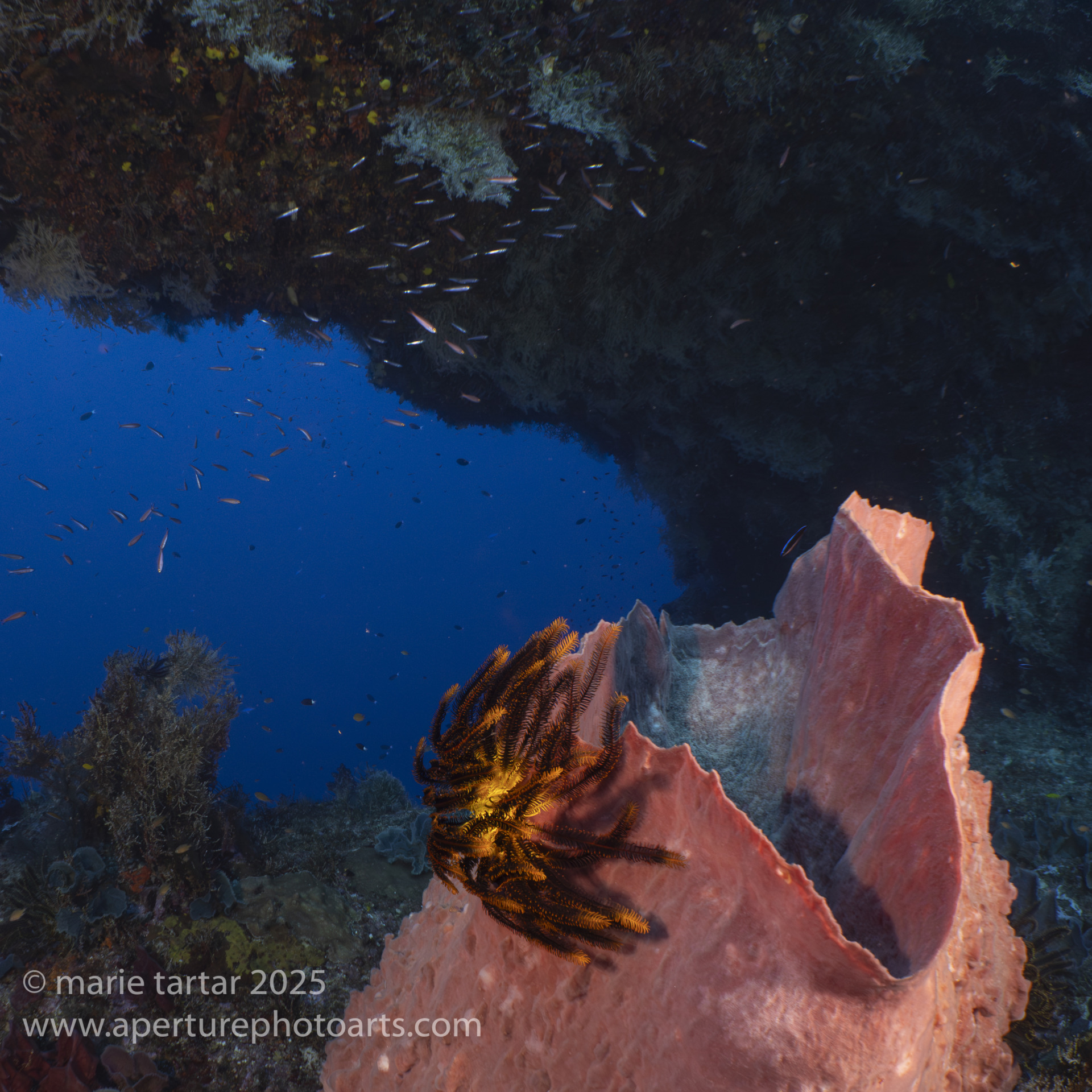
7 am: Our first dive, simply named the Arch, proved to be a giant festooned underwater arch connected by a line to a barren rocky ledge. (98 ft, 54 min) The two formations provided quite a contrast, with one a veritable explosion of color and shape, with soft corals and wavy sponges; the other a scrubby wasteland.
-

A large barrel sponge festooned with a crinoid stands vigil near a large underwater arch, PNG.
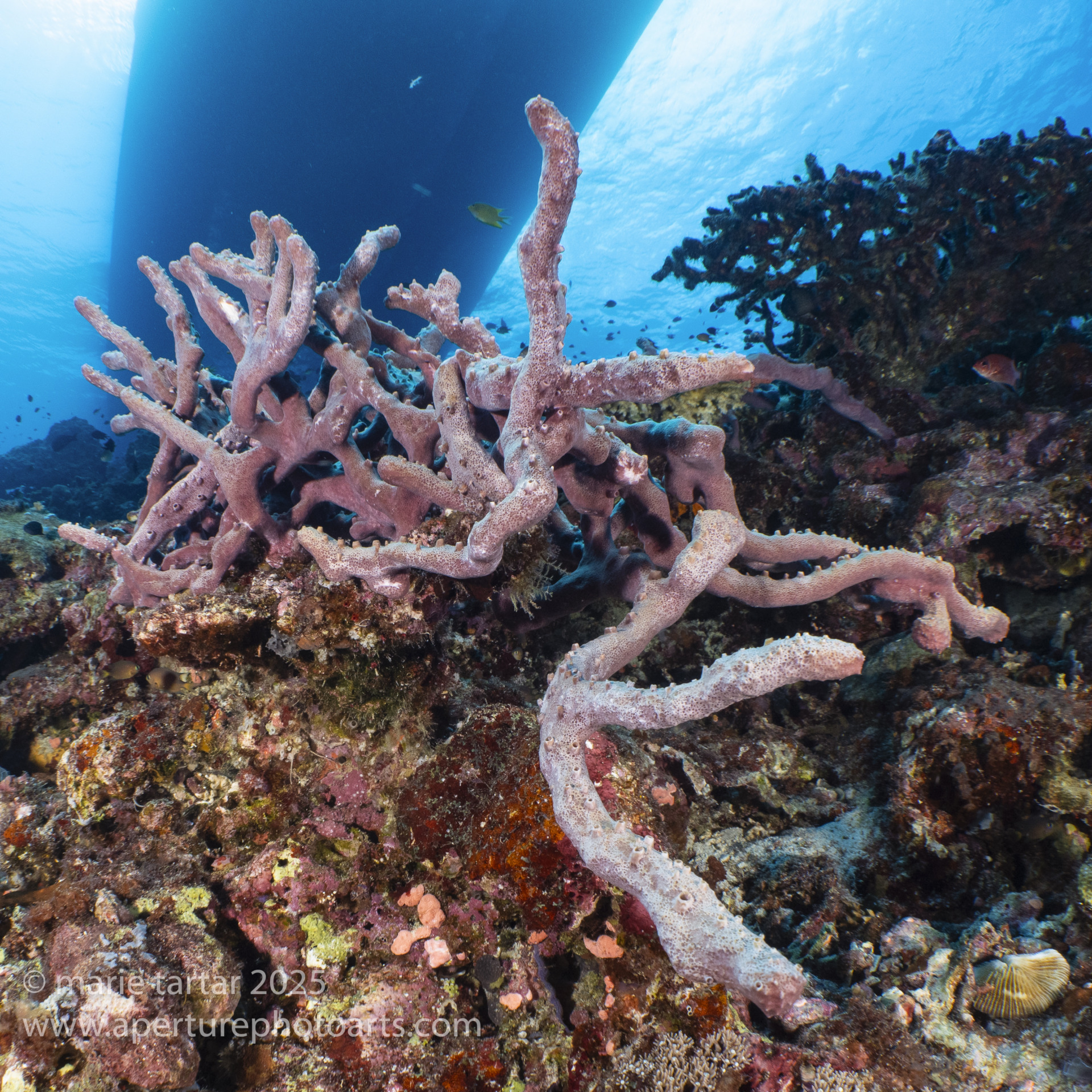
The water clarity was exceptional. The boat was clearly visible above at 50 feet depth on our return to the mooring site.
-

The boat was clearly visible from the reef, 50 feet down! Kimbe Bay, Papua New Guinea.
Lingering over breakfast, my phone pinged. I glanced down and was shocked to see a notation appearing on my calendar “Aaron died.” We’d been expecting this grim finality, but it seeing it in print was a cold slap in the face. No new texts or emails accompanied this terse electronic missive. I found Steve outside, talking on the phone with his older sister Susan, during which he had noted Aaron’s passing in the calendar. Sarah had texted Susan to say he had passed, but indicated she couldn’t speak. The time difference meant the actual date of his death at home was September 23, one month before his 52cd birthday.
Dive 2 Jayne’s (75 ft, 57 min)
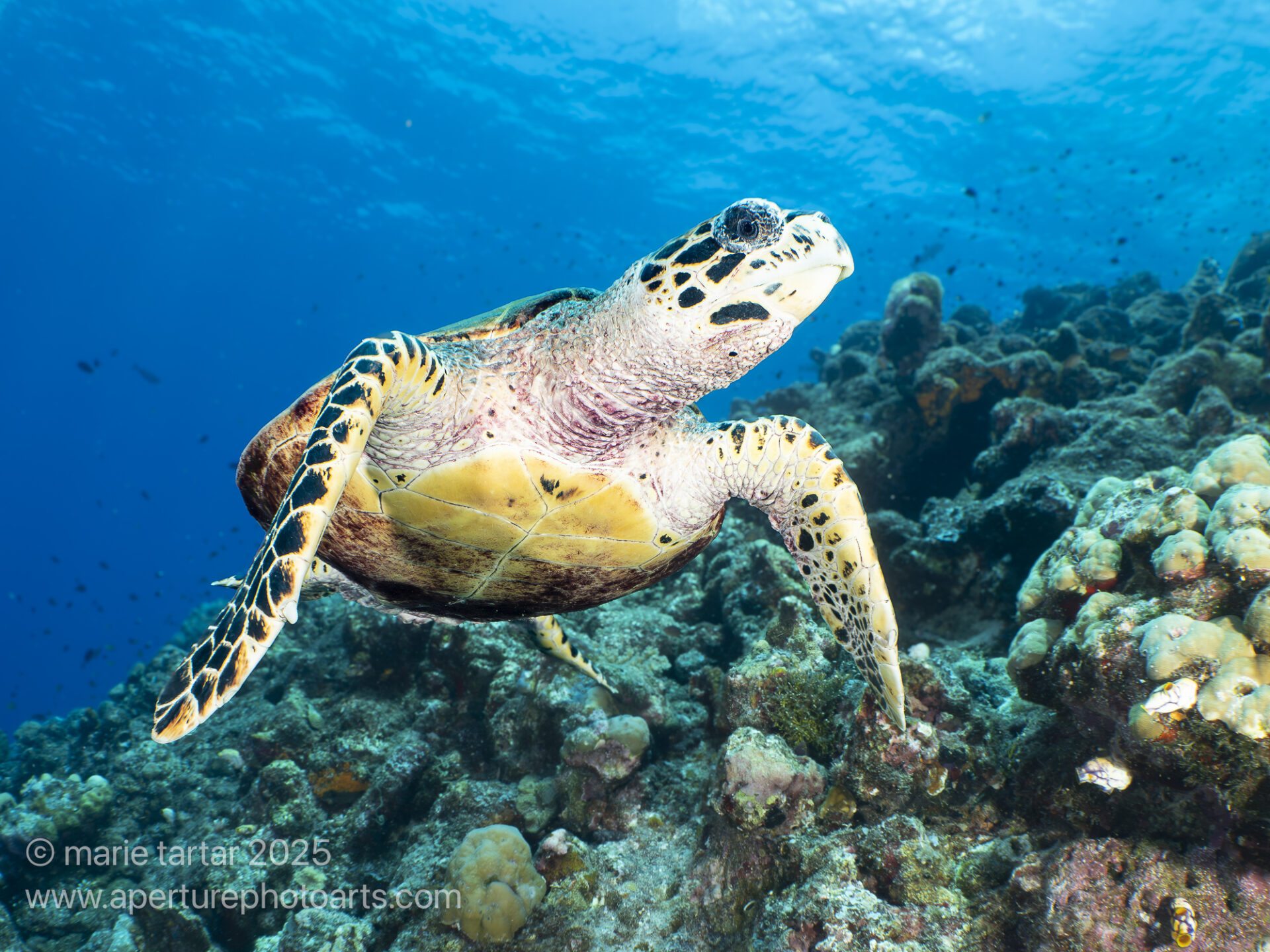
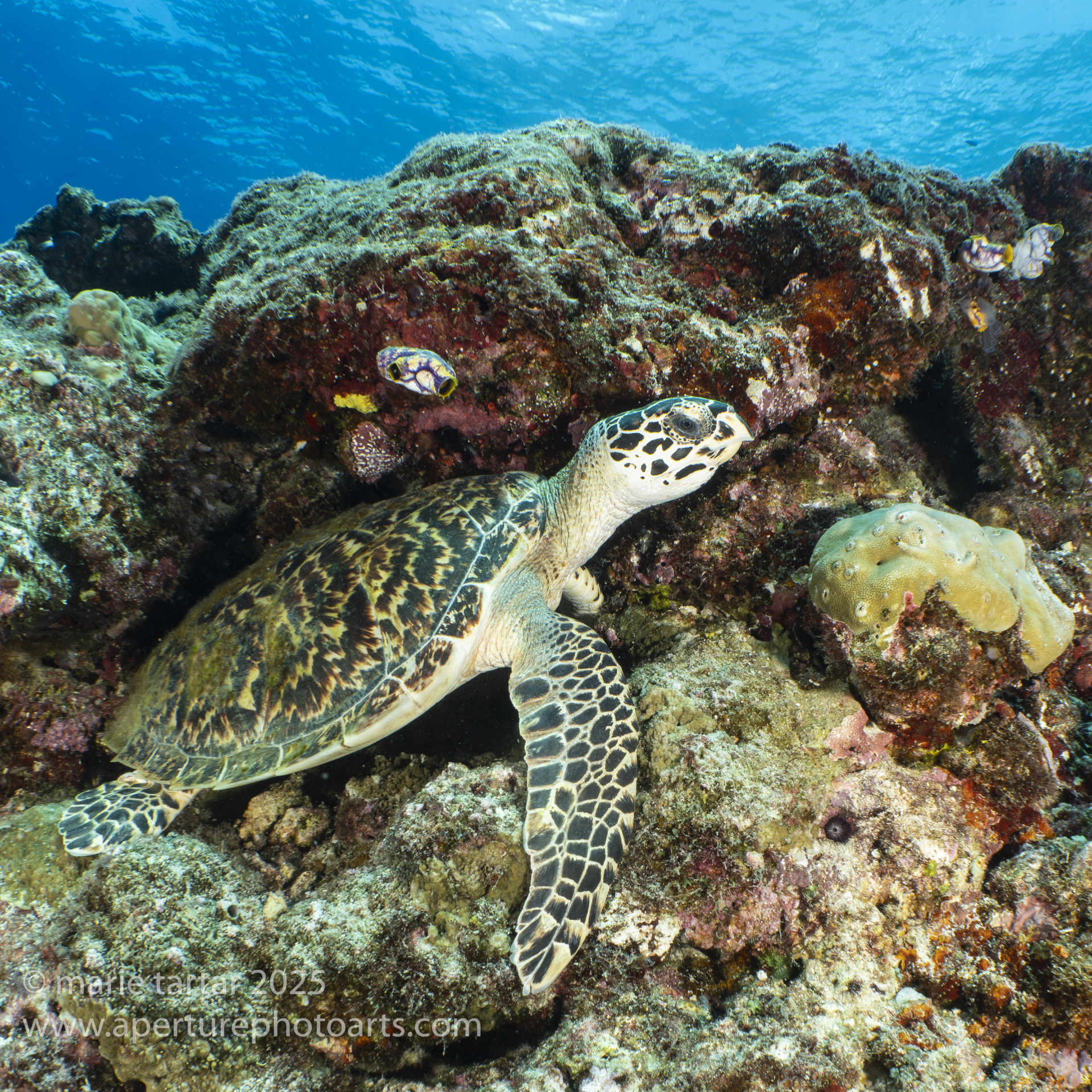
I was so distracted, I didn’t check my camera’s battery. It failed while we were engaged with a trio of friendly turtles.

- Hawksbill turtle, PNG.
-

Hawksbill turtle, PNG.
Dive 3 Norman’s (79 ft, 63 min)
Batfish flitted around in the shallows under the noisy boat.

- Day 2 on Oceana saw us further east in Kimbe Bay, at Fathers Reef (A=Arch, J=Jayne’s and N=Norman’s).
Thursday, September 25, 2025 (PNG Day 10, Oceana Day 3)
Dive 1, Guro Arch, featured large black coral bushes on the sides of a plateau. (91 ft, 61 min)

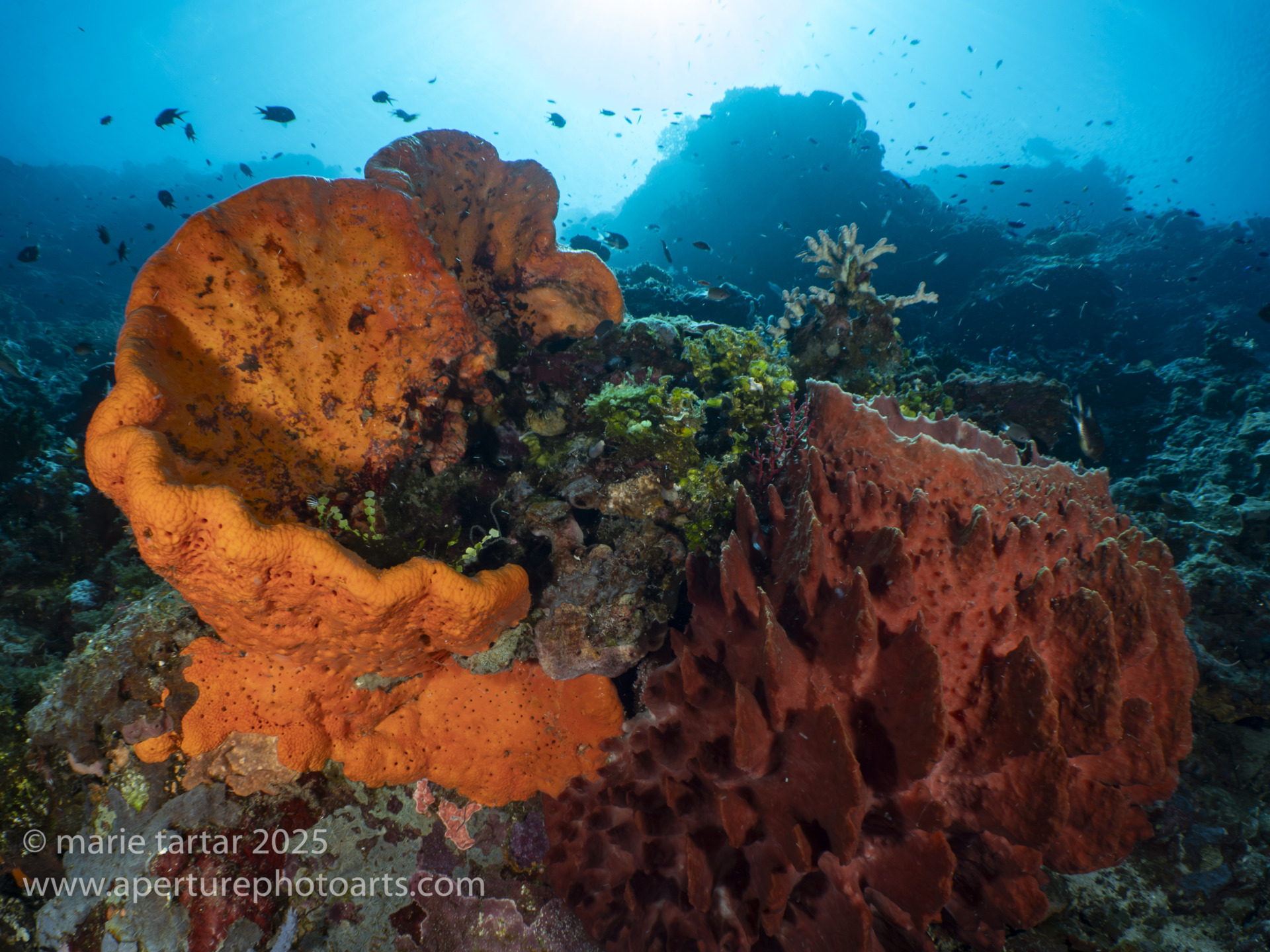
- Orange sponge and barrel sponge conclave, PNG.
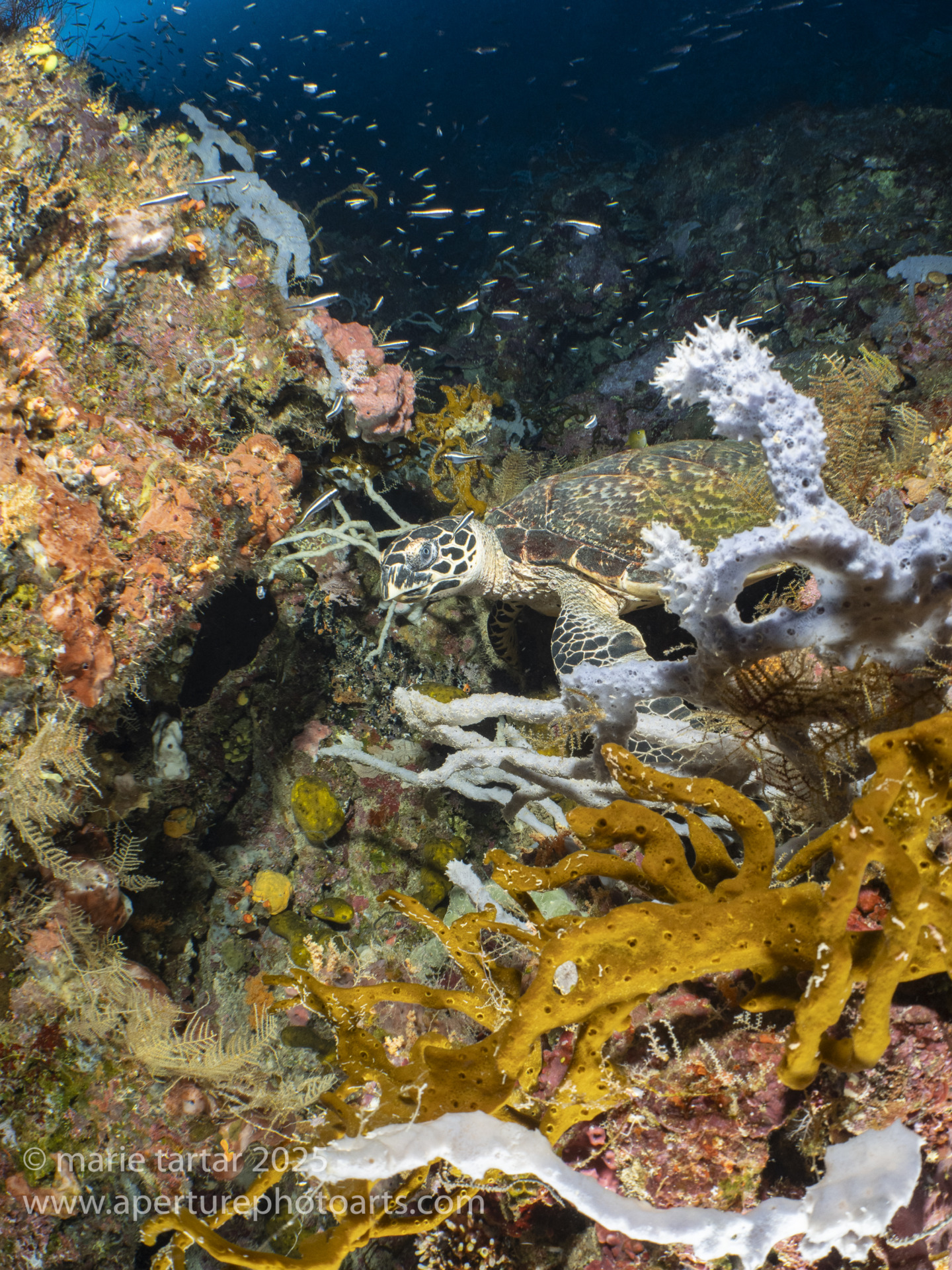
Dive 2 (Dickie’s (as in Tom, Dick and Harry, part of a trio of similar formations)) was a live dive, with the boat maneuvered into proximity with the shallow hard coral plateau. After entering, we waited on the surface and descended together. A turtle awaited us on the wall. (89 ft, 64 min)

- Hawksbill turtle pauses on a reef amidst a plethora of sponges. Kimbe Bay, PNG.
Dive 3 Wire Bay (75 ft, 62 min)
This site seemed unlikely at first, with scattered boulders, but gradually, we came upon fields of hard corals. A small anemone with two fish perched in an acropora hard coral.

- This pair of anemonefish have a home with a view. Kimbe Bay, PNG.
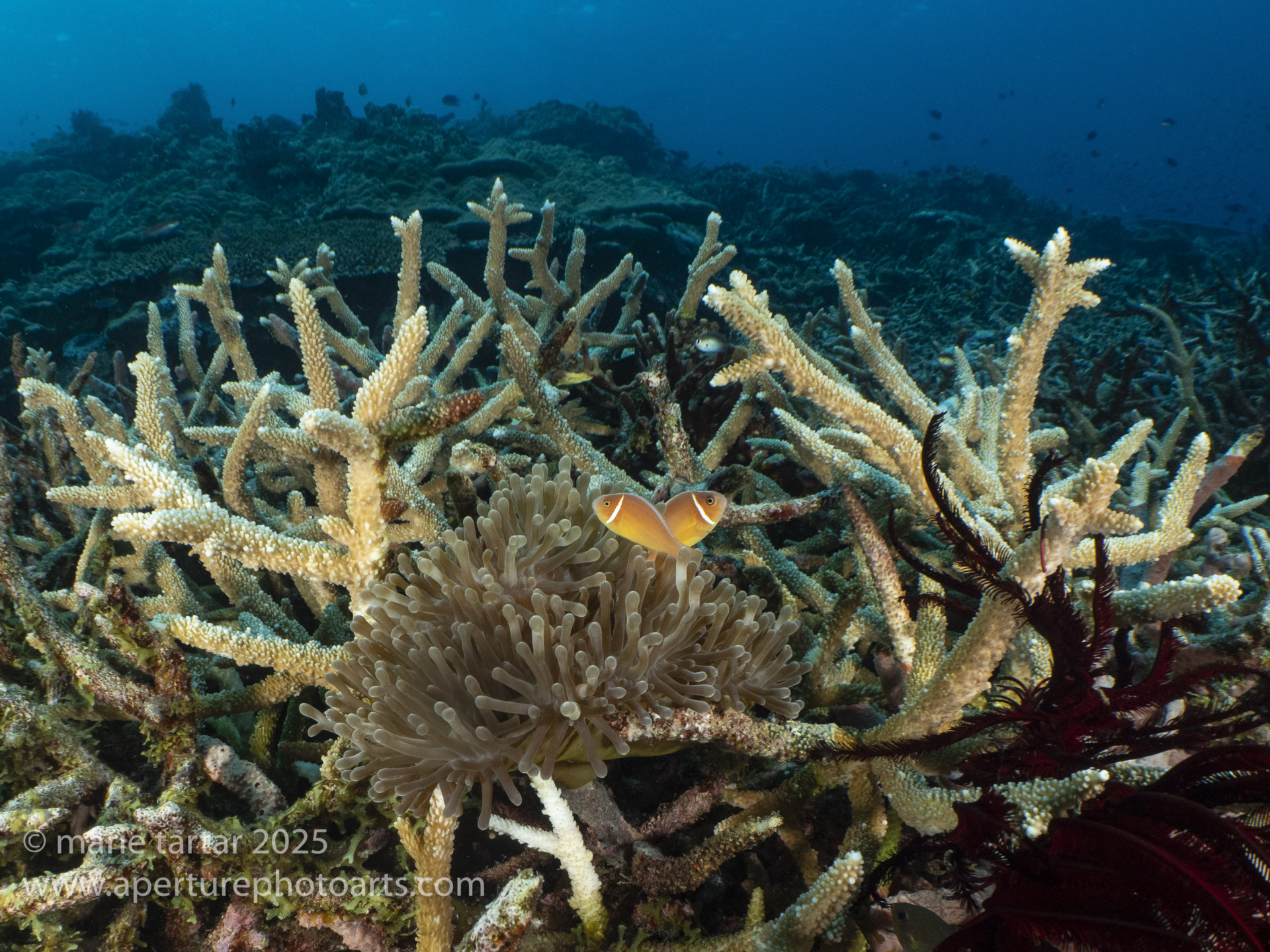
Spiky porcupine sponges were abundant.
Friday, September 26, 2025 (PNG Day 11, Oceana Day 4)
A tale of two contrasting dive sites:
First up was Harry’s (a companion site to yesterday’s Dickie’s): beautiful hard coral fields, stag horns, pinnate juvenile batfish under a hard coral shelf. (78 ft, 58 min)

- Crack that whip (coral)! Kimbe Bay, PNG.
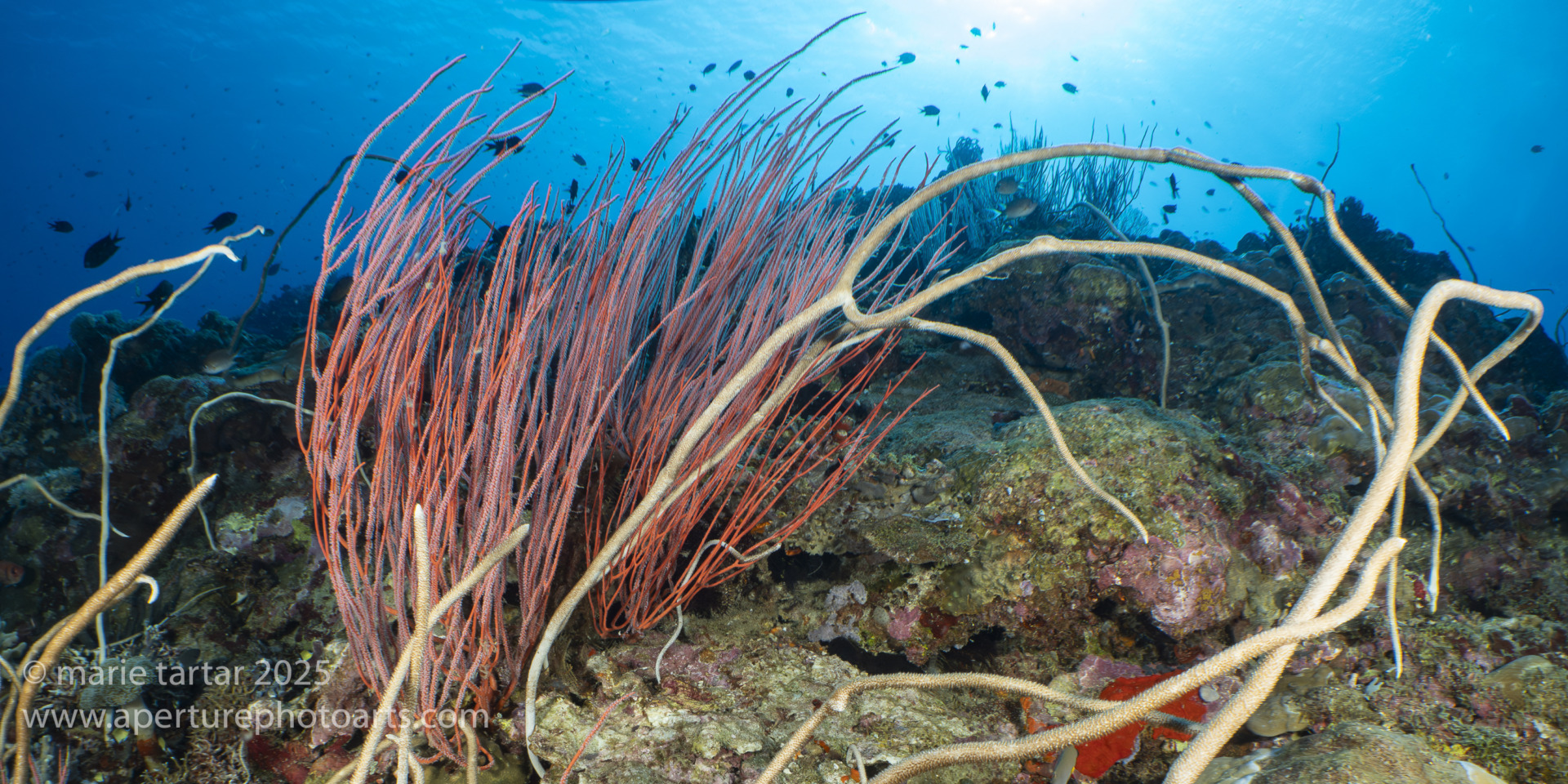
The second dive was an ugly remnant of a coral reef, drab browns and skeletons of hard corals, dotted with occasional colorful anemones. I did find a cooperative trumpetfish sheltered between two rows of a hard coral. (70 ft, 69 min)

- Trumpetfish often hang vertically, mimicking corals, but this one is sheltering horizontally betweens the shelves of a large Acropora coral in KImbe Bay, PNG.

The GI disturbance making the rounds reached me this afternoon, but the bouts of diarrhea were conveniently spaced between the 2nd and 3rd dives (71 ft, 70 min).

- Clown triggerfish (Balistoides conspicillum) under a table coral. For a change, Greg and his lights were in perfect position! Kimbe Bay, PNG.

Saturday, September 27, 2025 (PNG Day 12, Oceana Day 5)
All dives were in the morning, followed by a 17-hour crossing west to the Vitu Islands. I felt washed out and fatigued and slept much of the day.
I was able to eat, albeit smaller portions. The boat rocking from side to side after dinner sent my back into an acute spasm.
Sunday, September 28, 2025 (PNG Day 13, Oceana Day 6)
I managed to sleep, despite sleeping virtually the entire prior day. The GI eruptions were more spaced out but I still had to take a 5th dose of Pepto in the morning. I felt better initially, then the cramps recurred. The back spasm evolved into a low back ache, which responded to a miracle-working muscle relaxant Diane gave me.
I skipped the first dive, but was relieved to be able to do the second (77 ft, 61 min) and third. Reports were that the first dive at Guro Arch had “mushroom soup” visibility.
After the second morning dive to Dickie’s wall, dolphins rode our bow wave for a spell.
Lunch actually featured cream of mushroom soup.
Dan indicated we could potentially sight dugongs as we entered Wire Bay. Instead, the local children swam out to the boat.
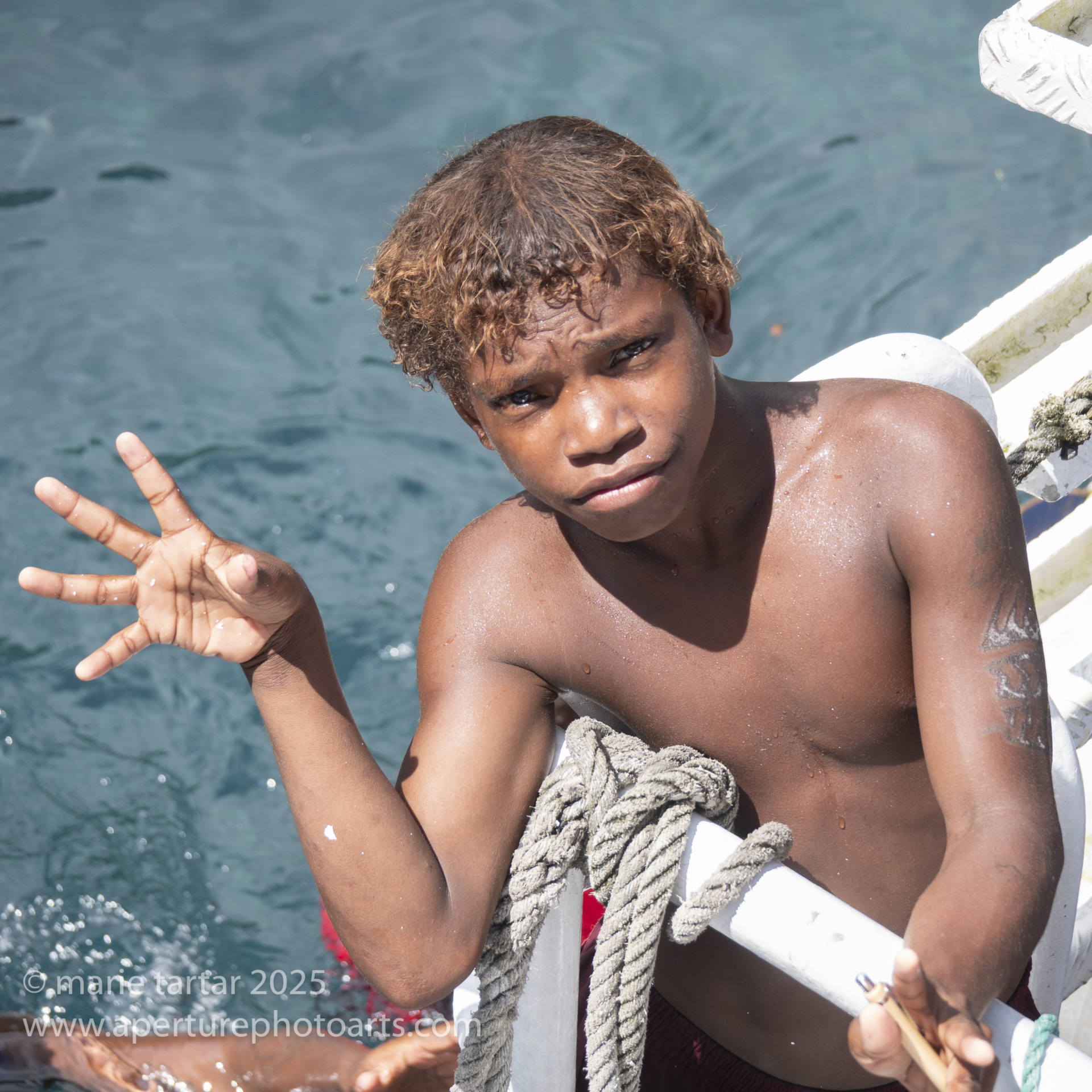
Boy, Wire Bay, Papua New Guinea
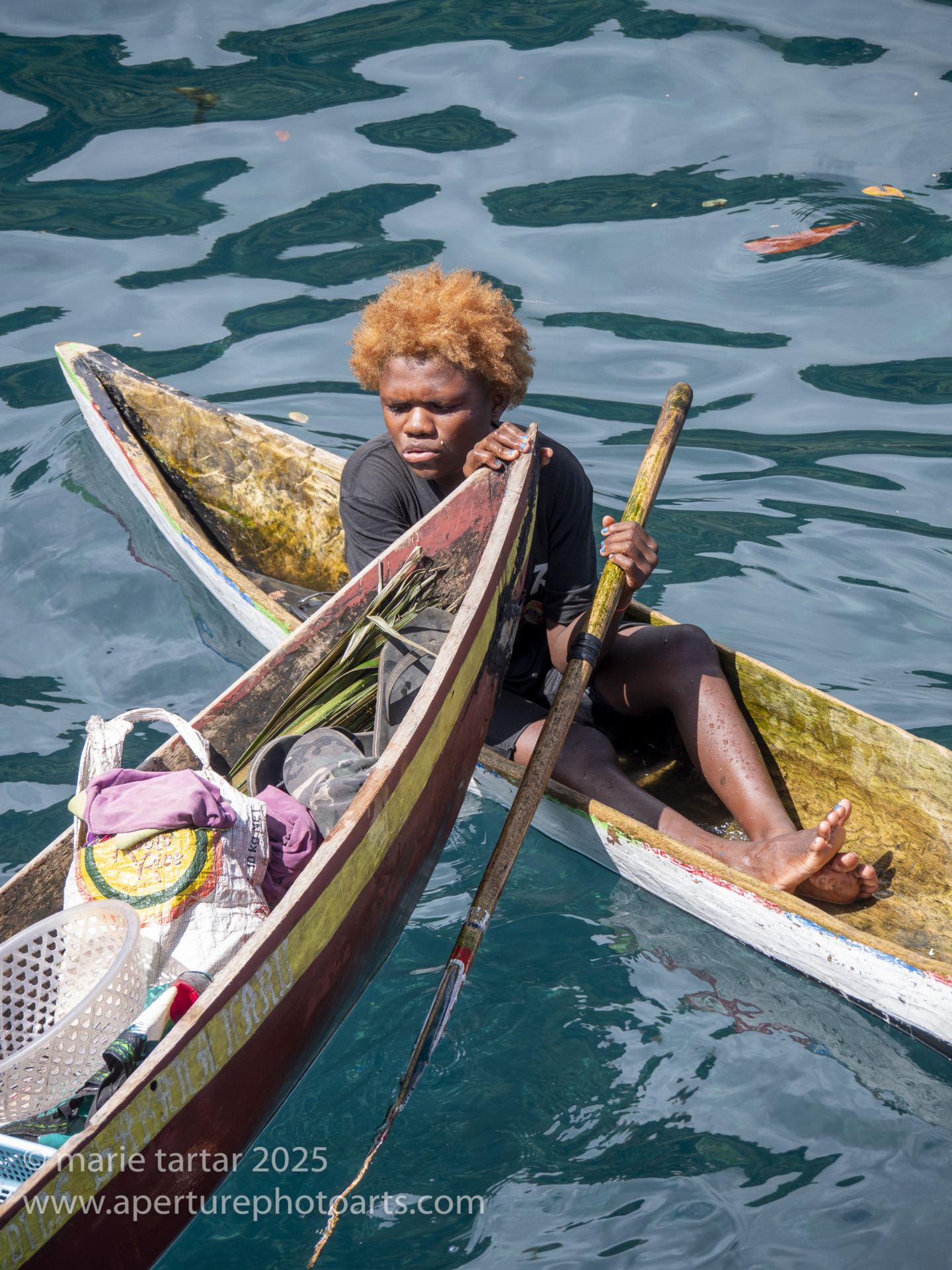
This girl’s light hair and dark skin is a pattern also seen in the Solomon Islands, not so far away from where we were in eastern Papua New Guinea. Even very young children ably paddle their own dug-out canoes.
Extra T-shirts were tossed to the eager kids. Happily, fresh bananas were among the produce items procured from the locals.
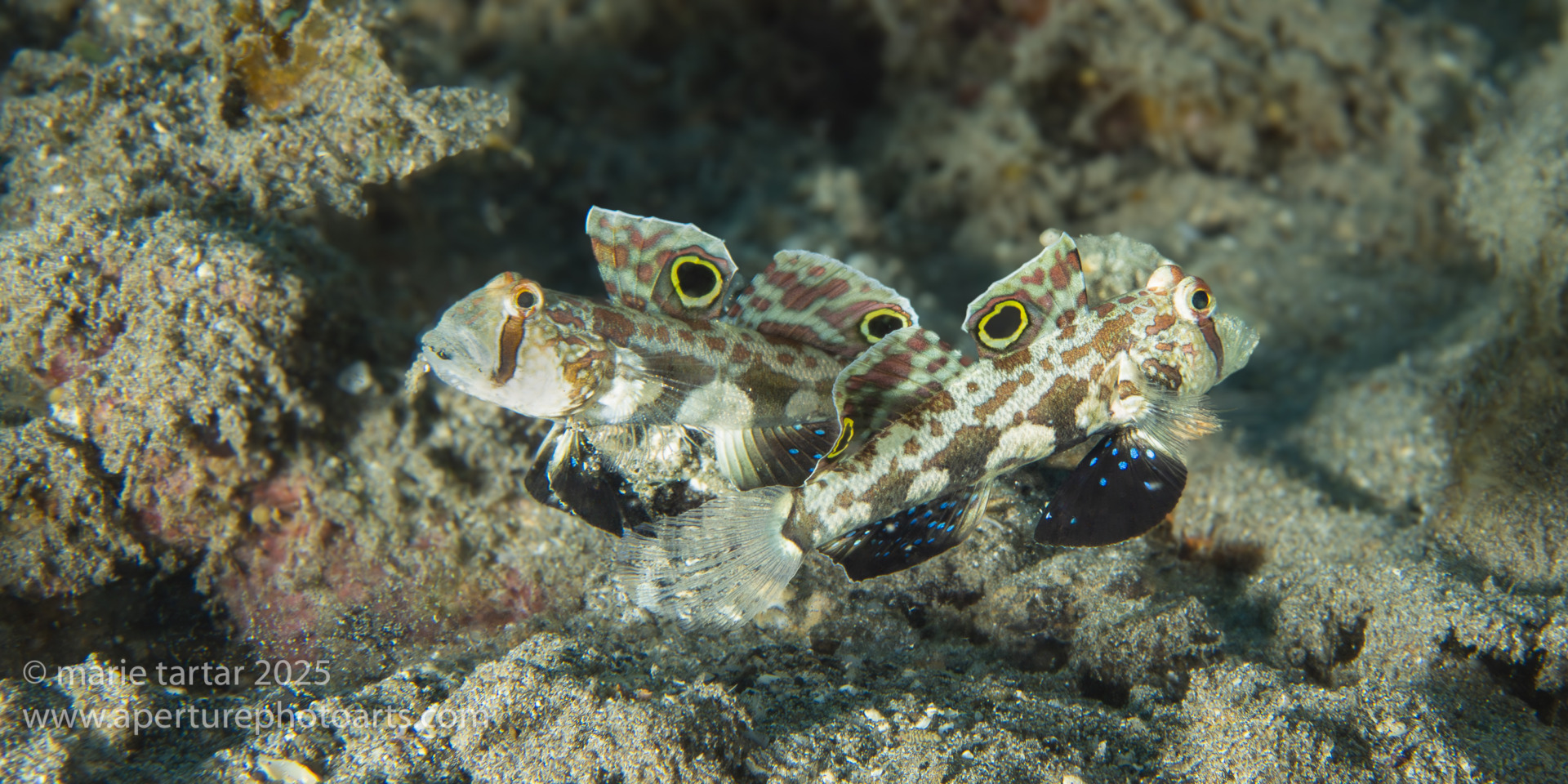
For the third dive at Wire Bay, I switched to macro (72 ft, 80 min). The site had all the ingredients of a muck dive but the best subjects to me were deeper, on patches of reef (tiny mantis shrimp peeking out of a hole in a coconut shell, a two-spot goby pair and a larger mantis shrimp in its shell-lined burrow in the sand).
-

Two-spot gobies ((Signigobius biocellatus) are adorable, the way they bounce around and “dance” around each other. They have multiple alternative common names, including twin-spot, signal or crab-eye goby. They do kick up a lot of sand as they hover over the ocean floor. They don’t do that to frustrate photographers but are sifting the sand for tiny invertebrates which they hoover up, expelling the sand through their gills.
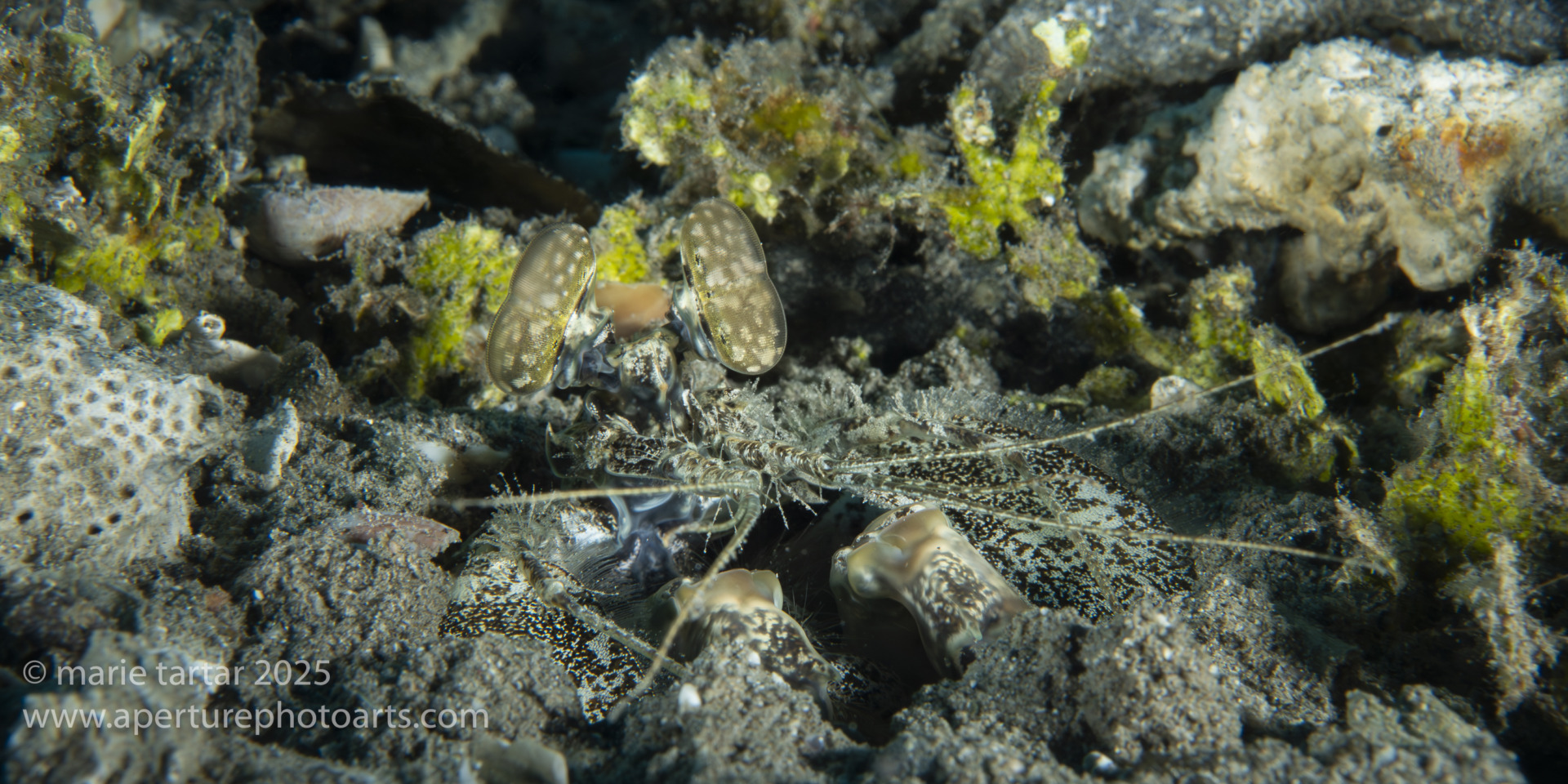
Mantis shrimp lies in wait in its rocky lair in the sand, Papua New Guinea.

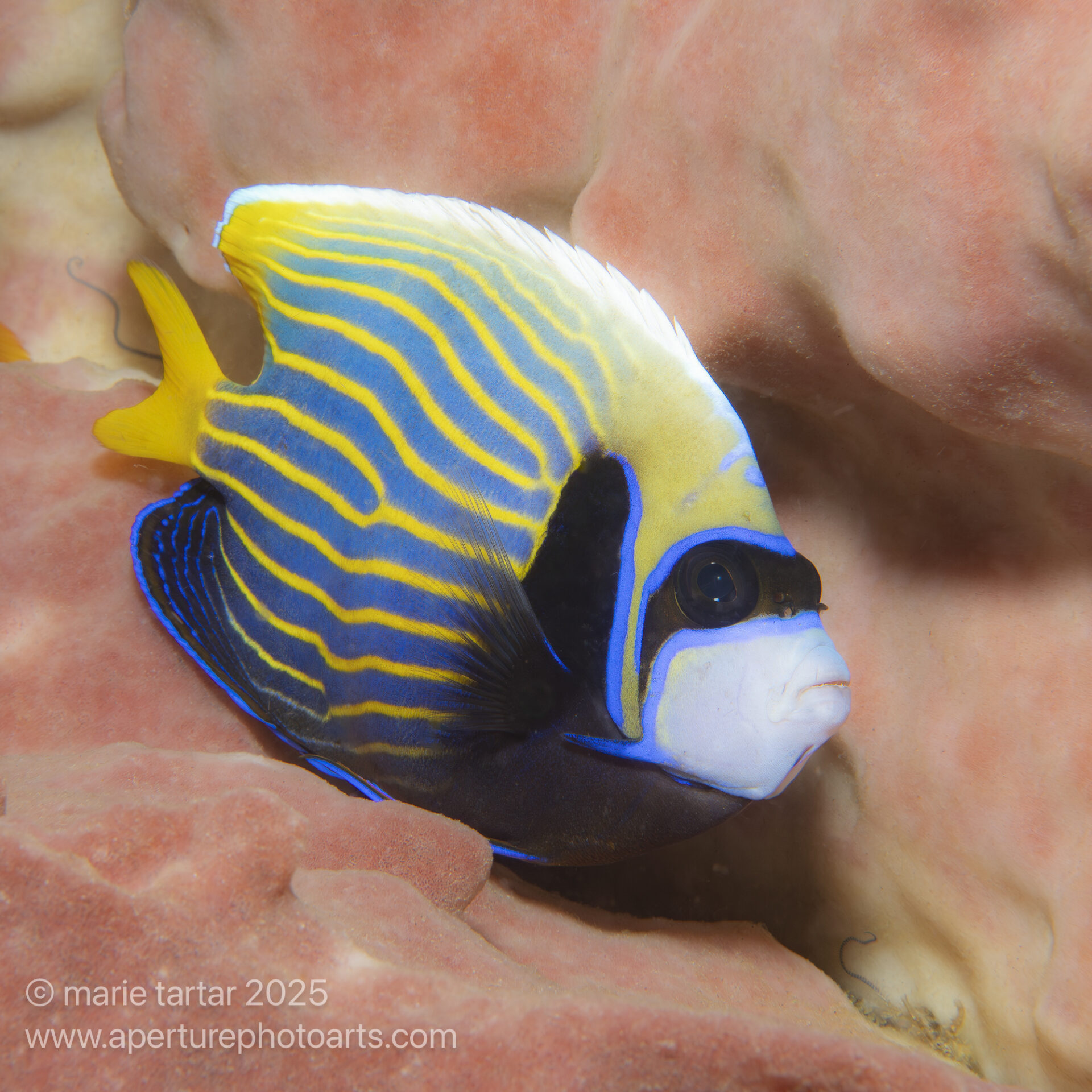
- Emperor angelfish, adult (Pomacanthus imperator). Bismarck Sea, Papua New Guinea.

- Pink skunk anemonefish, Bismarck Sea, Papua New Guinea.

I flew the drone after finishing diving, from the top deck.
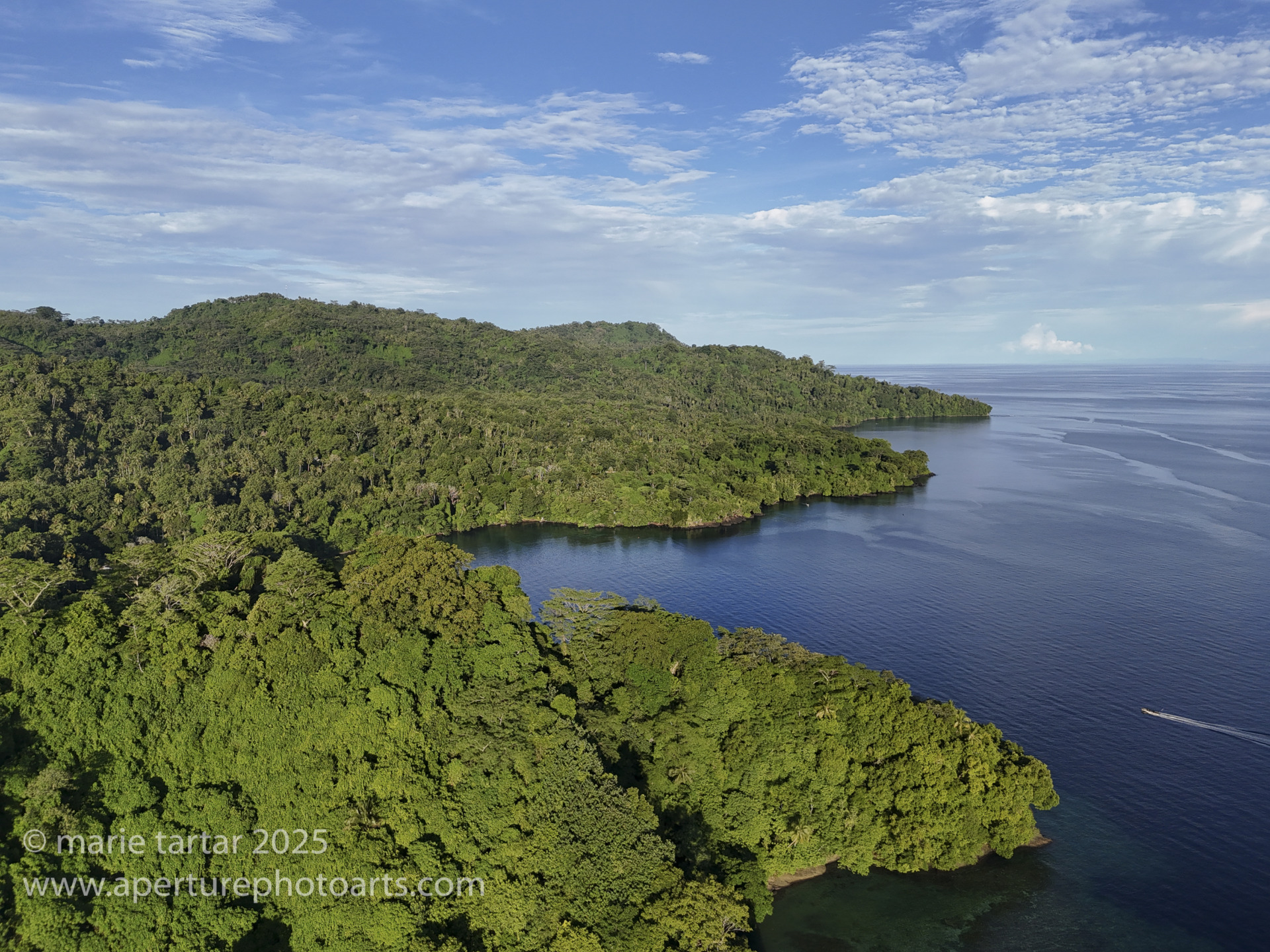
A boat streaks toward a remote dive site in the Bismarck Sea, Papua New Guinea.
Steve skipped the third dive but did the night dive, also at Wire Bay.
Lamb was served for dinner (too late for Diane), with fresh mango adorning a miniature cake for dessert.
I finished Throwim Way Leg by Tim Flannery (the subtitle is intriguing: Tree-Kangaroos, Possums and Penis Gourds), another great read with interesting commentary on PNG culture, written by a biologist with a way with words.
-

I love the title of this book. It’s pidgin, roughly translating as Throw Out a Leg or to start a journey.
Monday, September 29, 2025 (PNG Day 14, Oceana Day 7)
Today was Steve’s 68th birthday. Captain Dan’s birthday is tomorrow and Brian’s the following day. A joint cake celebration is planned for tomorrow.
Our first dive was a birthday-worthy wall, Widu Reef (77 ft, 67 min). Willie found us multiple macro subjects, including soft coral crabs, orangutang crabs, a flaming oyster. Beautiful hard corals graced the shoulder of the reef.
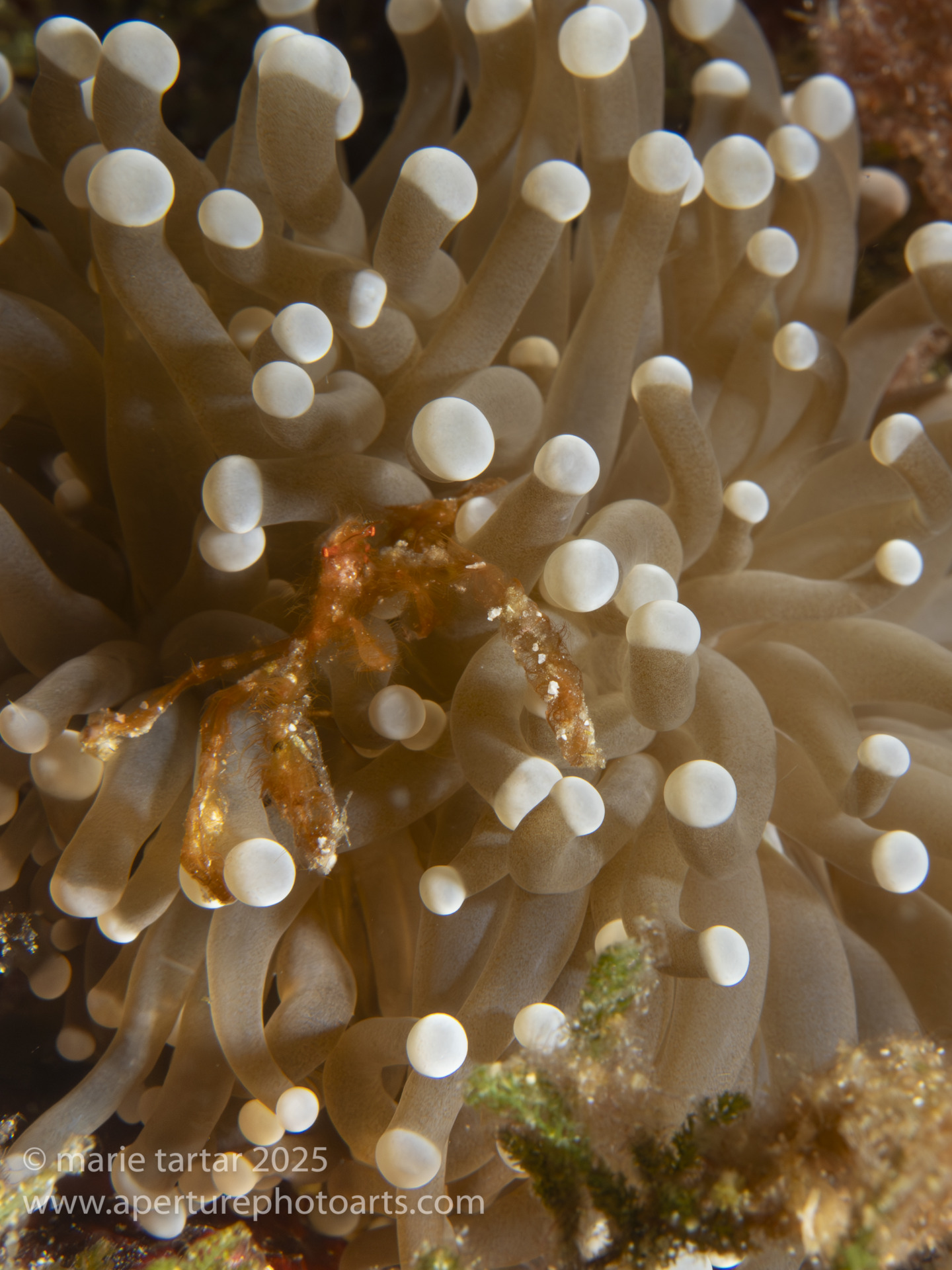
Tiny orangutang crab is covered with whispy algea fibers.
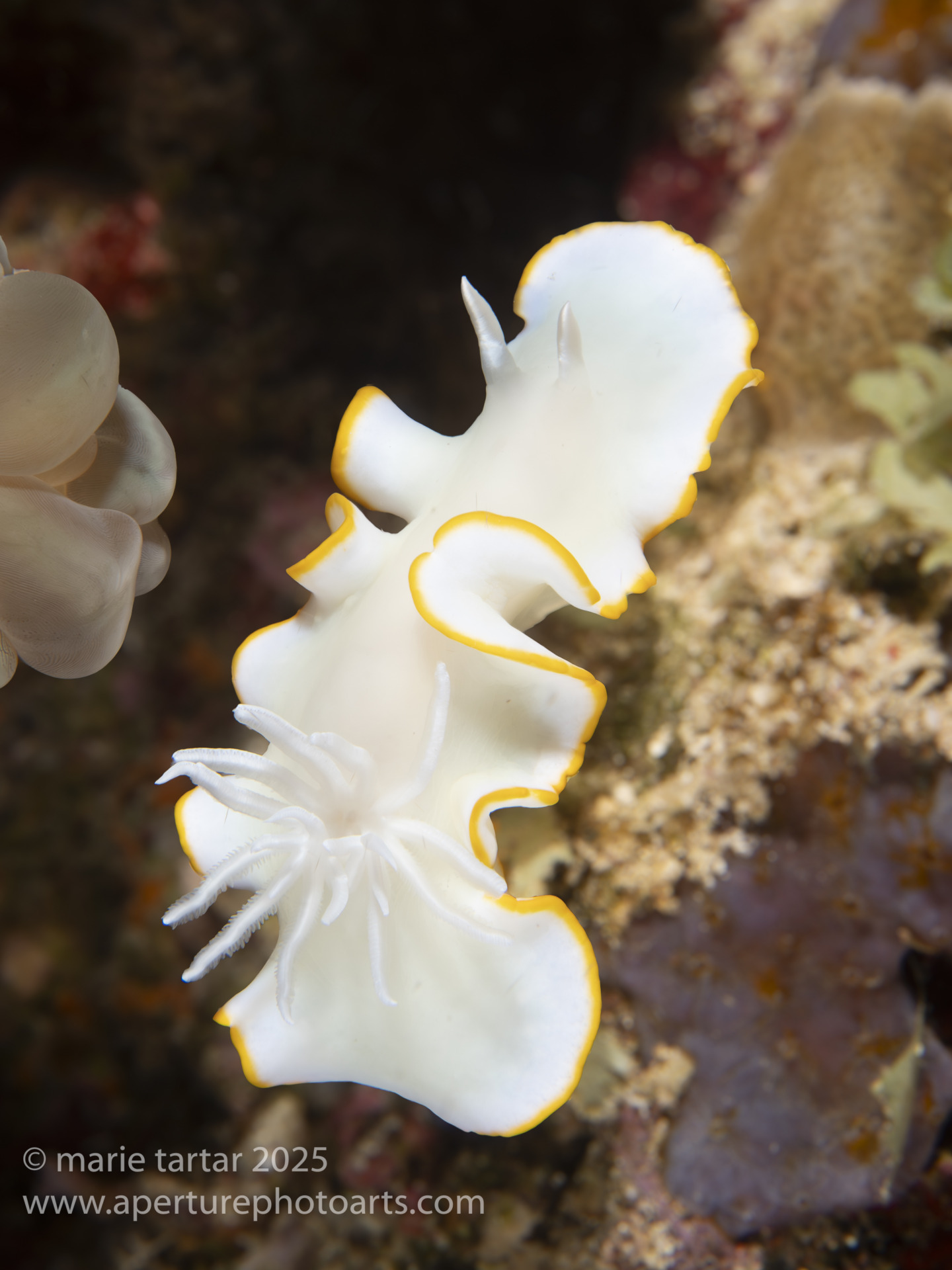
A big, gorgeous, aptly named nudibranch, the heron Ardeadoris or scientifically, Ardeadoris egretta.
We called Susan between the morning dives, catching her on the bus into Manhattan after dropping her dog off in New Jersey. She will stay overnight in the city. The first in a series of events memorializing Aaron is later today, in Brooklyn. Apparently, that was Aaron’s wish, that his friends in outer bouroughs wouldn’t have to pay the toll to travel into Manhattan. How like Aaron to think of others.
I switched to wide-angle for the second dive on Widu Reef (58 ft, 68 min) and back to macro for the third, a muck dive at The Crater. (55 ft, 77 min)
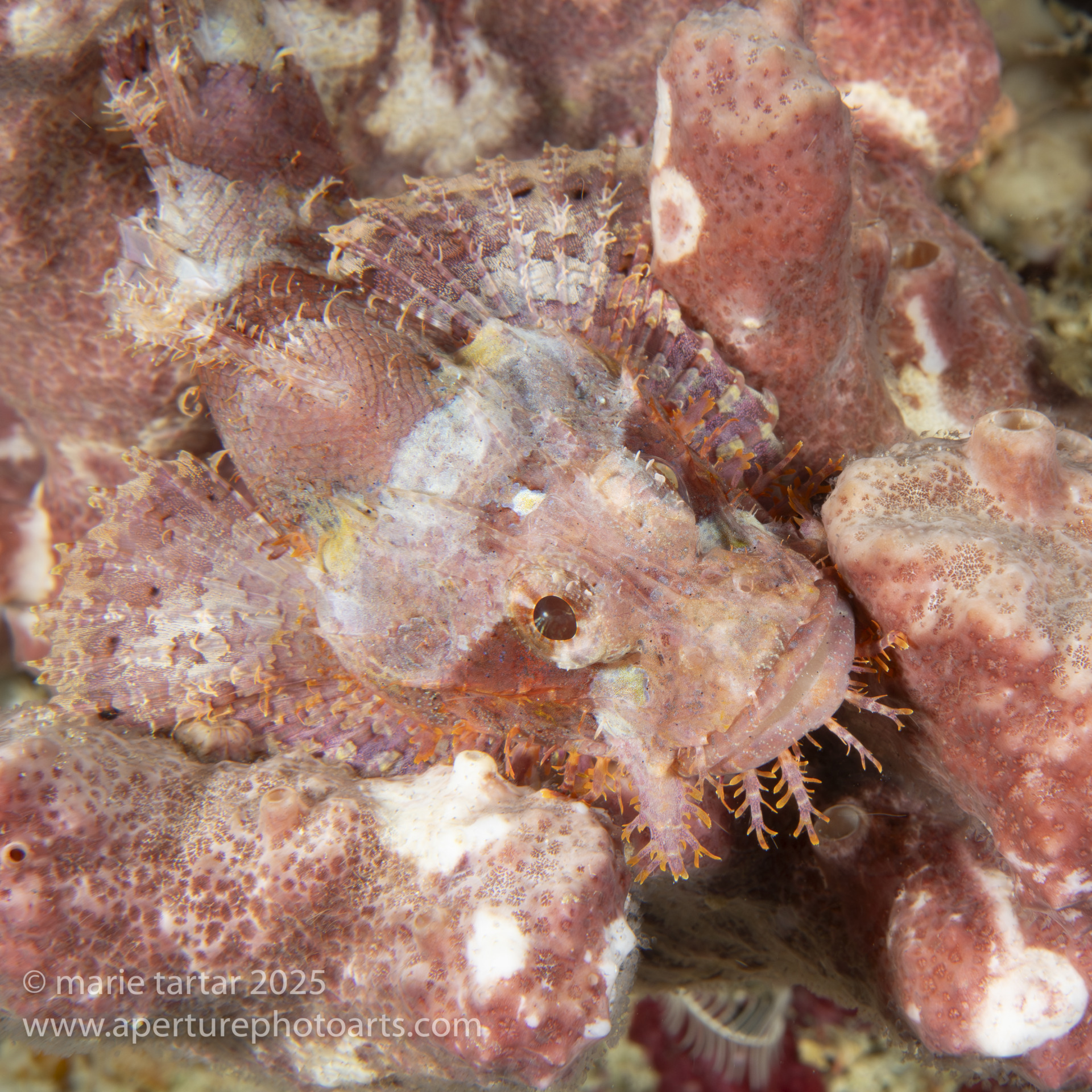
Pretty in pink: scorpionfish nestled in a matching aponge substrate. Bismarck Sea, Papua New Guinea.
I skipped the night dive, but Steve did it.
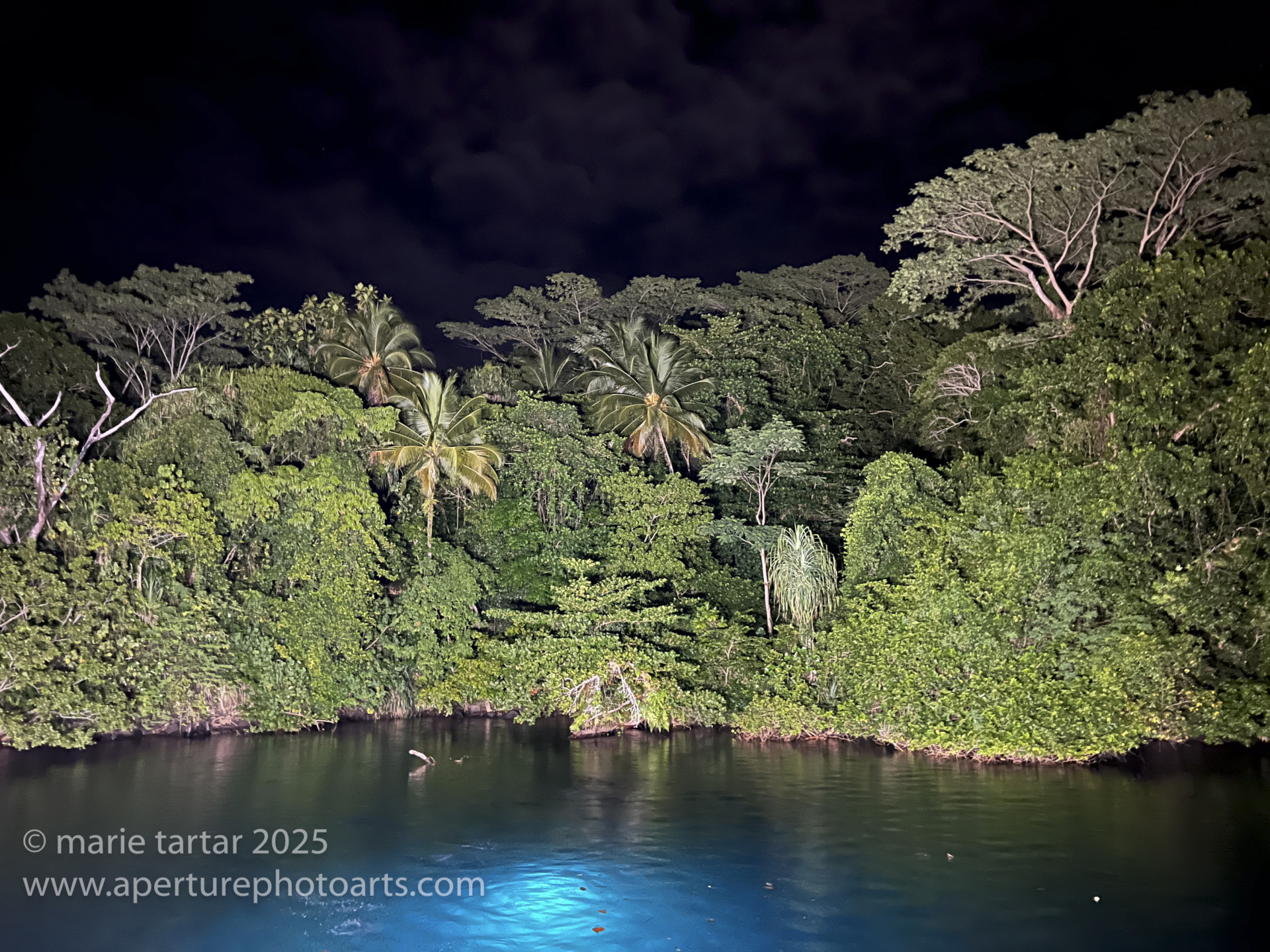
The view from the MV Oceana, night divers in the water, with the jungle-covered island lit by the boat.
Tuesday, September 30, 2025 (PNG Day 15, Oceana Day 8)
Today is Steve’s birthday at home and Captain Dan’s 50th birthday. Aaron’s memorial service is also today. Susan later sent us some pictures and video from the procession and service at Saint Patrick’s Cathedral on Fifth Avenue. The mournful tones of the bagpipers lining Fifth Avenue started the tears flowing …again.
Dive 1 Krakafak (78 ft, 65 min)
This is a famous site. It was very alive with schools of fish, beautiful rolled-up anemones and exuberant coral and gorgonian aggregations.
Our plan to do a second dive at Krakafak was scuttled by the current (strong enough to pull the bail-out bottle at the back of the boat horizontal). I asked Junior to change out my rig between dives so I could take my new Ocean Reef full-face mask out on its maiden voyage.
Dive 2 Swamp Tinny (78 ft, 62 min)
This was my first dive with my new full-face mask. Overall, it went well. I was a little anxious initially; later in the dive, I almost forgot about it.
Dive 3 Barney’s (75 ft, 62 min)
This dive with the full-face mask was less successful. It was noisy. I suspect it was leaking, with my hood interfering with obtaining a good seal. I still managed to do a full-length dive, but the noise interfered with my enjoyment.
Meanwhile, Steve’s mask developed, for the first time the entire trip, constant leaking from the right side. I remind him that a tank was accidentally set down on it (transiently) when he left it out before this dive.
Wednesday, October 1, 2025 (PNG Day 16, Oceana Day 9)
Bradford Shoals-we are back at the site where this trip started, only an hour or so from Walindi. The site is deep, with the top of the mound at 65-70 feet. The best action is in the water column nearby, thankfully mostly shallower, as the big barracuda school swirls around in mesmerizing spirals and swoops.
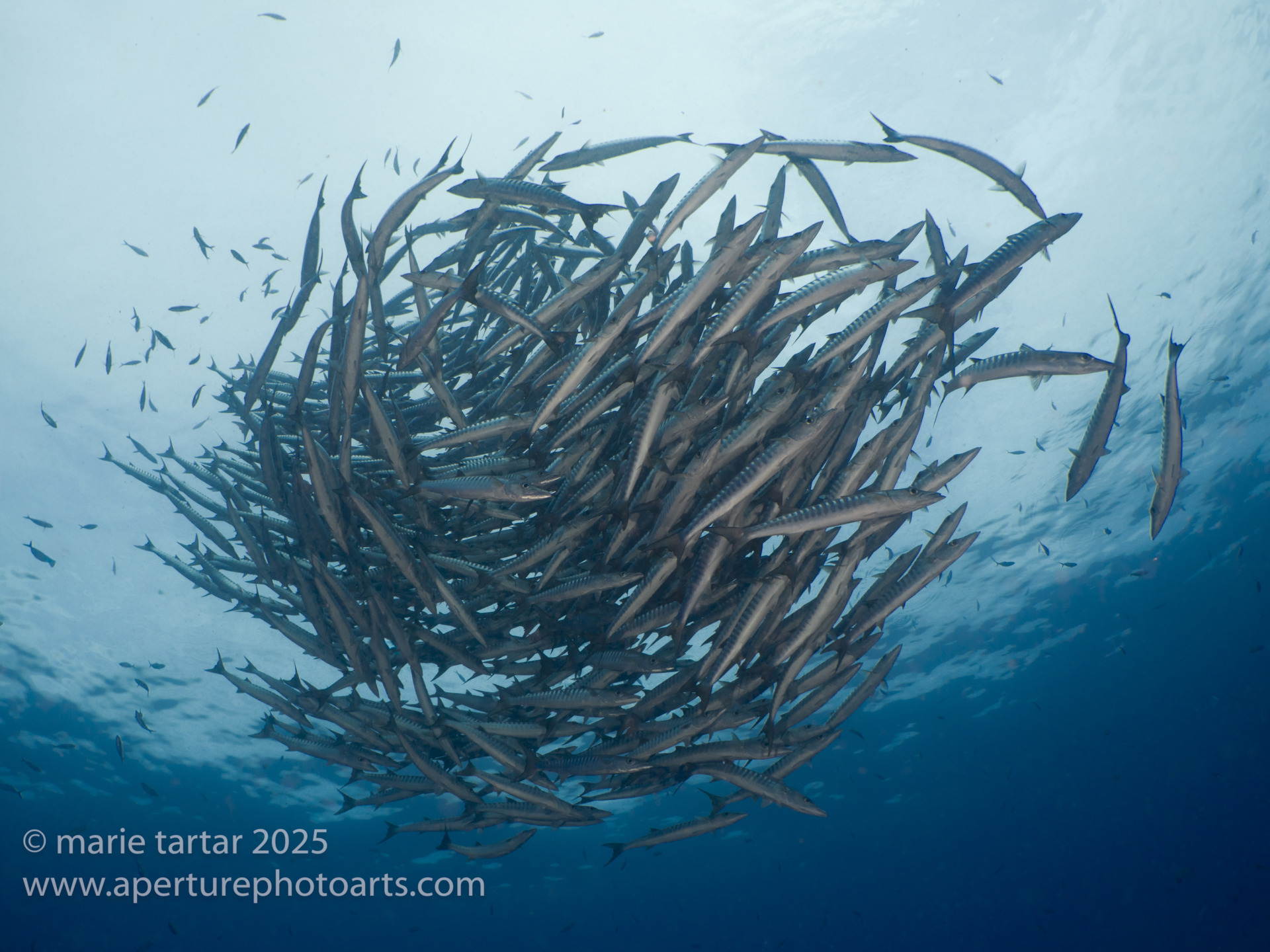
A barracuda ball, mesmerizing to watch as they swirl and spiral.
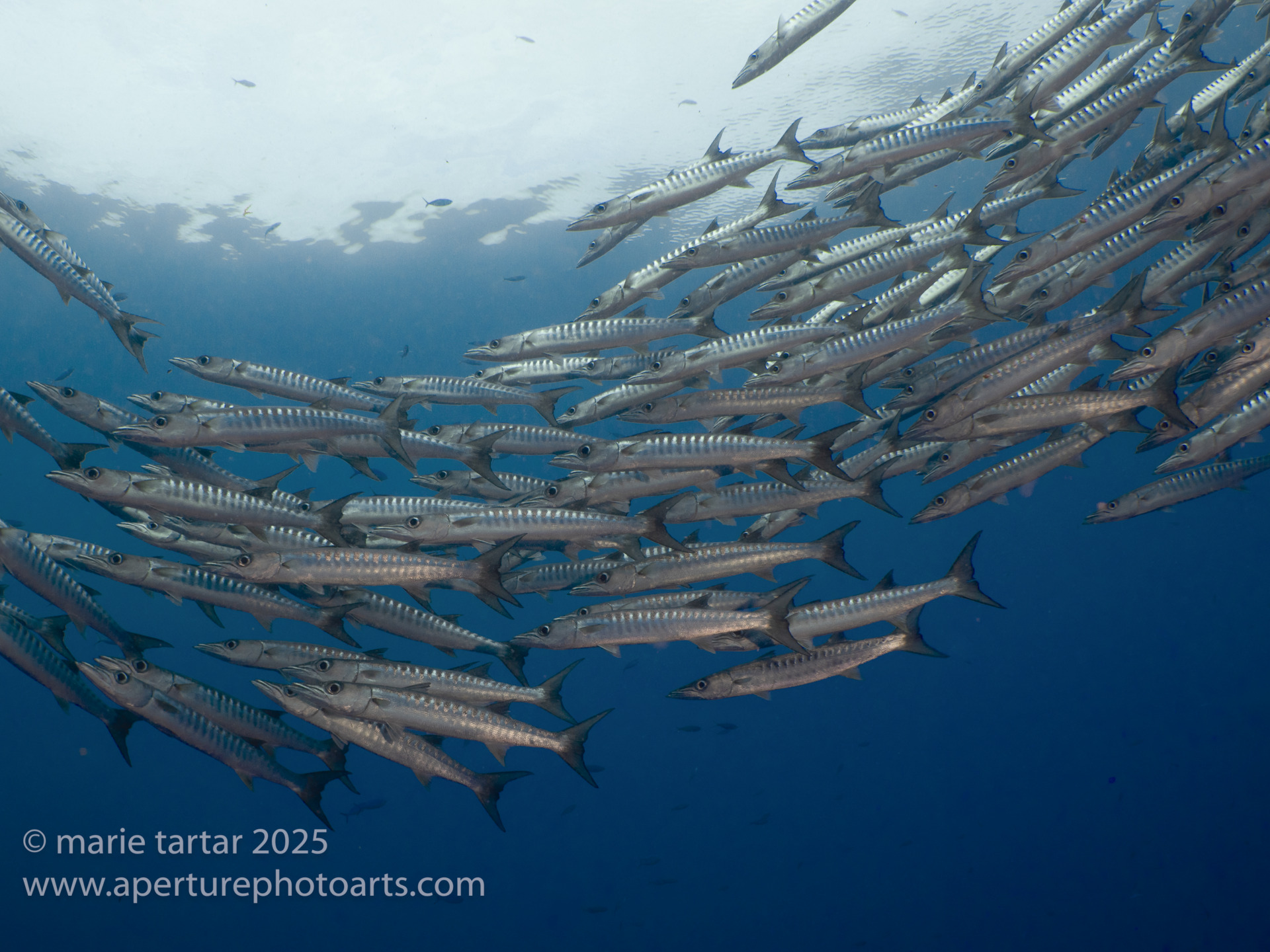
A curvilnear swoop of barracudas.
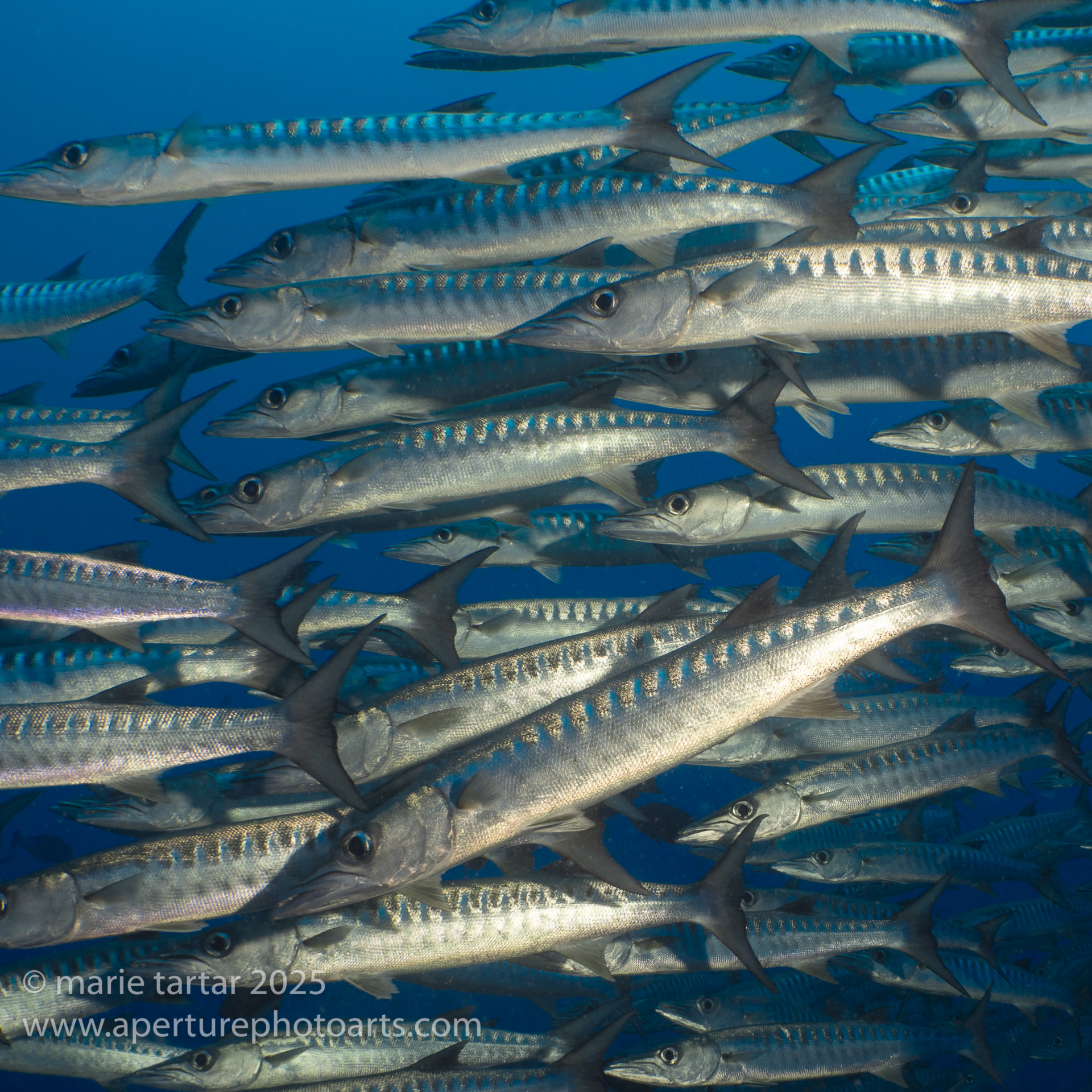
Barracudas close-up.
Batfish and jacks were schooling as well, but are not as readily approachable.
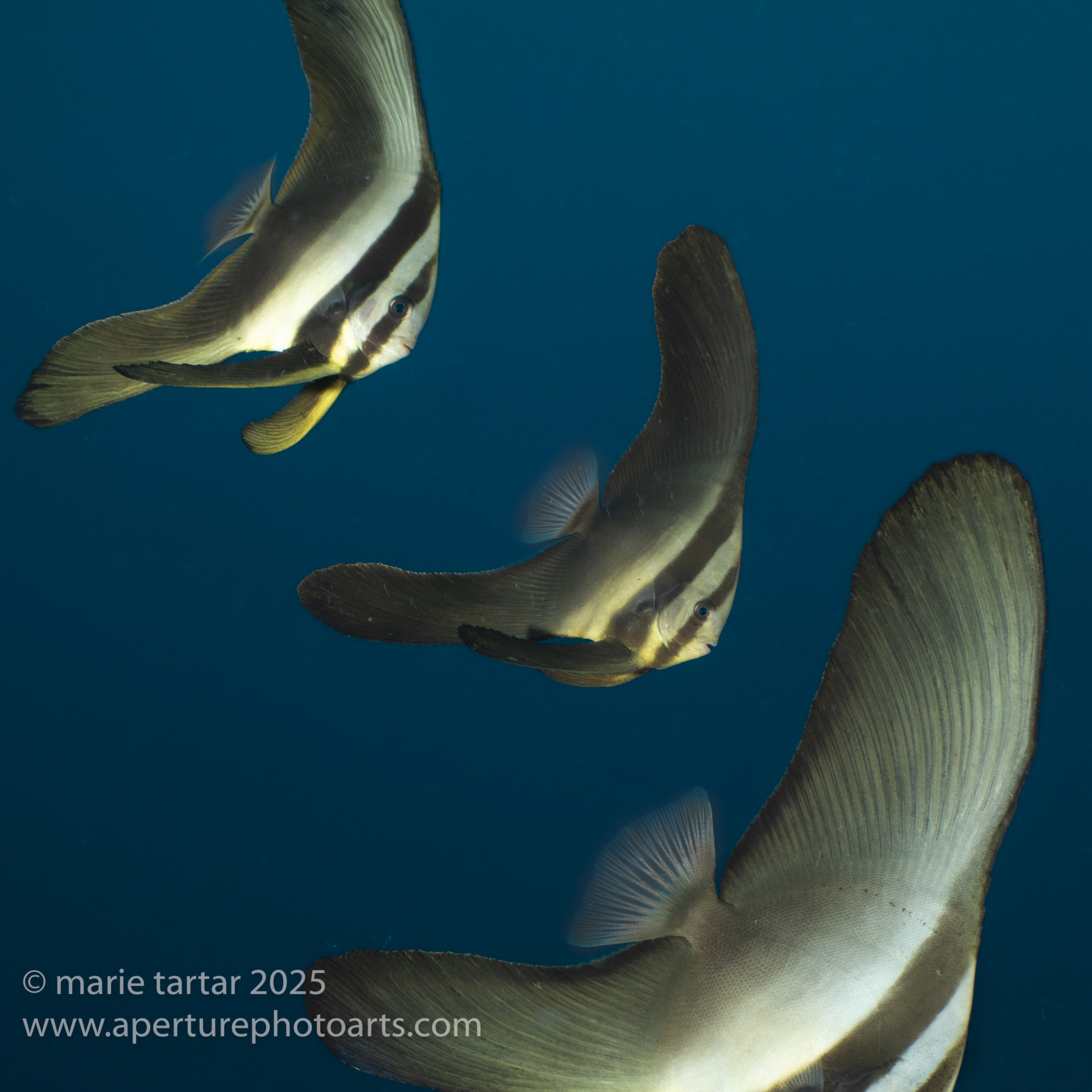
I guess if the Impressionists and Post-Impressionists were empowered by Japonisme (especially ukiyo-e woodblock prints) to include cut-off figures on the edges of their images, I can too (uncooperative batfish trio).
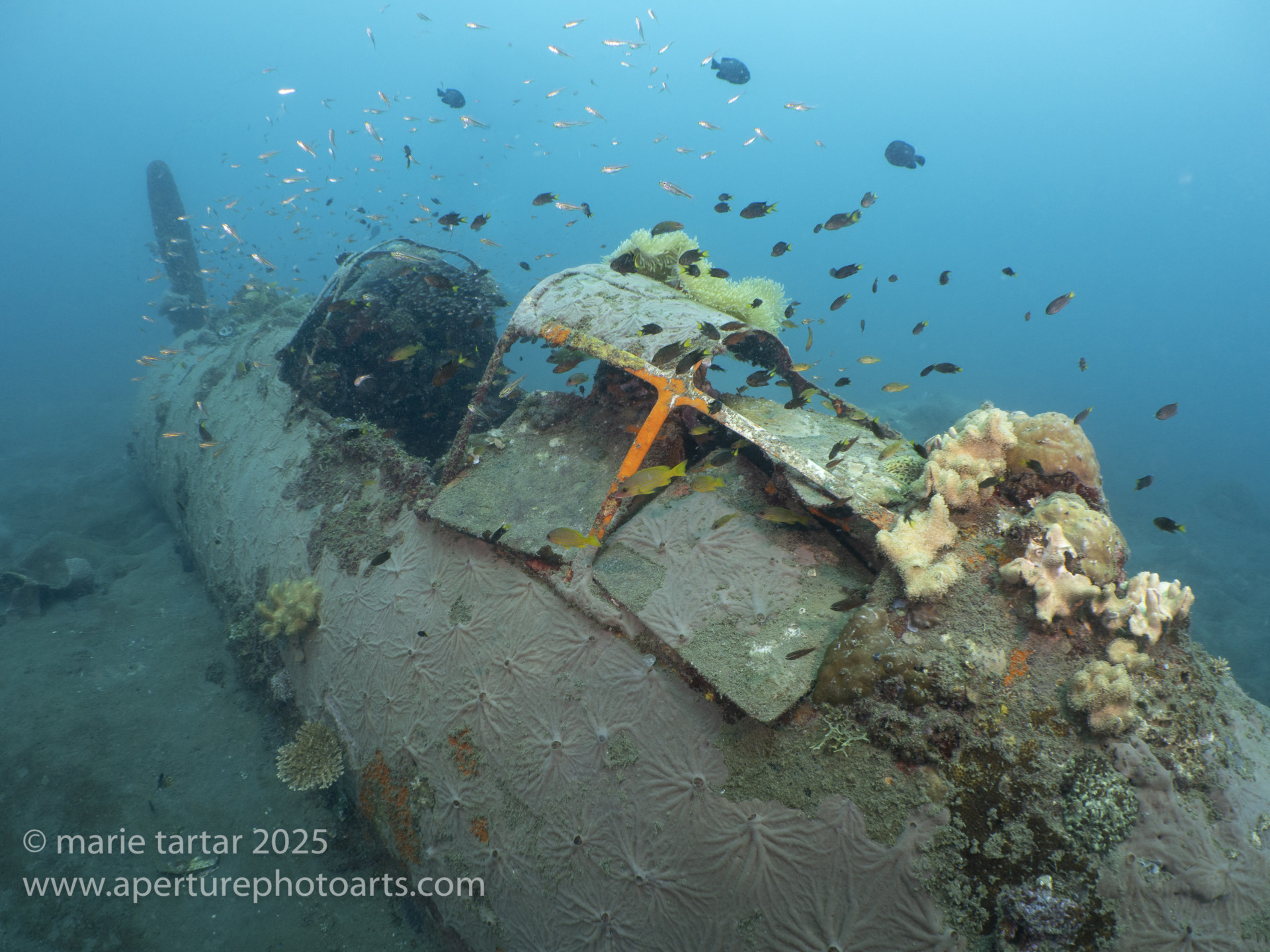
This Zero plane, with 80+ years of submersion, is upright, is in shallow water and from the throttle settings and position, it was inferred that it was intentionally ditched by the pilot, presumably lost and out of fuel.
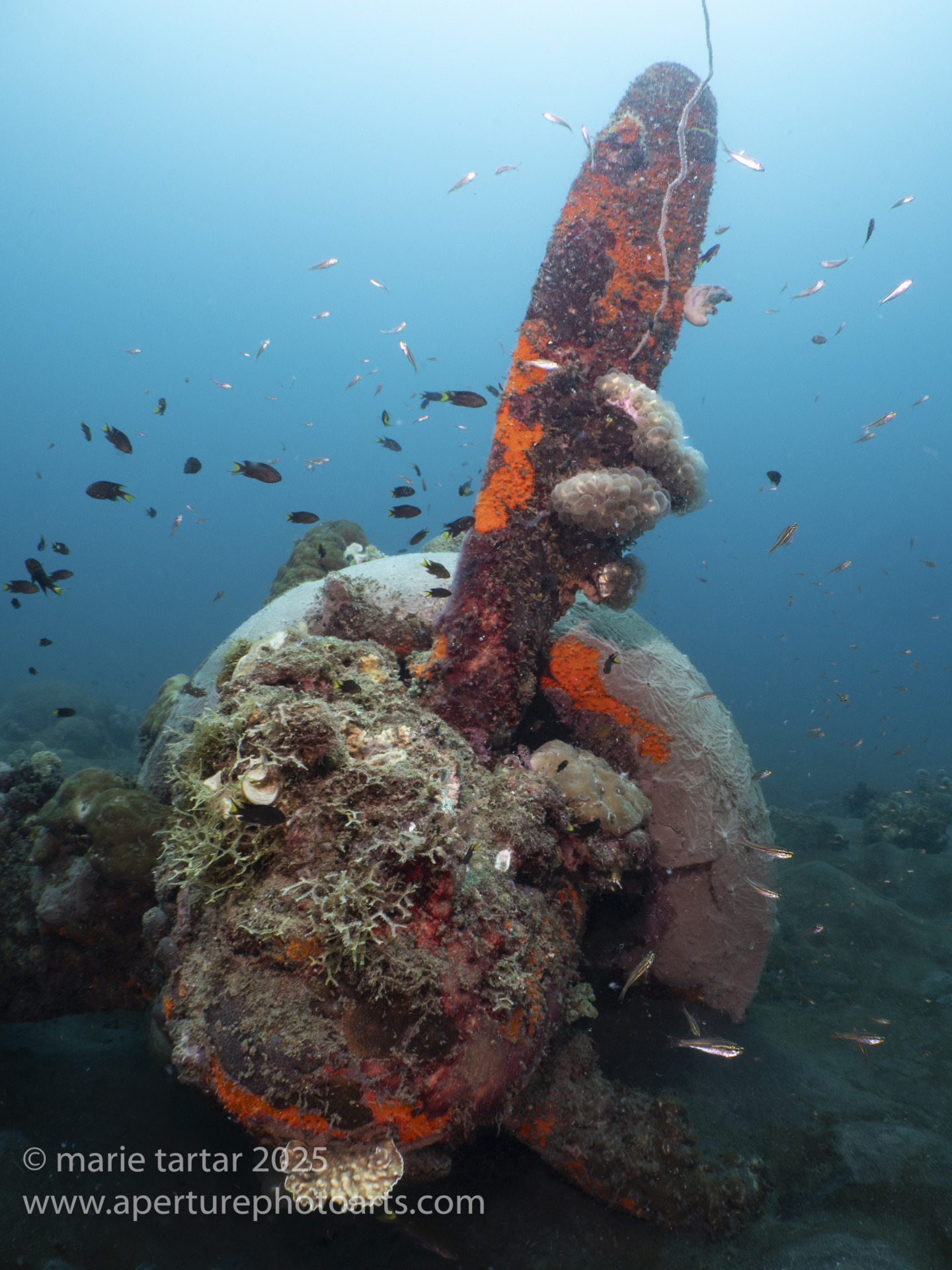
The Zero plane’s propeller is encrusted with sponges and other growth.
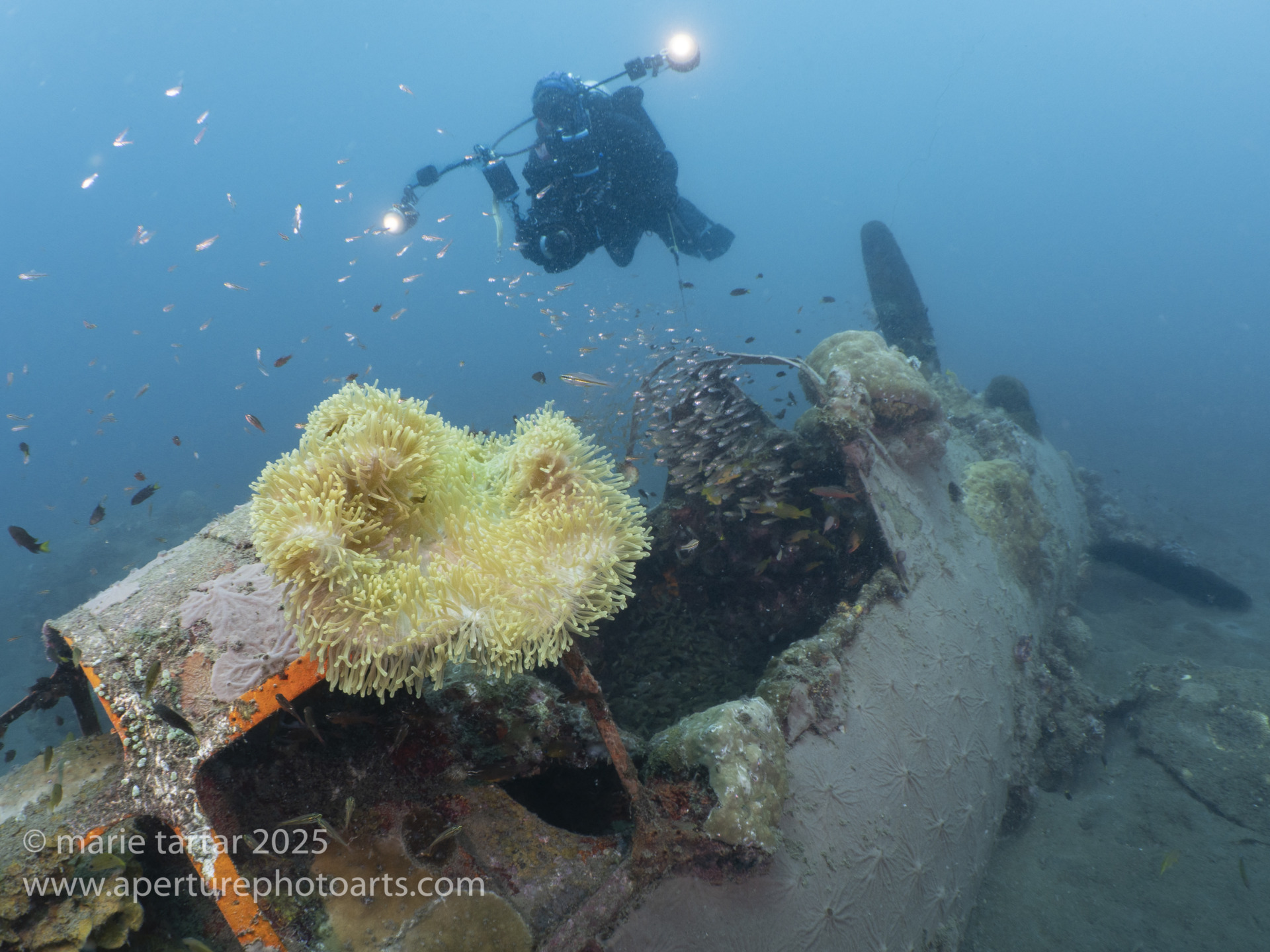
Greg hovers above the Zero plane’s cockpit, now filled with glassy sweepers and crowned with an anemone.
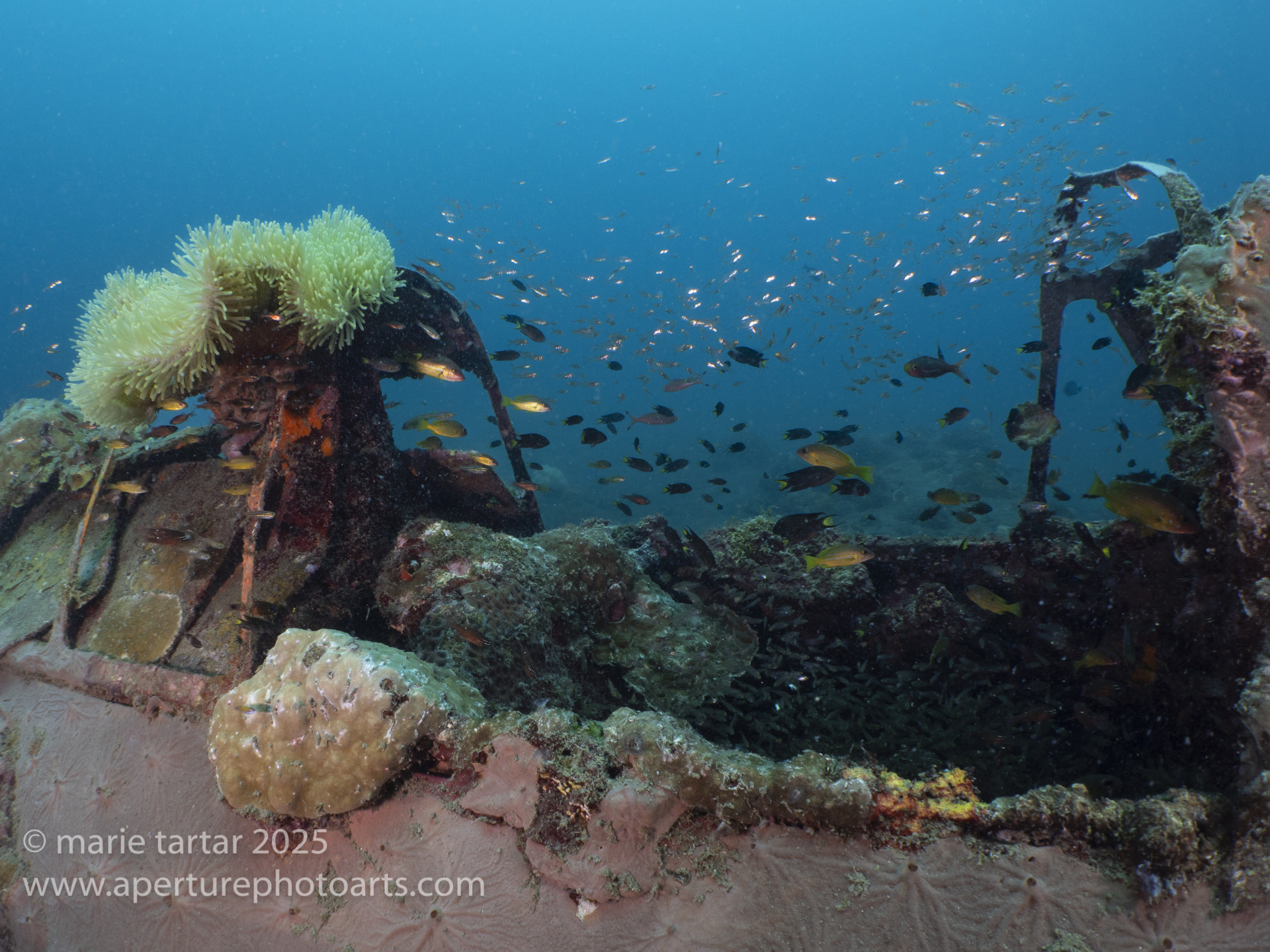
Another view of the Zero’s cockpit and its current inhabitants.
The visibility was milky. The plane was instantly recognizable by its shape. The cockpit was occupied by glassy sweepers and a pale anemone was jauntily perched on the rim of the cabin. This Zero was discovered by a free diver searching for sea cucumbers in 2000! It is upright and is believed to have been ditched by a pilot out of fuel. The name of the pilot is known (Tomiharu Honda) but not his ultimate fate. Using the still visible serial number and date, it was established that the plane went missing during the battle of Cape Gloucester on West New Britain on December 26, 1944.
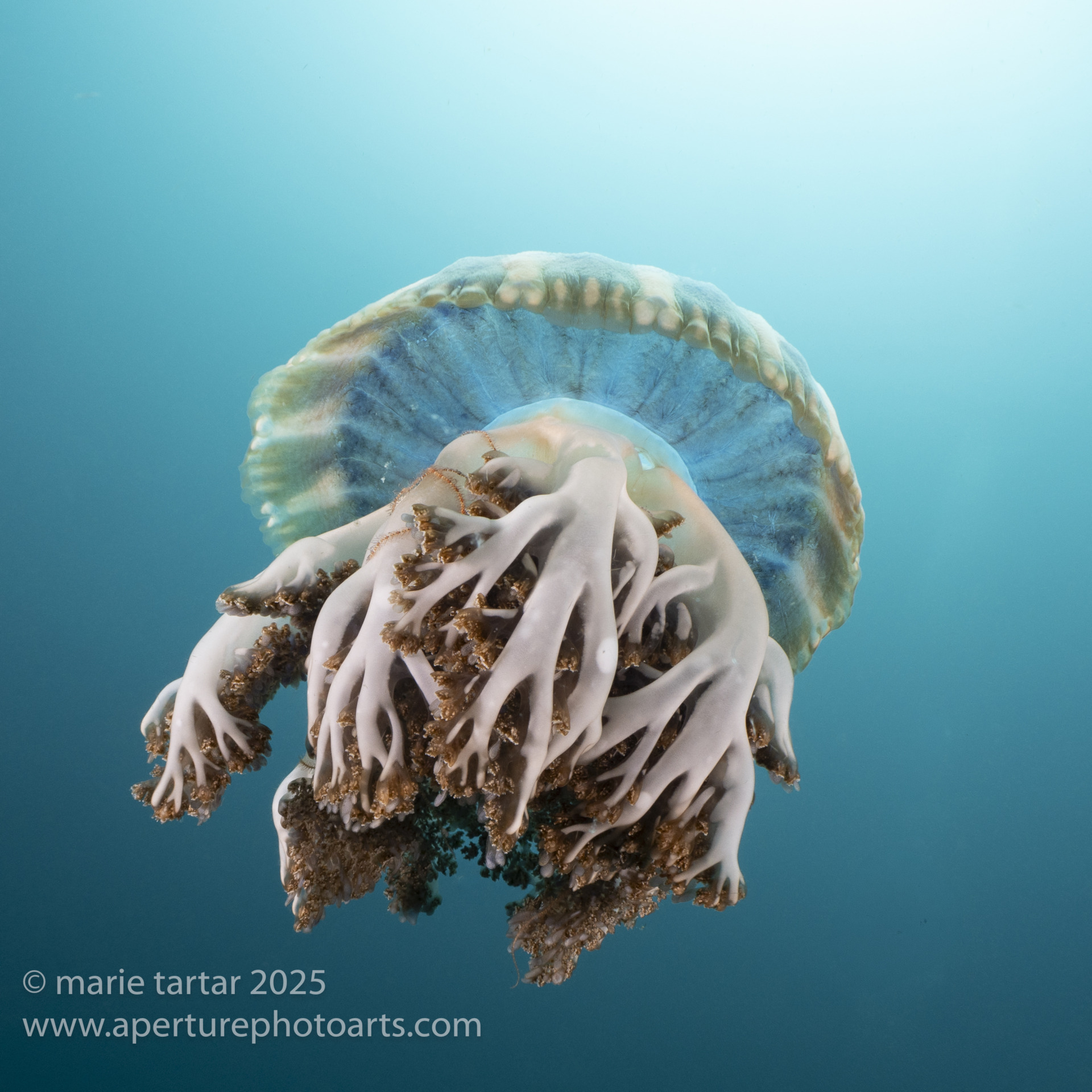
My last underwater subject for this trip-a jellyfish. Kimbe Bay, Papua New Guinea.
Robin and Gary were staying on at Walindi for another week so they had no worries in the afternoon, with no need to break down cameras or fret over drying out their wetsuits or SCUBA gear.
Back at Walinidi, Greg and I join a “casual” bird watching quartet from the Oceana’s next charter. We were taken in two vehicles on a rough, rocky dirt road through the cocopalm plantation to a ridge from which a stretch of verdant native forest could be seen. I quickly realized even my longest lens (560 mm equivalent) was insufficient for bird photography at this distance. We could see flying foxes (bats), hornbills, kites, parrots and cockatoos zipping in and out of the trees opposite us, especially once we employed the provided binoculars and peered through the spotting scope our guide set up. The sounds of the birds and insects was the best part of this relaxing outing.
As the light failed and the skies darkened, rain hastened our departure back to Walindi, where we still had to attend to settling our on-board charges and finish packing before the evening’s festivities began.
The local children, clad in grass skirts and abundant foliage, sang and danced for us. Cecily raises money for their school with donations given for these charming performances.
Our group assembled in the library for a group slideshow from the trip, followed by Bruce’s slideshow. We were all rather awed by the fact that he was done processing his images (admittedly, he seemed to spend most waking hours between dives working on them) and the breadth of subjects he captured that escaped our notice.
Thursday, October 2, 2025 (Day 17, Departure Day)
Our long journey home began today, VERY early, as we had to decamp from the boat at 4:30 am for the trip to the airport. Somehow, all of the myriad pieces of our photographic and diving retinue were maneuvered back into cases.
Steve and I were the last to check in at the airport. Eventually, after a lengthy calculation, we were informed that we were 12 kg overweight and owed 300 Kina (about $75 USD).
Susan sent us a high-quality video shot by a friend of Aaron’s of the funeral procession, featuring marching bagpipers in full regalia and uniformed officers standing at attention on Fifth Avenue. Watching it in the lounge in Port Moresby between flights brought the tears streaming again.
We had one fun final component to this trip. We overnighted in Brisbane again and had dinner with friends we met on our Japan winter trip, Lloyd and Angela. They met us at our hotel, the Hotel Brisbane Indigo City Center, which Lloyd could see from his downtown office. We walked to the nearby Pig ‘N’ Whistle, which had eluded us on our trip in.
How to summarize this trip? I managed 25 dives. The diving was good, albeit a mixed bag, with Captain Dan covering long distances to show us the best of Kimbe Bay and the Bismarck Sea, although the effects of coral bleaching were abundantly evident. It was colorful and memorable, tinged with sorrow for us, unforgettable for a myriad of reasons.
-Marie
Wow Marie; you did it again! Managed to bring this epic trip right back to life with your amazing memory and unforgettable images! Thank you for the loving care you always put into these incredibly detailed trip reports. It reminds me that despite the distance and wonky logistics, I really do want to return to dive here again.
Hi Barb, It was a long haul, but a lot to see, for sure!
-Marie