

Sunday, April 12, 2026
After trying (and failing) to see and photograph leafy sea dragons in South Australia, we had more success diving in Tasmania, with weedy sea dragons in colder and clearer water.
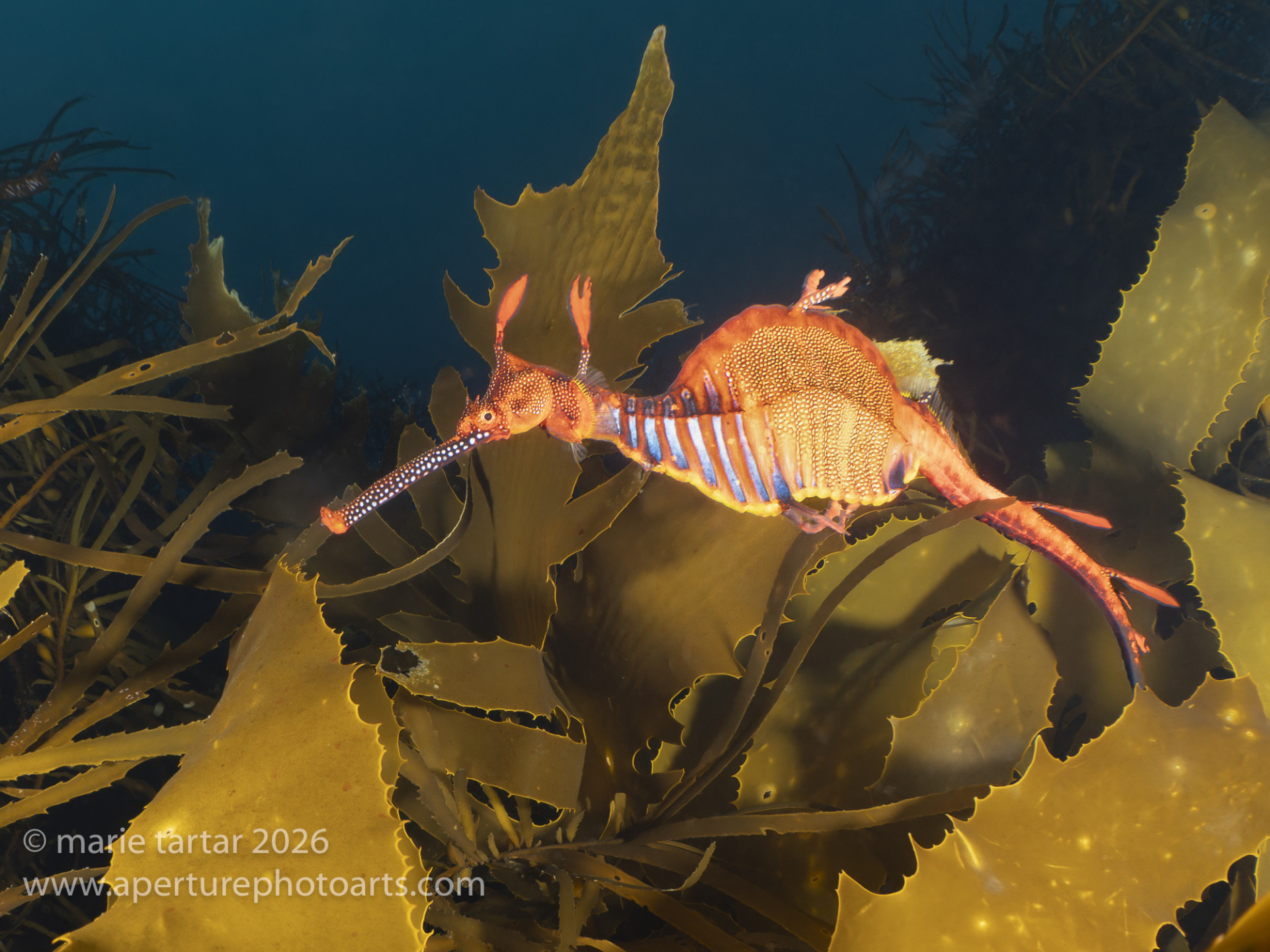
Female weedy sea dragon in cold Tasmanian water hovers over kelp bed.
We now had three days scheduled with Blue Green Expeditions to see more of Hobart and environs, after which Steve, Greg and I would do a quick jaunt to Cradle Mountain to check it out.
Maria Island was the plan for today but the weather looked unpleasantly cold for a hike, so we pivoted and stayed in Hobart, exploring the free museums in easy walking distance from the Old Woolstore Hotel.
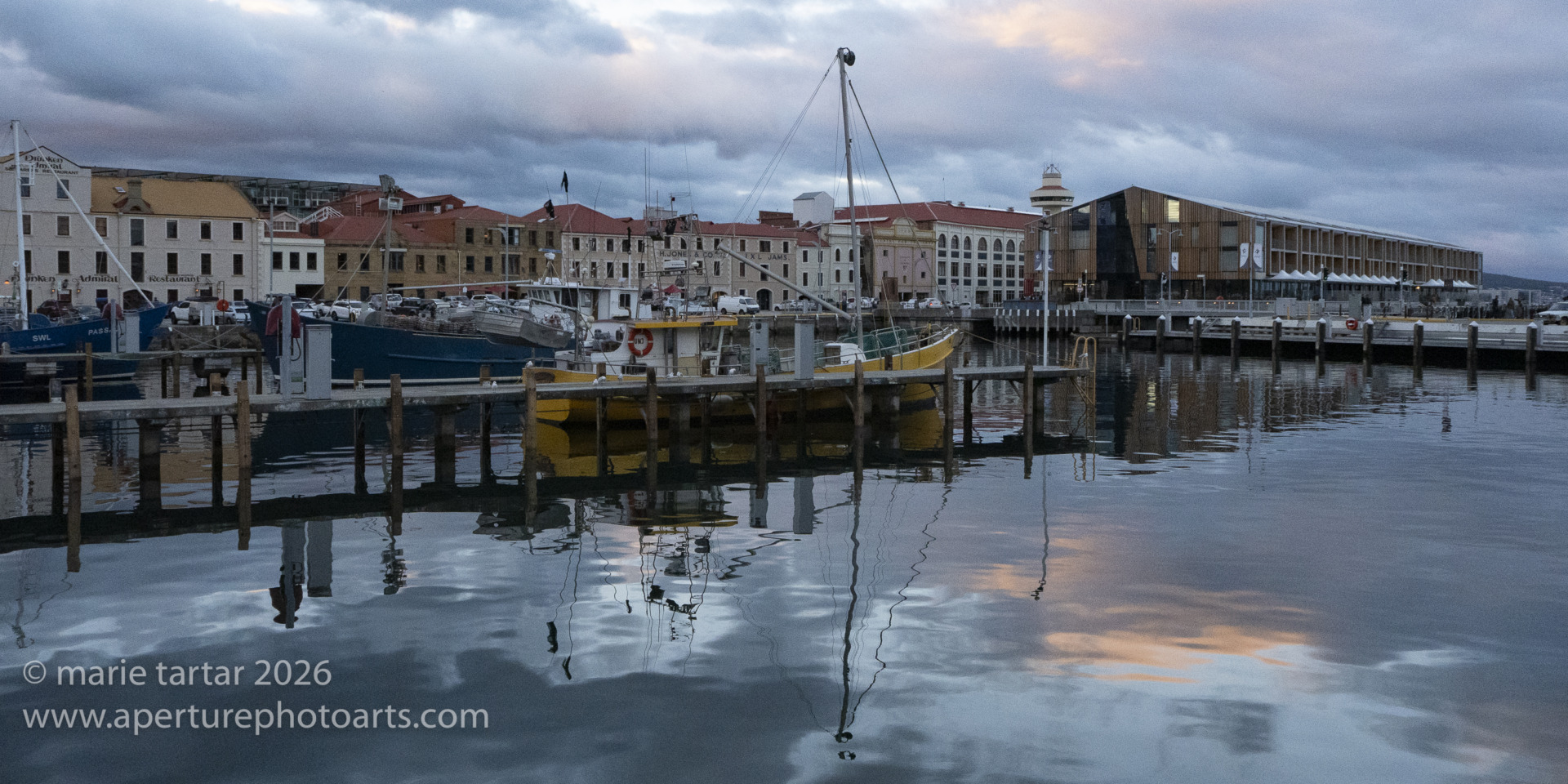
Hobart’s attractive waterfront has many good restaurants, not to mention good ice cream and coffee.
The Maritime Museum proved to be surprisingly interesting. At the Deep Glen dive site where we found weedy sea dragons, Mick had mentioned there was a plaque commemorating the survivors of the wreck of MV Blythe Star. We learned more about this maritime disaster from a volunteer at the museum. In October 1973, the vessel was heading from Hobart to King Island when it listed and capsized within 10 minutes on a calm sea near the southwest coast of Tasmania. The 10 crew members managed to escape in an inflatable life raft but were unable to send an SOS signal. The crew drifted in the unforgiving, cold Southern Ocean for 8 days before making landfall at Deep Glen Bay, where we had been diving. Three members of the crew died as a consequence of the ordeal. The vessel’s intended route was not known to the authorities, so the search, the largest air and sea search in Australian history, was misguided and called off prematurely. Reforms were subsequently implemented to Australian maritime laws, including the mandatory installation of Emergency Position Indicating Radio Beacons (EPIRBs) and the creation of the AusREP ship-tracking system.
The Tasmanian Museum and Art Gallery occupied the rest of the morning. It is quite large, and like many of the historic buildings in Tassie, was built with convict labor. It functions as a history, natural history and art museum. Connie and Dave spent most of their time in the portion devoted to the effects of English colonization on the Aboriginal population and the history of “transportation”, as the English practice of shipping convicts to prison in far-off lands was called. The American Revolution in 1776 meant the British could no longer decompress their overcrowded prisons by shipping the convicted off to America. Convict colonies were thereafter established in Australia and, in 1803, in Tasmania (then called Van Diemen’s Land). Over the next 50 years, some 40% or an estimated 76,000 convicts were sent to Tasmania.
The art gallery portion was quite interesting, with paintings documenting the colonial era through to beautiful contemporary ceramics.
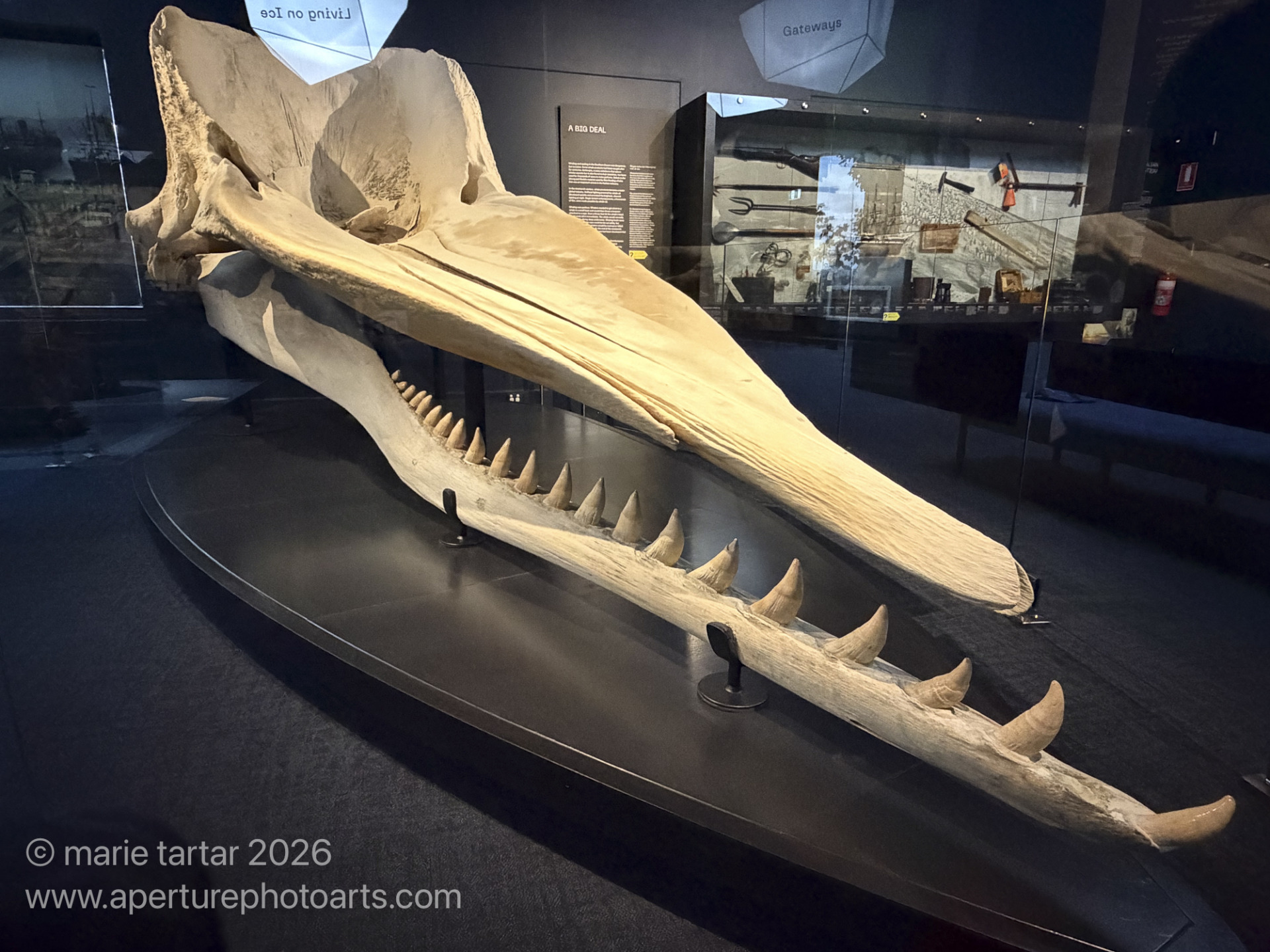
A sperm whale jawbone at the Tasmanian Museum and Art Gallery. Tasmania’s eastern coast was a major whaling corridor in the 1800s and our hotel, called the Old Woolstore for a later incarnation, was once a whale processing station.
An entire gallery documented the fate of the thylacine, a striped carnivorous marsupial also known as the Tasmanian tiger, that went extinct in 1936 when the last known animal died in the Hobart Zoo. Sadly, official protection of the species by the Tasmanian government came much too late, 59 days later. Amazingly, the remains of the Endling (the last known example) at the Tasmanian Museum and Art Gallery were only rediscovered in 2022! Although extinct, the thylacine is central to Tasmanian identity and figures prominently in the Tasmanian coat of arms.
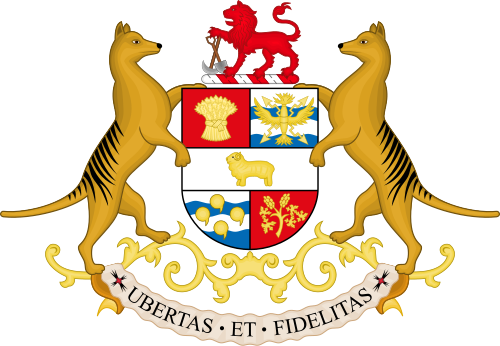
Tasmanian coat of arms features two striped thylacines, presumed extinct since the 1930s.
Willem Dafoe stars in a 2011 film we watched recently (set and filmed in Tasmania) called The Hunter as a mercenary charged with finding a thylacine for a shady military corporation that thinks DNA from a thylacine will enable them to make a paralyzing neurotoxin from its bite (from what I can discern from available information, this is pure fiction).
For lunch, we returned to Jam Packed for their excellent Reubens and orange-and-almond cake. I found a couple of excellent souvenirs at an Aboriginal art gallery in the same complex: portable, lightweight, flat and beautiful pillow coverings embroidered in wool using Kashmiri chain-stitch technique with graphic Aboriginal designs. One by Willie Ngungutjara Wilson depicts a creation story, with two wati-men sitting on either side of a central rockhole.

Willie Ngungutjara Wilson design depicts a creation story, with two wati-men (Aboriginal man or a male spirit/creator in various Indigenous Australian languages and mythologies) sitting on either side of a central rockhole.
The other is by Nina Puruntatameri and shows the rising moon. The gallerist mentioned of this one: “I sold the painting with this design.”

Aboriginal artist Nina Puruntatameri design featuring the moon, based on her painting, executed in wool using Kashmiri chain-stitch technique. (uh, is my love of textiles showing?)
We had a group dinner at Mures Upper Deck. Steve, Greg and I shared a Langmeil Three Gardens Viognier Marsanne Rousanne, accompanying roast potatoes, green beans, oysters, chowder for Steve,a scallop entrée and salad for me, and Greg’s blue-eyed trevalla.
Monday, April 13, 2026
Hobart is home to an unusual and very interesting private art museum, MONA (the Museum of Old and New Art). We spent the entire day there and for us contemporary art and architectural aficionados, it was a real highlight. MONA opened in 2011 and effectively put Hobart and Tasmania on the international art map, with a huge surge in international tourism attributed to the “MONA effect”.
Even the ferry, which we caught at 10:15 am, is a trip, with sheep stools, a black sheep affixed to the ceiling, an artfully graffitied stairway. There was a Posh Pit which enabled earlier entry and a front seating area.
For the able-bodied, 99 steps lead up to the entry. The museum houses the idiosyncratic private collection of David Walsh, described as a professional gambler. Evidently, he is quite a successful one as the architecture of MONA, which burrows down three stories into a sandstone cliff, is out of this world.
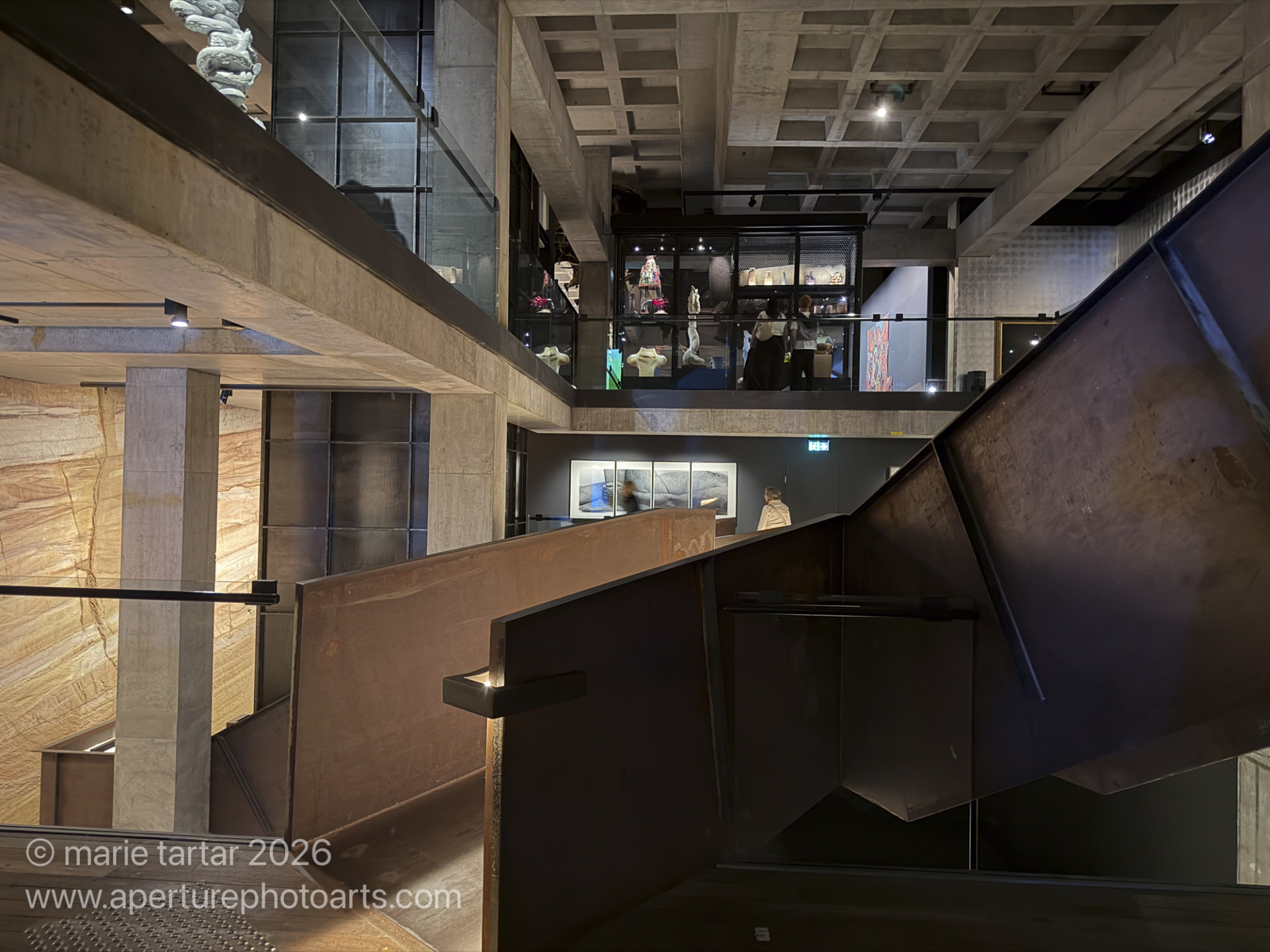
At MONA, steel staircases and ramps burrow down 3 stories into sandstone.
Nonda Katsalidis is the architect. The sandstone is exposed and juxtaposed with extensive rusted steel and glass. The lighting is precise and carefully optimized to each artwork.
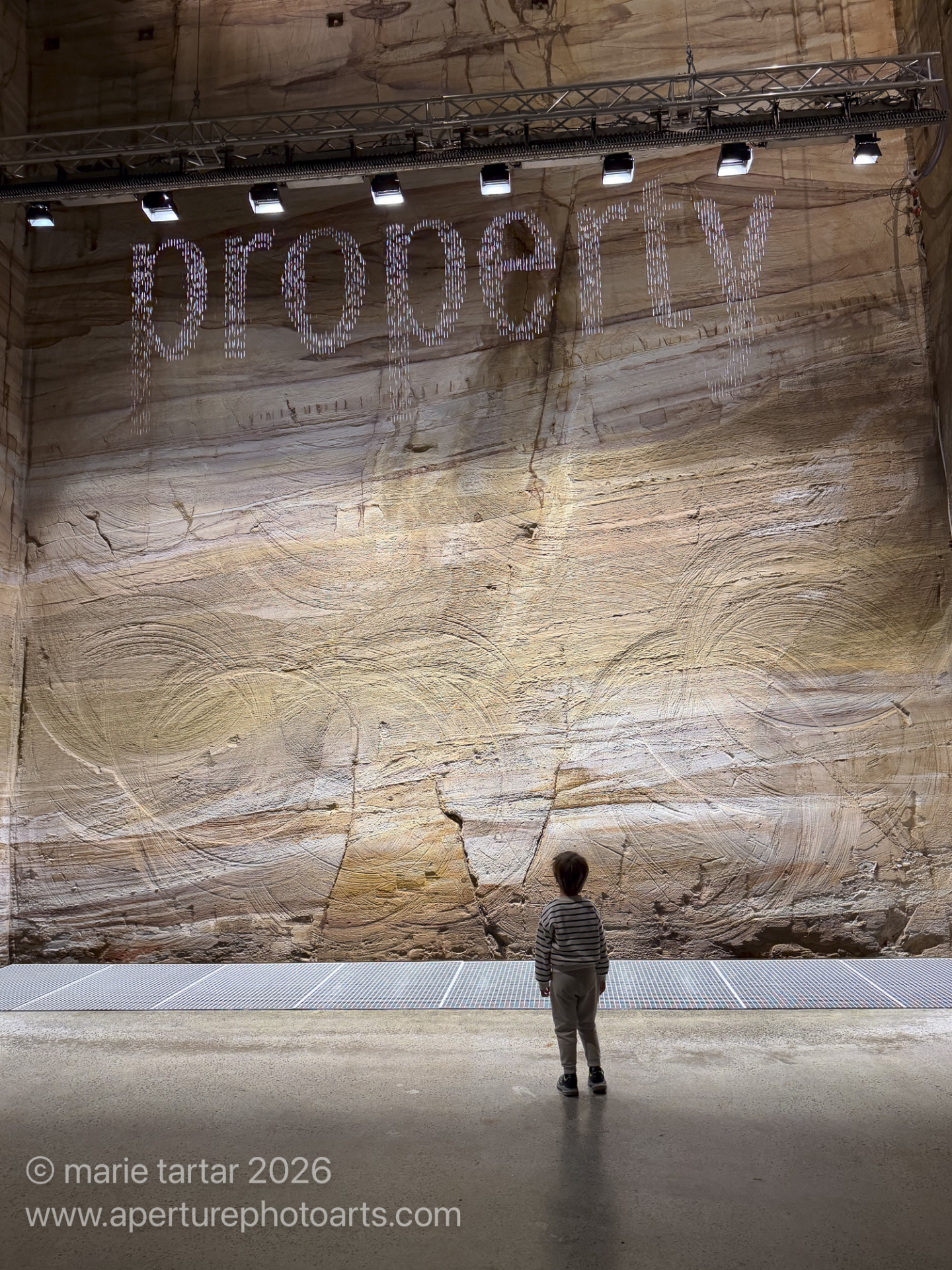
A truly astounding waterfall of words installation at MONA entitled Bit.Fall by Julius Popp. Drops of “rain” forming words drawn from trending news sources appear continuously. This little boy was quite entranced, as were we.
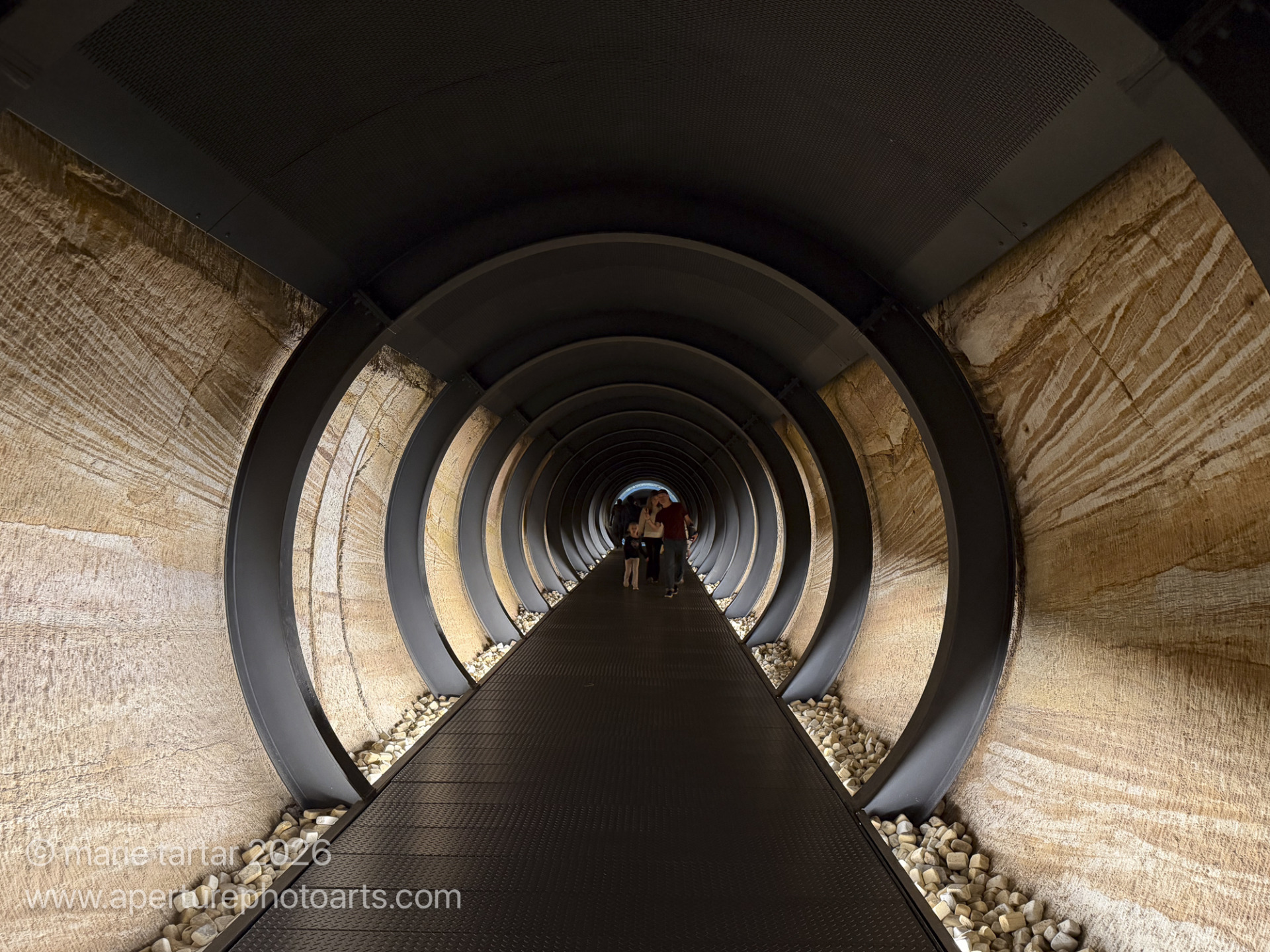
Getting from one part of MONA to another is part of the architectural adventure.
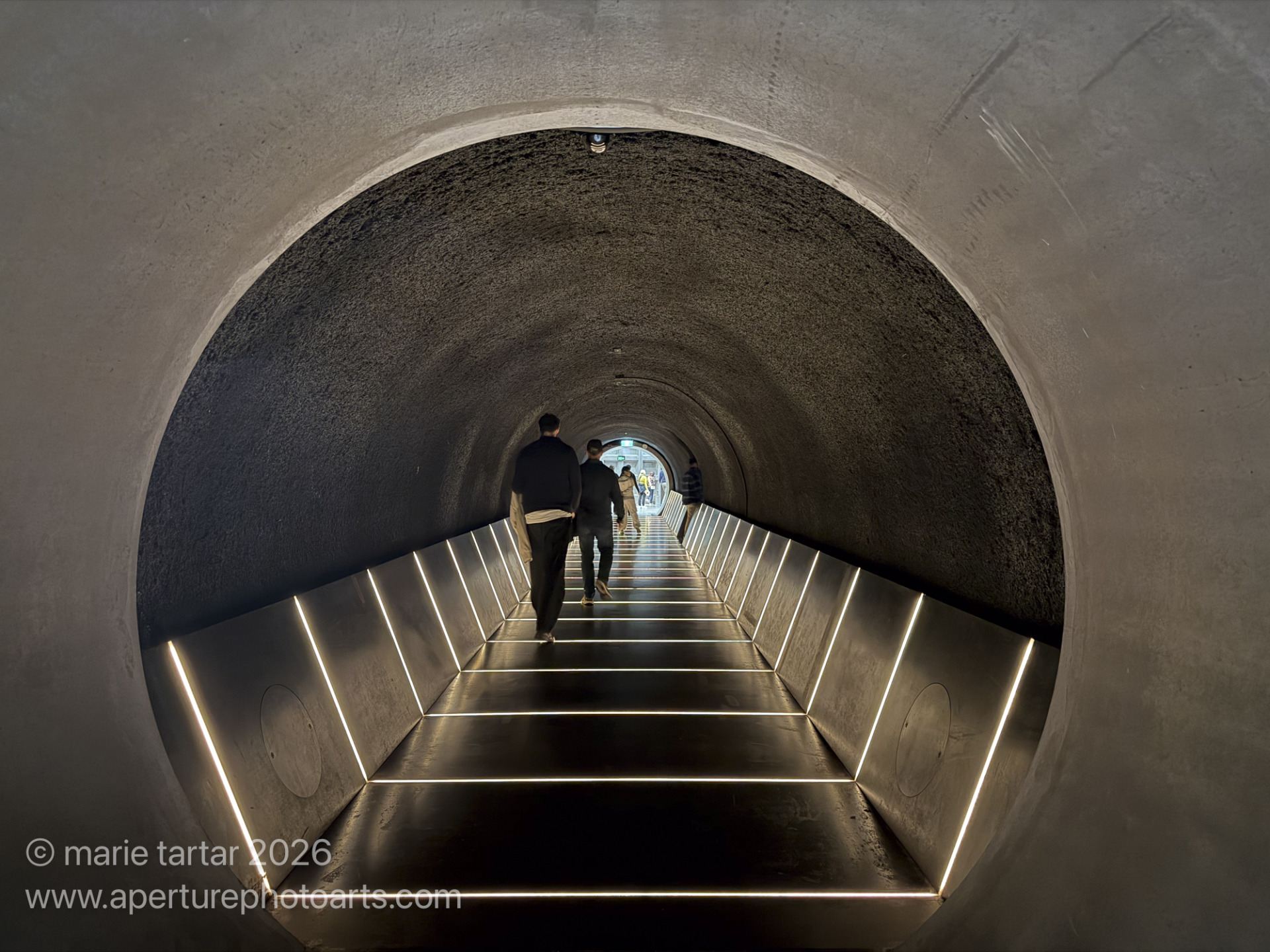
Another enticing tunnel leading elsewhere, at MONA, Tasmania.
One distinguishing feature of MONA is the absence of any labels on artworks. Visitors are instructed to download the “O” app on their phones. As one moves from room to room, the app updates to display pictures of nearby artworks. Clicking on one links to information on the work and the artist. Some of the commentary is by the owner and reflects his assertion on the webpage that MONA is both his “playground and megaphone”.
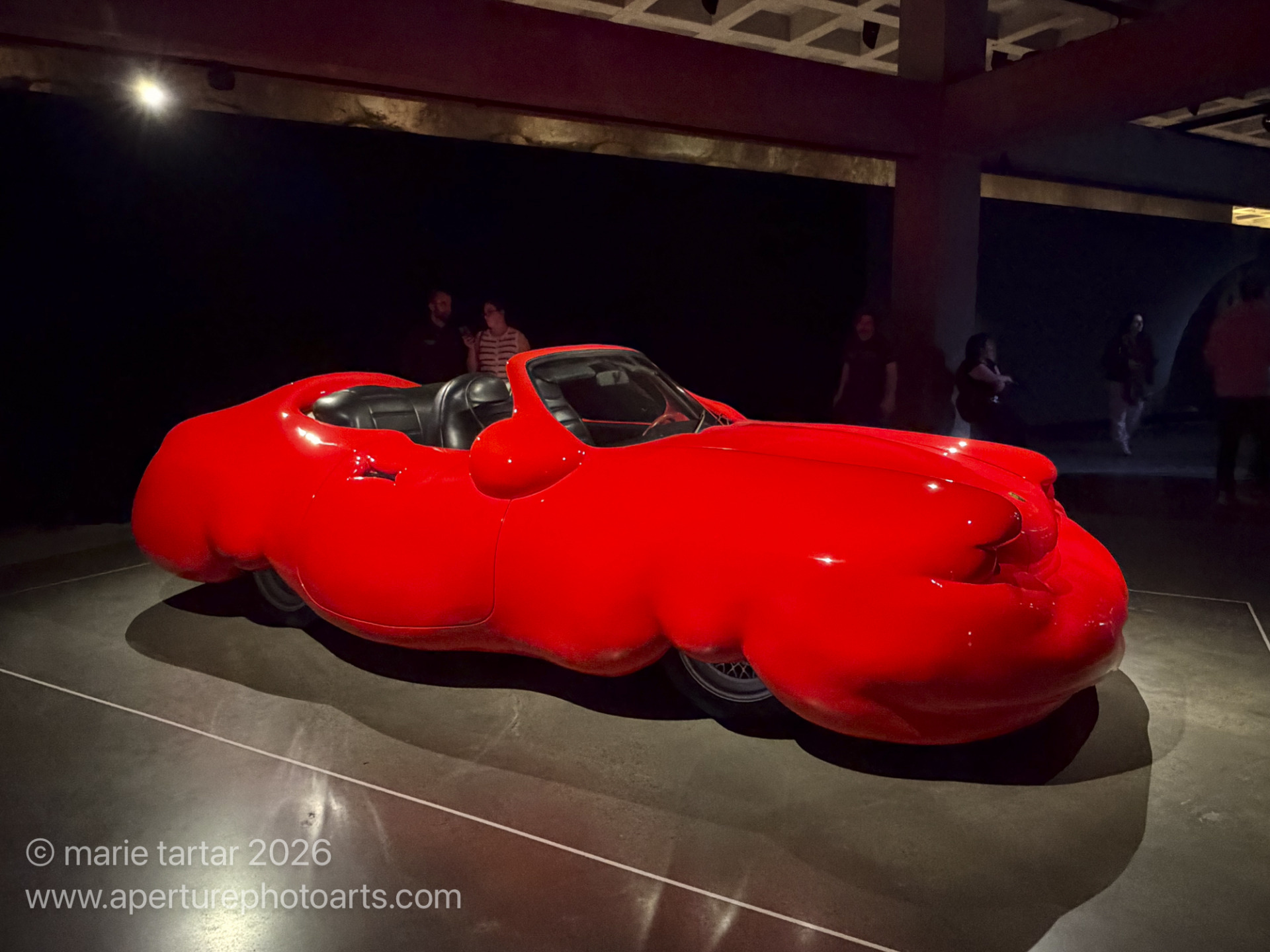
Here’s the ultimate fat cat vehicle, called Fat Car, a bloated, fire-engine-red Ferrari at MONA, a pointed commentary on commercialism and excess. It is the work of Austrian sculptor Erwin Wurm.
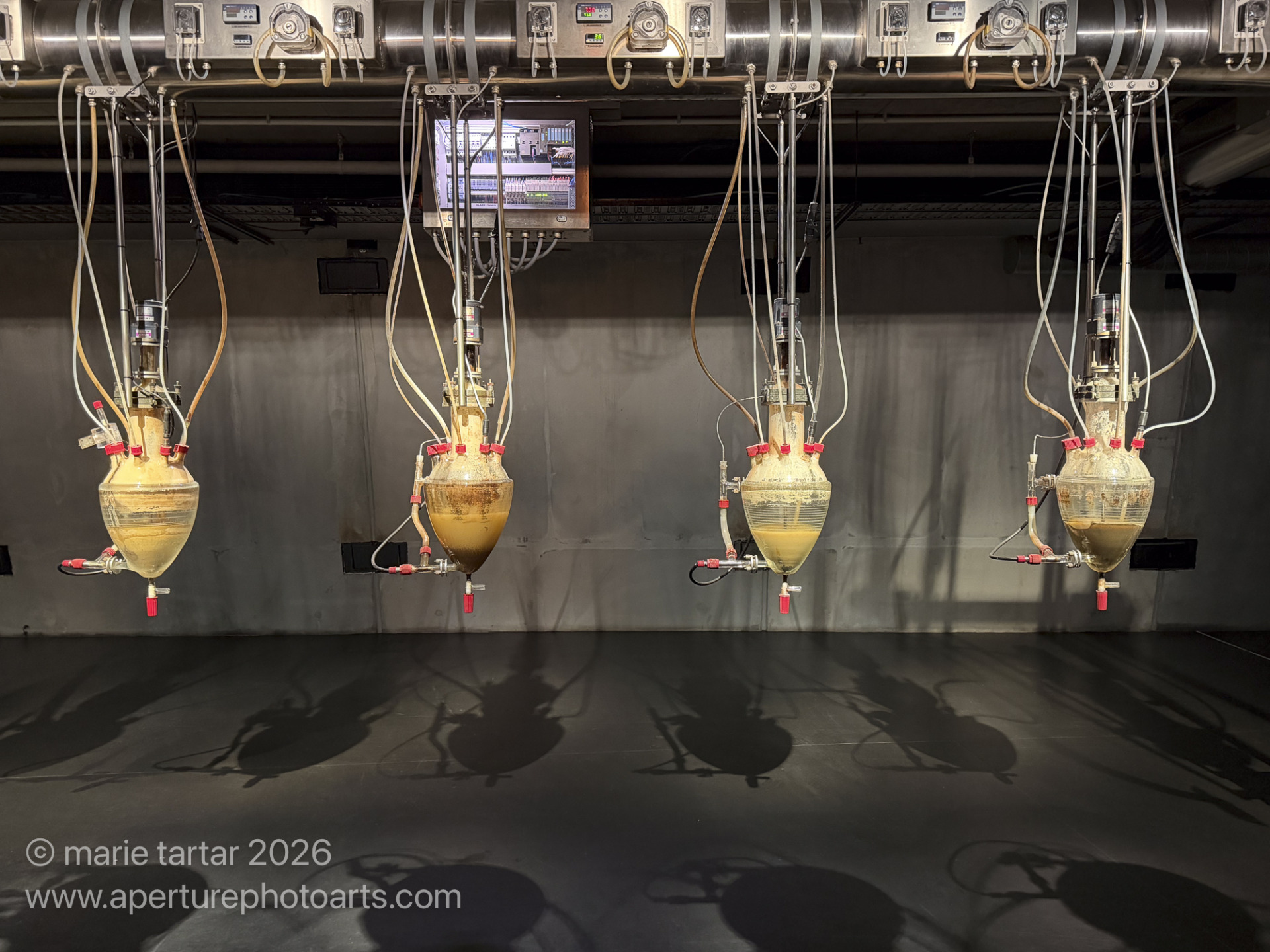
Another famous (infamous) work on display at MONA is entitled Cloaca Professional and is by Wim Delvoye. It replicates the work of the human digestive system, including a daily poop. We elected to attend to our own digestive systems by going to a late lunch instead of returning for the daily afternoon event.
We spent a lot of time in a large prison-cell installation by the artist Anselm Kiefer, who consistently fascinates us, called Elektra. Kiefer is German and was born at the end of World War II. His prodigious body of work engages with Germany’s Nazi history and memory, how the past shapes the present.
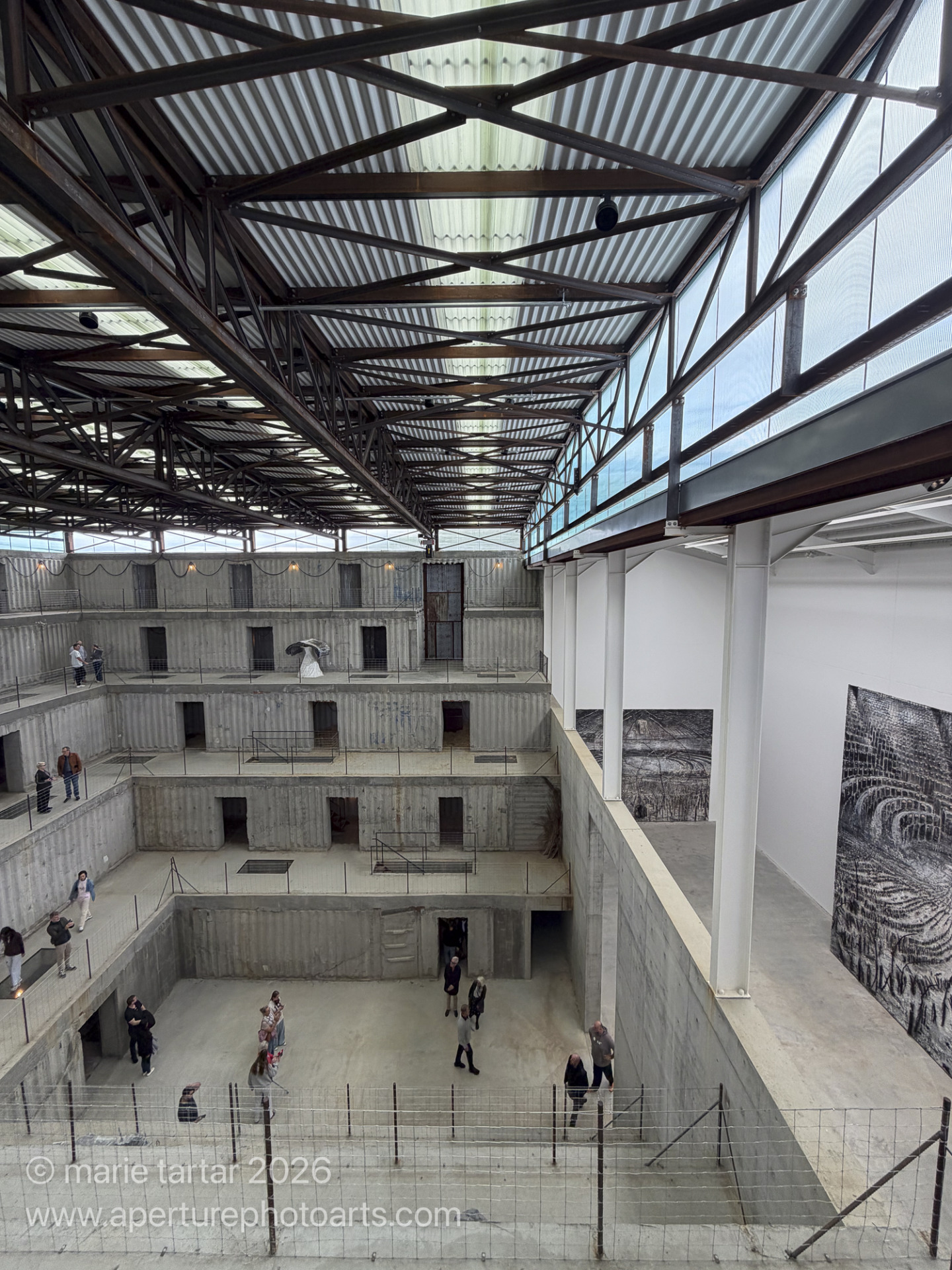
Apparently, David Walsh had an epiphany after seeing Kiefer’s La Ribaute, near Barjac, France. Elektra required 4 years of construction and just opened in December 2025, so in this regard, our timing to finally visit Tassie was good!
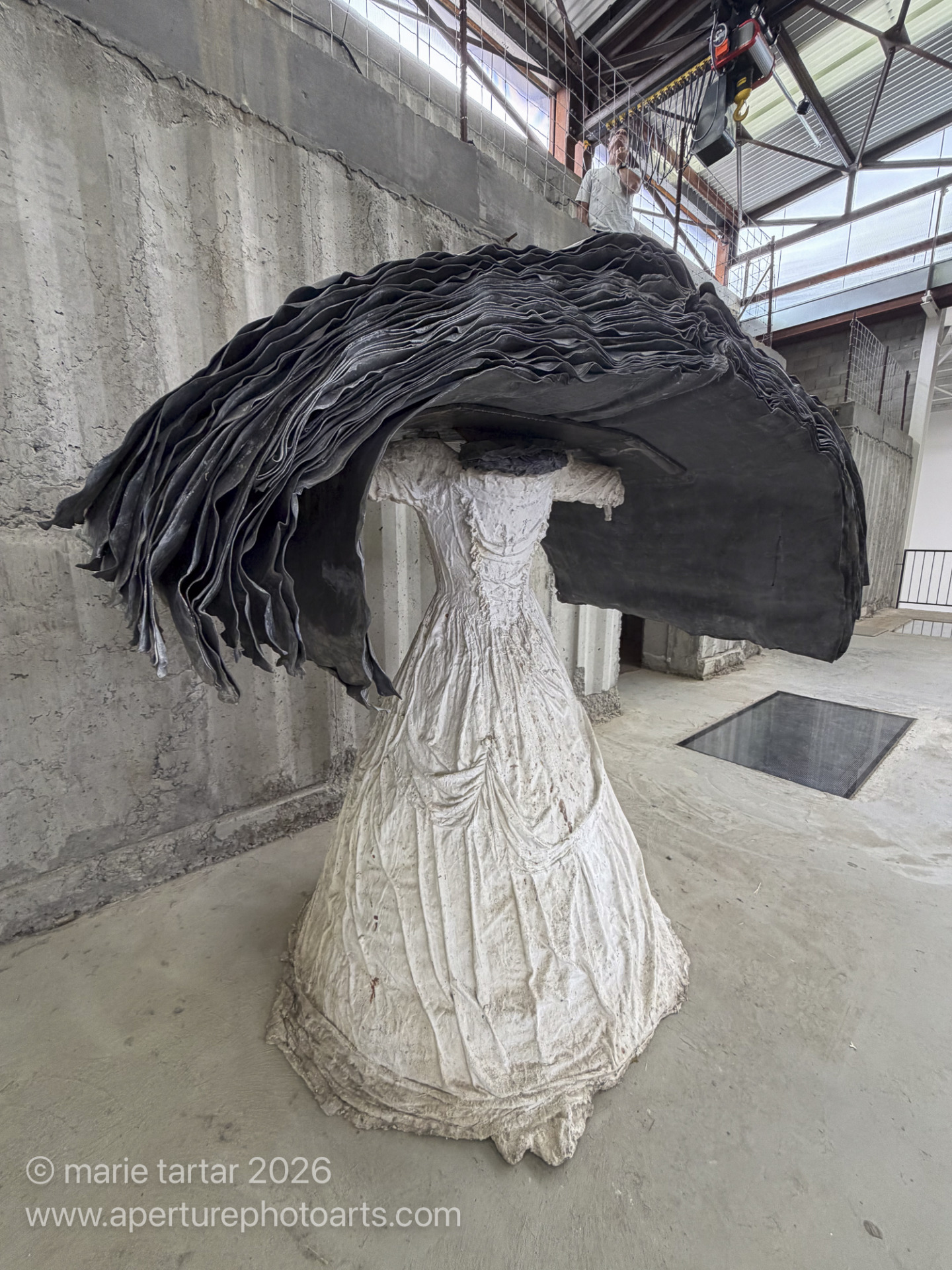
Female figures and lead book pages are familiar Kiefer motifs. His work engages with loss and collective memory, destruction and desolation.
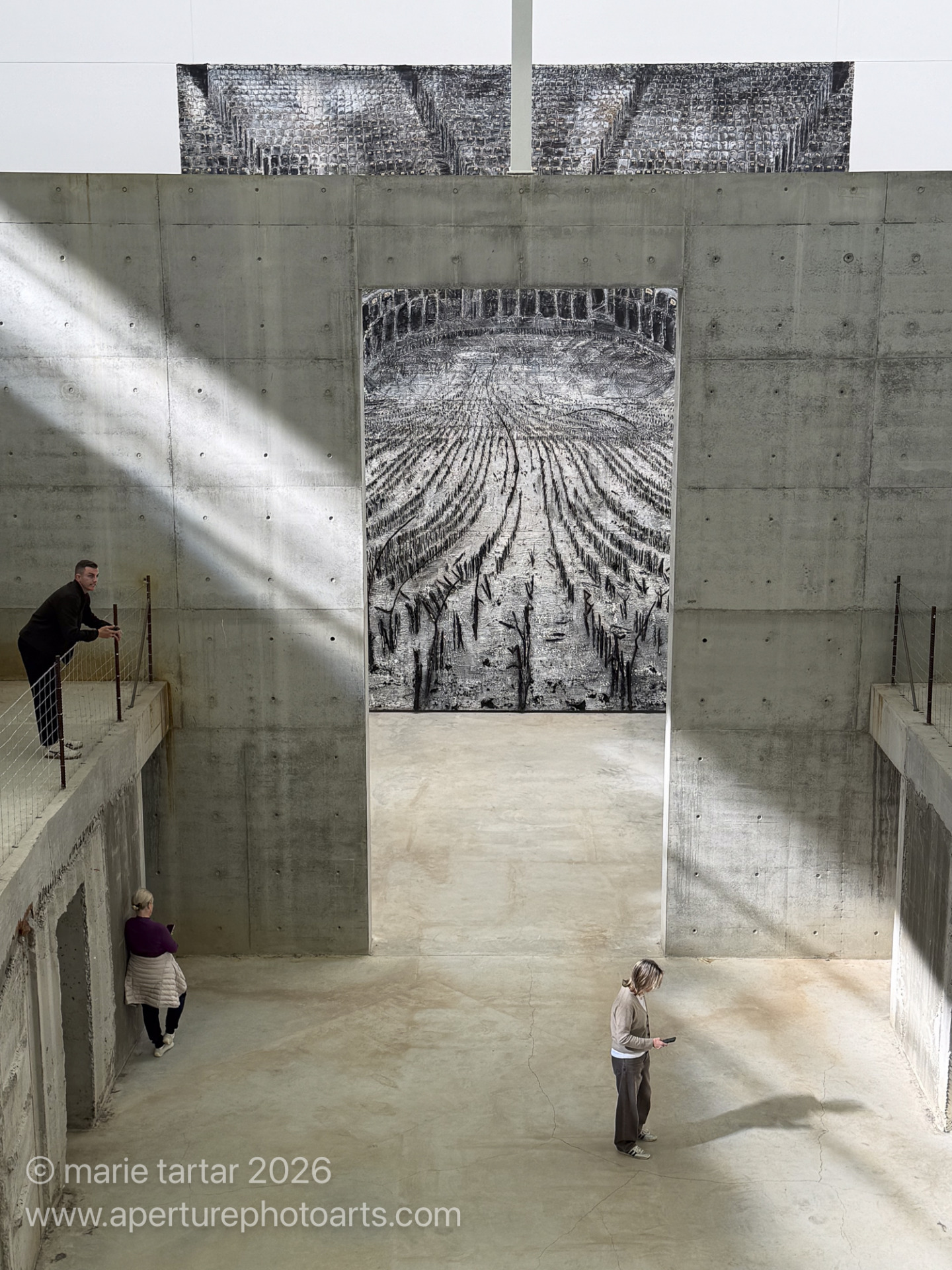
The scale of Electra is evident, with enormous paintings with rough textural surfaces.
There are multiple dining and drinking venues, as the museum is on the grounds of the Morilla Winery. Steve, Greg and I had a late lunch at the Faro.
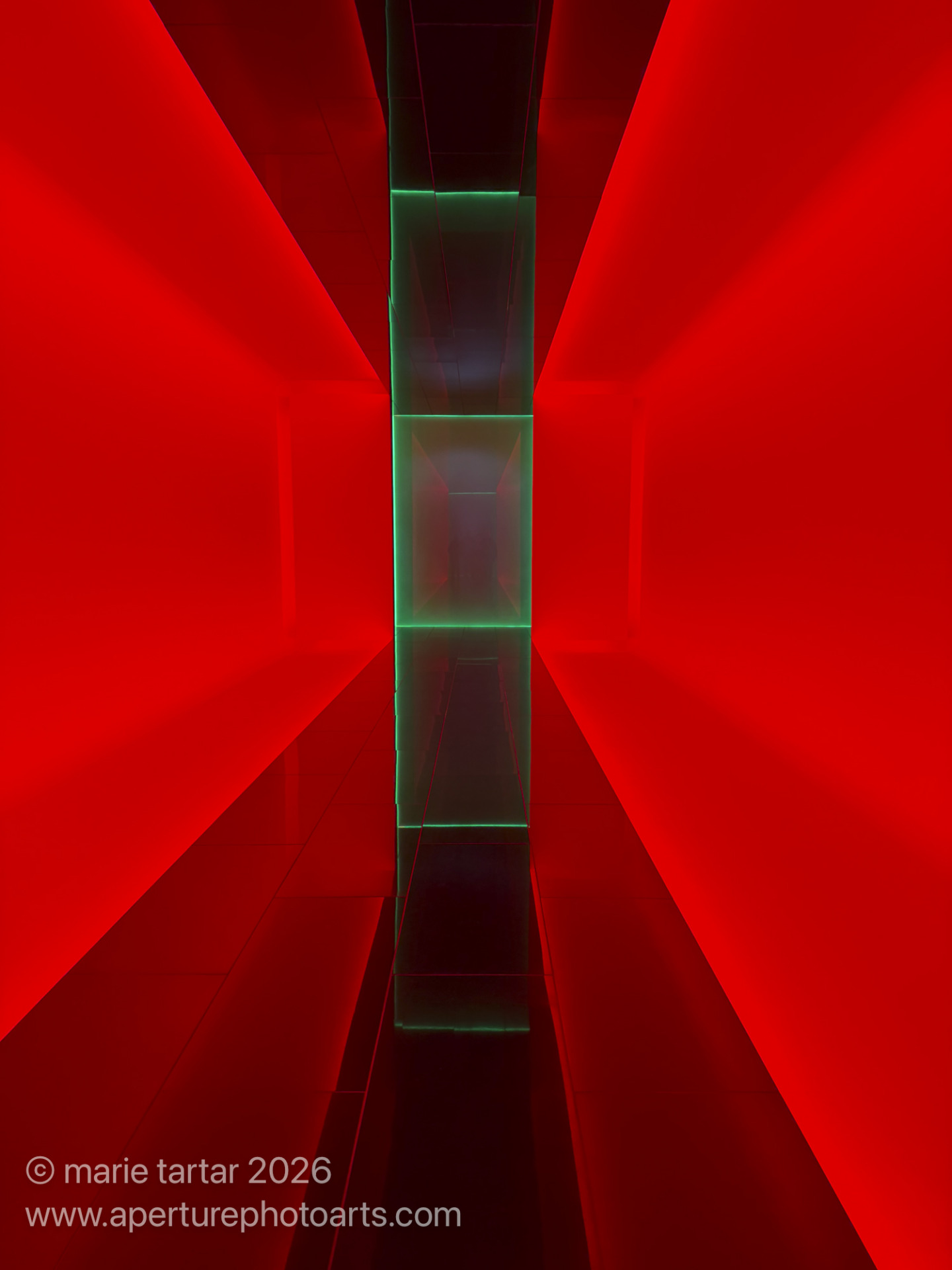
The stunning James Turrell hallway/light sculpture installation necessary to traverse to reach the Faro Restaurant.
To reach it, we traversed a stunning James Turrell-lit hallway that led to a dining room with floor-to-ceiling glass windows and Derwent River views. A huge sphere, a separately ticketed Turrell installation, partially filled the room.
Two somber-faced women musicians/performers had us laughing, maybe inappropriately.
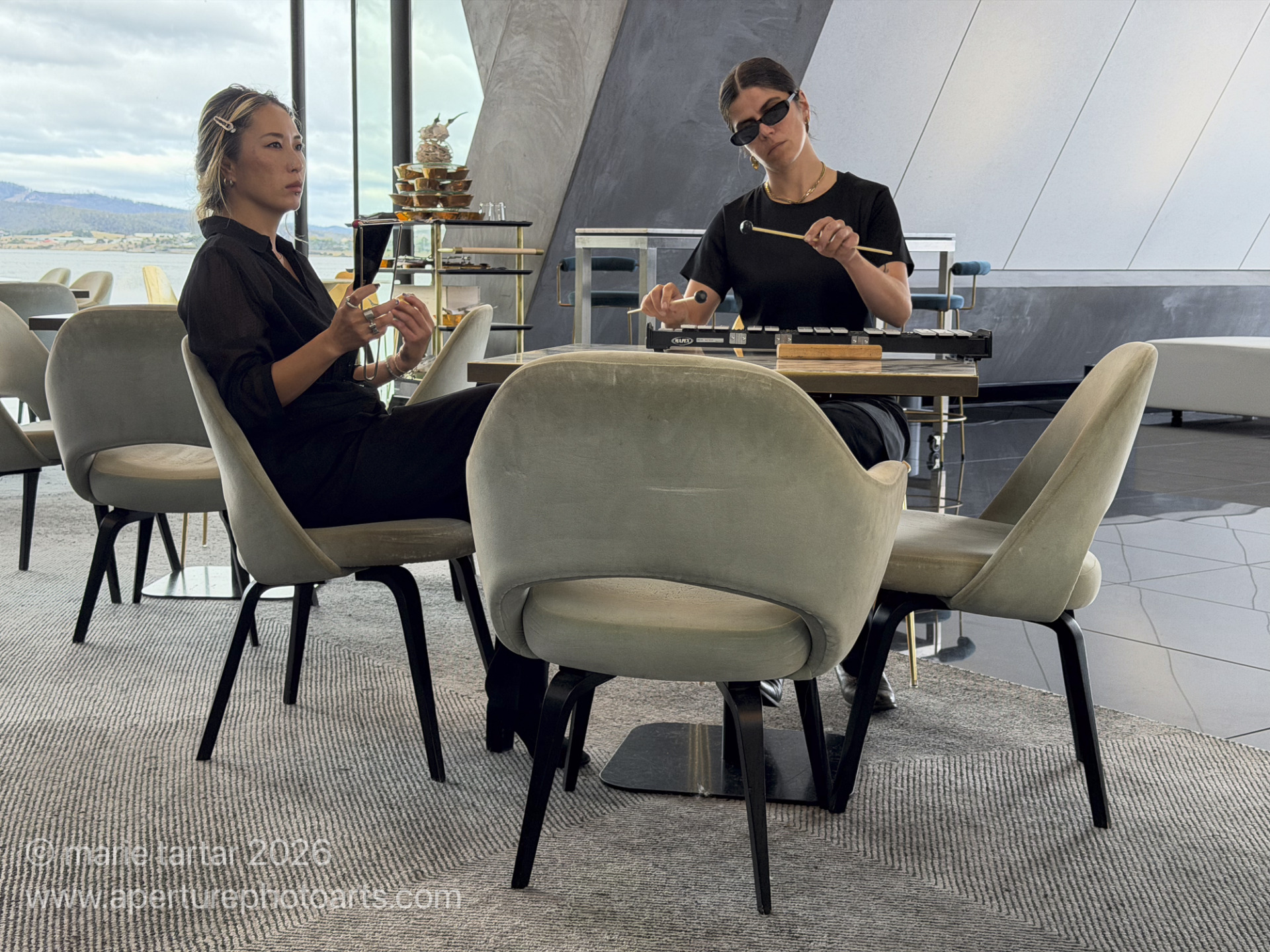
These performers at the Faro restaurant at MONA had us in stitches!
One played a xylophone, filling the room with soft tinkling notes, while the other accompanied her by squeezing and manipulating plastic animal toys: first one plastic pig, then another, then a rhinoceros, then a giraffe. She danced around the room, completely deadpanned in expression, eventually placing several of the animals atop the large hat adorning a woman at the next table.
Later, it was my turn to play a few bars on the xylophone.
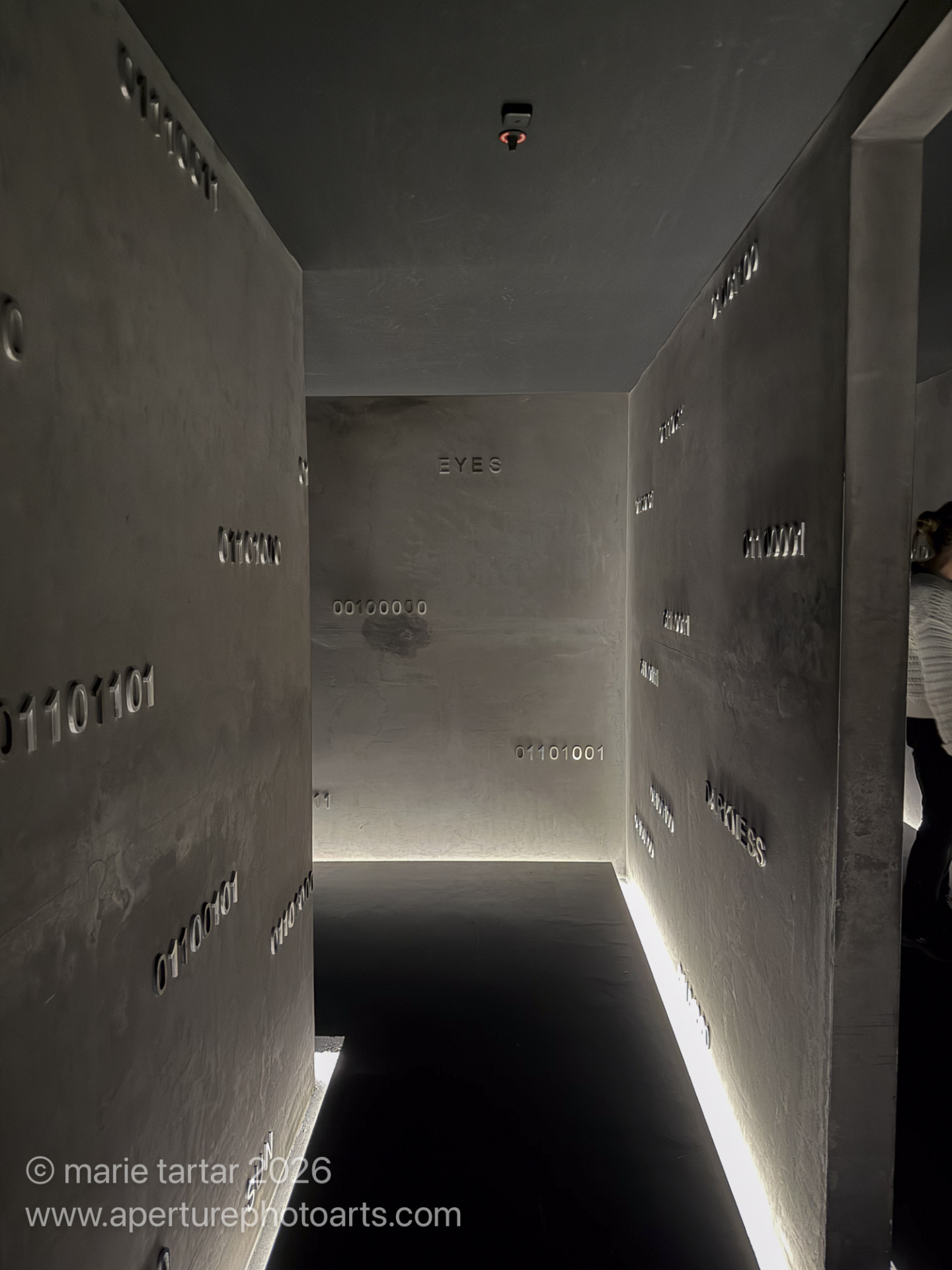
This enigmatic work by Brigita Ozolins is built into MONA and is entitled Kryptos. In binary code, it translates portions of an ancient Babylonian Cuneiform text in Walsh’s collection of the Epic of Gilgamesh, written around 2700 BCE. An example: “He who saw the deep, the foundation of the country. He saw the secret and uncovered the hidden. He brought back a message.”
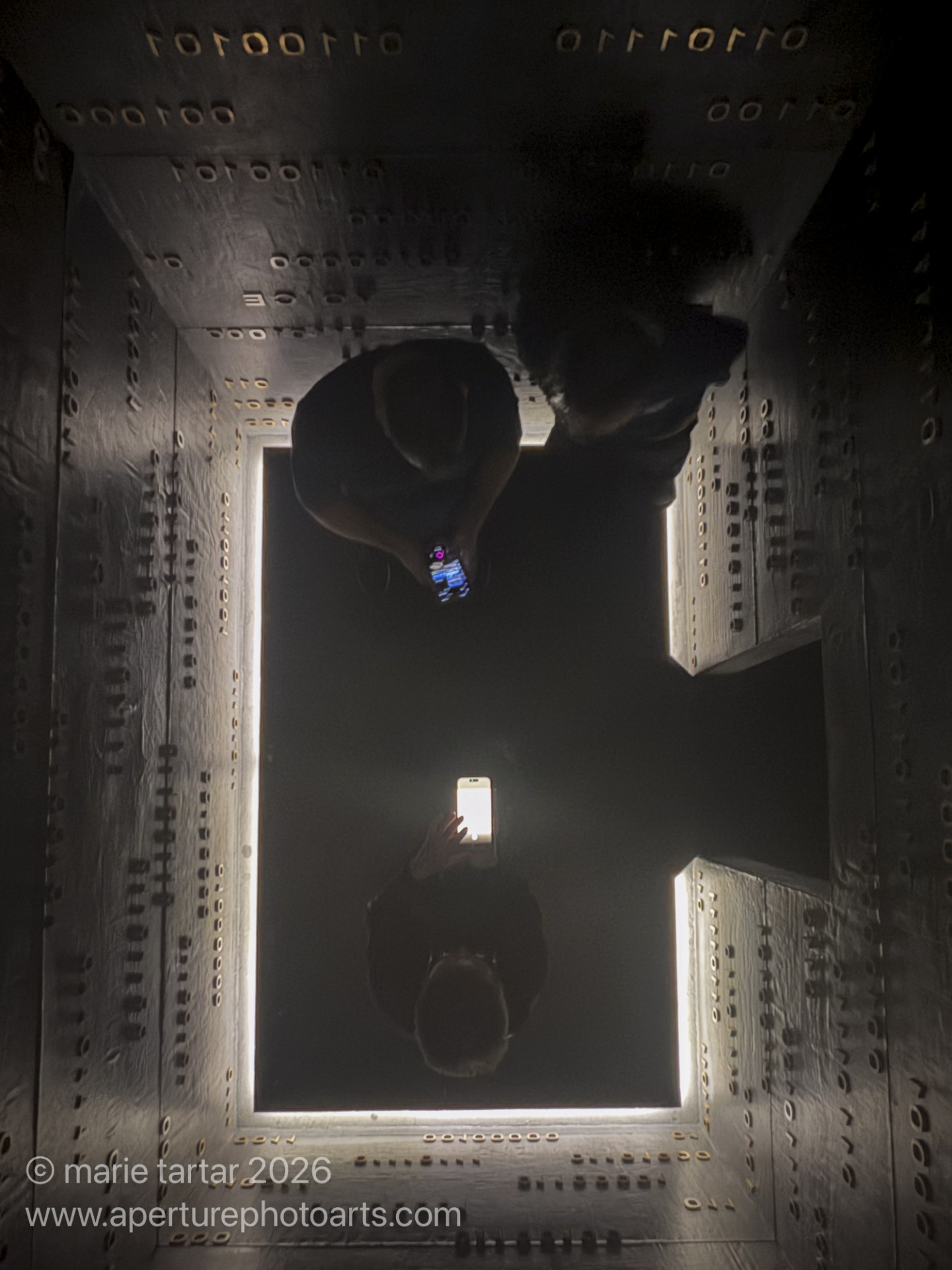
The innermost sanctum of Kryptos, at MONA, a work perfectly encapsulating everything MONA is about, the old and the new, the continuity of communication through the ages. The artist, Brigita Ozolins, has a background in library studies and many works in her oeuvre engage with language, text and symbols.
The rest of the group returned to Hobart on an earlier ferry. A WhatsApp text alerted us to excellent Creamery ice cream at the waterfront, which we sampled on our return (sour watermelon for me, chocolate hazelnut and pepperberry and leatherwood honey for Greg).
We returned to Mures Upper Deck for dinner, sharing the house chardonnay, seafood laksa for me, chowder for Steve and mushroom and oysters for Greg.
Tuesday, April 14, 2026
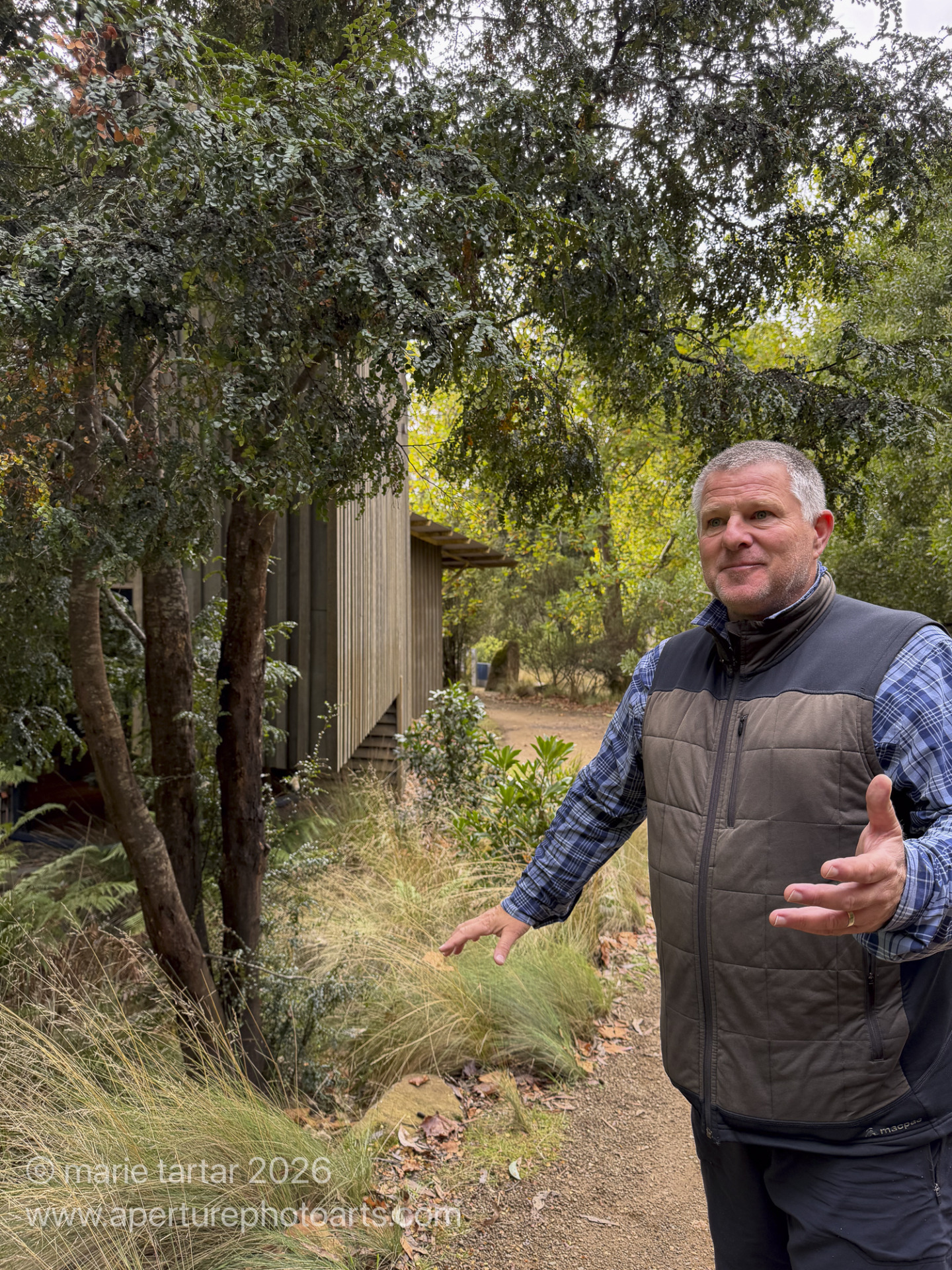
Ben, our amiable guide for a day trip outside of Hobart, to Mount Field National Park and beyond.
Ben Andrews (admin@adventuretrailstasmania.com.au) picked the group up at 8:30 am for a day trip outside of Hobart in his 12-passenger van. This was his second year guiding for Blue Green.
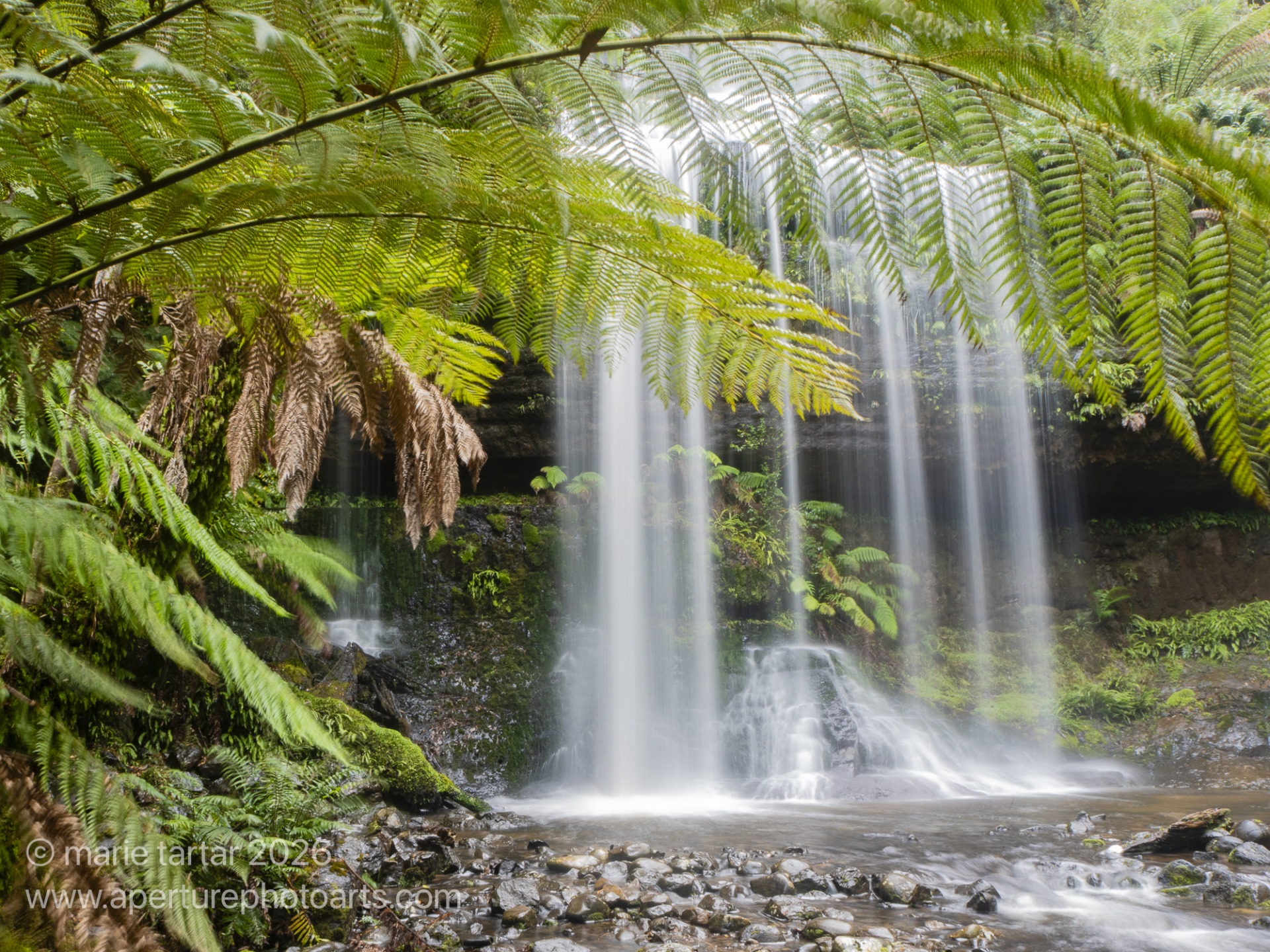
Beautiful Russell Falls, easily reached by a short walk in Mount Field National Park, Tasmania.
Mount Field National Park was the highlight. Short hikes led to two lovely waterfalls, Russell and Horseshoe) through a beautiful old-growth forest, glowing green with moss-covered branches and giant ferns. Multiple pademelons (small, forest-dwelling wallabies) were sighted along the way.
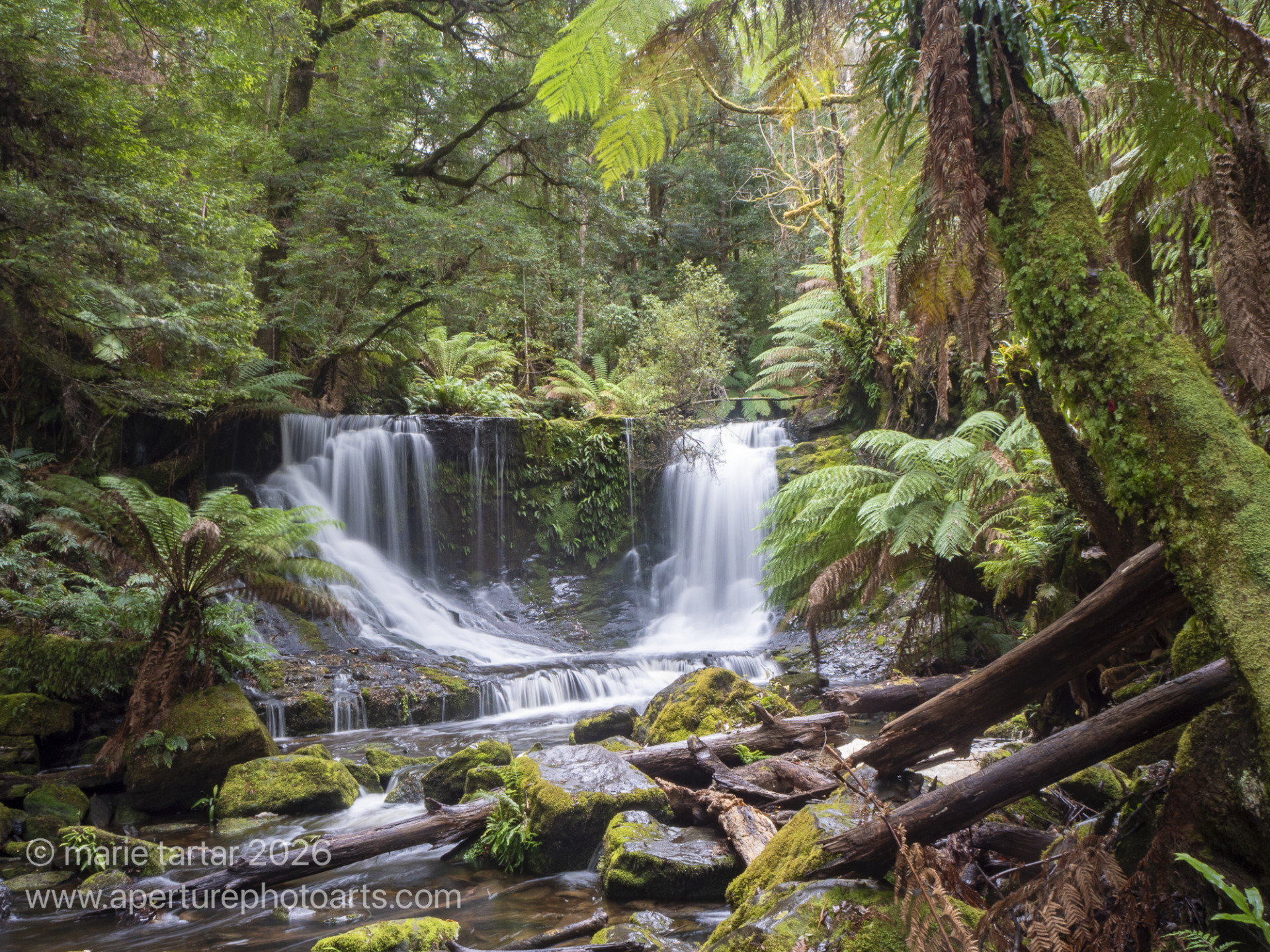
Aptly named Horseshoe Falls in Mount Field National Park, Tasmania.
Antarctica and Australia were once joined as the supercontinent Gondwana, which broke up 100 million years ago. Plants in this park are remnants from that time. Dolerite rock, forming the cliffs of Tasmania, is also found only in Antarctica. Aboriginal peoples have occupied Tasmania for 40,000 years, including through the last Ice Age 10,000 years ago.
A pause along the Derwent River yielded a brief sighting of the back of a diving platypus.
At Bonorong Wildlife Sanctuary, the highlight was a pair of owl-like tawny frogmouths (Podargus strigoides), probably injured by swooping down in front of a car at night in pursuit of insects; this pair became mates at the sanctuary.
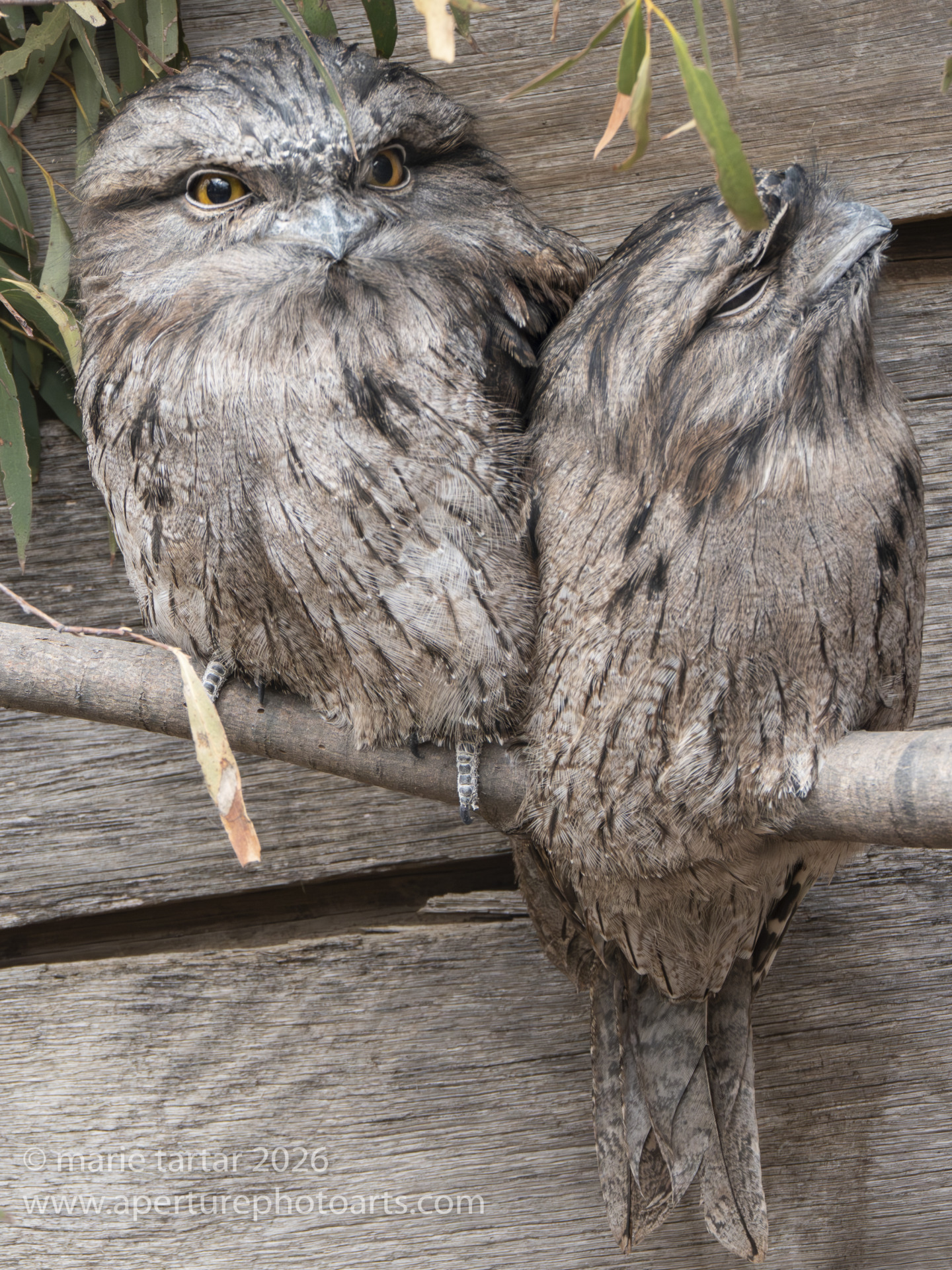
Tawny frogmouths (Podargus strigoides), probably injured by swooping down in front of a car at night in pursuit of insects; this pair became mates at the Bonorong Wildlife Sanctuary, Tasmania.
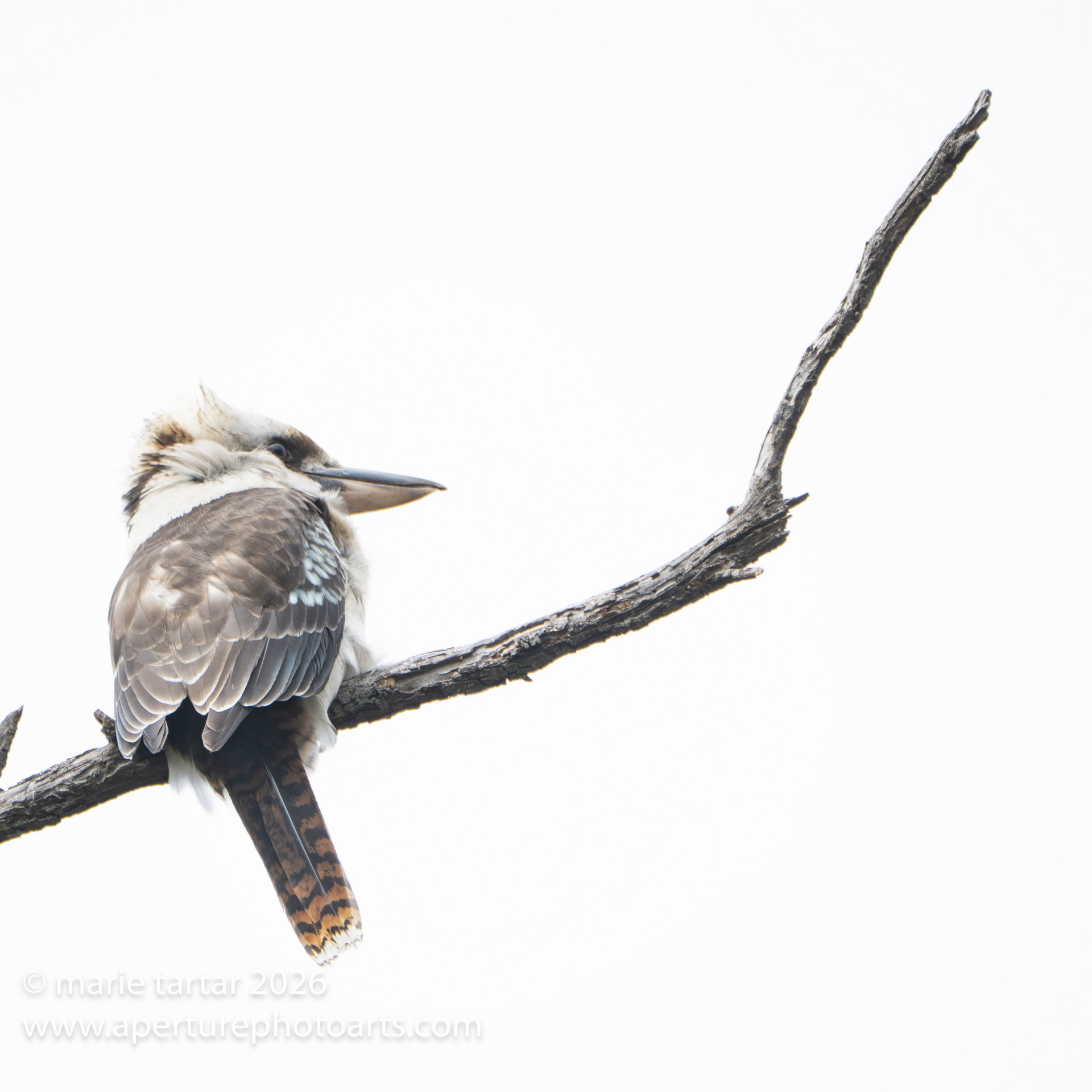
I recognized this as a type of kingfisher, seen at Bonorong Wildlife Sanctuary, but only identified it as a laughing kookaburra (Dacelo novaeguineae) once back at home. I was surprised neither Steve nor Greg had ever heard the kookaburra song I remember from childhood, which I just learned is of Australian origin, dating back to 1932. It was written by a music teacher, Marion Sinclair, who worked with the GIrl Guides. I suspect I learned it at camp or in the Girl Scouts.
The lyrics go:
Merry, merry king of the bush is he.
Laugh, Kookaburra! Laugh, Kookaburra!
Gay your life must be!
Eating all the gum drops he can see.
Stop, Kookaburra! Stop, Kookaburra!
Leave some there for me.
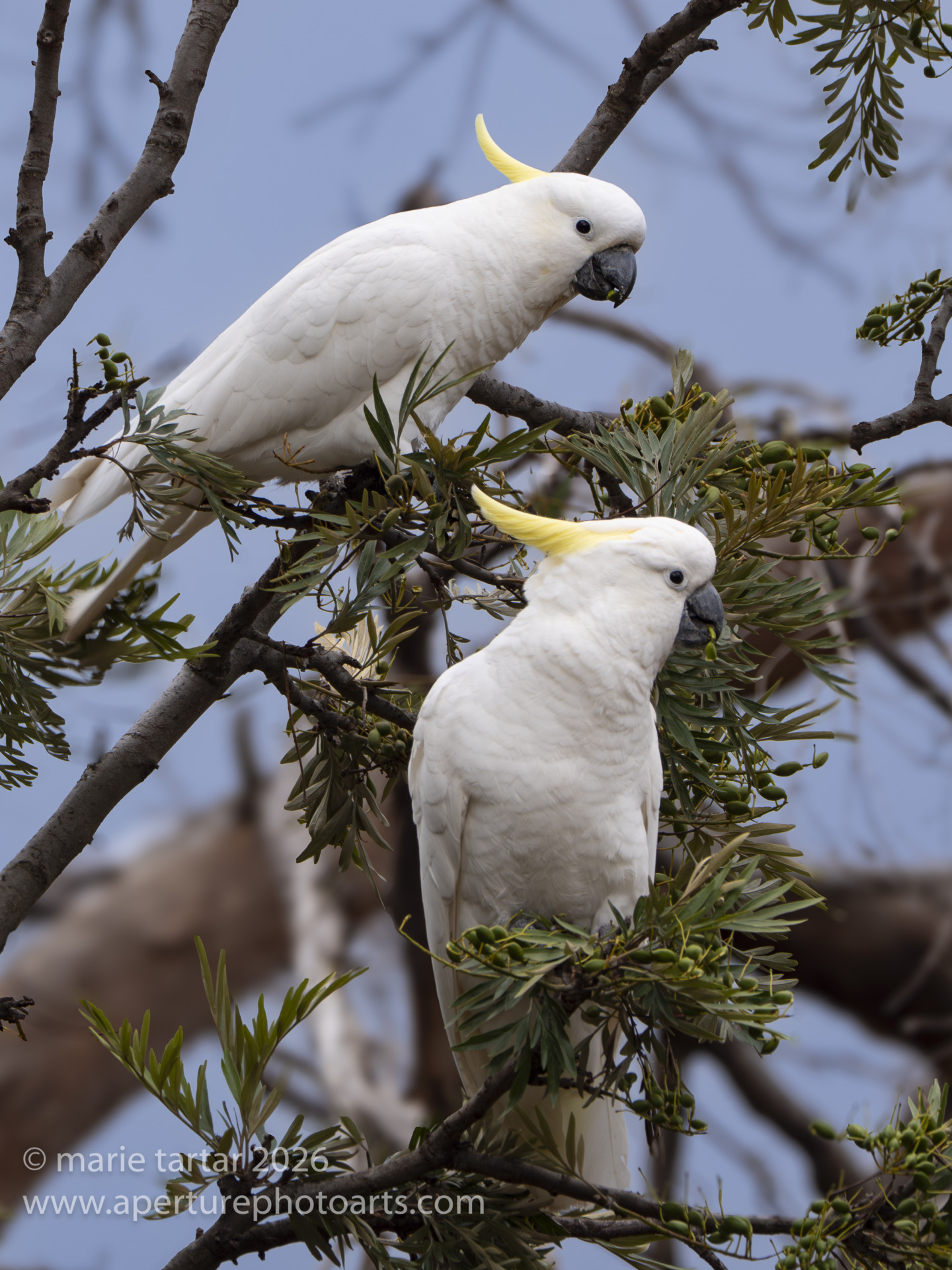
Sulphur crested cockatoos (Cacatua galerita) are so common in Australia that one might think they were the national bird (they’re not-it’s the emu!).
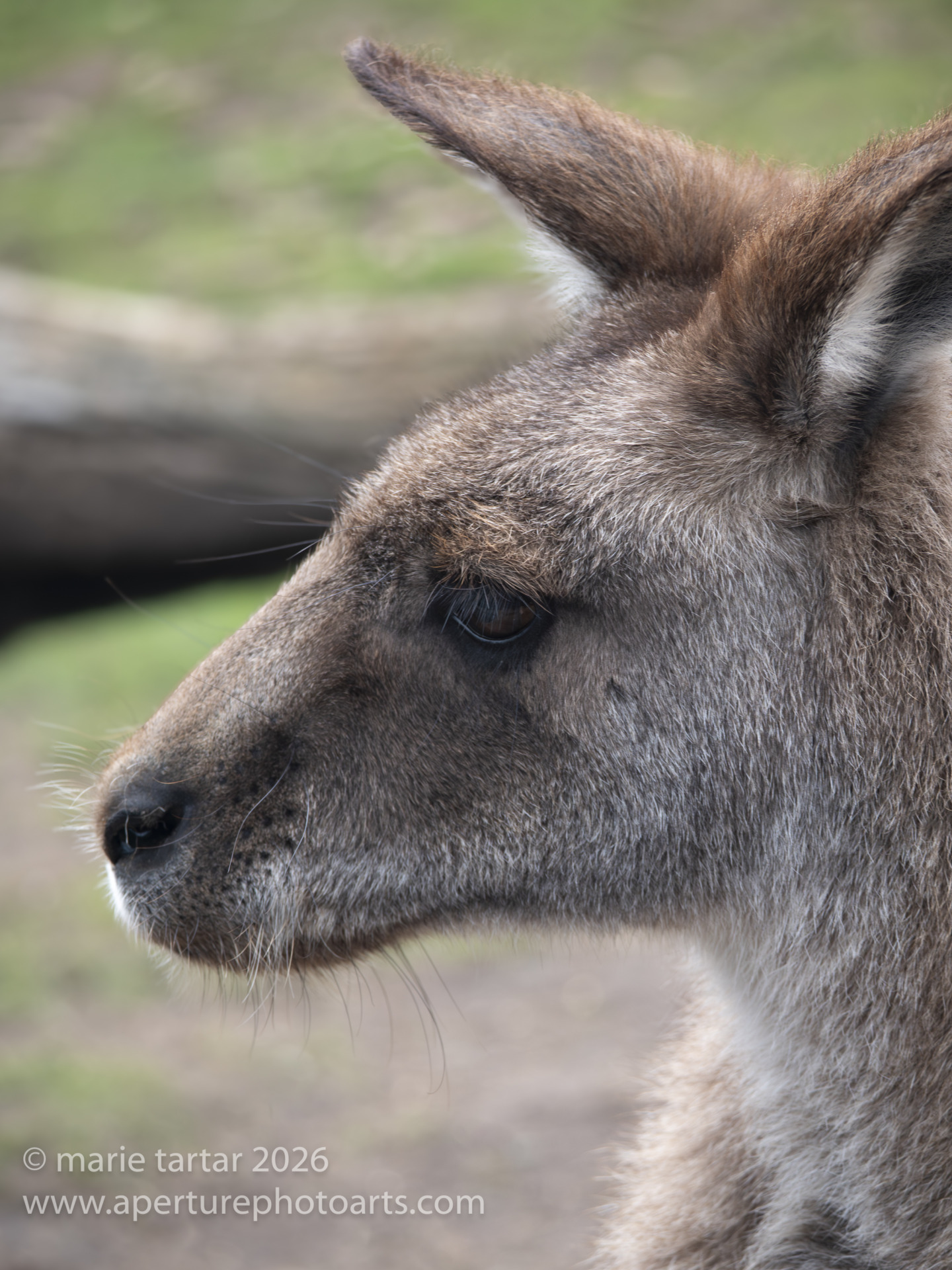
Forester kangaroo (Macropus giganteus tasmaniensis) profile, Bonorong Wildlife Sanctuary, Tasmania.
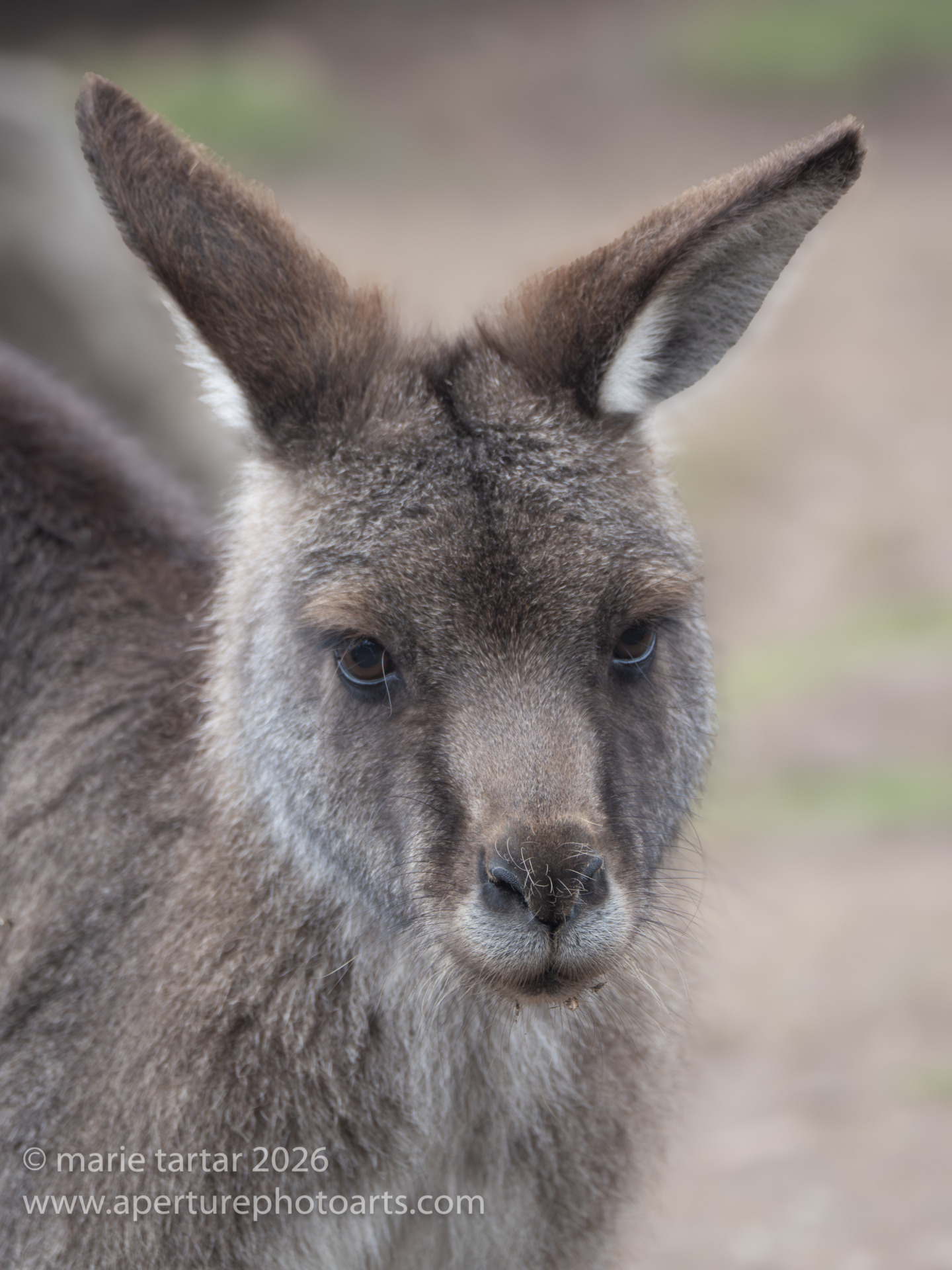
Forester kangaroo (Macropus giganteus tasmaniensis), Bonorong Wildlife Sanctuary, Tasmania.
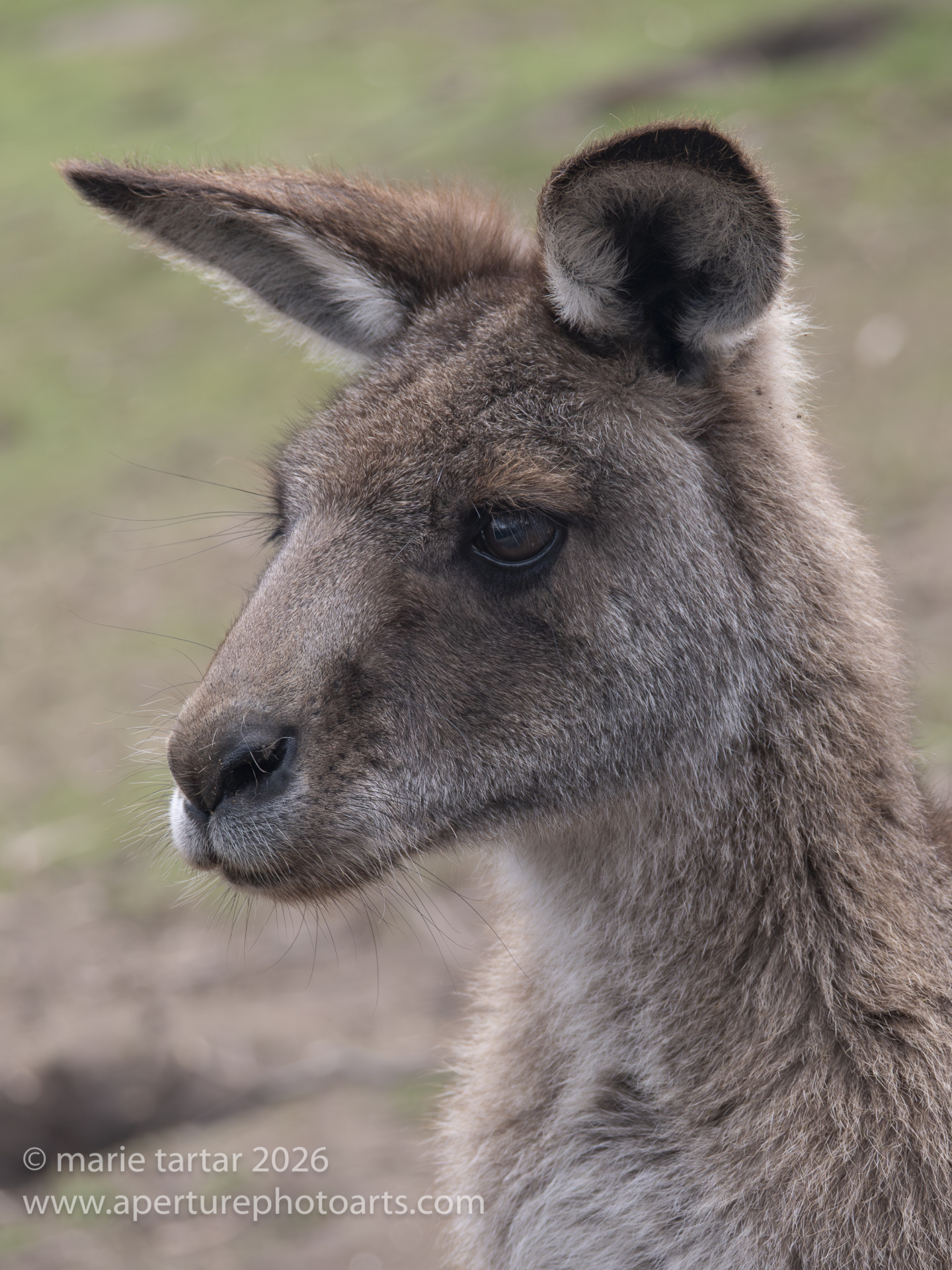
Forester kangaroo (Macropus giganteus tasmaniensis), Bonorong Wildlife Sanctuary, Tasmania.
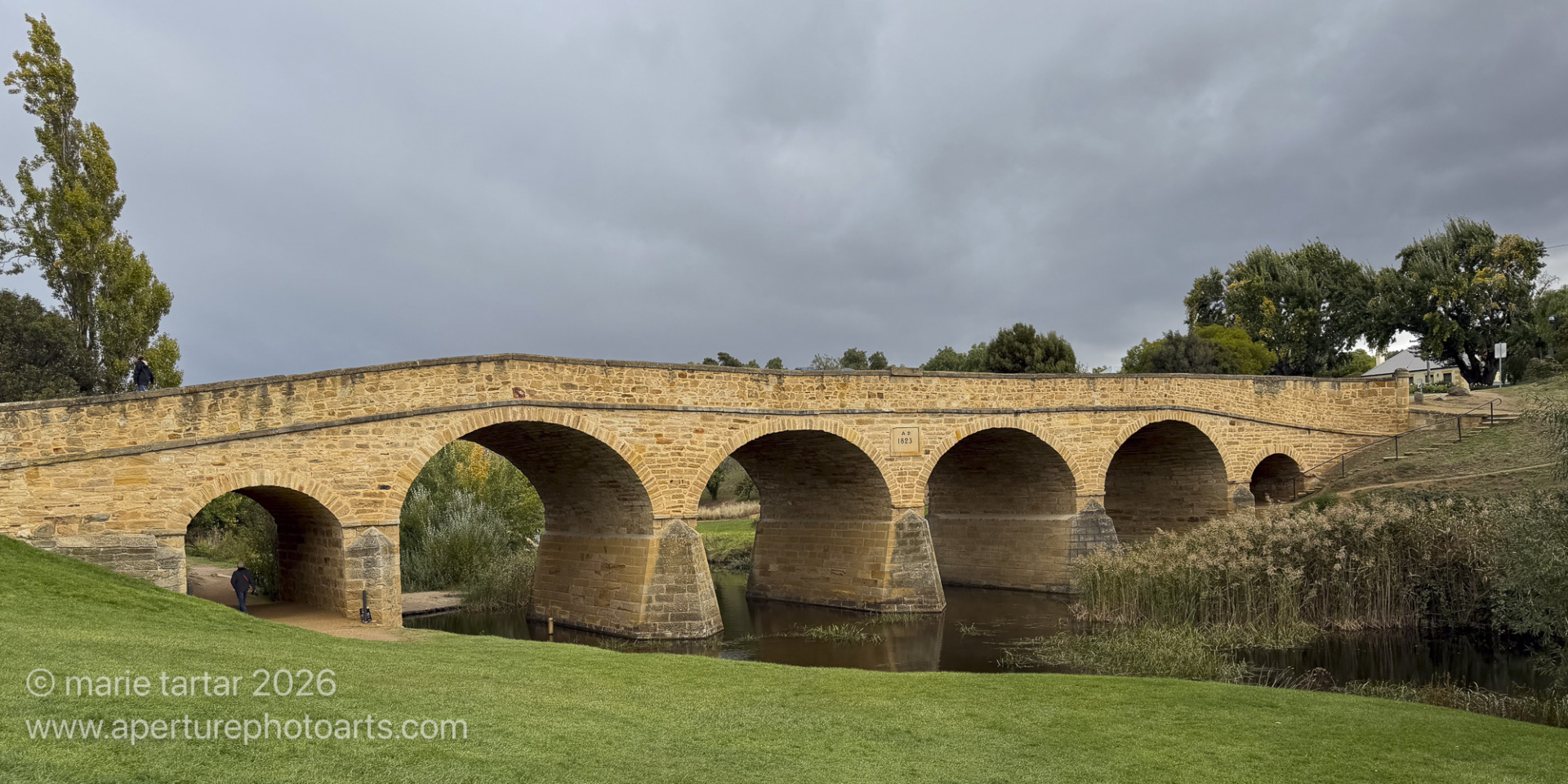
A beautiful stone bridge in Richmond, the oldest in Australia, was completed in 1825 and built (of course) with convict labor.
We learned some interesting history about our hotel from Ben that isn’t mentioned on their website. It once was a center of whaling activity, where blubber from slaughtered whales was processed. Later, it became a hub for the wool trade, with the stepped roofs housing weavers who needed good light.
We had lunch so late (delicious scallop and curry pie) that no one had appetite for dinner. We met up for a good-bye toast in the hotel’s bar.
Wednesday, April 15, 2026
The rest of the group took off this morning, journeying to homes in Alberta and southern California. We were off to Cradle Mountain, considered the crown jewel of Tasmania’s Wilderness World Heritage Area in Australia.
Steve, Greg and I stored our dive gear at the hotel in advance of a different Ben picking us up at 8:15 am in a Mercedes. He was a low speaker and the gas-powered car was noisy enough that I could hardly hear him in the back seat.
The 5-hour drive to Cradle Mountain passed through many different habitats, from rolling, pale-gold hills to lush forests. The transfer was broken up by several interesting stops. The first was a bakery and coffee shop within a building dating back from the 1850s, now partially occupied by the post office of Bothwell. We picked up an outstanding banana bread (with chocolate, walnuts and pecans) for the following day’s breakfast.
In a forest clearing, a Stonehenge-like arrangement of large stones formed a circle called Steppes Sculptures. They are the work of Stephen Walker and were installed in 1992 as a gift to the Central Highlands community. Each large stone was adorned with a metal sculptural relief, depicting the indigenous people and local flora and fauna.
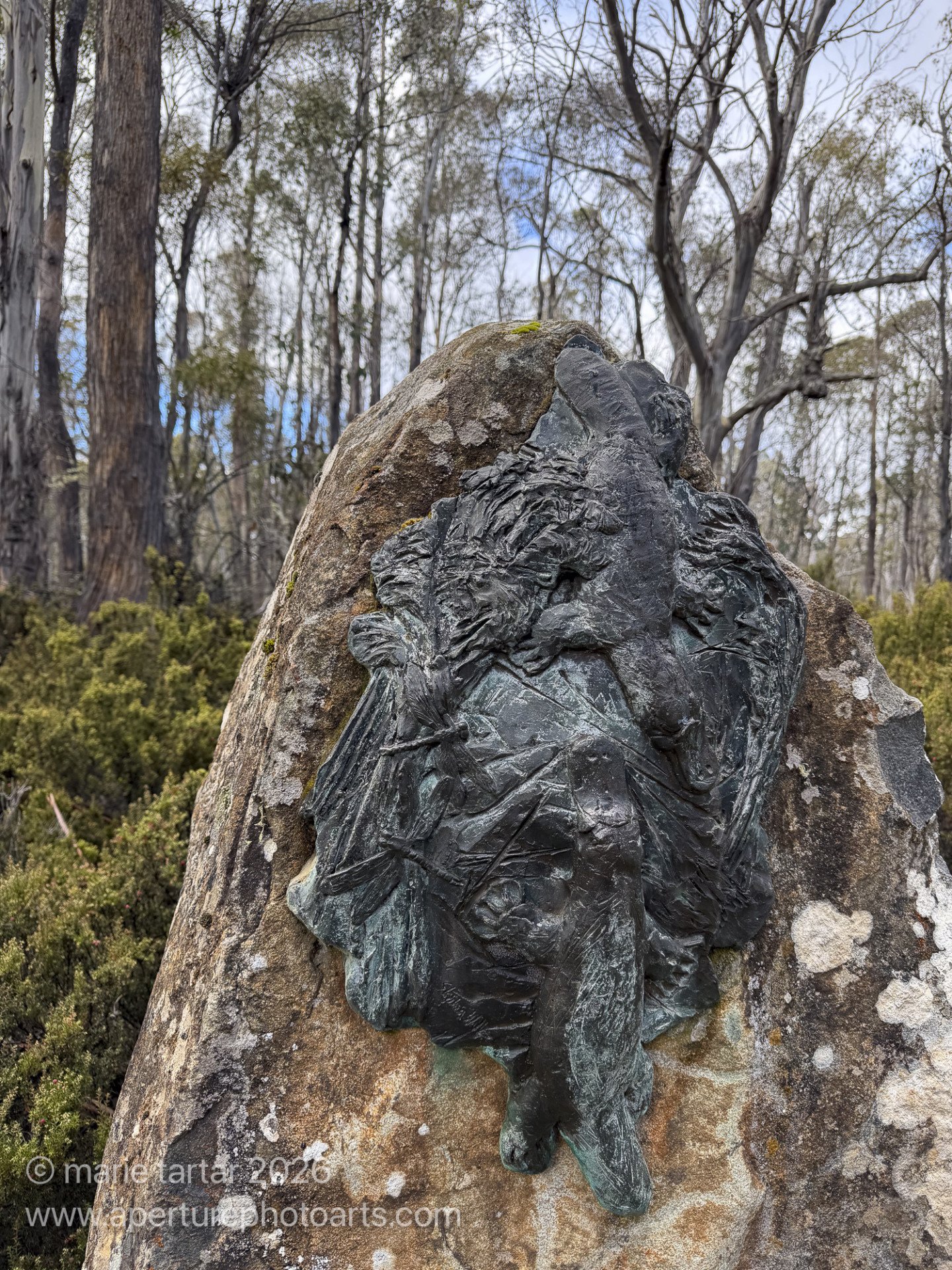
What a surprise, this Steppes Sculptures installation on the road to Cradle Mountain. Sadly, this was also our closest encounter with a platypus.
An open stretch of road was notable for a brown ball on the side-our first and only echidna sighting!
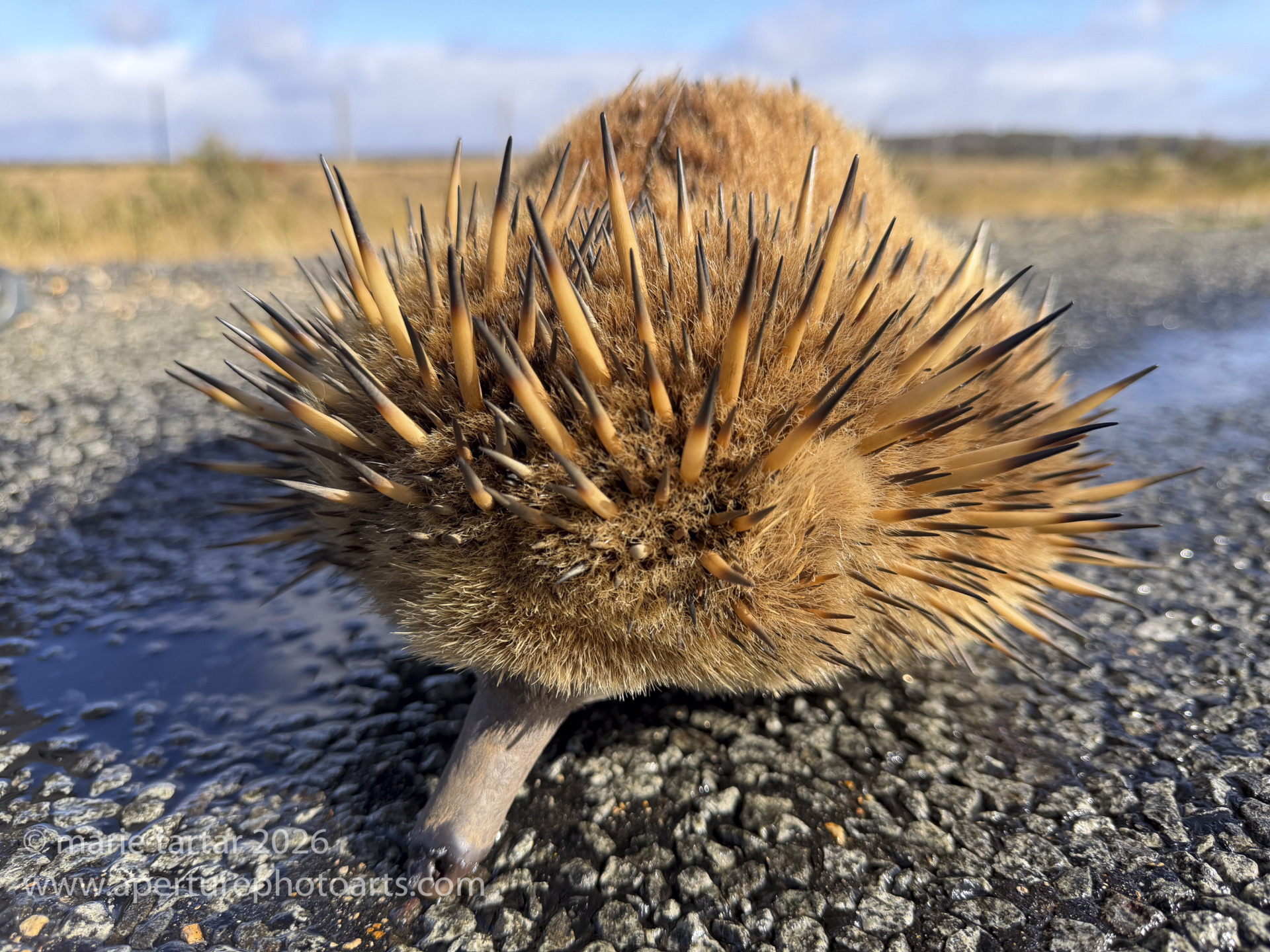
The brown ball on the side of the road was drinking from a rivulet of water; an echidna!


Steve, dissatisfied with the echidna’s choice of a water source, later transposed it (with AI’s help) to this more idyllic setting.
Ben brought the car to a halt and we piled out. Thankfully, there was little traffic. The echidna’s snout was trained on a rivulet of water on the side of the road. Ben reassured us it would move out of harm’s way when it was done drinking.
A store featuring honey tasting stations and every manner of honey-related product was our next stop.
It was too early to check in to our cabins at Peppers Cradle Mountain Lodge, so we invited Ben to lunch with us at the Tavern Bar & Grill while we waited…and waited. When ordering at the counter, there was a notice of a 45-minute wait for food. Ben’s first two choices, cottage pie and penne alla Norma, were sold out. His third choice, pepperoni pizza, and Steve’s Caesar salad with lox, arrived in the allotted time, but Greg and I waited at least another half hour for my mushroom gnocchi and his veggie burger.
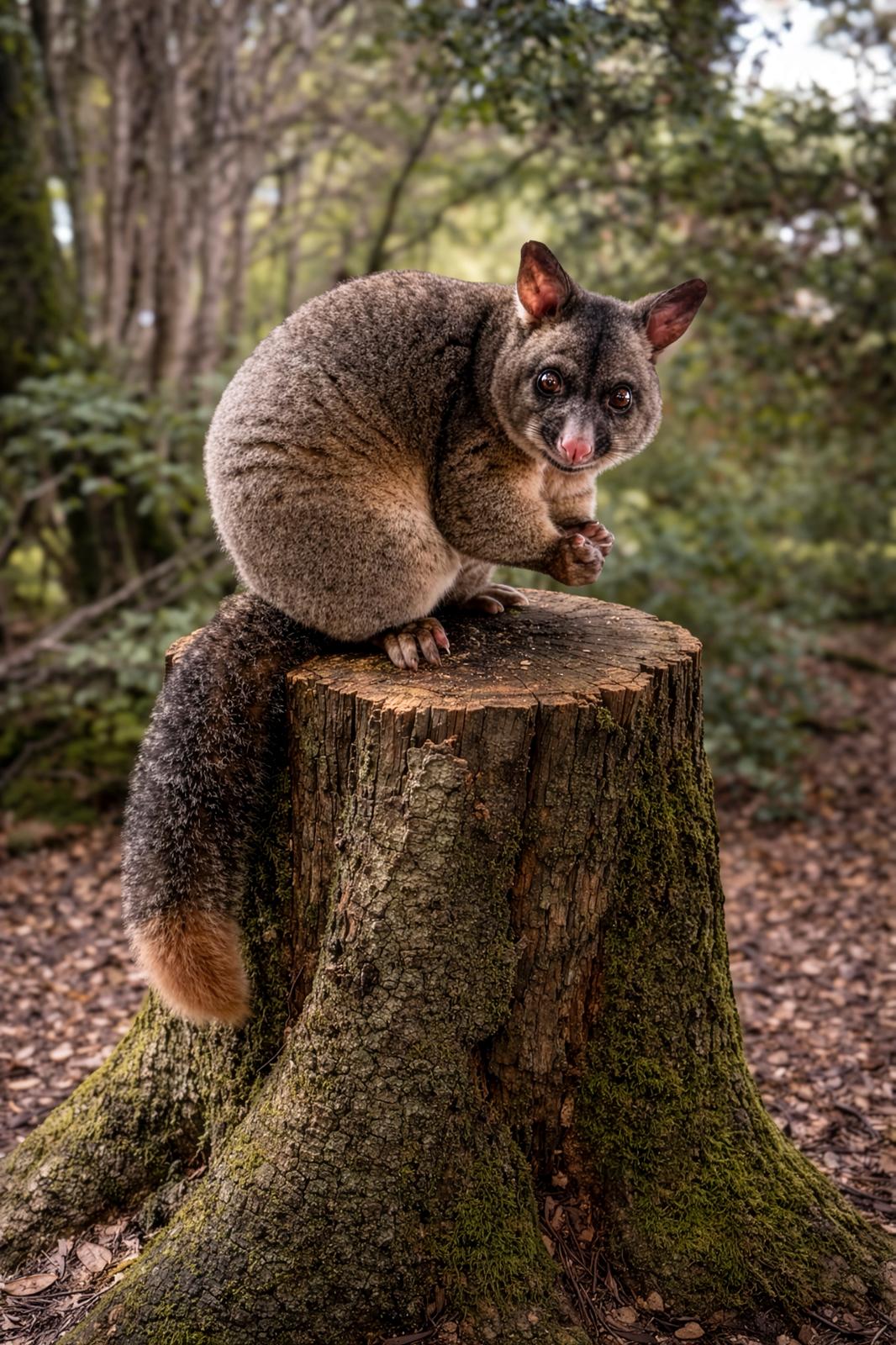
Steve saw this brush-tailed possum on the wooden railing of our lodging in Cradle Mountain but with AI’s help, transposed it to this more “natural” setting.
After checking in and donning multiple additional layers (including my heated vest), we walked several short trails accessible from the grounds, including the Enchantment Walk, which follows Pencil Pine Creek through a mossy forest (1.1 km), and the Waterfalls Walk, which offers views of Pencil Pine and Kynvet Falls (1 km).
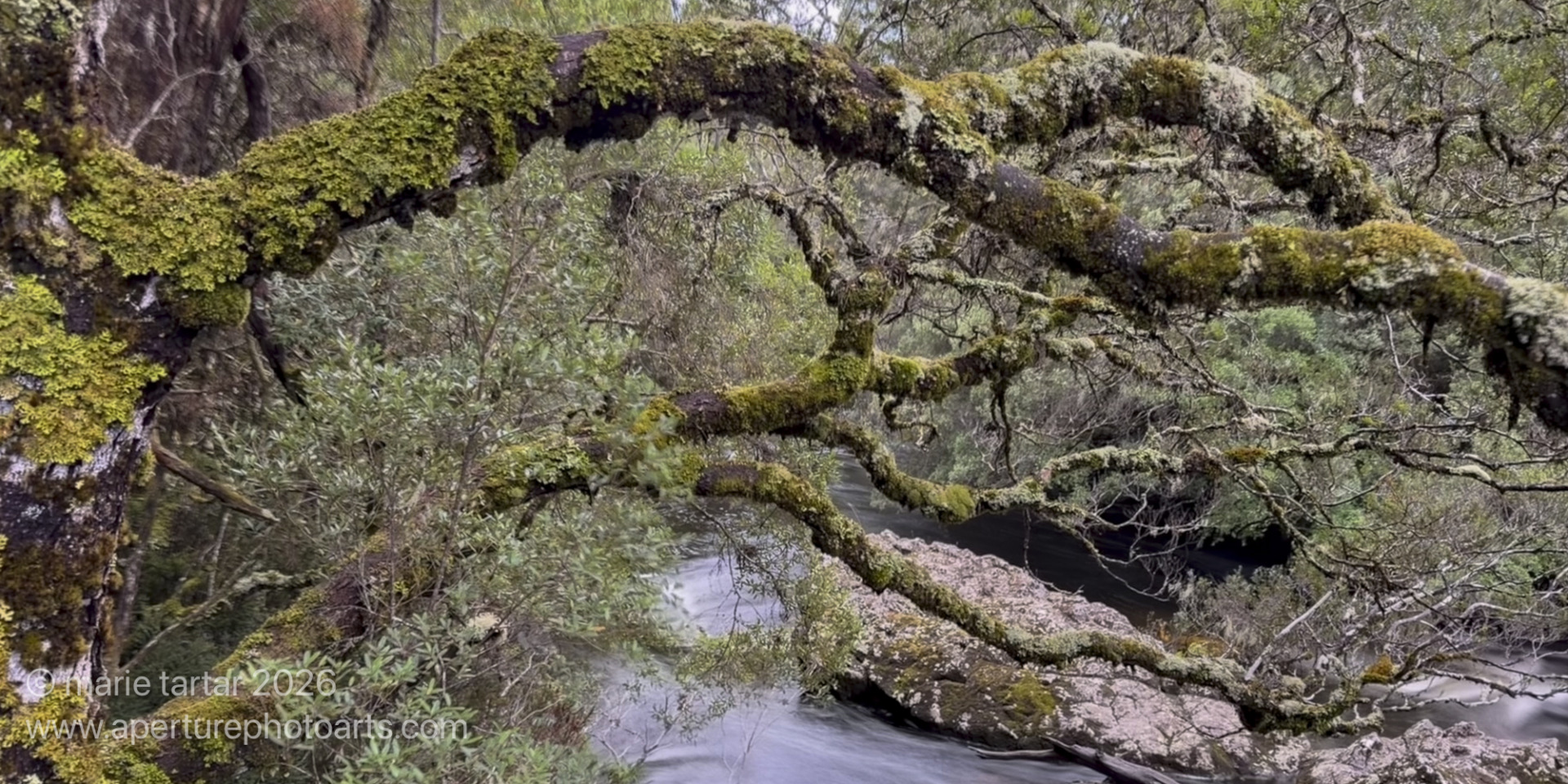
Lush mossy forest scene in Cradle Mountain.
We had an early dinner (being unable to get a reservation except at 5:30 pm) at the Highlands Restaurant (two-course minimum, $105). I loved my main of charred broccolini on a bed of lemon freekeh and macadamia cream, with toasted almonds and chile oil drizzle, but my harissa-glazed eggplant starter was less successful. Greg indulged in wallaby tartare as a starter with smoked cherry tomato gnocchi with pine nuts and pesto as a main. Steve had chicken ballotine with wild mushrooms and pistachio on a corn and barley risotto base, and we helped him with a dessert of orange semi-freddo.
Thursday, April 16, 2026
The plan was to catch the first bus to the park at 8:15 am. It was a few-minute walk in a light drizzle to the Interpretation Center and the shuttle bus stop. Steve and I arrived early enough for me to stroll the Rainforest loop, a cool temperate pencil pine and myrtle forest with views of Pencil Pine Falls from the opposite side of the river from the day before.
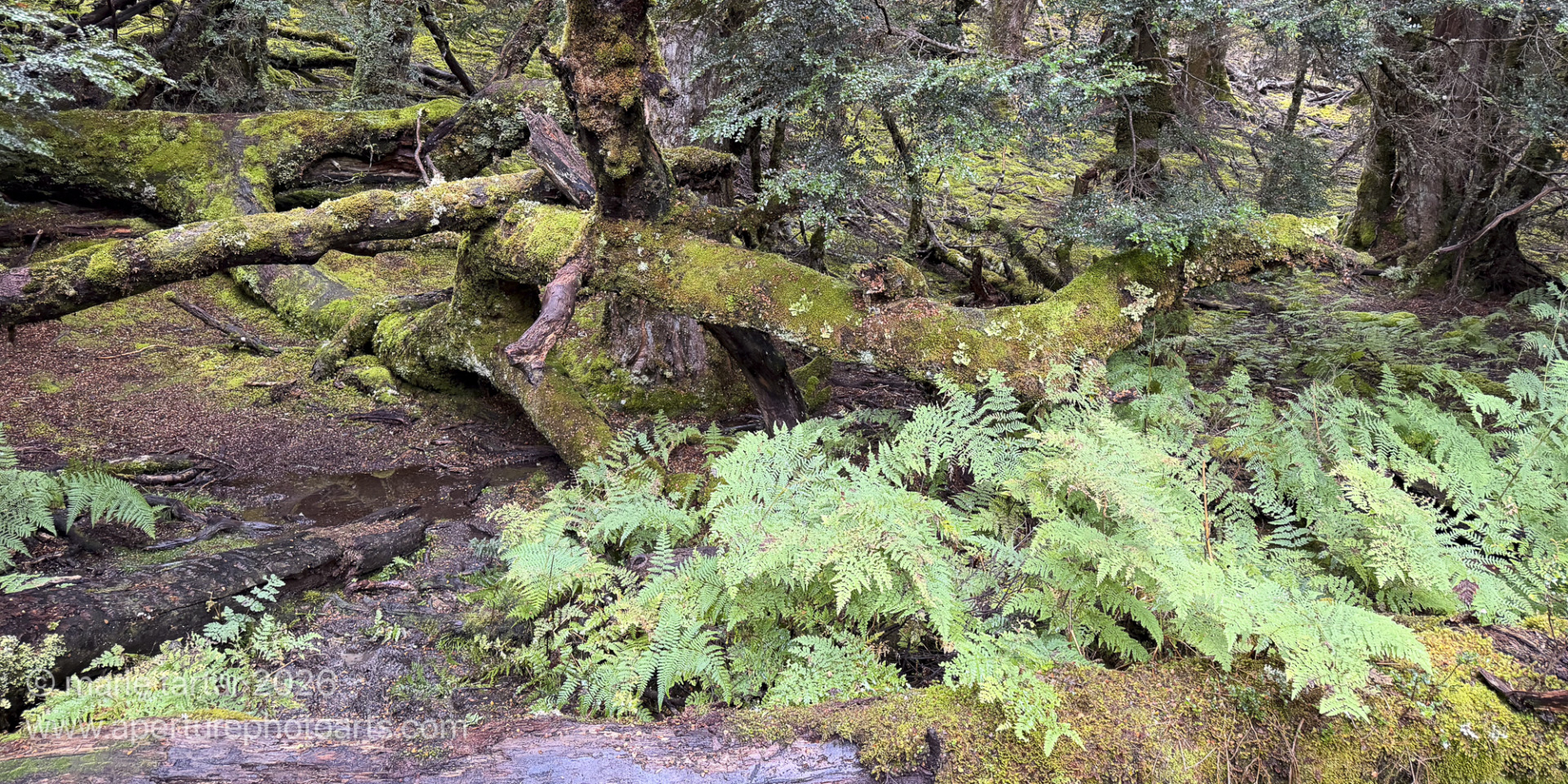
The lush underpinnings of the Rainforest loop, a cool temperate pencil pine and myrtle forest in Cradle Mountain.
As departure time approached, Greg did not appear. He had taken a wrong turn out of the Lodge and was walking the wrong direction.
We boarded the nearly full bus and texted Greg to catch the next one, due in 10-15 minutes.
At the monastic Dove Lake visitor’s center, we waited….and waited. Several buses came but no Greg. It was cold in the unheated building, so we texted Greg to walk the Circuit clockwise as advised and we set out. Just as we were starting the hike, I glanced back and saw an orange-clad figure that seemed to be wearing a backpack and clutching a tripod.
It was Greg. The circuit is feet from the lake’s shores at times and at other points, is in dense forest. As with most of the trails we walked in Tasmania, it was sturdy and well-maintained, with long segments of wooden boardwalk wrapped with chicken wire for good grip underfoot, alternating with gravelly and rocky but not technical sections. This was considered a moderate trail at 6.5 km (4 miles).
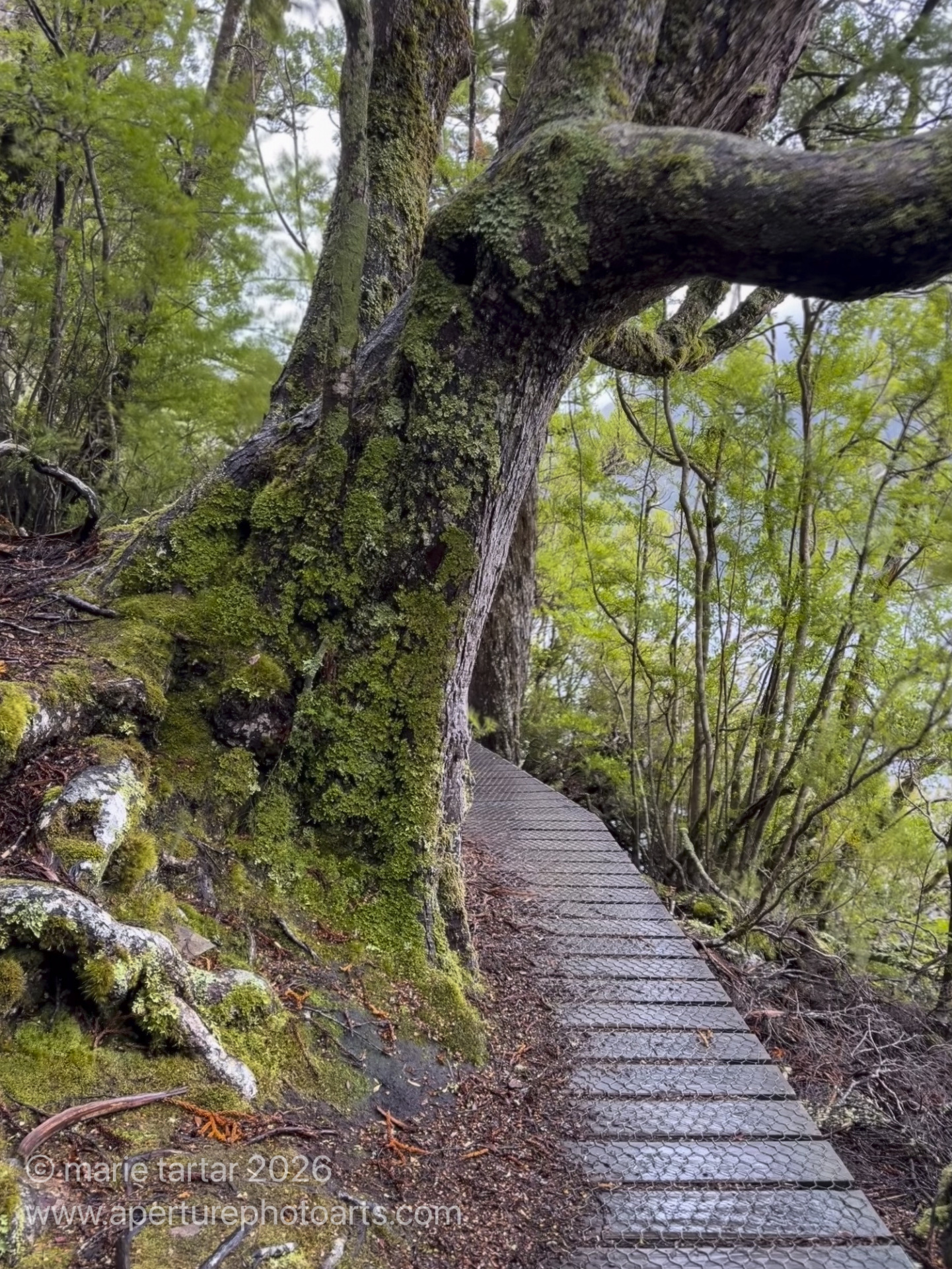
Dove Lake Circuit, in Cradle Mountain-Lake St Clair National Park, takes one through beautiful, moss-covered forest and right along the water’s edge (seen through the trees here).
The hike is spectacular, particularly the first half. It would be amazing in better weather. We had steady, initially light, then insistent, rain throughout and by the second half, my pants (hiking pants over long john underwear) were wet enough to cling. My 5 layers on top (merino camisole, Fourth Element long-sleeved top, a thin Patagonia micro-fleece top, a lightweight thermal jacket and a rain jacket, coupled with my heated vest, kept me reasonably comfortable, although the bulky heated vest batteries, one under each breast, made my torso thick enough I could barely zip the rain jacket. By the end of the hike, Greg also had an unusual mid-torso bulge of one of his cameras zipped under his rain jacket.
My waterproof backpack came in handy. I was able to carry the tripod (which I ended up using only for the Mount Field waterfalls) and my camera inside.
When the Cradle Mountain Explorer bus appeared, Greg muttered that the driver was the same charmer he had encountered trying to reach Dove Lake. We waited for the offloading passengers to disembark and then moved forward to board.
“Bus stop!” she barked, jerking her head to indicate a site on the opposite side of the horseshoe-shaped driveway, 20 paces away!
We had happy hour in our cabin in front of the gas fireplace, finishing off cheeses accumulated along the way, as well as a dessert wine from d’Arenberg.
Dinner was again at the Highlands Restaurant (pumpkin carpaccio starters for me and Greg, wallaby tartare for Greg, grilled broccolini for me, beef cheek for Steve and we all finished off the pepperberry pannacotta and lemon sorbetto).
Friday, April 17, 2026
Our long journey home began with a pickup at 8:45 am by Shawn. The rest of the van was filled with a lovely family of four (parents with 11- and 13-year-olds, all with sizable backpacks) who turned out to be from Second Valley, where we spent the first leg of this Down Under trip. They intended to conquer the Overland Track, a weeklong backpacking trek at Cradle Mountain, but had to cut it short and take shelter after encountering thigh-high snow!
Shawn handed all of us over to Ian, who dropped the Second Valley family off in Launceston, where they would regroup and pivot. Other than stopping for a coffee and chicken toastie for Steve and Greg at Frankie’s, the next stop was Hobart. We retrieved our stored dive bags and photography gear at the Old Wooldstore and Ian dropped us at our final hotel, the Mantra Hobart Airport, selected with an eye to our 6 a.m. flight the following morning.
Saturday, April 18, 2026
Steve and I were in for a harrowing dark o’clock departure. The alarm was set for 3 am, an Uber was ordered for 4 am, and our flight was scheduled to leave Hobart for Melbourne at 6 am. We were only a mile from the airport. When we checked in the prior day, Steve decided he didn’t need his Away bag with dive gear and left it downstairs in reception, which it turned out isn’t manned until 7 am! This airport hotel also doesn’t operate a shuttle to the airport until 7 am; hence the need to arrange an Uber.
I had ordered an XL Uber for 4 am, as had Greg. Steve rolled out of our room with his bags before me. When I made it downstairs with mine, he had a panicked look on his face. I think he thought the bag he left downstairs would be sitting out where he left it, behind the reception desk. The downstairs was dark and the bag was nowhere to be seen, apparently secreted behind a locked door we couldn’t access. He had unsuccessfully tried to call the after-hours reception number, but the call didn’t connect. I called from my phone and reached someone who assured me that someone would arrive shortly to retrieve the bag.
Our troubles did not end there. Two Ubers arrived at 4 am as scheduled. Greg took off for the airport after I roused the after-hours reception staff. I helped the Uber driver load our luggage into the vehicle while Steve awaited his captive bag. Once in the car, the driver asked for my PIN number. I had no idea what he was talking about. I showed him my confirmatory email from Uber arranging the ride. The driver refused to budge without this mysterious 4-digit PIN about which we had no clue. He also refused cash. We had to take our bags out of the car and call another Uber, billed as a Comfort car. Luckily, this car took only a few minutes to arrive and the driver did not demand this mysterious PIN number (Steve ordered this car). Seeing the car, Steve thought there was no way we could fit us and all of our luggage ( 2 large duffels, 2 large hard-sided suitcases, 2 camera backpacks and 2 computer bags) and was on the verge of ordering yet another vehicle when I intervened. I was certain we could make it work and we did-2 hard-sided suitcases and one duffle in the trunk, 2 computer bags in the front passenger footwell, a large duffel in the front passenger seat and 2 camera backpacks stacked between us in the back. This 1-mile ride was $11, vs. $60 for the unsuccessful scheduled ride we didn’t take!
Despite all these travails, we found at the airport that we were only 3 parties behind Greg in line, as the Qantas desk wasn’t open when he arrived! So much for showing up 2 hours early for our 6 am flight! The rest of the journey was uneventful. I saw two terrific films on the long flight to LAX from Melbourne. The first was a fun 2015 Australian film titled The Dressmaker, starring Kate Winslet as a talented dressmaker who returns to the backwater town from which she was sent away as a child. The circumstances of her banishment are obscure. Her elderly mother (Judy Davis) is ailing and mentally unstable.
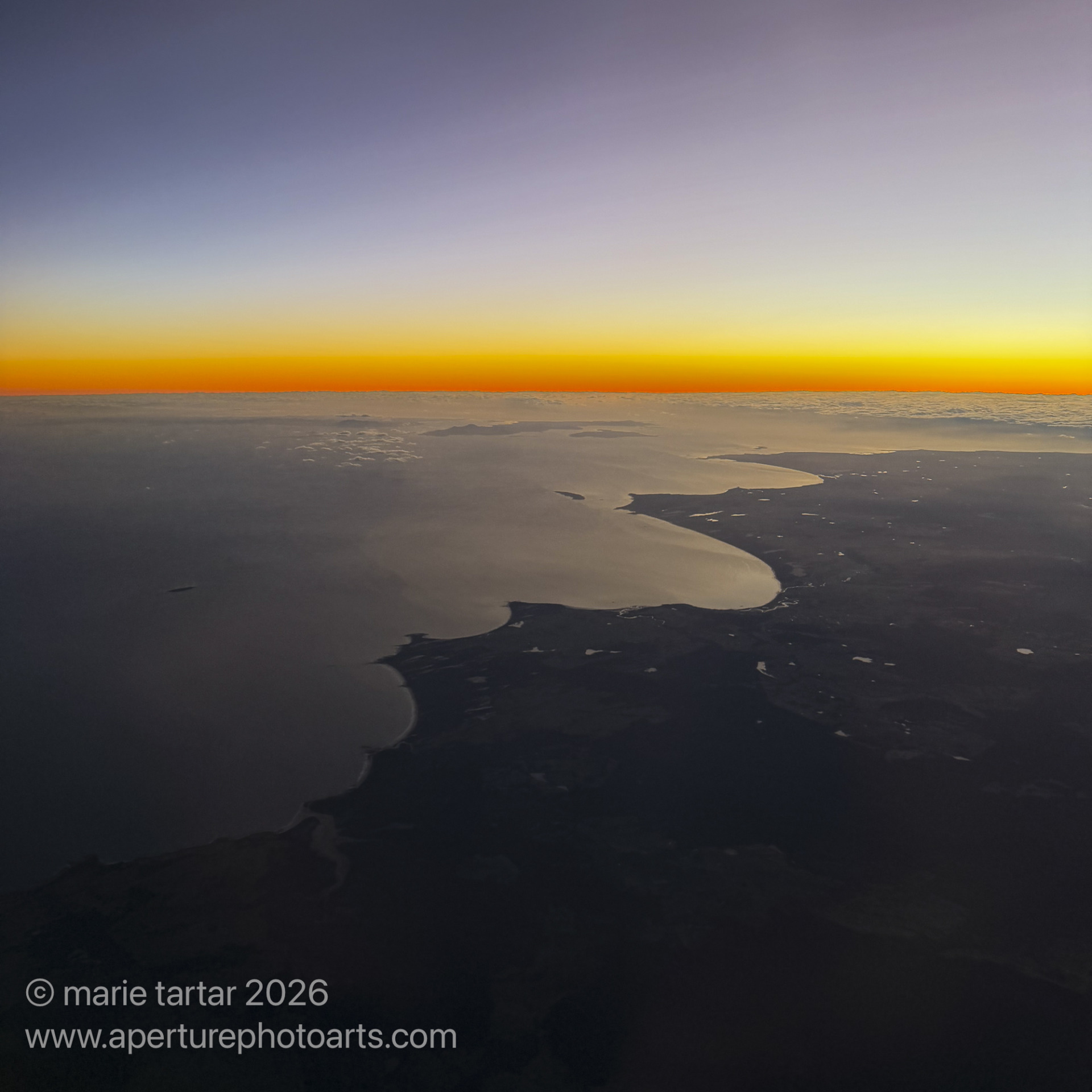
What a 6 am departure from Hobart is good for: a last glimpse of Tasmania, seeing the sun rise from the plane to mainland Australia.
The second was nominated for Best Foreign Film at this year’s Academy Awards and was intense: Sirat. A father and his young son intersect with the rave scene in Morocco while searching for his missing daughter. They join up with a migratory band of ravers to continue the search across an unforgiving desert. Now, I just need to see The Voice of Hind Rajab to complete seeing all of the Best International Feature nominees.
Back at home, South Australia and Tasmania has been much on my mind. I think for Steve, diving there is a “one and done”, but I’m not so sure…I still yearn to see a leafy sea dragon in the wild, but it may take a while for the aftereffects of the algae bloom to subside. While we were in South Australia on our fruitless quest, there was a write-up in the New York Times that graphically displayed its consequences. We can only hope that nature’s resilience, coupled with conservation and restorative efforts, will see regression of the South Australian algal bloom and regrowth of Tasmania’s formerly luxuriant kelp forests.
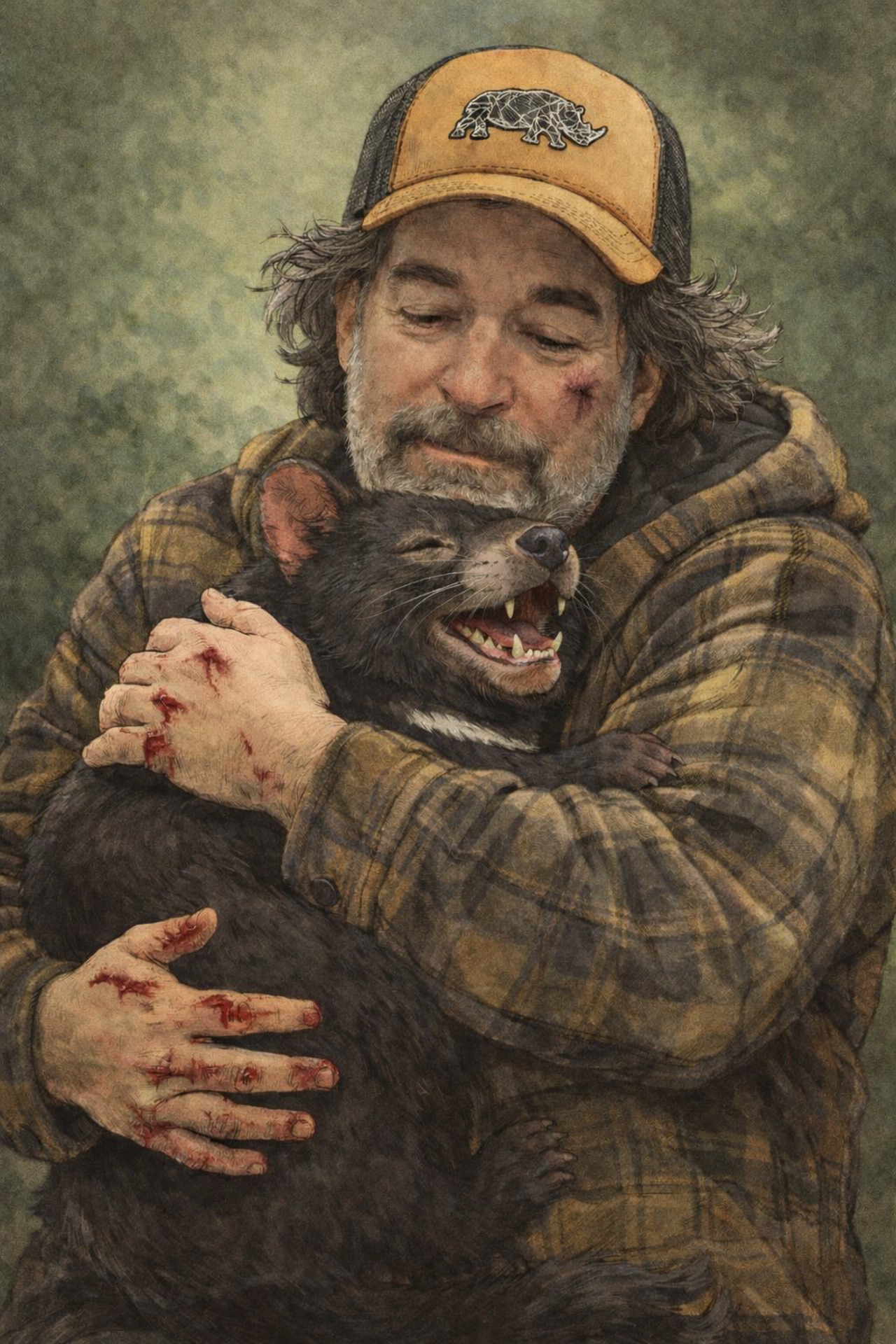
More fun with AI: Greg and Tasmanian devil. Some of us had more trouble than others tearing ourselves away from Tassie and our new friends!
-Marie