

After getting reacquainted with our drysuits and working through equipment issues the prior week in southern Australia, we were on to the main event: Tasmania. Most diving in Tasmania centers on the east coast. We would be based southeast of Hobart, Tasmania’s capital and largest city, at Eaglehawk Neck, a small enclave positioned just north of a narrow isthmus dividing the Forestier Peninsula from the Tasman Peninsula.
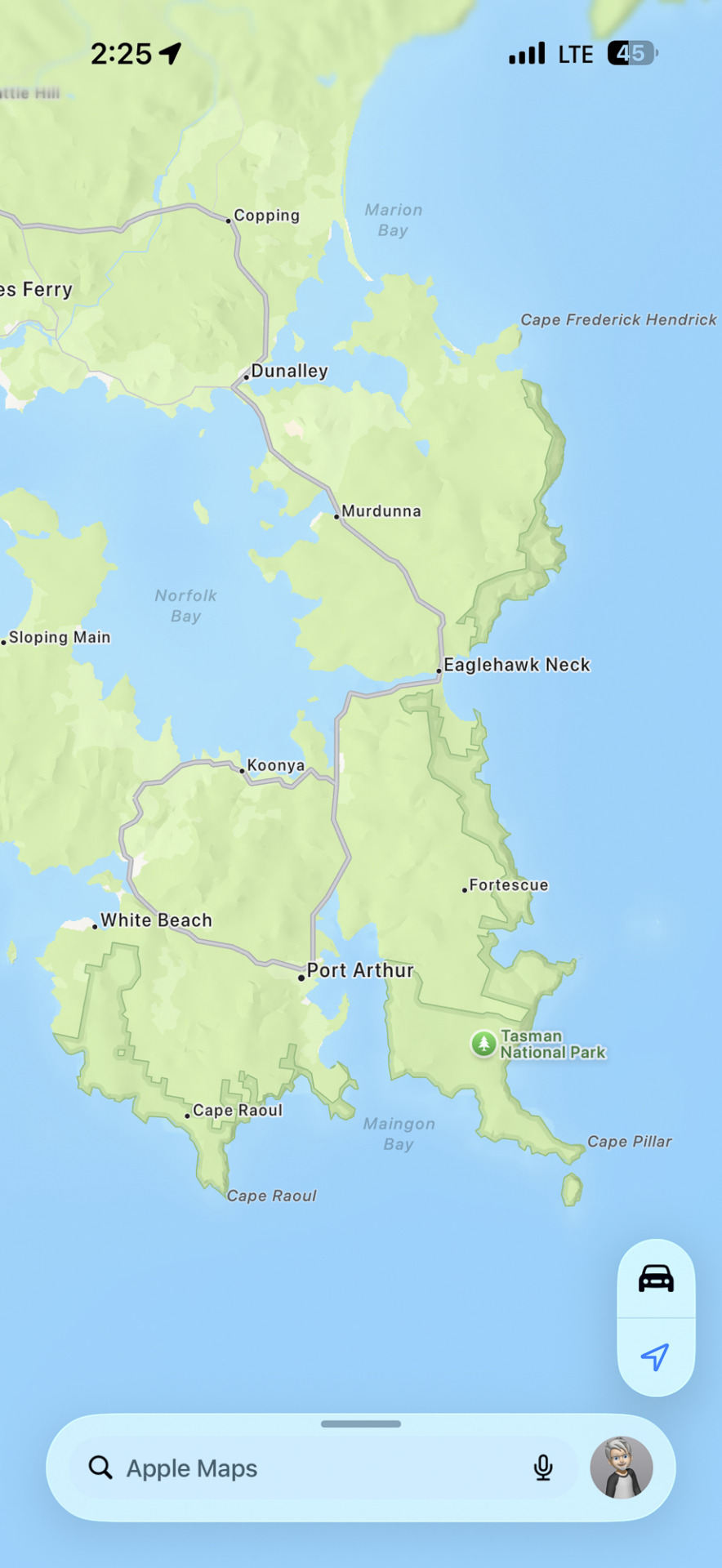
The southeast corner of Tasmania. We stayed at Eaglehawk Neck, a narrow isthmus, exploited by the English to keep prisoners from attempting escape to mainland Tasmania from Port Arthur. Today, another narrow isthmus, at Dunalley, is a bulwark against the spread of the fatal facial tumor disease threatening the Tasmanian devil.
This feature was exploited by the British from the 1830s to the 1870s to deter convicts imprisoned at the Port Arthur penal colony from escaping to the north. The so-called Dog Line was just that-a line of vicious dogs chained together, close enough to touch, but not close enough to fight. The noise of dogs aroused by an escaping convict would alert soldiers housed nearby.
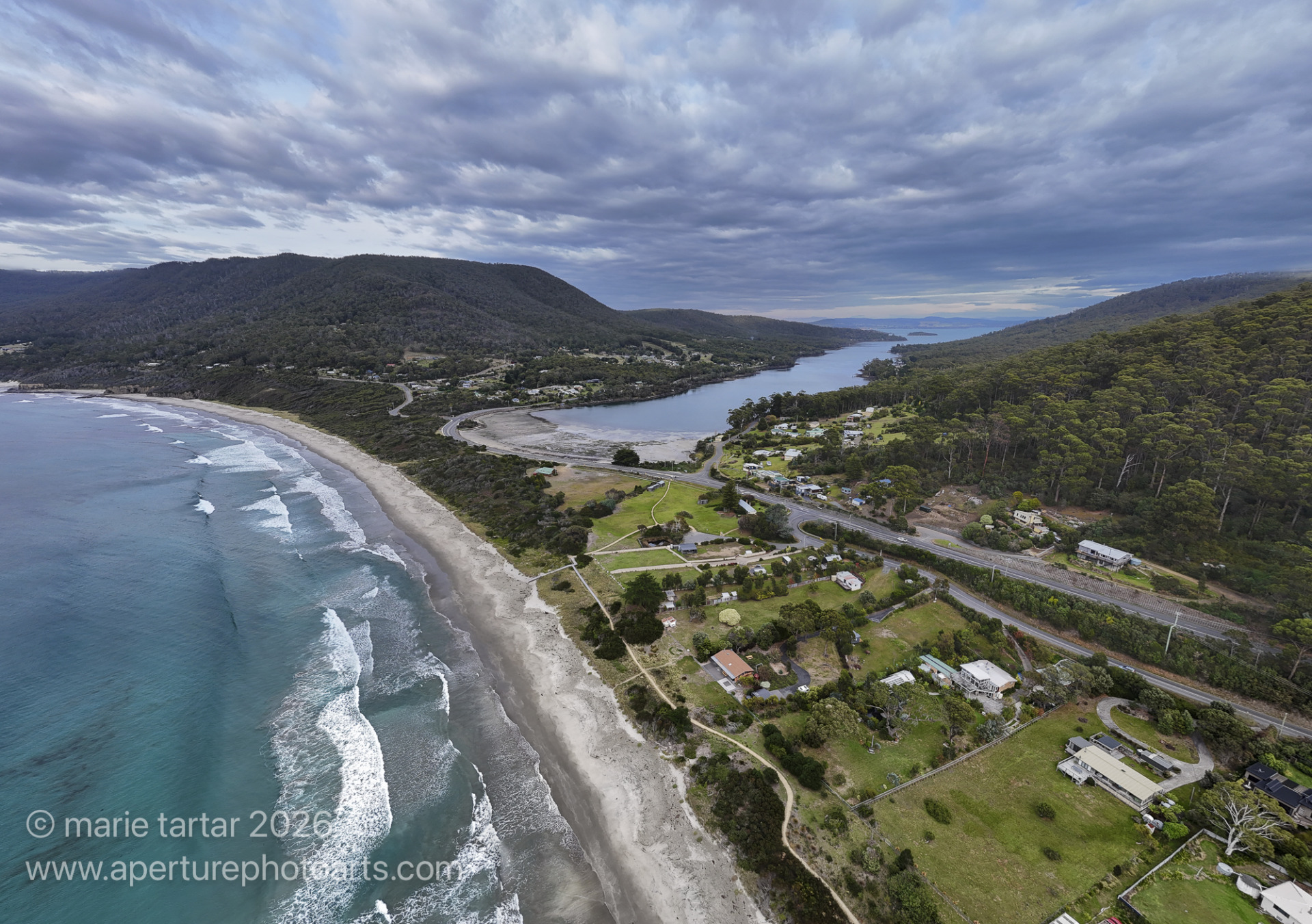
Looking south, Eaglehawk Neck in the foreground and the Tasman Peninsula beyond. The narrow isthmus was put to macabre use by the British in the 1800s as the site of the Dogline, where a string of vicious dogs was positioned to detect any north-bound prisoners from Port Arthur trying to escape.
Monday, April 6, 2026
Today was our first day in Tasmania. Drey met us at 8:45 in the morning after a comfortable night at the Old Woolstore in Hobart. The rest of the group (Drey’s partner Trina, and Canadian dive store owners Connie and Dave) were already installed in Eaglehawk Neck, about an hour’s drive away. Drey had previously identified a good source for coffee, Jam Packed, near the waterfront. I split an excellent reuben sandwich with Steve on the drive to Eaglehawk Neck, with a stop at a grocery store en route for provisions.
Karen Gowlett-Holmes and Mick Baron are co-owners of Eaglehawk Neck Dive Centre, which was founded in 1991. Between them, they have decades of experience observing the local environment as a marine scientist (Karen) and long-time diver and boat captain (Mick). There was a massive die-off starting in December 2013 of formerly magnificent kelp forests which occured over a period of months. The short film Reviving Giants details their observations over the years and their efforts to revitalize the kelp forest. Karen also has a small herd of alpacas and knits with their wool. We both acquired new beanies, with grey fleece from Juliette and Antwanette and white from Neil.
It was afternoon before we were ready to head out on a dive. Although we were diving in Tasmania from a boat, it is far from the ease of live-aboard boat diving. The boat is quite small, with room for 8 divers with 2 tanks apiece and 2-3 staff. The dive center is a short drive from the dock and the hotel, but all of the gear (tanks with BCDs and regulators attached, extra tanks for second dives, rain slickers for the inevitable wind, lunches, gear bags and cameras) must be loaded into a trailer, then offloaded at the dock and onto the boat.
The plan was a 2-tank dive but Steve, Dave and I were cold after the first dive and waited on board in the wind while Drey, Greg and Connie explored Fossil Point with the 3 guides, Jacob, Pauline and Ben. We also were somewhat sated because our first dive turned up not one, but two, of the delightfully improbable and beautiful weedy sea dragons, one a male with eggs against a colorful wall at 30 feet and the other a large female in the short kelp at about 50-foot depth. Even the prospect of pot-bellied seahorses could not lure me into the water at that point. Time to pull out and charge my heated vest!
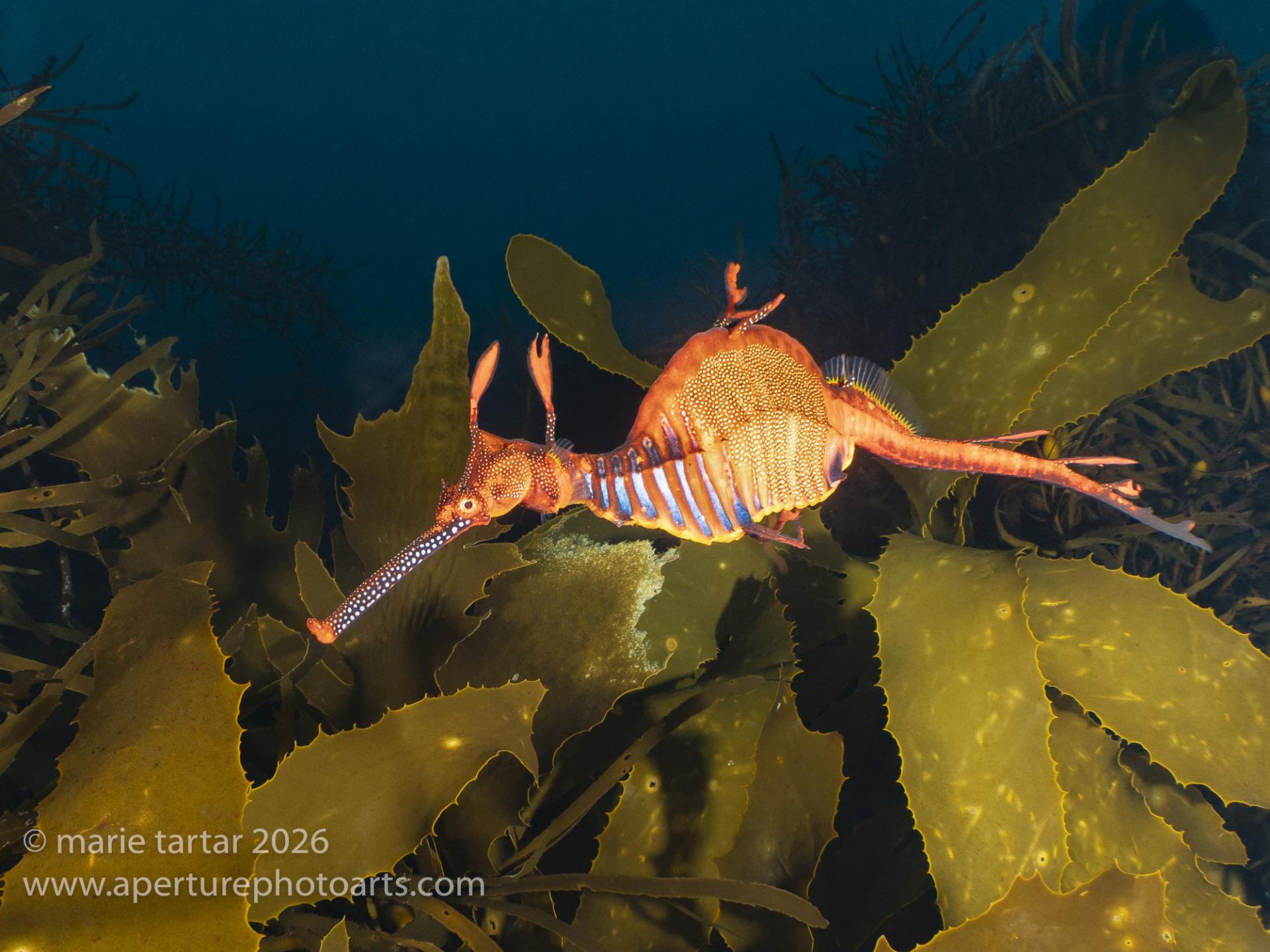
Female weedy sea dragon in kelp, Tasmania. The scientific name, Phyllopteryx taeniolatus, means “leafy fin with little bands.”
The water temperature was significantly colder than in southern Australia, around 62 degrees F (vs. 68 degrees F further north). I hadn’t felt the need for the heated vest I brought before, but resolved to start wearing it after this first foray. (Studio 1, 56 ft, 64 min)
We hadn’t been able to check in to the hotel until after the diving, with clean up taking place in the dark. As I was showering after moving into the Lufra Beachfront hotel, I heard Greg’s voice outside, saying “It’s 7:30, the kitchen’s about to close!” He read me the menu through the slightly open window. I was happy with my pan-fried Tasmanian salmon with crispy fat chats (potato wedges) and slaw. Their local oysters were delicious.
Tuesday, April 7, 2026
Today we assembled at 7:50 am for the quick run over to the dive center. Our departure was delayed by filling of larger (15 L) steel tanks with Nitrox for Steve and Greg, instead of the usual 12 L. It was smoother going on the water out to the same dive site as yesterday (Studio 1), home of the weedy sea dragons.
I added the heated vest to my retinue today, which was a tremendous help.
As I finished suiting up, with Pauline’s help, a gear problem surfaced, a big problem: one side of my modular BCD’s cumberbund had gone missing. Without it, I wouldn’t be able to keep the BCD secure around me. It had certainly been present the prior day. I wondered if it had ripped off when my rig was being hauled out of the water.
Fortunately, there was a spare BCD stored in the boat. Pauline began to move my regulator over to the spare. A problem with this solution was swiftly identified-namely, hose connector incompatibility with my Air2, my secondary air source. Out came a spare regulator, hoses were swapped and voila, I was ready to dive, finally, well after the others had left.
I waited while Pauline readied her side-mount set-up. She describes herself as a novice side-mount diver although appeared quite competent to me.
At last, we were in the water. As I descended, I briefly saw two of the local draughtboard sharks below me. Everyone was on the wall again with the male weedy sea dragon with eggs on its tail. The conditions had deteriorated, with surge and sand, a mess to shoot in. I managed only a couple of shots.
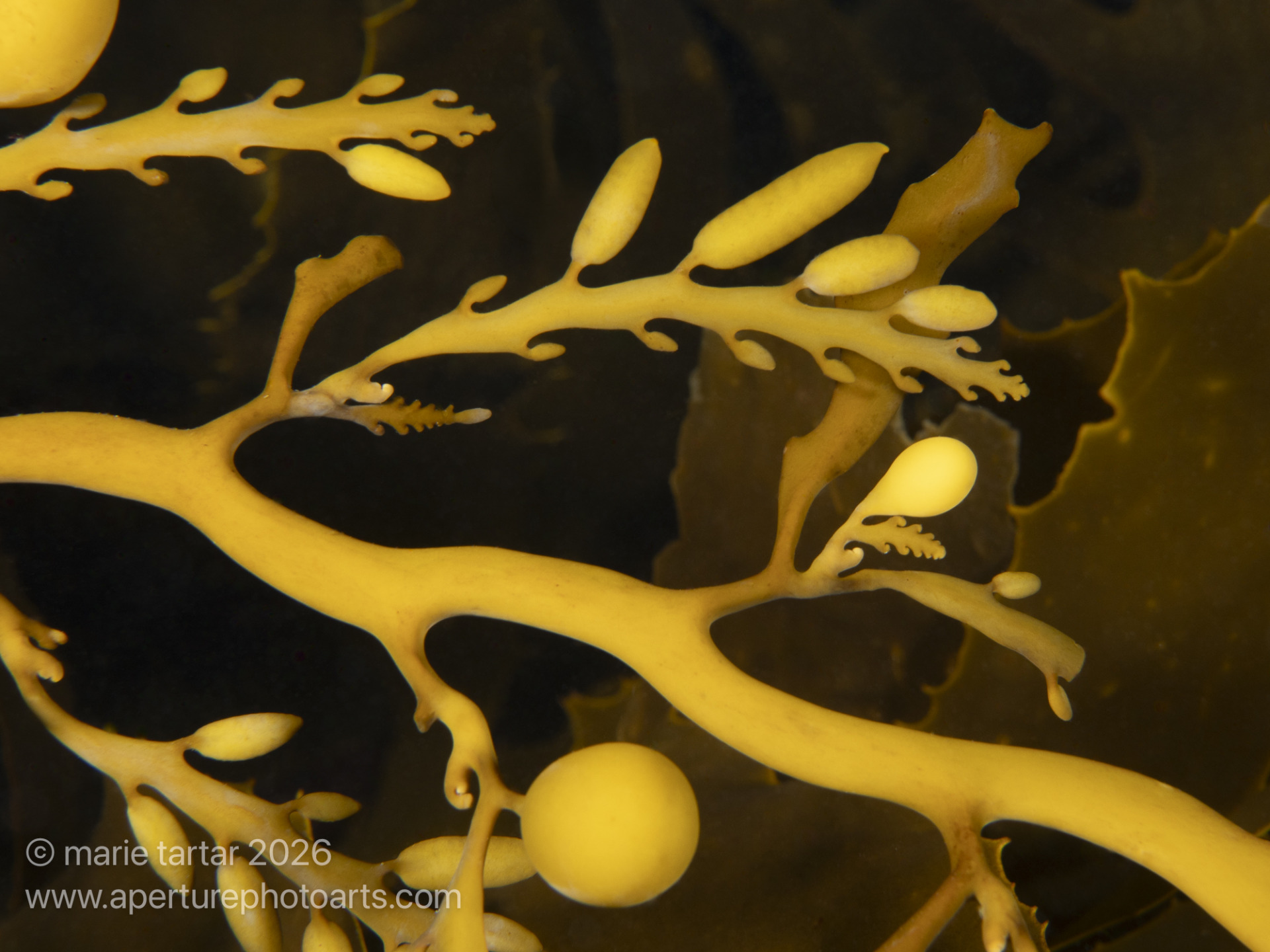
Kelp, Tasmania.
I had more trouble as I attempted to follow the group out deeper, where Tim had located a female weedy sea dragon. My head ached with sinus pressure. I could clear my ears but slowly and had trouble keeping my ears cleared in step with the changing depths. I had to add air to the drysuit and the BCD to stay level enough to give my head a chance to equalize. It was a losing battle, as I slowly drifted to the surface and ascended. (Studio 1, 48 ft 33 min)
Steve and I were prepared to sit on the boat, waiting for the others, as we each decided one dive was enough (his heated vest was safely back in San Diego and he was cold). Drey was nice enough to suggest the dive staff run us back to the dive lodge and hotel during the surface interval while the others had lunch and a bathroom break back at the dock before diving Fossil Point again.
In the evening, we returned to the dive center for a presentation by Karen on Tasmanian marine life. She is a real authority, with 13 species named for her. A BBQ dinner followed at the “Blue House”. On the menu, there was wallaby (indistinguishable from beef to me), hamburgers, chicken skewers and salads (cole slaw and green). My favorite was a delicious vegetarian sausage.
Wednesday, April 8, 2026
Mick took us on a long boat run down south, as far as Tasman Island, where the remnants of the machinery previously used to supply the lighthouse keepers can still be seen. Along the way, we admired the craggy, soaring dolerite stone cliffs, which form caves and arches along the way, including Tasman Arch.

Admiring the soaring dolerite cliffs of Tasmania, Australia’s tallest sea cliffs and were formed by Jurassic magma intrusions. Dolerite is an igneous rock, formed when a large amount of subsurface material melted during the break-up of the former supercontinent of Gondwana, starting about 170 million years ago.
Near two particularly statuesque formations, Cathedral and Totem pole, a pair of climbers were securing their small boat as they prepared to ascend the completely vertical Totem pole obelisk.
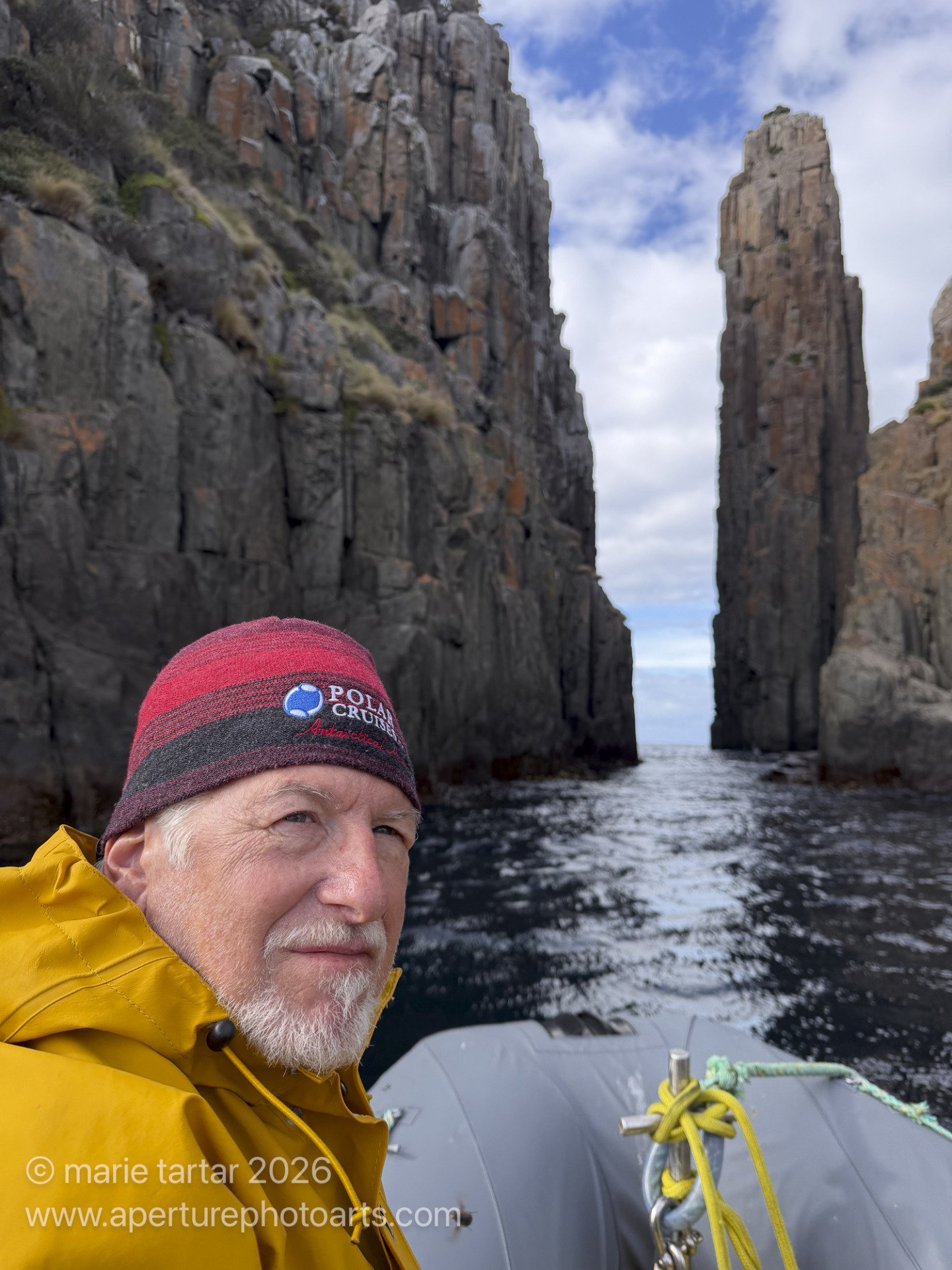
In the background, the appropriately named Totem Pole, a destination for brave and skilled climbers!
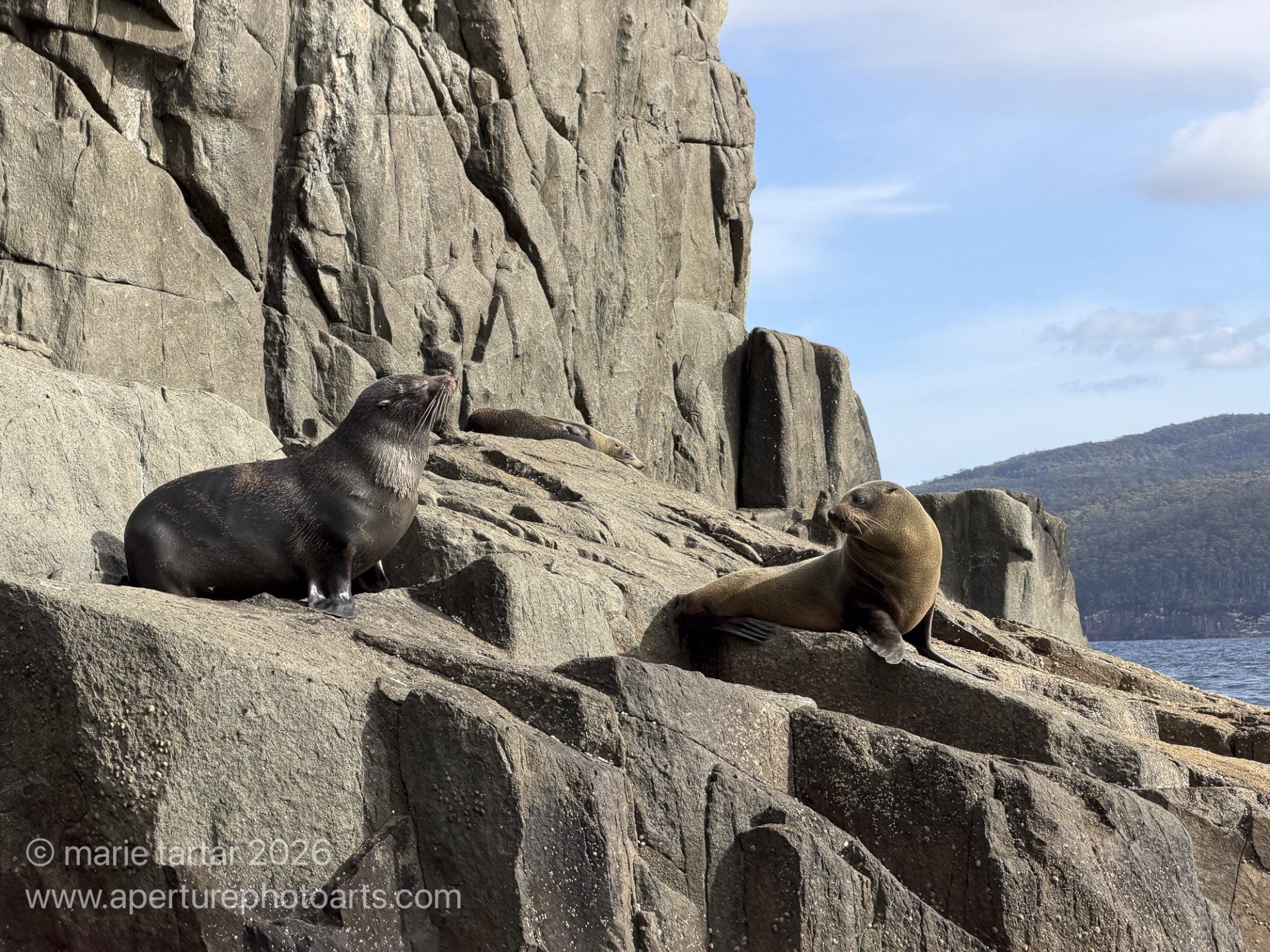
These Tasmanian pinnipeds did not stampede into the water as we approached, so I think they are long-nosed New Zealand fur seals.
Along the way, we passed several clusters of New Zealand fur seals (long-nosed), as well as a group of the larger Australian fur seals, who promptly stampeded into the water.

After the stampede of Australian fur seals into the water, there were a few brave souls remaining on the rocks.
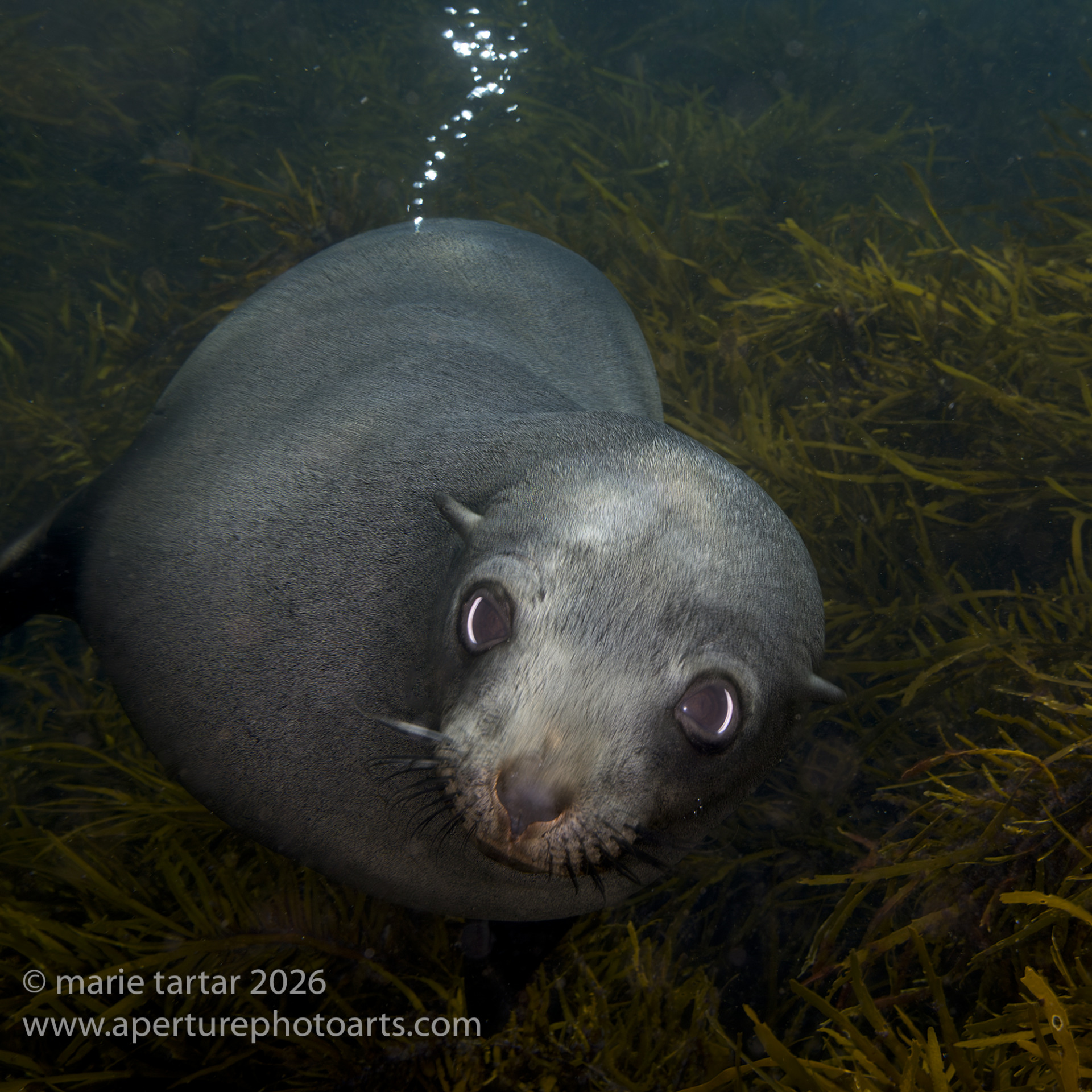
Thinking we were returning to the lair of the weedy sea dragon, I was prepared with a macro lens, definitely not the set-up I would have chosen for pinnipeds!
Mick hoped to take us to a newly recognized “secret” site but it was assessed and the rolling unpredictable waves coming in made it untenable. We ended up back at one of Tim’s favorite sites, Cape Huoy.
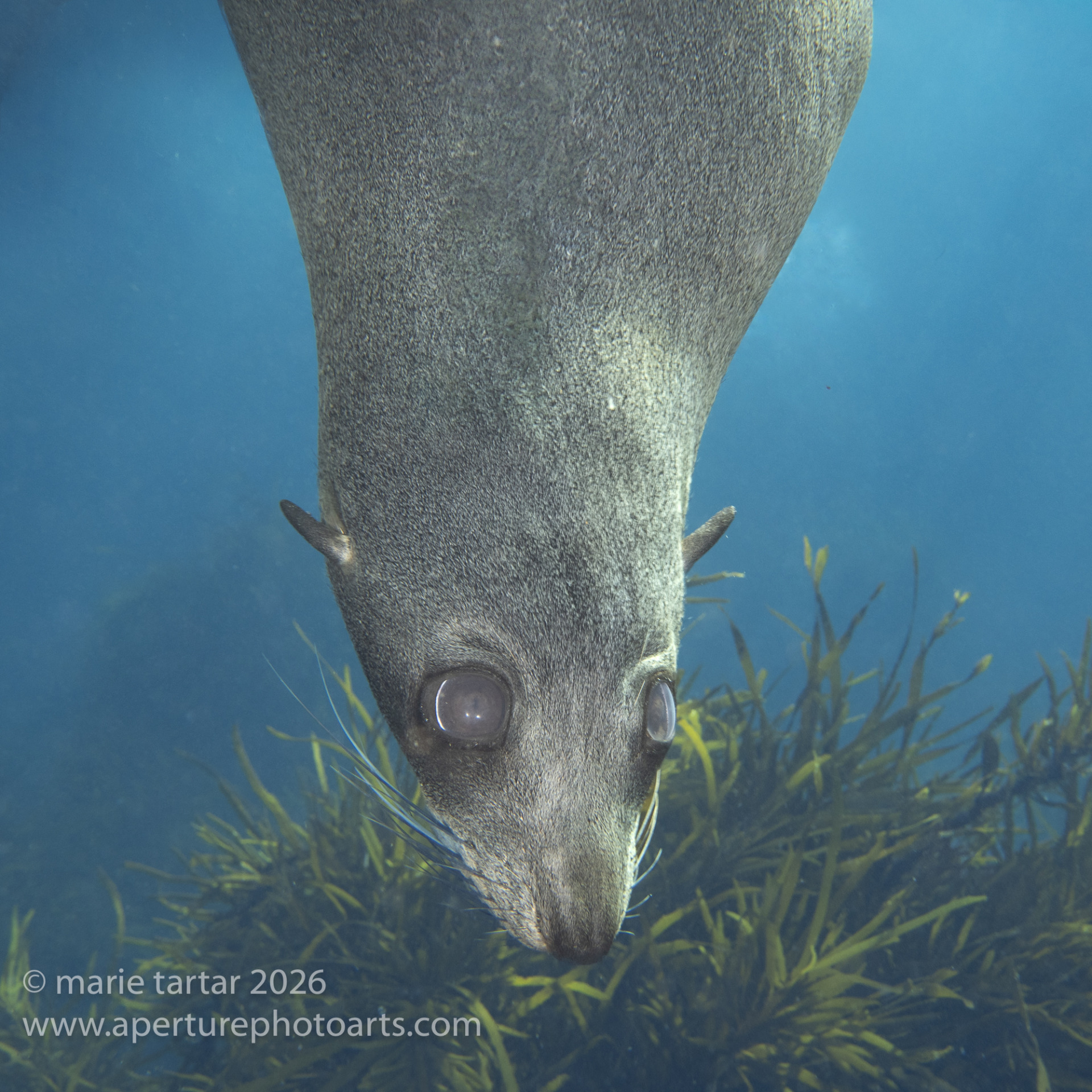
Hanging upside down seems to be a preferred behavior of fur seals.
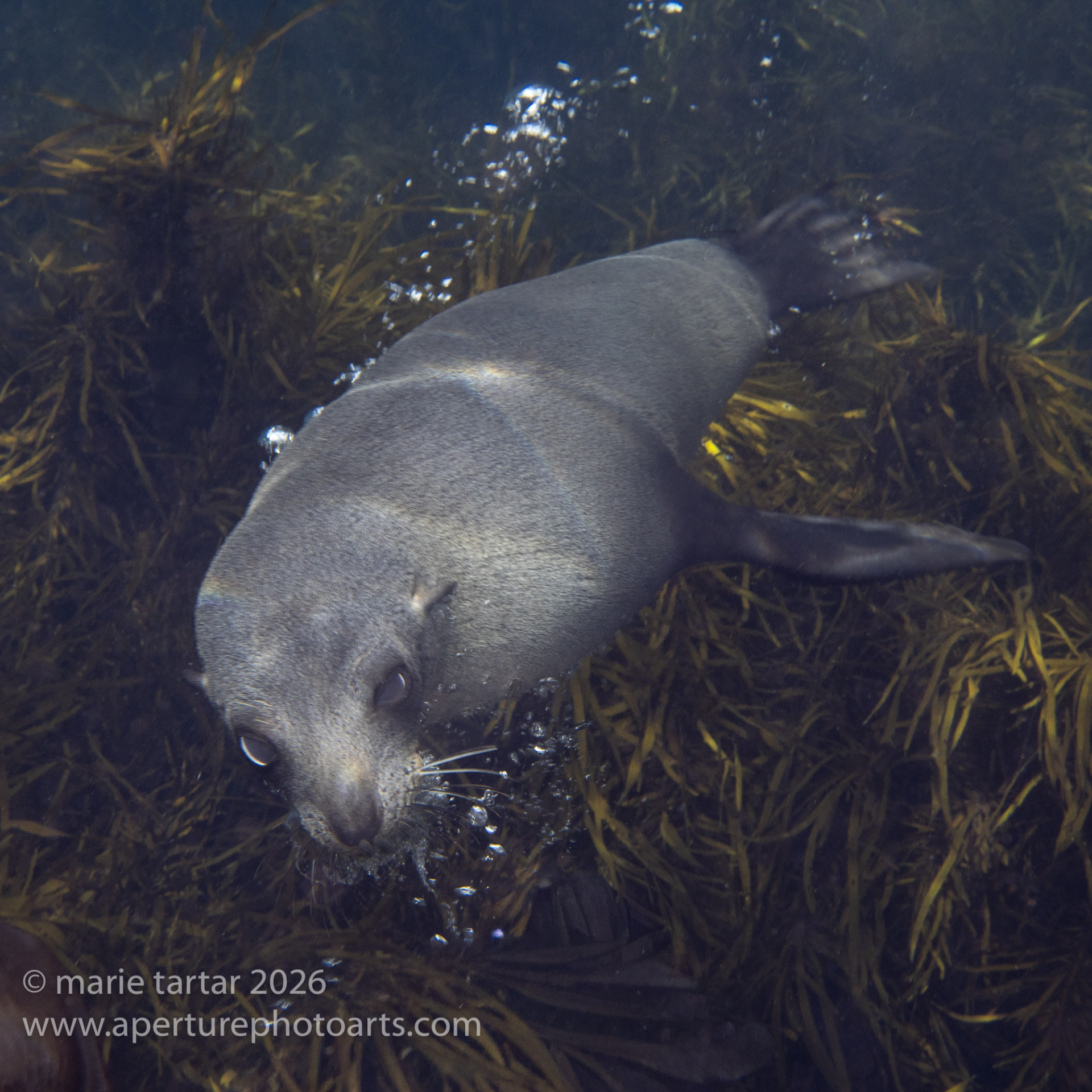
The fur seals were indeed zipping around in the water. It was very shallow (mostly less than 10 feet) and the purples and golds of the algae and kelp resembled California dive sites. Meanwhile, Tim located a weedy sea dragon away from the shore in deeper water. Mick towed Steve and me to where Jacob was holding vigil, with an inflated SMB. Apparently, he had been waiting quite a while, as he was nearly out of air and was ascending when we arrived. (Cape Huoy, 15 ft, 42 min)
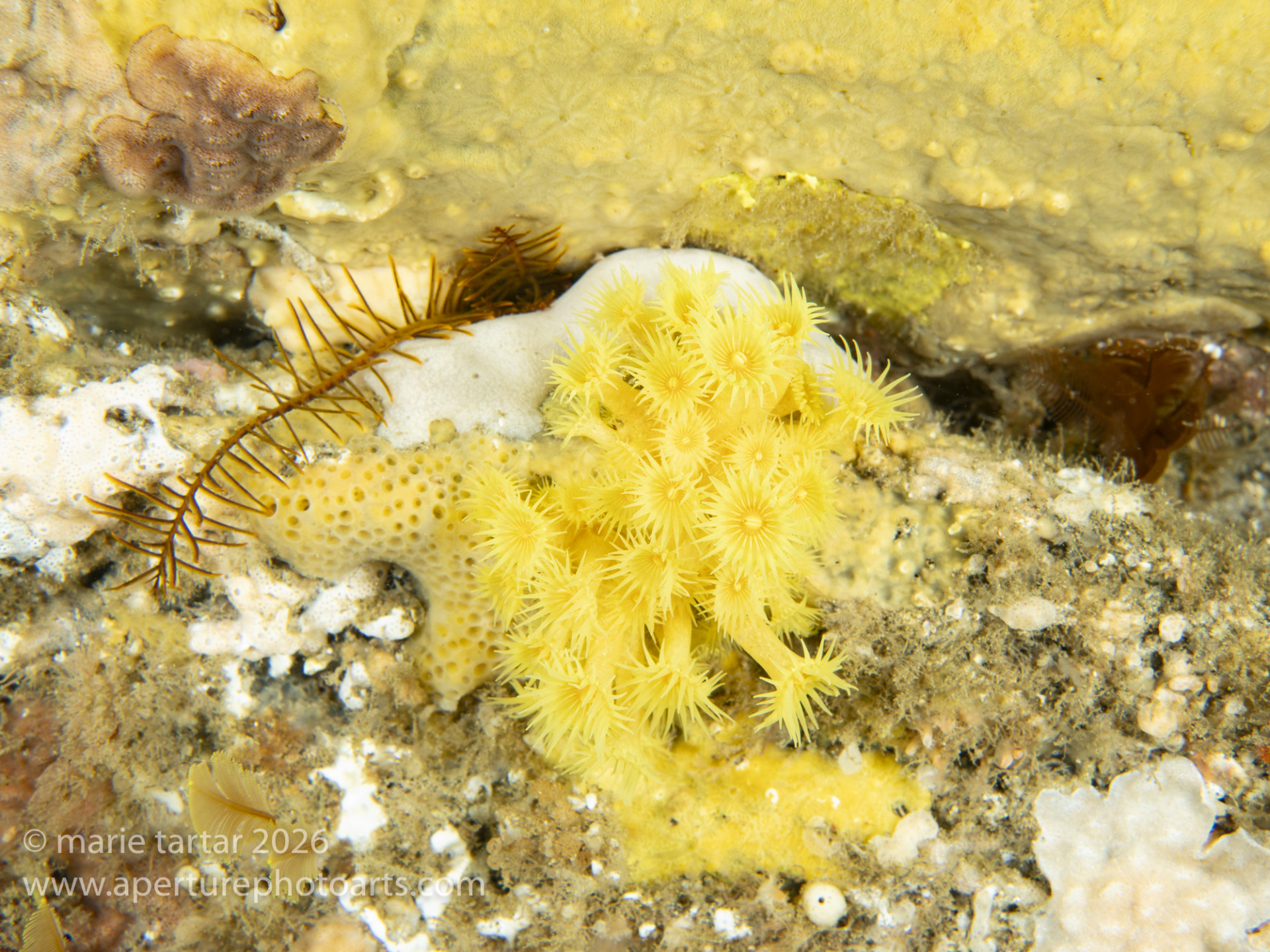
Invertebrates are abundant in cold Tasmanian waters: sponges coat the walls and a crinoid arm protrudes from a crack. A cluster of colonial zoanthids (Parazoathus sp.) forms a bouquet of beauty.
Our second dive, Cathedral Cave, was further back towards home in Waterfall Bay and quite an adventure. From a large cathedral room, there are multiple tunnels leading into the cliff. Steve elected to sit out this dive. I was very glad it was guided, as there are quite a few passages. It was quite surgy inside and the water hammer pounding of the surf against the rocks reverberated underwater. There was nice invertebrate life on the walls, but it was dark and not a time to lose the others so I did not pause to take any shots. At one point down a long narrow corridor, I found myself at a triple fork. The person in front of me (I think Greg) was nowhere to be seen. The straight passage forward dived down and looked narrow enough to potentially be stuck. I paused and looked around. Fortunately, Jacob came along and gestured to take the hard left. I think this was a feature called Revelation Bend, reached after passing through Skull Cave. Some of the other portions of this system have rather sinister names, including Devil’s Tonsils and Purgatory Passage. (Cathedral Caves, 67 ft, 44 min).
For dinner back at the Lufra hotel, I again elected the Tasmanian salmon, not quite as savory as before, but the local oysters indulged in by me, Greg, and Dave were again briny and refreshing.
Thursday, April 9, 2026
The original plan was to do a single long shallow dive at Handfish Beach looking for the rare and tiny handfish, a type of frogfish, on the way back to Hobart in two days. Because of the weather forecast, the plan was changed for this dive to be today. Neither Steve nor I was crazy about the idea of driving an hour back to Hobart for a single dive and we hadn’t even had a chance to walk across the street to check out the tessellated pavement at the beach, so taking the morning off appealed to both of us. While Steve slept in, I luxuriated in the lobby with a latte after walking down the path to the tile-like rocks. I flew the drone up and down the coast and later, when the sun peeked out briefly, flew another battery’s worth.

Our hotel, the Lufra, peeks through the vegetation on the Eaglehawk Neck coast. On the beach is a geologically unique formation called Tesselated Pavement.
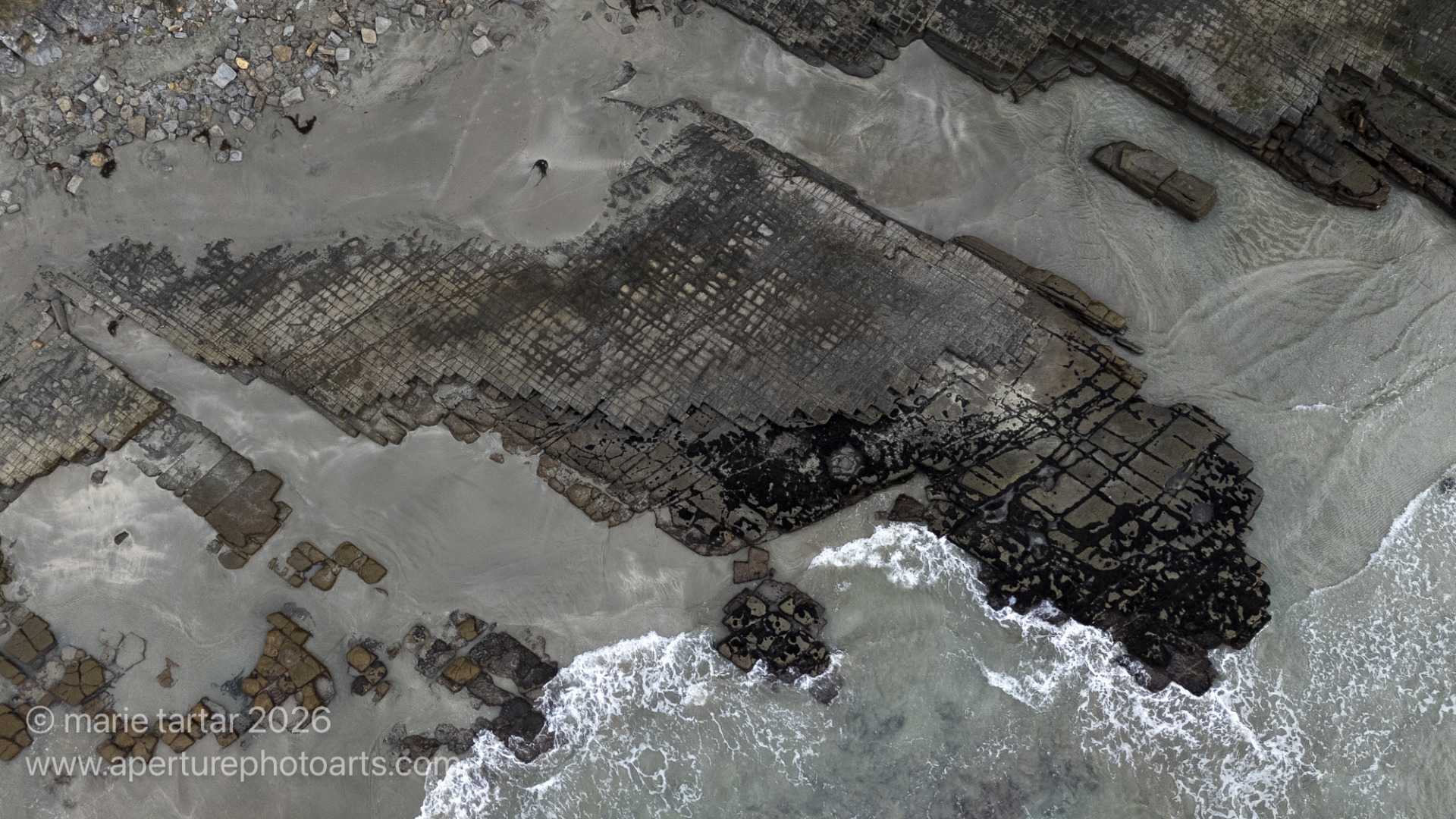
Bird’s eye view of the Tesselated Pavement. This formation story begins 290-265 million years ago, when a depression in the earth’s surface was filled by inflows from different sources, including sea ice. From 160-60 miliion years ago, this silt was covered with sedimentary deposits and compacted, becoming siltstone. This siltstone cracked due to stresses in the earth’s crust, forming the tile-like formations, which have been further carved over time by immersion in salt water and erosion. The further the distance from the sea, erosion affects the “pans” more than the cracks. Closer to the sea, erosion affects the cracks more, forming “loaves”.
Steve was on the patio, freshly showered when I returned from my coffee break and we set out on a coast walk, towards the narrow isthmus and the Dogline separating the former Port Arthur prison on the Tasman peninsula from the mainland.
Steve had caught sight of a ferocious-looking dog as we passed this site in the van the previous day while Jacob was explaining the significance of the location, and was fooled into thinking there was still a fierce dog manning the border! What he actually caught sight of is the sculpture commemorating this history.
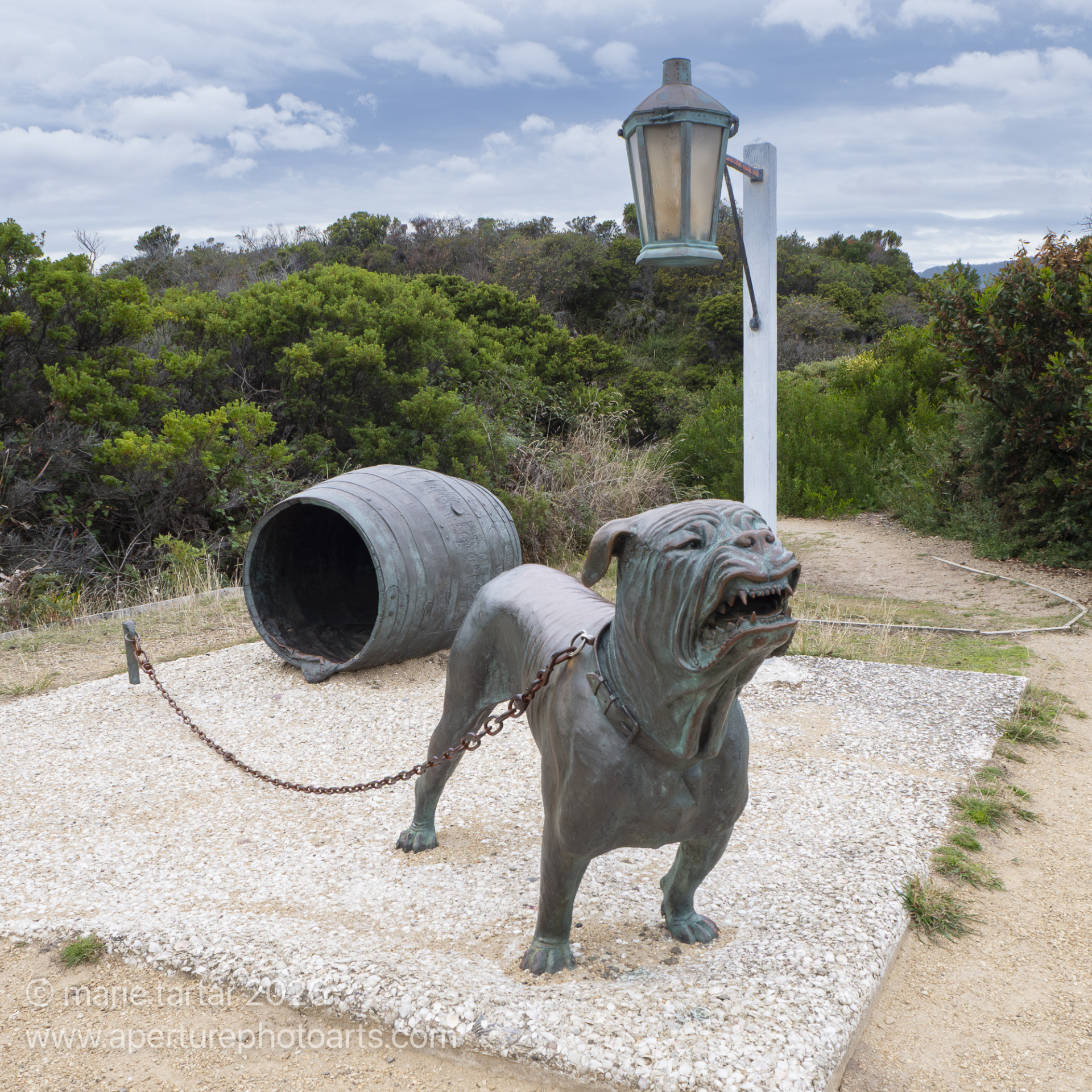
I guess from a moving vehicle one could mistake this for a ferocious dog. A line of vicious dogs, as in this commemorative sculpture, once served as a deterrent to prisoners from Port Arthur to the south who might consider escaping across the narrow isthmus separating the Tasman Peninsula from mainland Tassie.
We capped off the afternoon at the Tasmanian Devil Unzoo, where some of Tasmania’s signature wildlife can be seen in natural settings.
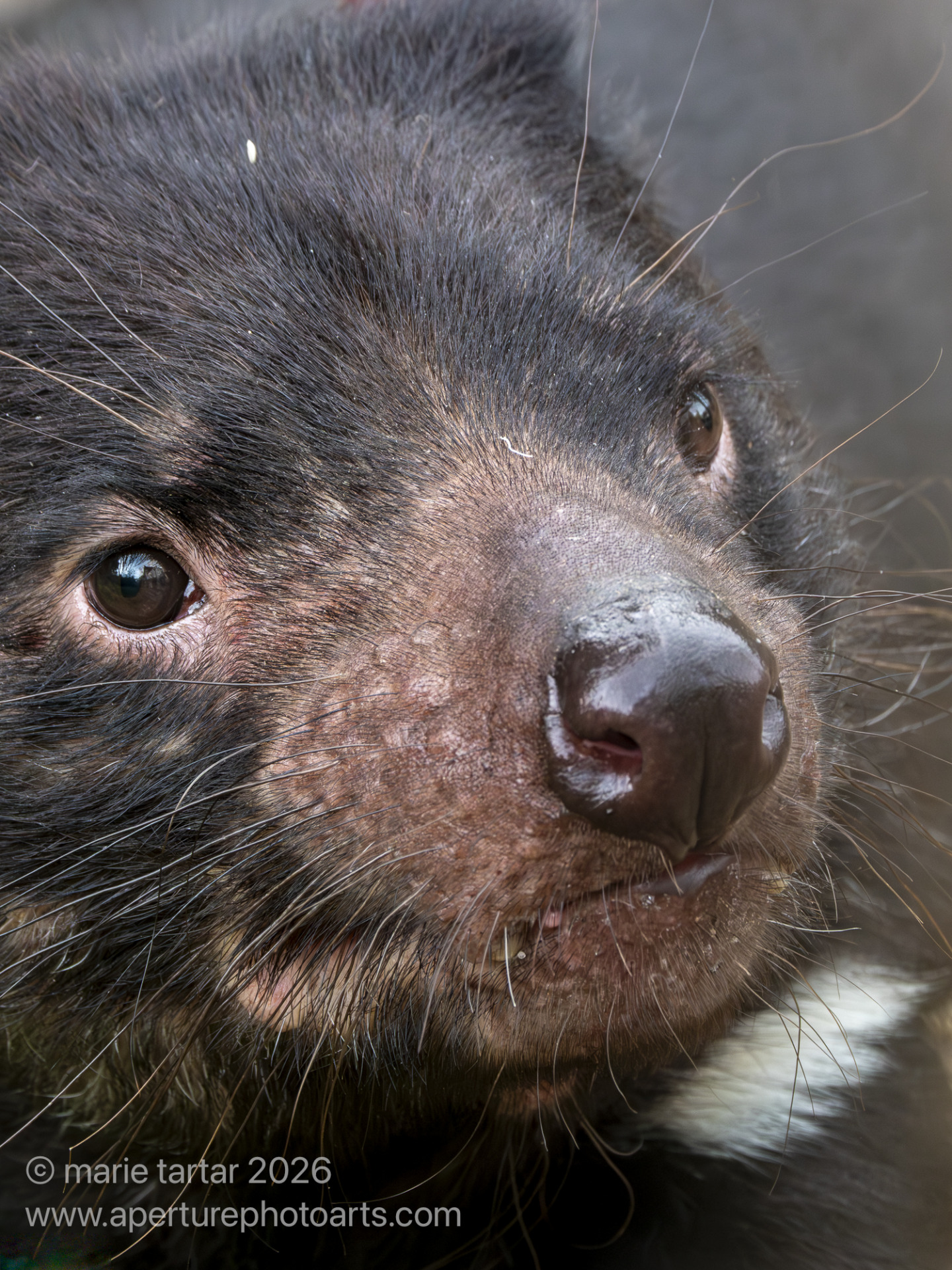
Who says Tasmanian devils are not cute? They are seriously endangered now by a contagious cancerous affliction called Devil Facial Tumour Disease (DFTD). The devils’ habit of biting during feeding and mating permits the ready transmission of cancer cells. Large growths on the face and around the mouth prevents the animal from feeding, leading to starvation, organ failure and death. In some areas of Tasmania, devil populations have declined 80% since the 1990s. The Unzoo is helping to keep the peninsula’s devil population disease-free by installing devil-proof fences at natural bottlenecks (like the isthmus at Dunalley, where the Forestiere Peninsula joins with mainland Tassie).

A more typical depiction of the Tasmanian devil, with a menacing set of fangs. The “devil” is a reference to the “demonic” nocturnal noises they make, which frightened early European settlers. They are not particularly dangerous to humans, despite the strength of their jaws and mostly feed on carrion.
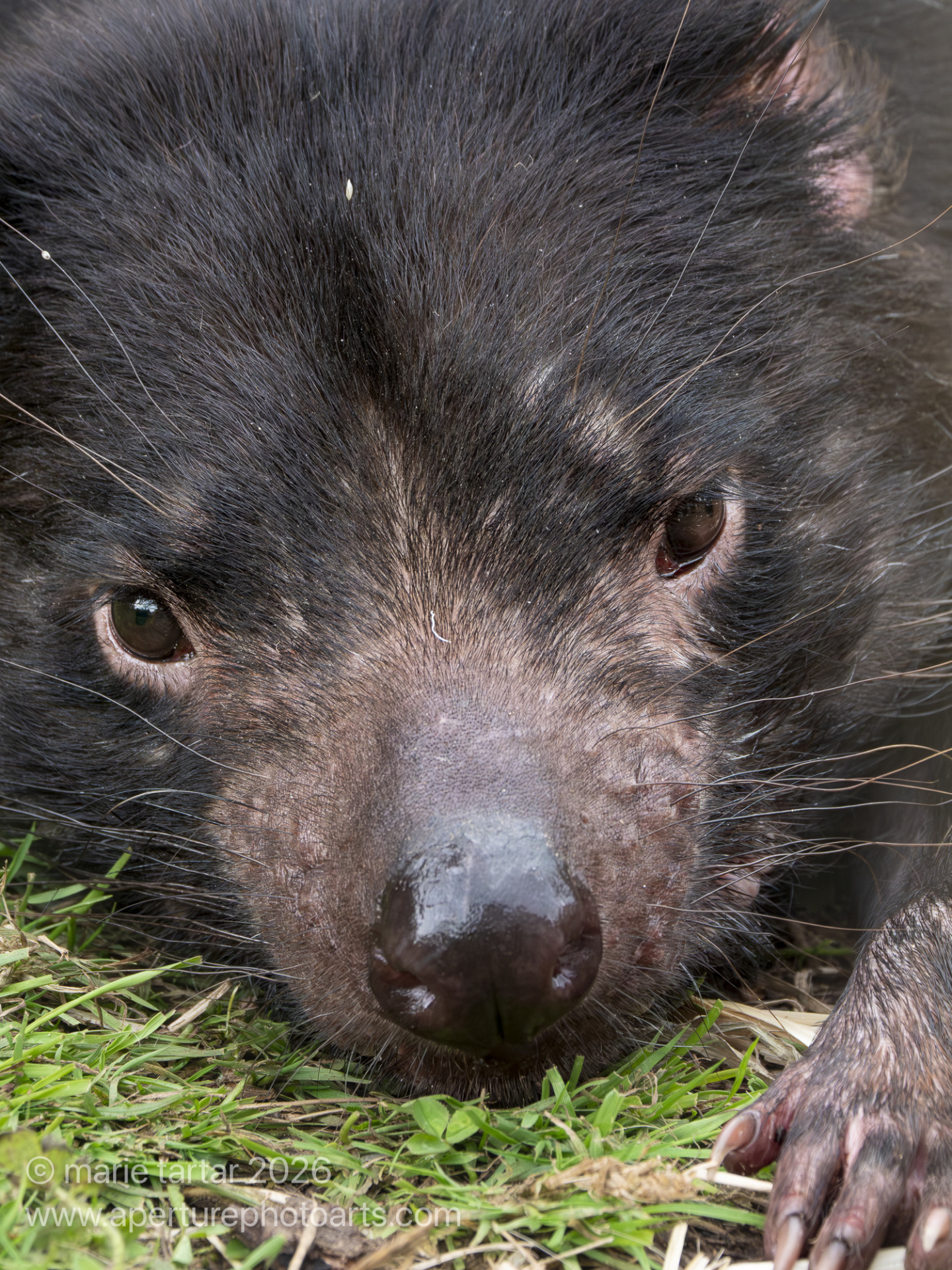
Tasmanian devils are naturally found only in Tasmania, having gone extinct on mainland Australia some 3500 years ago. They were reintroduced to mainland Australia in a sanctuary in New South Wales in late 2020.
We witnessed the feeding of Tasmanian devils (the world’s largest carnivorous marsupial), had birds nibbling seeds from our hands (green rosellas, a gorgeous parrot) and plied kangaroos with food.
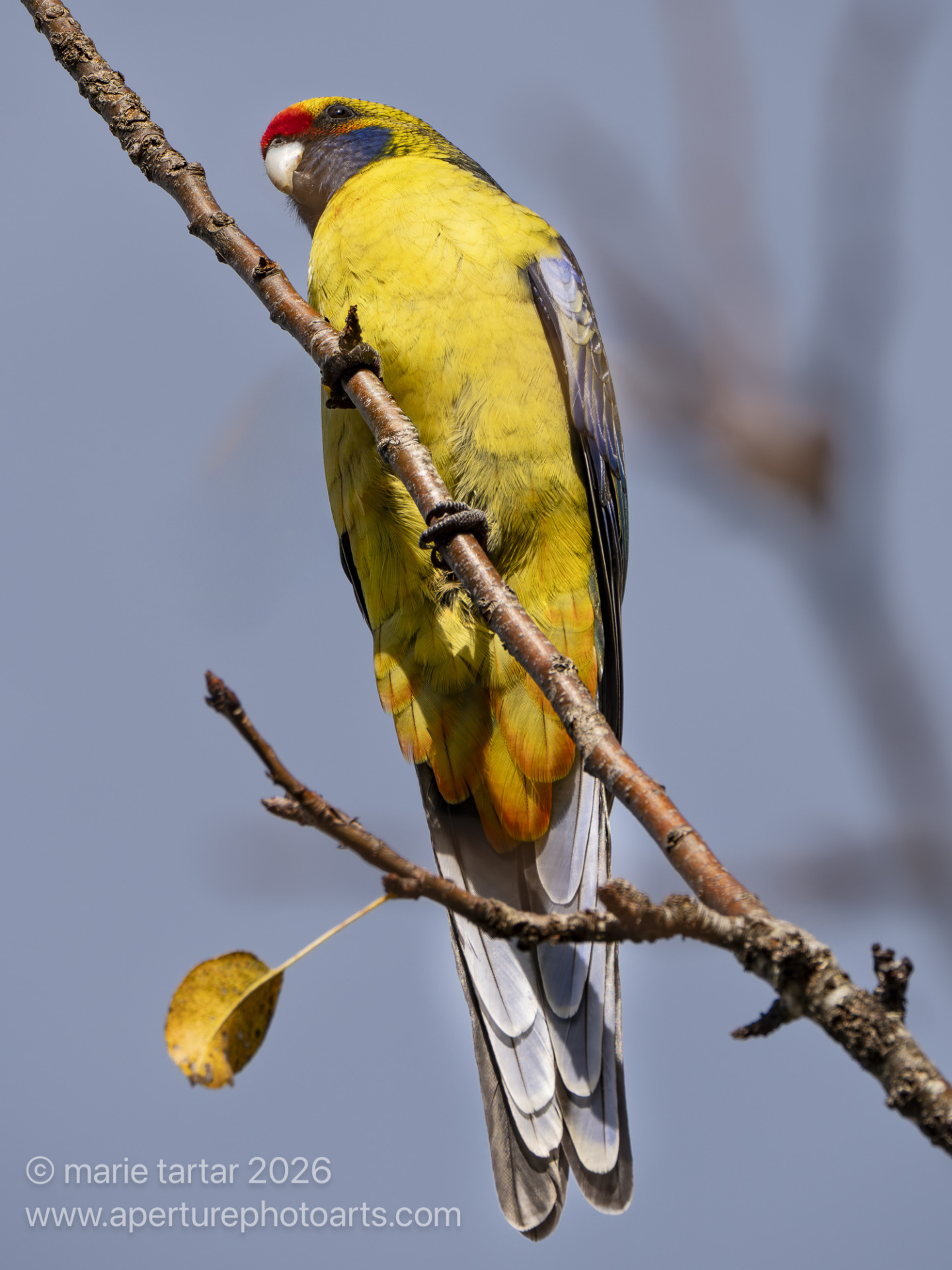
Green rosella, aka Tasmanian rosella (Platycercus caledonicus) is a parrot native to Tasmania.
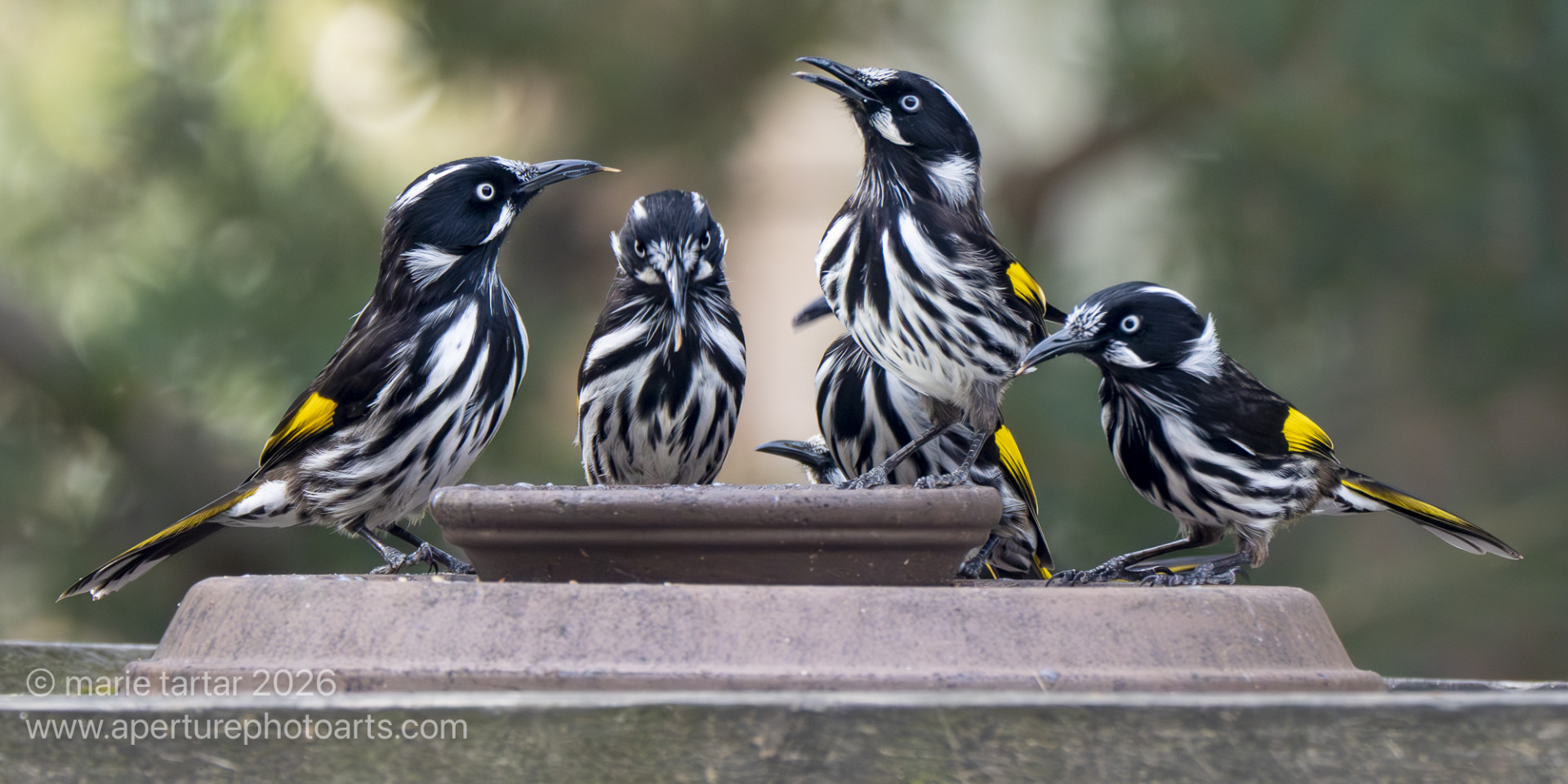
Feeding time at the Tasmanian Devil Unzoo brought a flock of New Holland Honeyeaters!
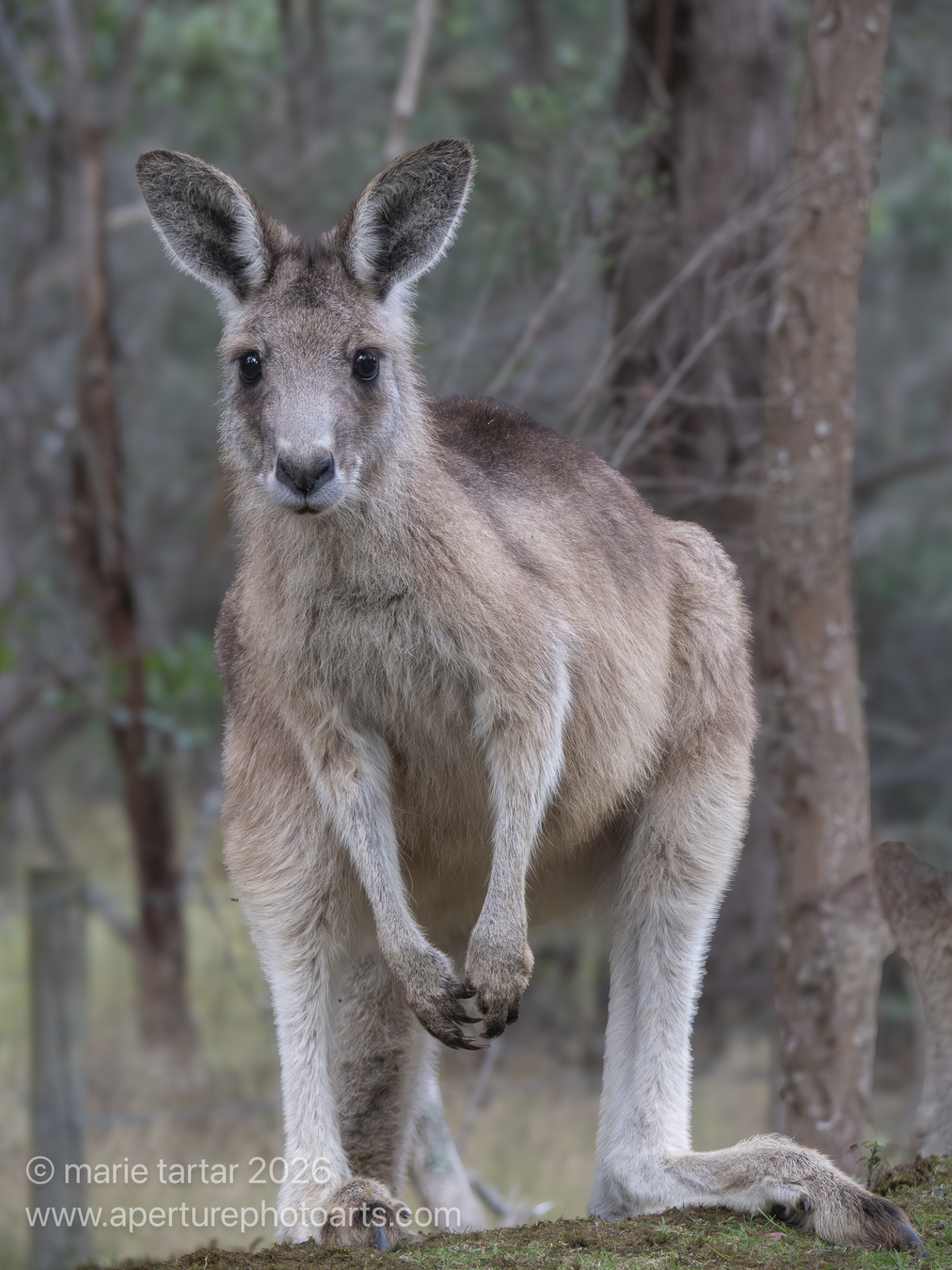
Kangaroos at Tasmanian Devil Unzoo can be fed as well.
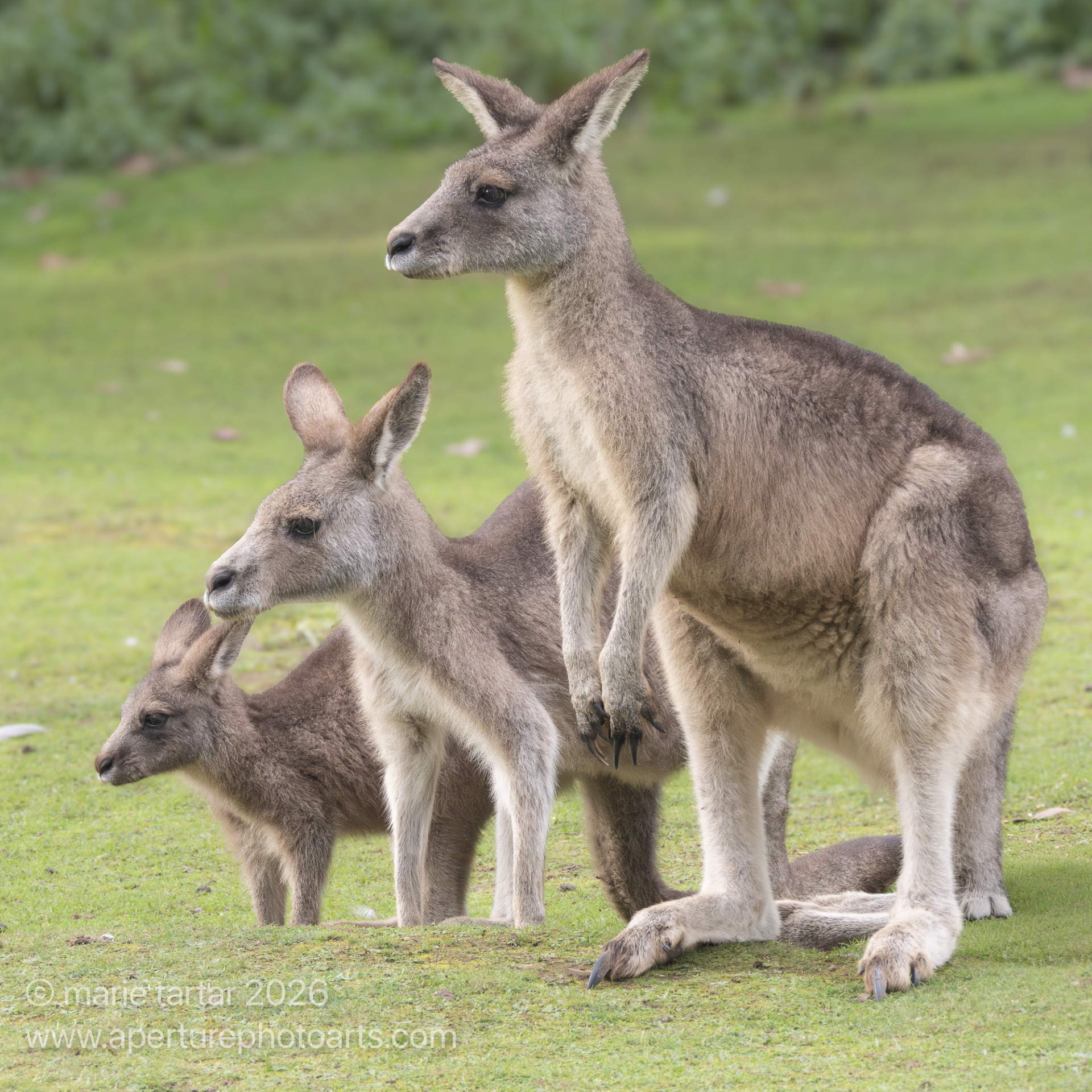
Kangaroo trio, Tasmanian Devil Unzoo.
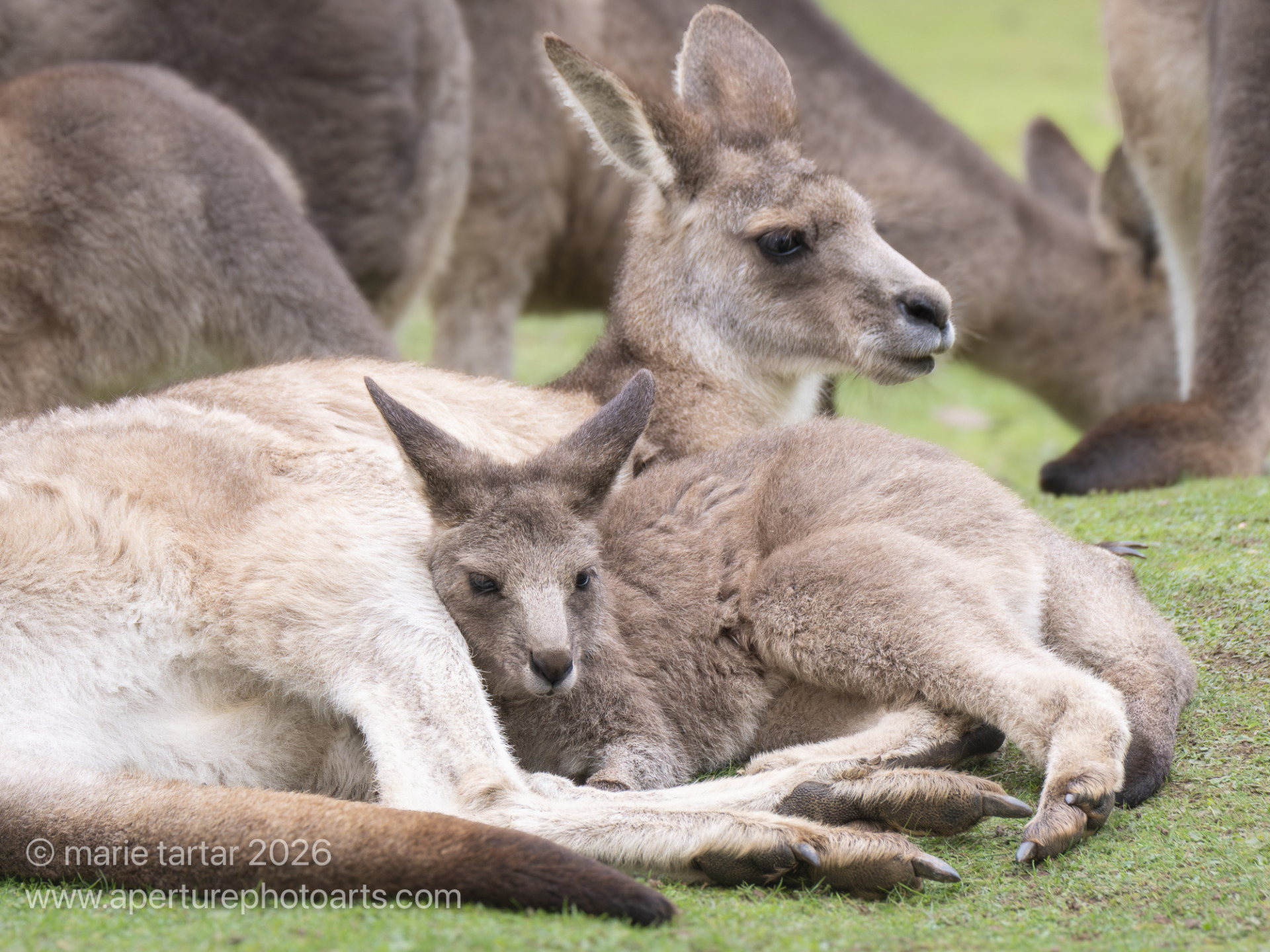
Kangaroo and large joey, Tasmanian Devil Unzoo.
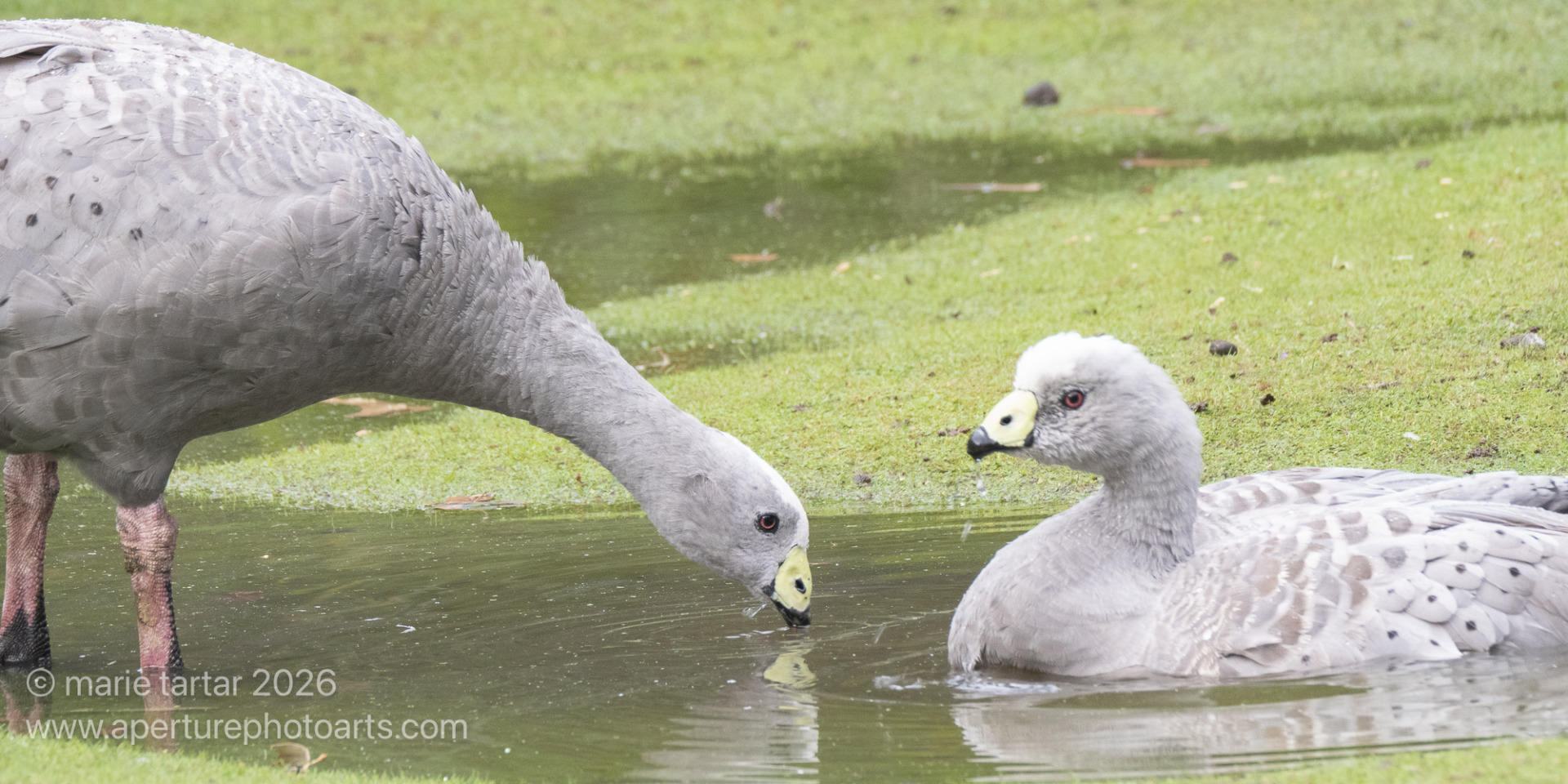
Cape Barren geese, Tasmanian Devil Unzoo.
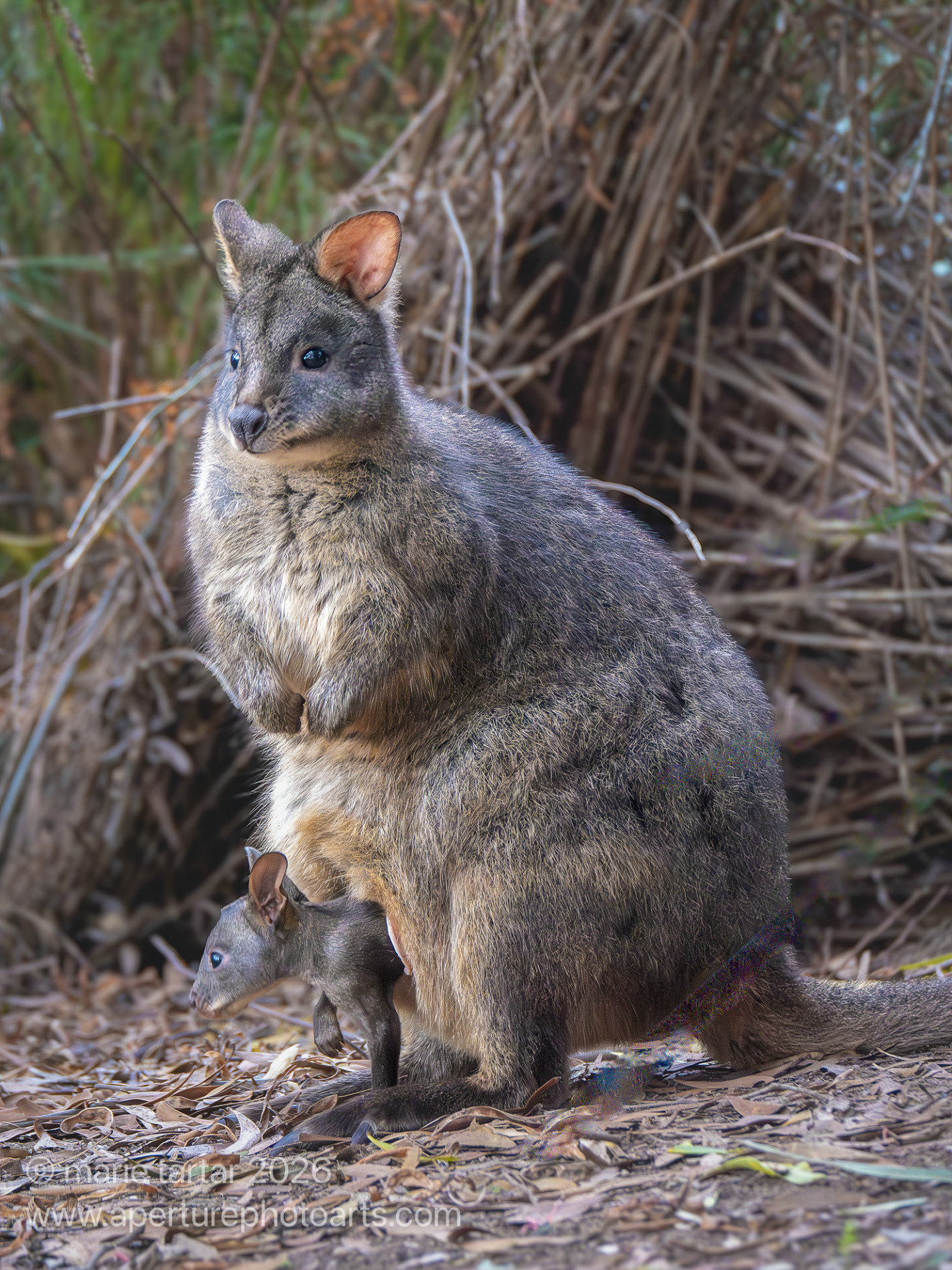
My best sighting was a pademelon (a small, forest-dwelling wallaby) with a joey.
The plan had been to eat out in the area, but we were turned away at two regional inns and ended up back at the hotel for dinner (Steve chose chicken parmigiana, while I had duck confit with mashed potatoes and broccolini. The chicken parm was such a giant mound of food that Steve later deployed the leftovers into delicious sandwiches! ).
Friday, April 10, 2026
It was windy and chilly as we departed. Mick drove us north to a wall where we opted for the calmer of two options (North Wall, Deep Glen Bay, 92 ft, 52 min).
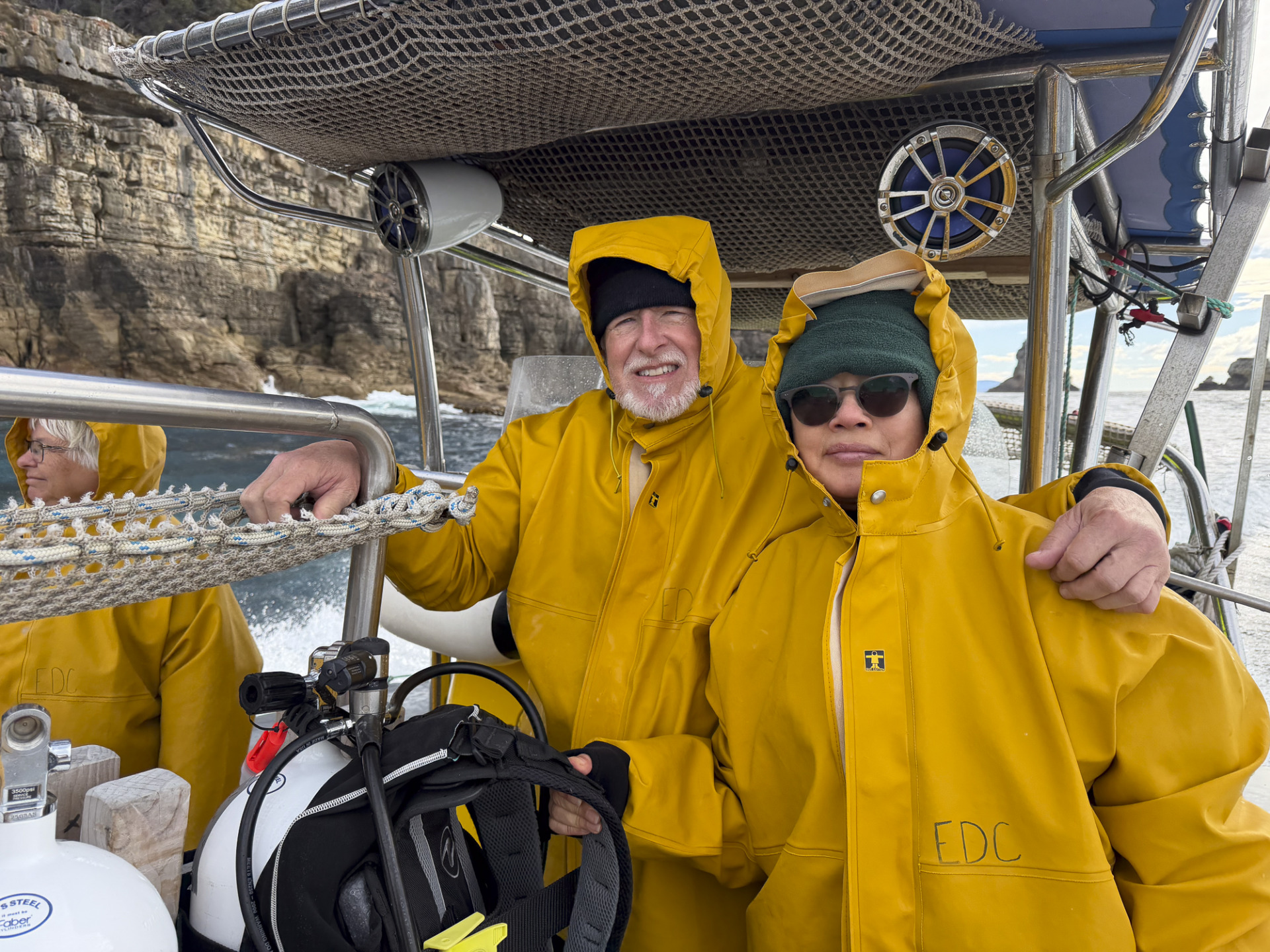
Yes, the wind and constantly changing conditions meant we were generally quite bundled up on this trip to Tasmania.
We encountered lots of color on the wall and multiple lobsters in crevices.
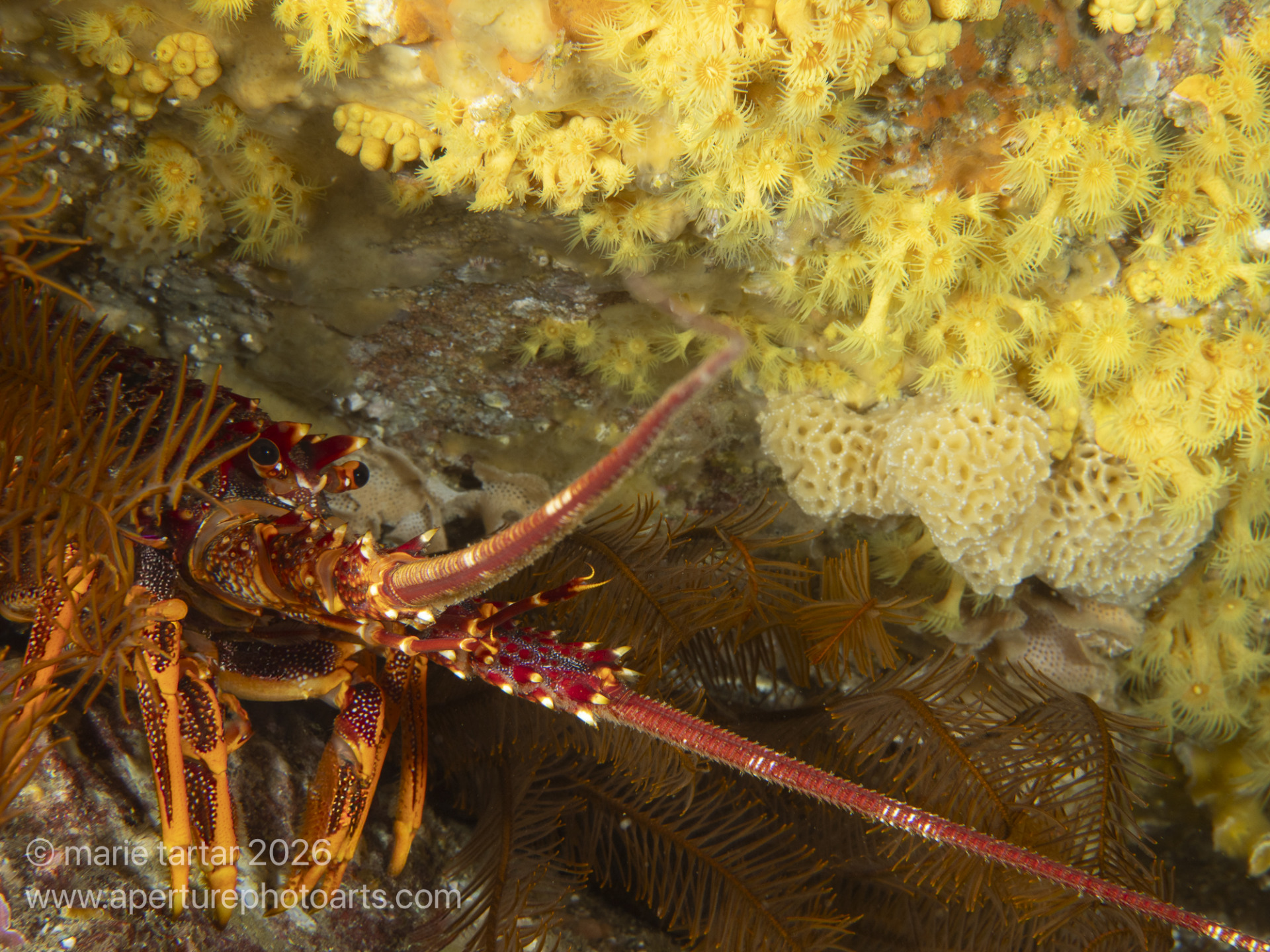
Tasmanian (Southern Rock Lobster (Jasus edwardsii)) lobsters, aka crawfish, have equally colorful homes!
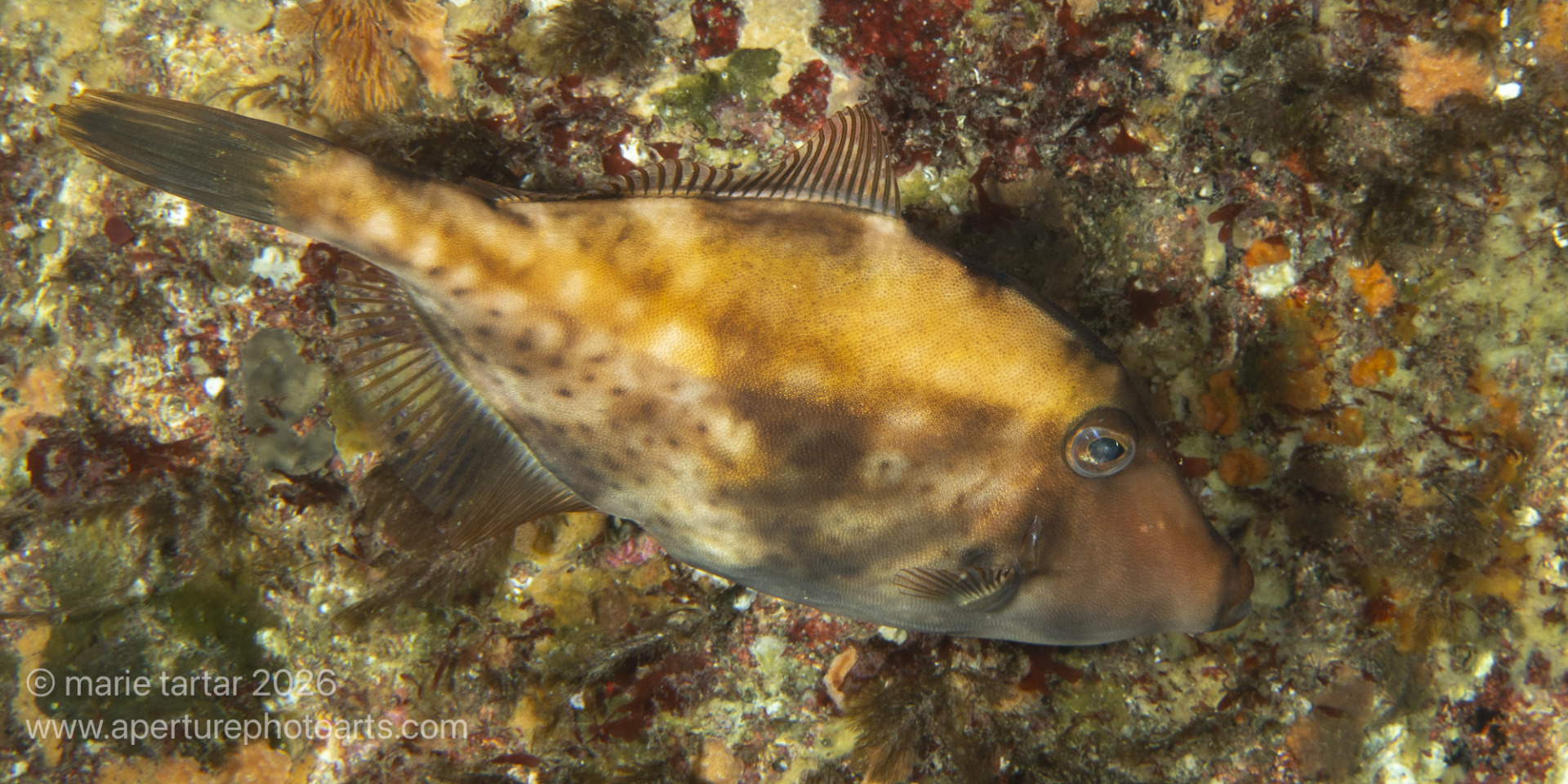
We did see some fish in Tasmania. This filefish (I think a female toothbrush leatherjacket (Acanthaluteres vittiger) blends into the encrusted wall.
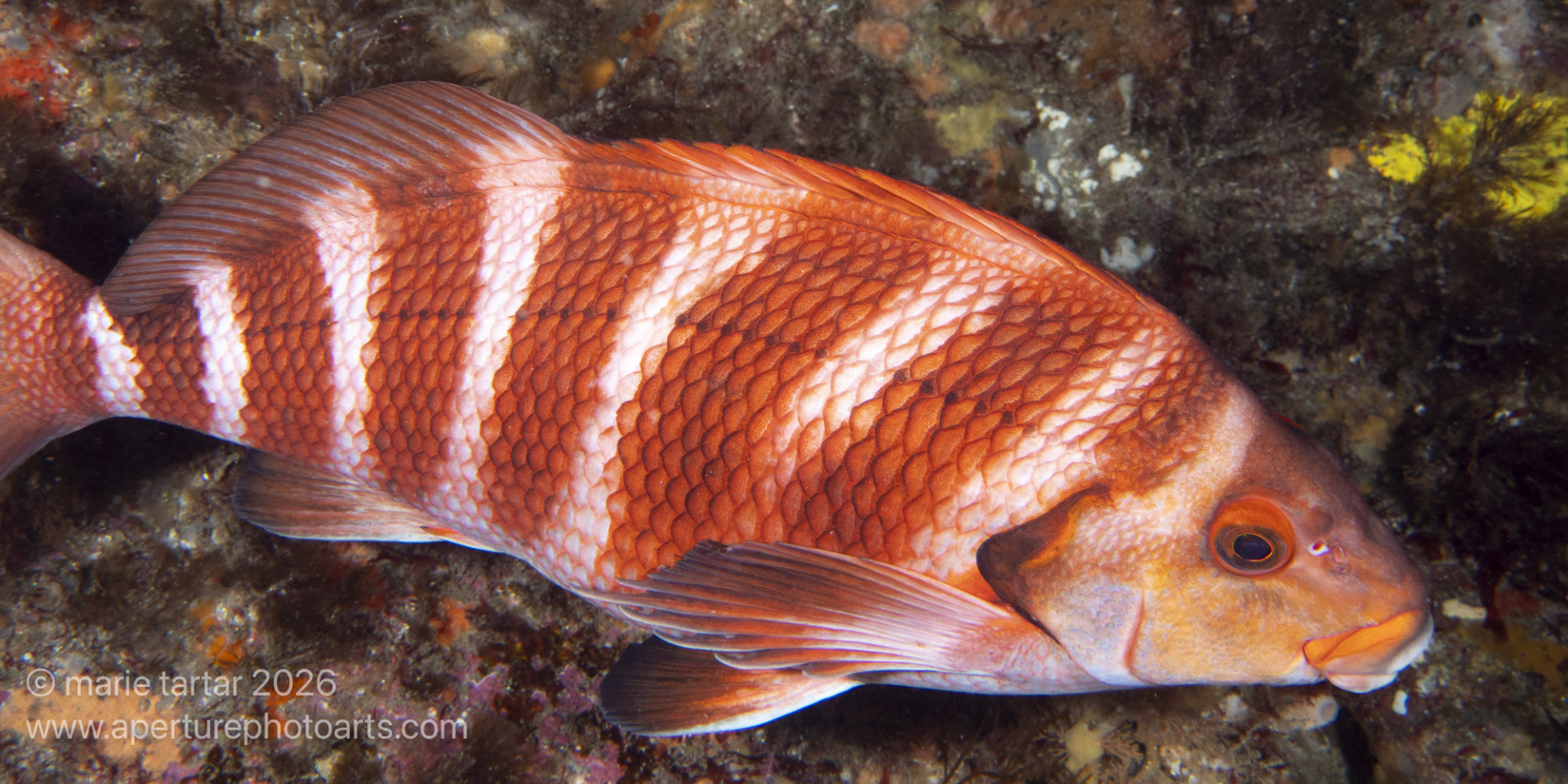
Banded morwong (Cheilodactylus spectabilis), Tasmania.
The heated vest enabled me to do both dives. It was cold enough that I had it roaring most of the time. Steve was ruing leaving his at home, enough to sit out the second dive back at Deep Glen’s Studio 1, home of the weedy sea dragon, which Tim found promptly. Connie’s strong video lights blinded us and drove the male with eggs off the wall, down into the kelp at 60 feet, where we lost it. Dave was having sinus issues and did not dive today.

Male weedy sea dragon, wearing…blue jeans? No, those are eggs (pale blue on tail).
As we were preparing to enter the water for the second dive (59 ft, 51 min), it began to rain. But no, this rain was solid, pelting us-hail!
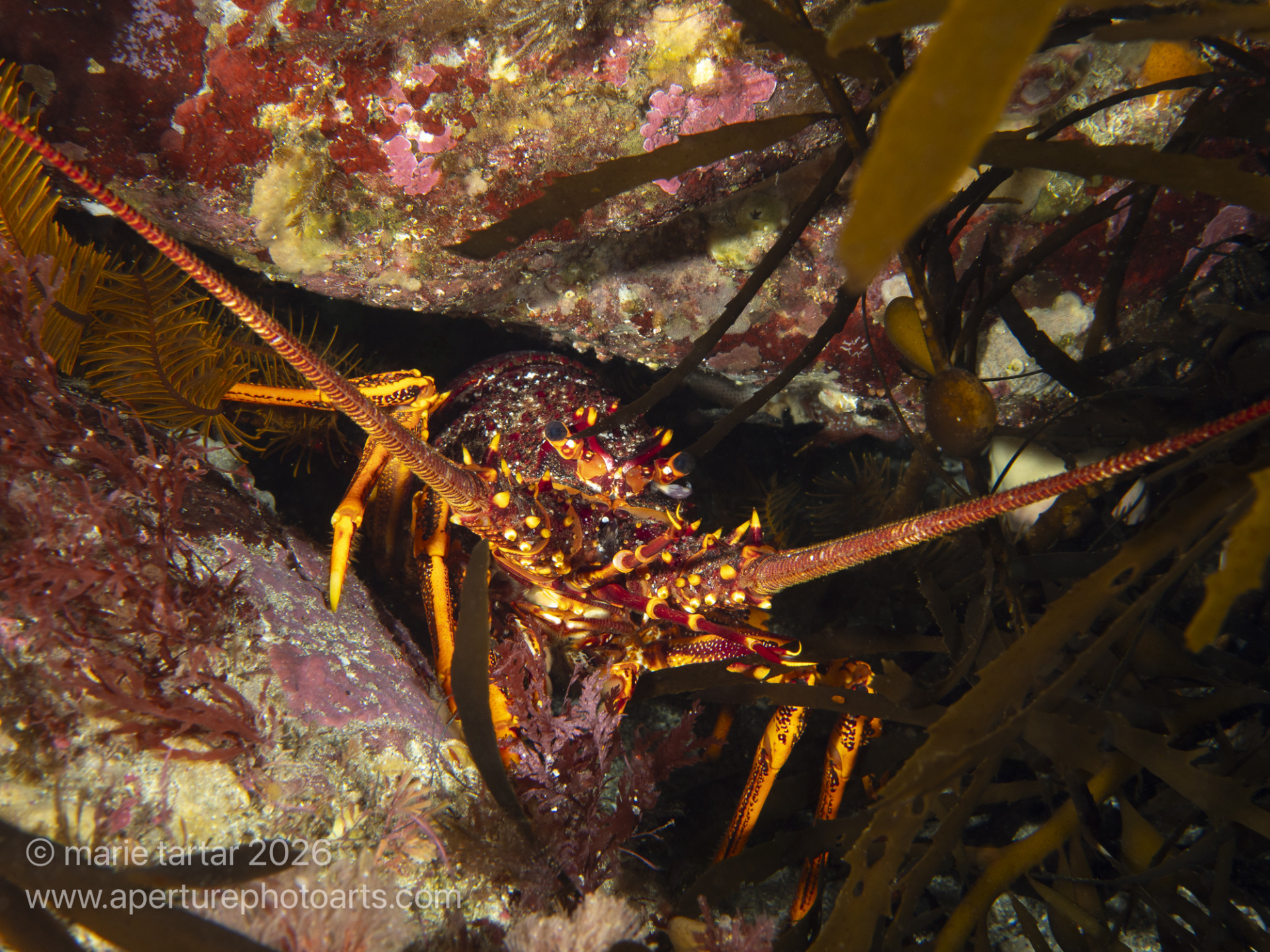
Tasmanian (Southern Rock Lobster (Jasus edwardsii)) lobsters, aka crawfish.
We did a quick turnaround after the dive day in order to visit the Port Arthur Historical Site, a former prison and WHO site. It is a remarkably idyllic setting for a prison, with gorgeous tall trees. The site is also notable for being the locus of one of Australia’s worst mass shootings, in 1996, an event that led to gun law reformation (what a concept!).
We had dinner at the Cannery in Dunalley, north of Eaglehawk Neck with Mick, Karen, Ben and Pauline (excellent local oysters, small tender abalone with garlic butter, grilled cray(fish) (the local lobster) with fries and coleslaw, Steve had red curry with vegetables).
Saturday, April 11, 2026
Steve opted out of our last day of diving. The rest of us had to pack up for the transfer to Hobart before leaving for the dive center in the morning.
Heading out from the dock, there were whitecaps and it was blowing. Ducking the spray, the conditions seemed dubious, until we escaped the harbor where it was smoother sailing.
We returned to the site of our prior day’s first dive, the deep dive, North Wall Sponge Reef at Deep Glen Bay (120 ft, 45 minutes.). Today we made it off the wall past an encrusted boulder field to an island of reef, with whip corals, sponges and lots of color. The maximum depth meant we had only a couple of minutes to admire the plenitude but not really much time for photography until we ascended into shallower depths.
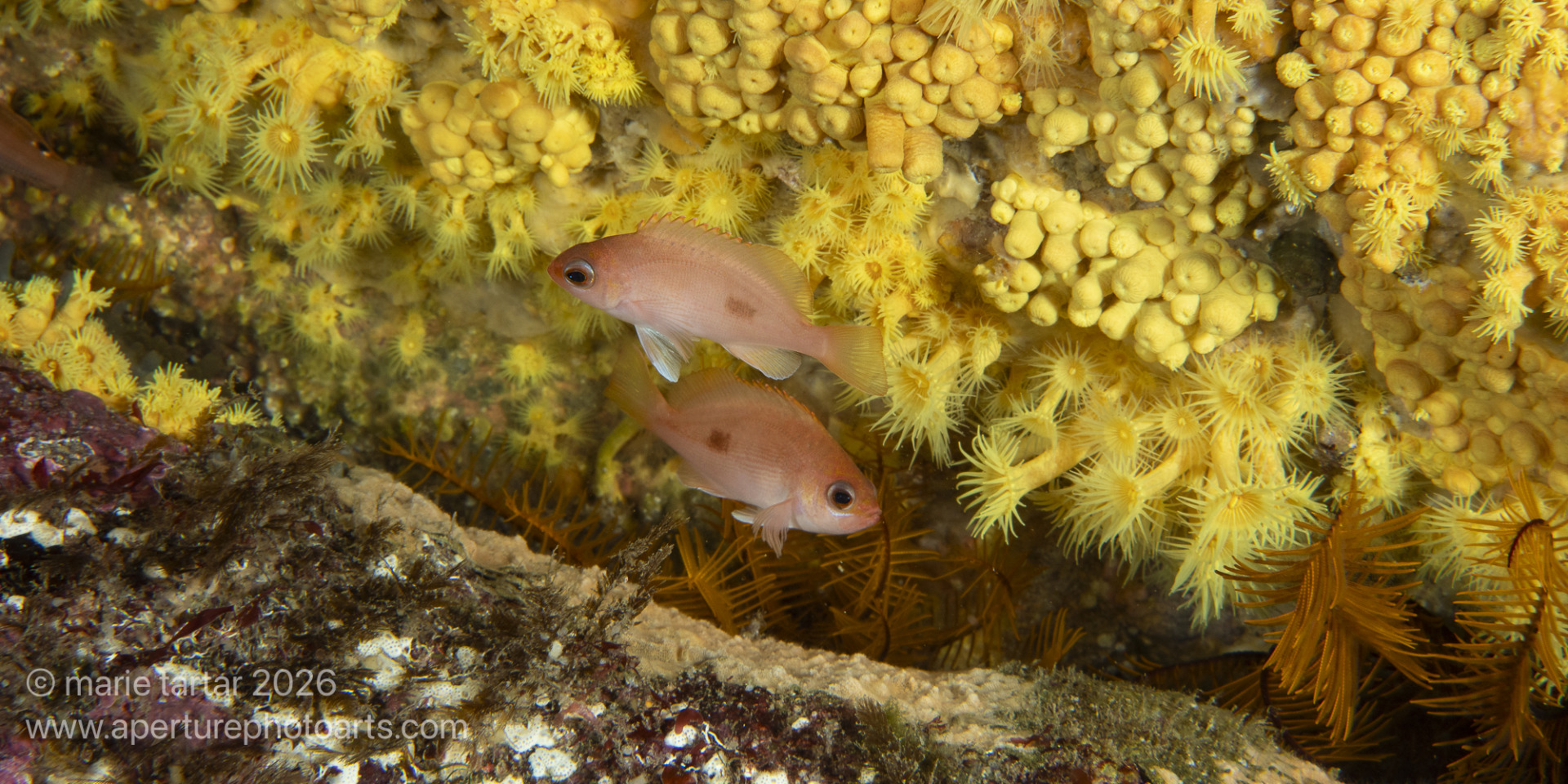
Butterfly perch (Caesioperca lepidoptera) were abundant in Tasmanian waters.

Southern hulafish (Trachinops caudimaculatus), Tasmania.
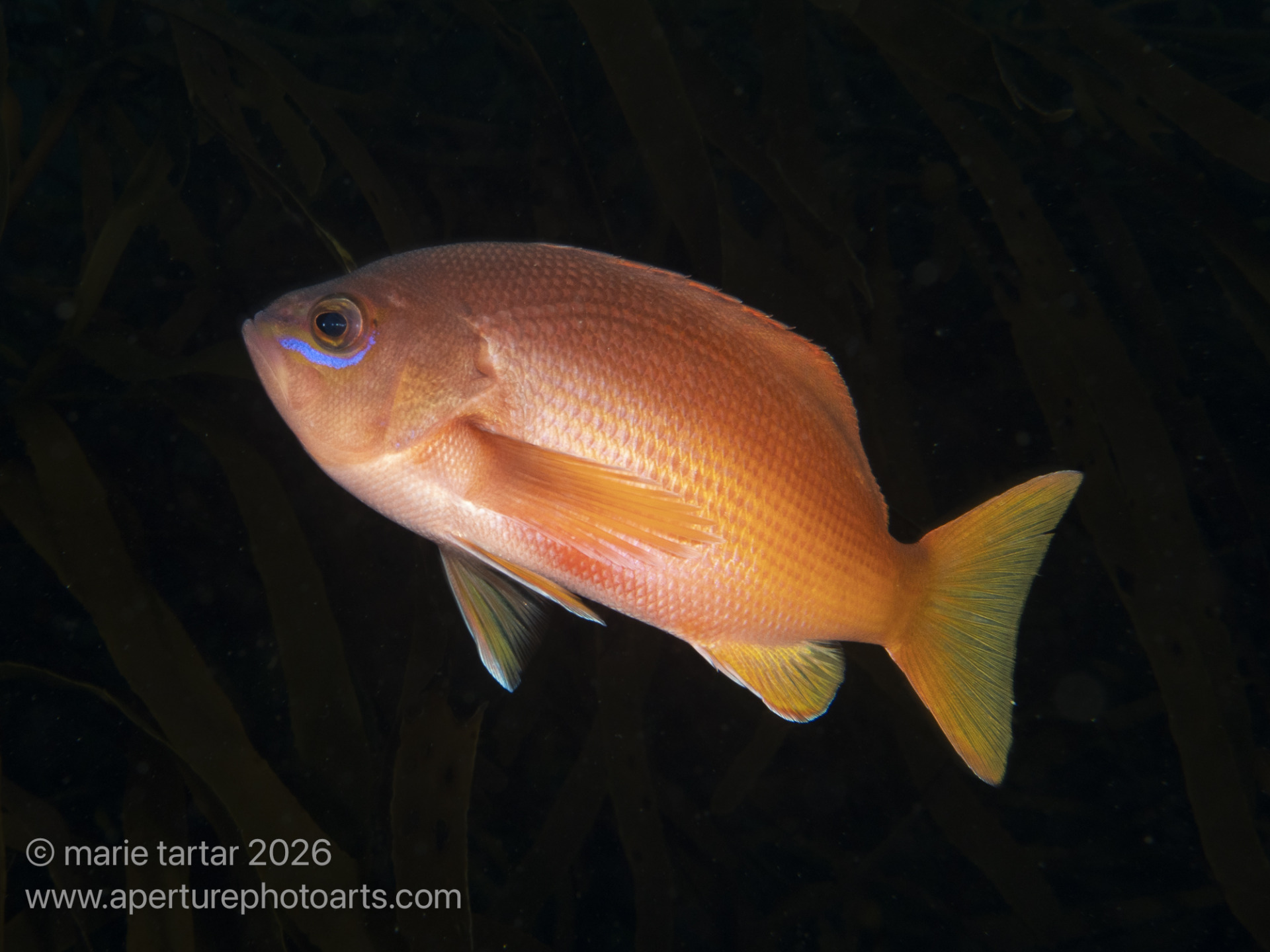
Female barber perch (Caesioperca rasor), Tasmania.
At Fock Rock (50 ft, 59 minutes), we found many nudibranchs and tiny sea spiders with eggs.
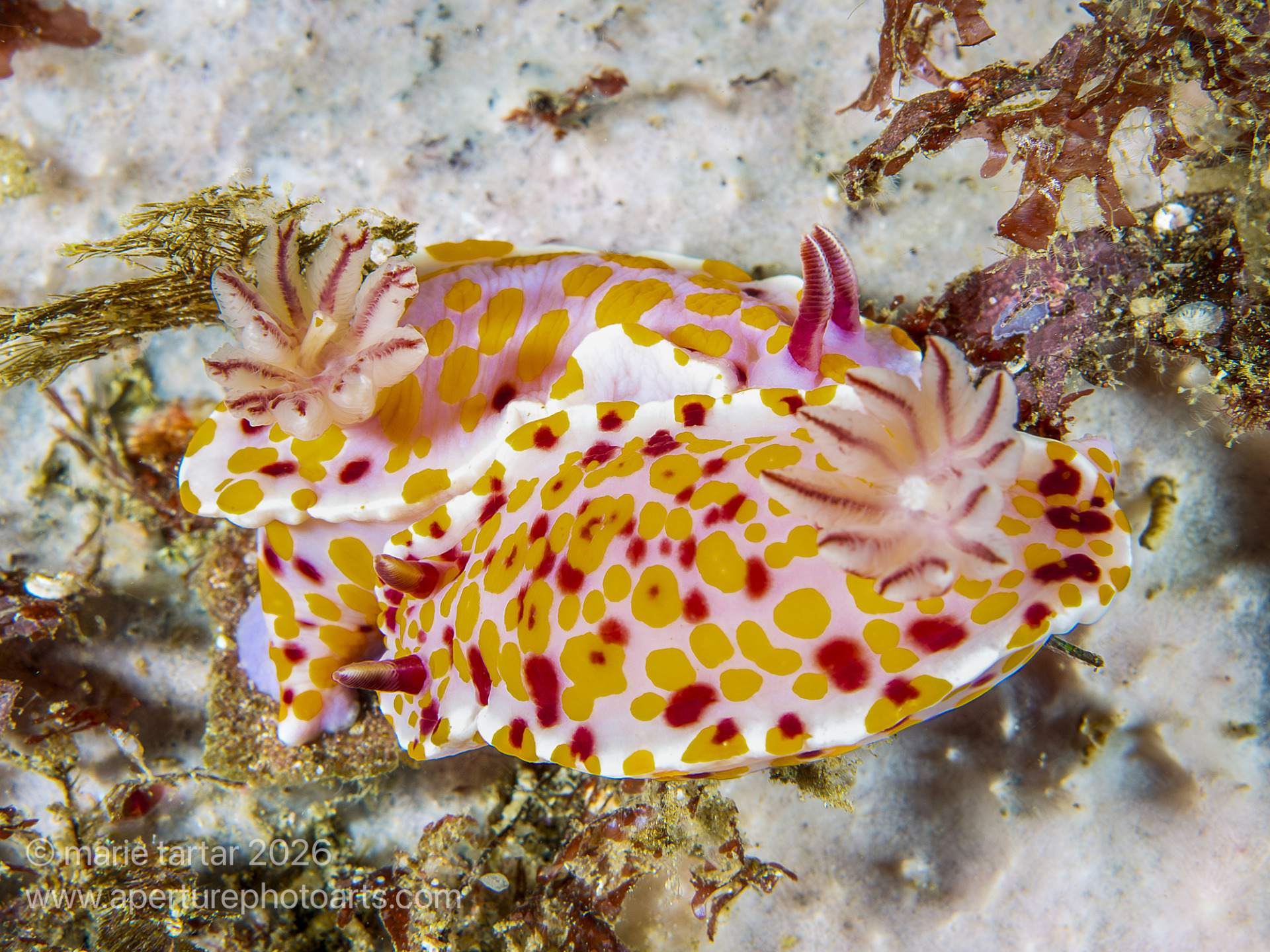
Mating ceratosoma amoena nudibranchs.
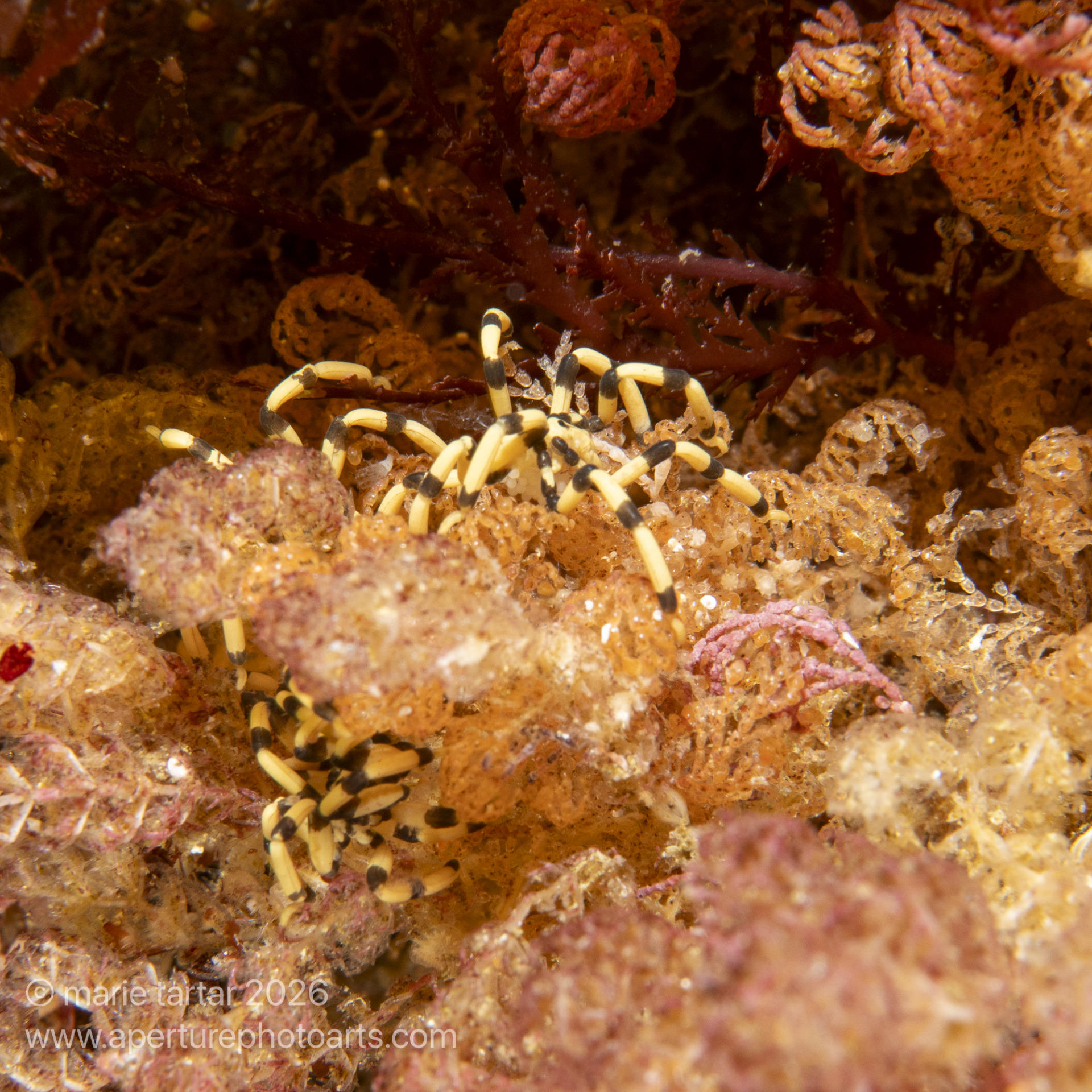
I can’t tell front from back, but there are at least 3 tiny sea spiders (Stylopallene longicauda or striped sea spider) in this image, maybe with eggs? These are pycnogonids.
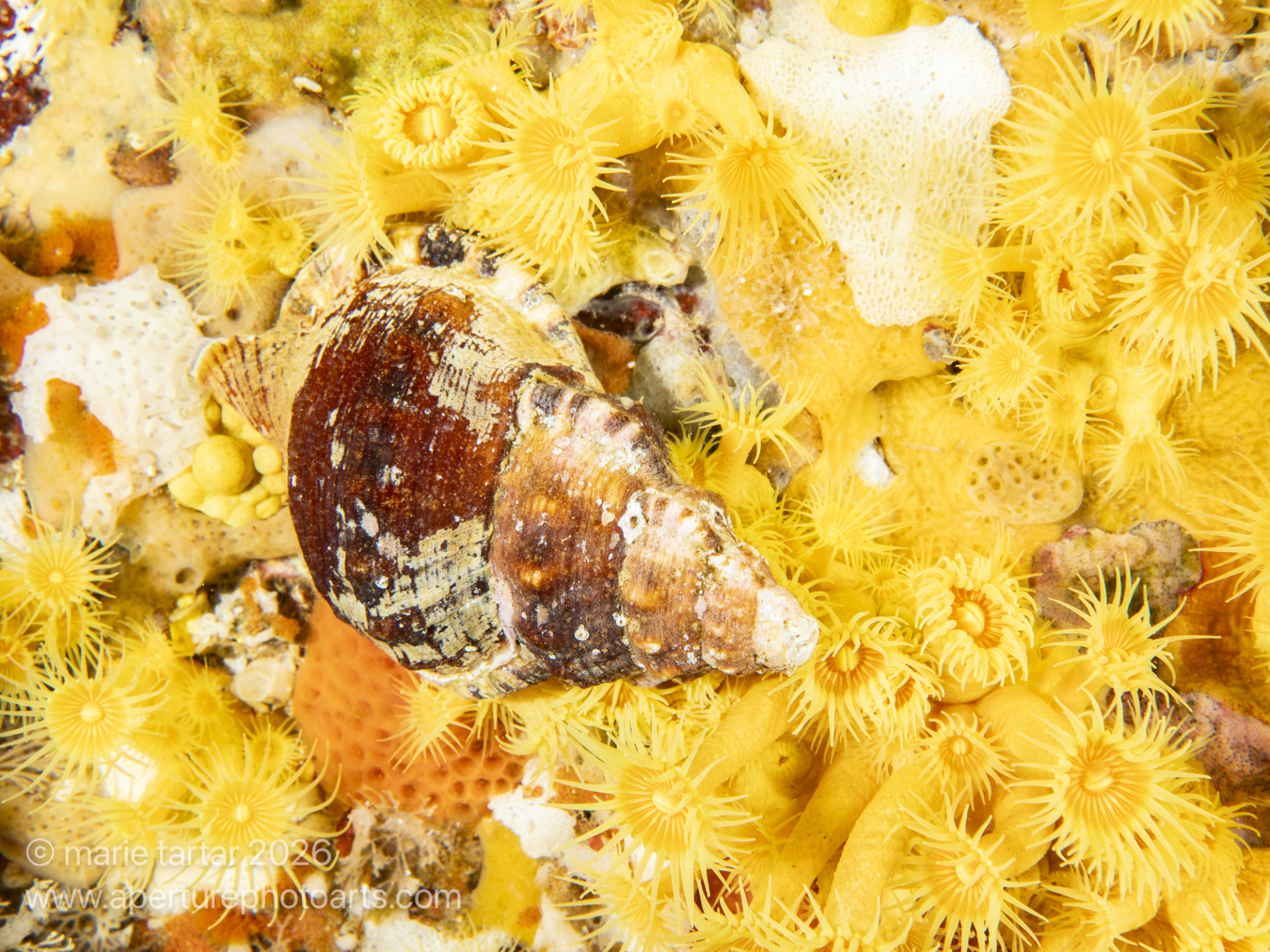
An embarrassment of invertebrates in Tasmania. With the cold water, kelp and plenitude of invertebrate life, I was reminded of Californian and British Columbian waters.
Thus concluded our 6-day introduction to diving in Tasmania. The hardier, healthier and/or more determined among us (Connie, Drey and Greg) did 11 dives, while Dave managed 8. Coming off what was later diagnosed as sinusitis, I was happy I managed to eek out 7 dives to Steve’s 4. The fun wasn’t over, as we still had 3 days of terrestrial activities with Blue Green Expeditions, after which Steve, Greg and I would head to Cradle Mountain for a short introduction before heading home.
Back in Hobart, Steve, Greg and I celebrated over a delicious Japanese grill dinner at Stone & Flame on the waterfront, opening to the same courtyard as our new favorite coffee shop (salmon bites, okonomiyaki, blue-eyed trevalla with rice, lemon sorbet, and a slightly savory sweet potato crème brulee).
Next up, the final installment, devoted to terrestrial Tasmania, in which we become better acquainted with Hobart and briefly glimpse a platypus’ backside!
-Marie