

Although we’ve traveled the world over to dive in a variety of environments, we’ve given Australia short shrift over the years. People are surprised to learn we’ve never dived the Great Barrier Reef, although we’ve spent a lot of time diving in Indo-Pacific waters from the Philippines to Thailand. At last, we were embarking on a trip solely dedicated to Australia: 3 weeks in South Australia and Tasmania. Our prior stays in Australia had been a few days here and there, coming and going, en route to Papua New Guinea or the Solomon Islands to dive, sampling Sydney, the Blue Mountains and Brisbane, along the way.
How this trip came about was circuitous. In February of 2025, while traveling around Iceland with Byron Conroy, he mentioned he was coordinating a trip for Faith Ortins and her company, Blue Green Expeditions, for the total solar eclipse of August 2026. I had been investigating where to be for this eclipse (Greenland vs. Iceland vs. Spain) but hadn’t settled on a plan yet. By the time our week of gale-force winds, ice caves and weak aurora was over, Steve, Greg and I had decided another trip to Iceland was in order.
Byron introduced us to Faith by email and in March, we connected by phone. In the meantime, we heard enticing details from our friends Margi and Eric about a trip they’d done with Faith to a place we’d always wanted to go-Tasmania! Six days of diving were planned as well as three days of land excursions in and around Tasmania’s capital, Hobart. This sounded like a good introduction to Tassie. As Eric and Margi had done on their trip the year before, we added on a multi-day South Australia stay, in hopes of seeing leafy sea dragons, in addition to their weedy cousins, who are most reliably found in Tasmanian waters. We also added on a couple days at Cradle Mountain to round out our 3-week journey.
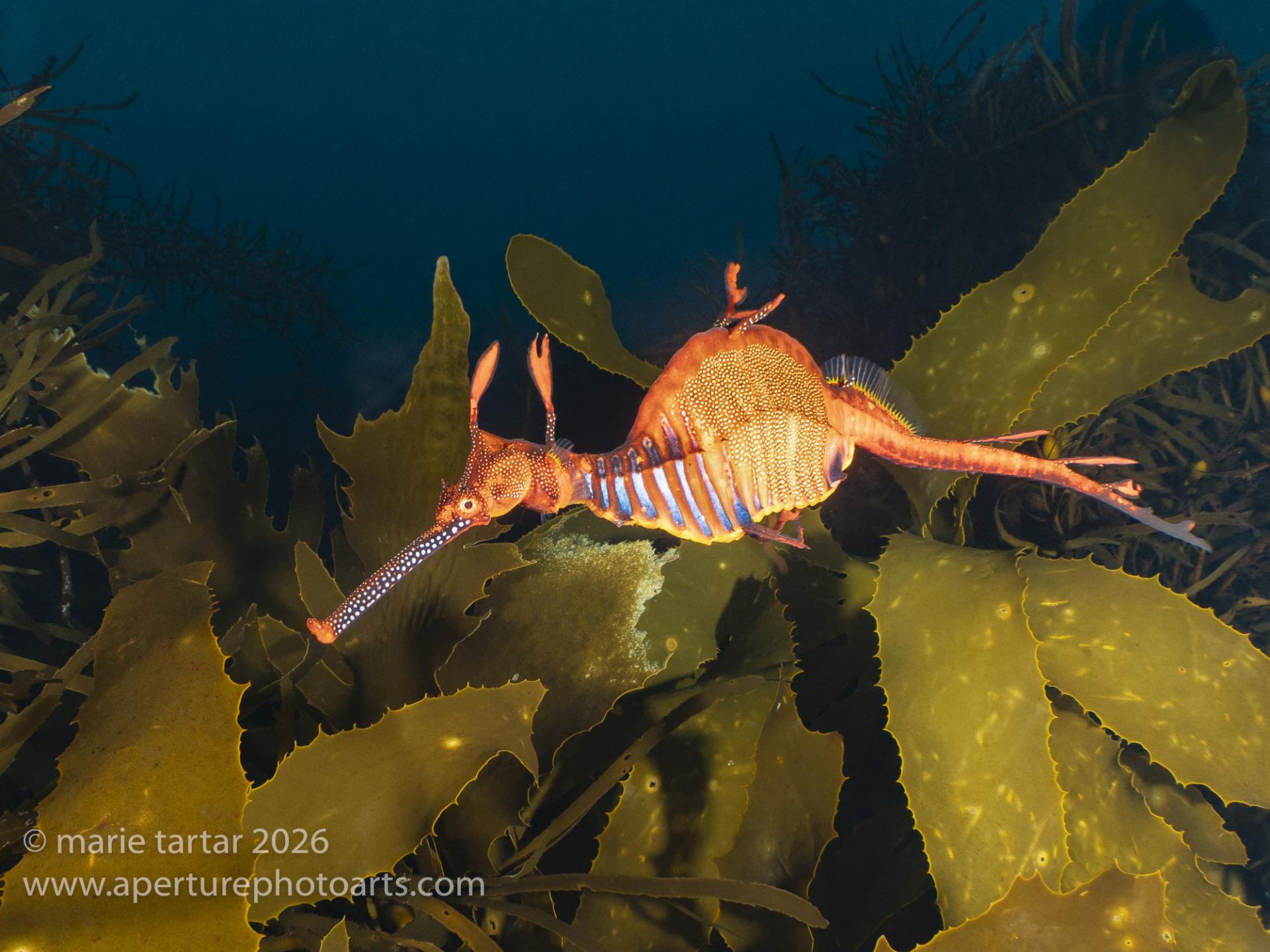
Happy ending: we did succeed in seeing weedy sea dragons in Tasmania.
Saturday, March 28, 2026-Monday, March 30, 2026
Our long-awaited trip Down Under started with a bang. Not an audible bang, but a drop, more a prolonged plop, of Steve’s camera bag going to ground near the curb at LAX. Rumors of prolonged ICE-related waits at US airports had prompted us to move our departure from home up a half hour, to 3:30 pm, hours in advance of our 9:50 pm departure for Australia. David drove us with his usual cheer and attention and after sailing past terminal after terminal at LAX without the usual delays, we were disembarking at Tom Bradley International Terminal. David had filled the back of his Hyundai Highlander to the brim with our Away rollers, Osprey duffle bags and two camera backpacks and flung the back open. Down to the ground went Steve’s heavy Gura Gear camera backpack.
We both had instant flashbacks to the start of our 2019 Lofoten photo trip in Norway. On that occasion, our first stop after meeting up with our small photography group was a grocery and the victims were Steve’s camera backpack and his drone backpack (in those days, our DJI Phantom drone was large enough to require its own backpack). The casualties were multiple: his Nikon D800 failed to fire up again and within a day, the Phantom flew away over a lake and never returned (I maintain it had the mechanical equivalent of a concussion.)
Our fears of a bogged down LAX proved overblown-we were through with Clear and TSA precheck within minutes. Installed in the Quantas lounge, Steve’s Nikon D850 seemed intact.
On the drive to LAX, we received an email from Faith. We knew she’d just returned from 3 back-to-back trips to Antarctica. It seemed we’d have to wait until August in Iceland to meet her in person-another guide’s husband was seriously ill and Faith would have to take over guiding that trip. We’d had an All-About-Tasmania video call together a few weeks before, at which Faith introduced Andrea “Drey” Stockert, who ably assumed leadership of the trip.
The journey itself was flawless. 18 K worth of business class tickets on Quantas, including our domestic flights to and from Hobart, Tasmania, had been finagled for 4 K and a ridiculous number of Chase points. Thin gray pajamas were proffered while settling in, much to Steve’s delight. Several of our neighboring passengers immediately changed into them, so I followed suit, in the restroom. This detail may seem obvious, but a woman several rows in front of me astonished me by changing at her seat, standing, pulling off her top and exchanging it for the pajama top as though she were completely alone, her bra clearly visible to me from rows away. And no, this was while boarding when the cabin lights were still fully illuminated.
I had started the film Nuremberg at home the week before but hadn’t had a chance to finish it, so that was my first screening. I followed that up with an Oscar nominee for Best Foreign Film, from Jafar Panahi, It Was Just an Accident, which was so riveting I recommended it to Steve, who watched it as well and agreed.
I slept nearly a full night’s sleep, probably helped by sleeping poorly the night before at home. My last screening was of a Sondheim musical we missed in New York, Merrily We Roll Along.
Meanwhile, Greg was flying towards Australia from Chicago, via Sydney. His delayed flight cut down his layover to 2 hours, still enough to clear customs and recheck his bags.
Both of us had mild delays of our short haul flights. We arrived to Adelaide 45 minutes before Greg. Our bags were just rounding the bend of the carousel as we arrived.
Greg had reserved a Tesla from Avis. Now that we had our own recently acquired Model Y, we had serious doubts as to whether we could fit all of us in with our gear. Greg had already made a supreme sacrifice in anticipation of this difficulty, with his second checked bag a large soft duffel without wheels.
While we were waiting for Greg, I walked over to Avis to see what larger SUV options they might have for us.
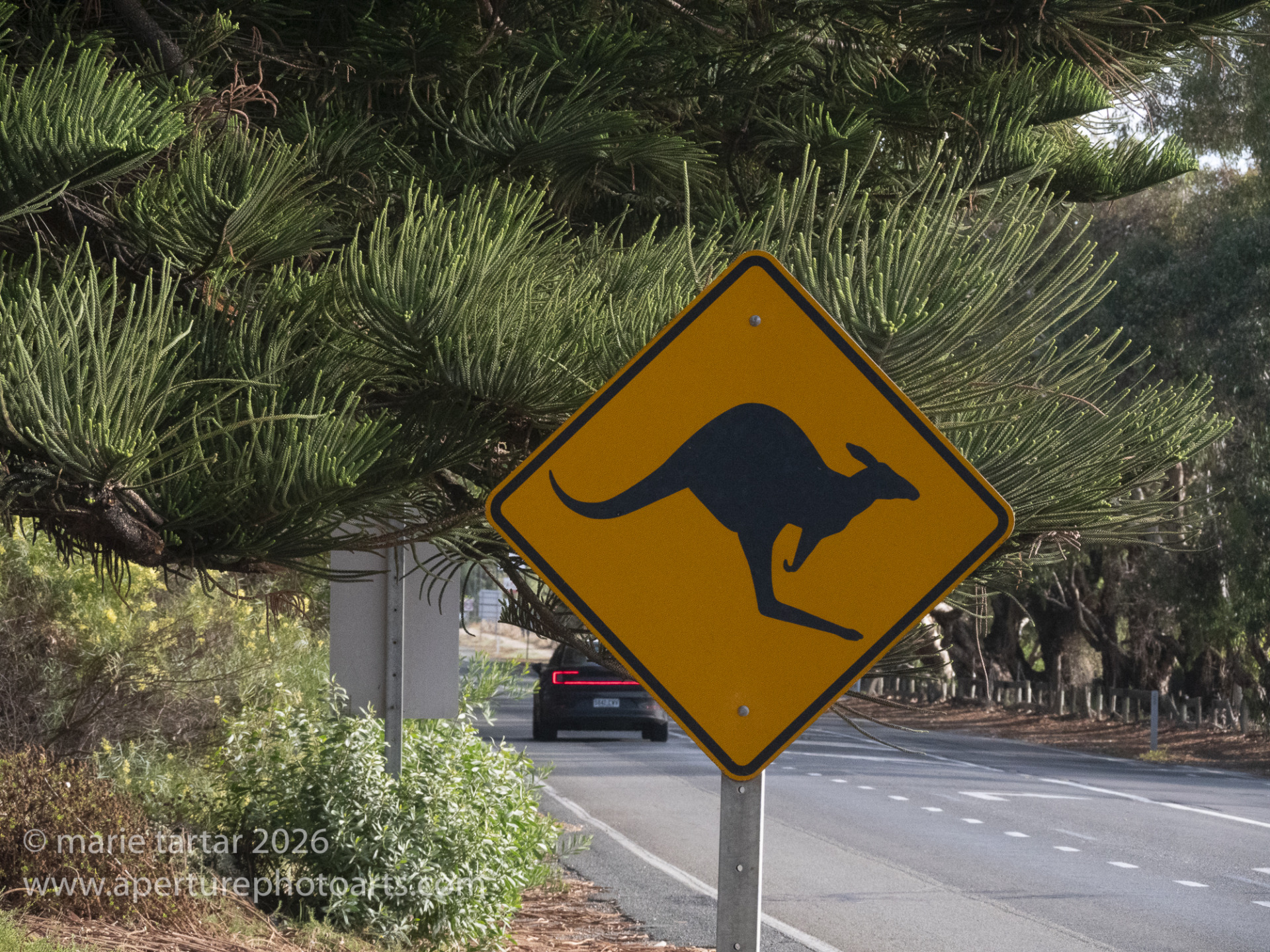
We were all more than a little concerned about driving in Australia, not because of the kangaroos, but driving on the opposite side of the street?! Somehow, Greg was appointed group chauffeur, a task he dispatched ably, with no close calls, some swearing and elevated cortisol levels and much unintended windshield wiper deployment.
The other big concern we had was driving on the other side of the road. Tesla’s lane-keeping capability was a major reason Greg was high on renting a Tesla specifically.
Ultimately, it came down to a dress rehearsal. We could just barely squeeze us and all of our gear into the Tesla. The rear passenger (me) would be seated next to a literal wall of gear.
Next, we unloaded the Tesla and packed everything into the alternative, a mid-size Mitsubishi SUV, which was $400 AUD cheaper. It just fit, although was only marginally roomier than the Tesla (with its front truck, the Frunk) but we decided it was probably a safer bet.
Thankfully, the Mayfair Hotel in downtown Adelaide was only a 17-minute drive away, with few turns and optional valet parking. There was at least one missed turn off at a roundabout which headed us back towards the airport and Greg kept activating the windshield wipers instead of the turn signals, but we made it into town intact and were only too happy to turn the car over to the valet.
The hotel was well located in easy walking distance of two free major downtown attractions, namely the Museum of South Australia and the Adelaide Botanical Garden.
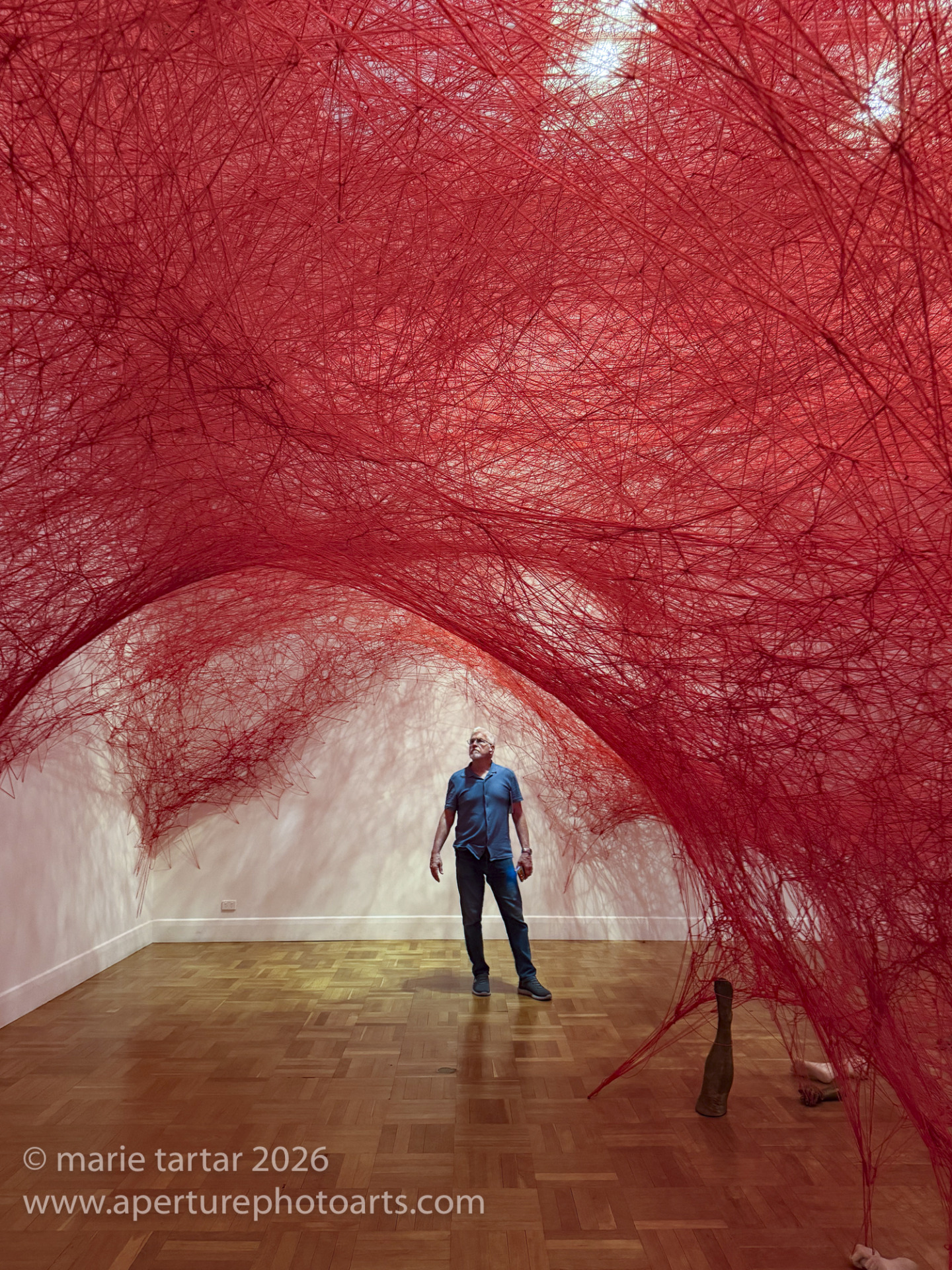
The Art Gallery of South Australia has an appealing mix of contemporary and traditional art. One large gallery was filled with an installation by a Japanese artist, Chiharu Shiota, whose work we enjoyed last fall at the Japan Society in NYC.
Steve was tired enough he waited on a bench while Greg and I walked around the lovely grounds.
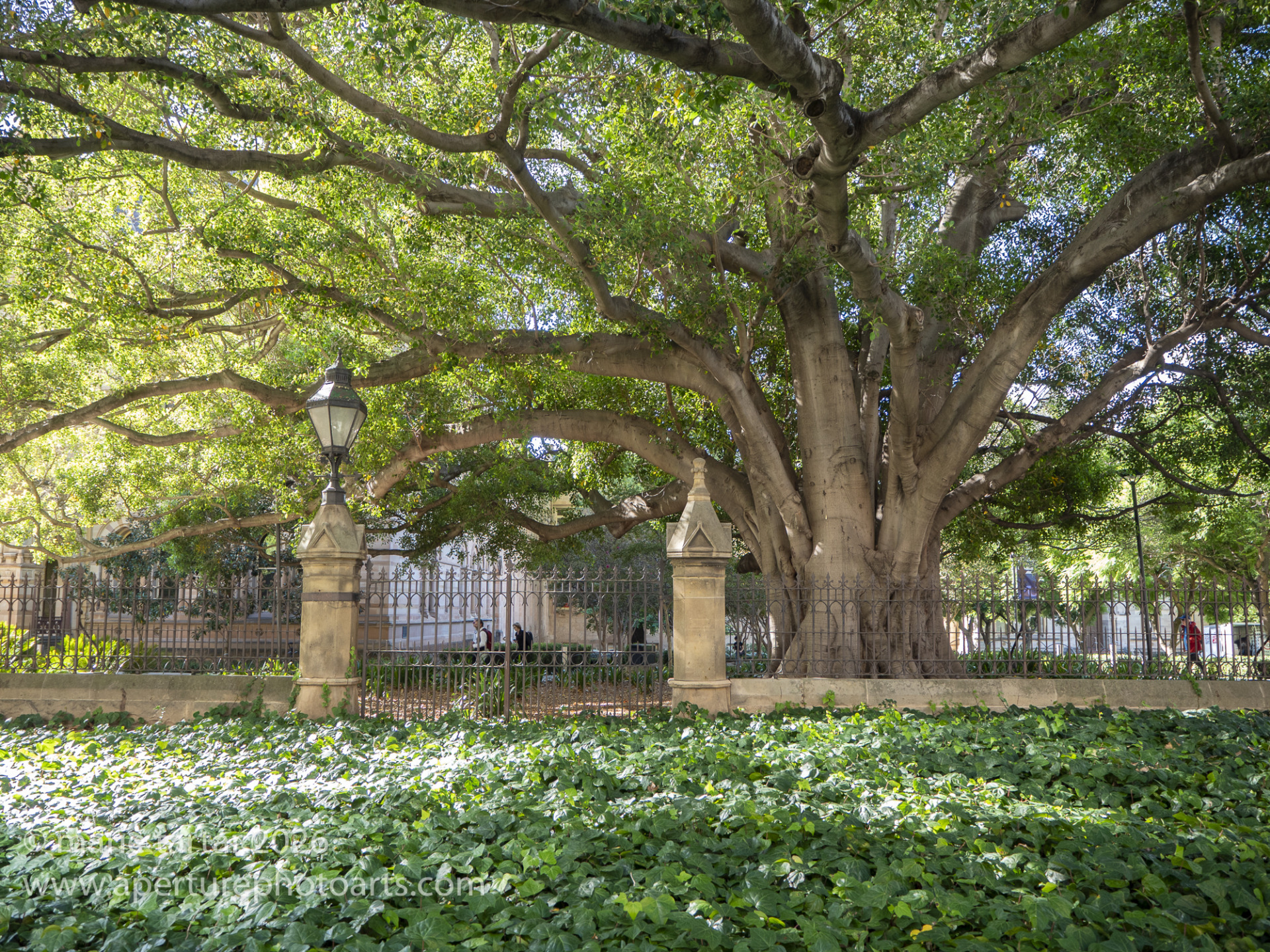
Downtown Adelaide is pleasant and walkable, with colleges, Parliament, museums and gardens in close proximity. Huge old trees like this Moreton Bay fig provide shade.
We consulted Chat GPT for a dinner option, which suggested Peel St, which proved to be close to the hotel, a convivial and agreeable venue. We shared a series of yummy dishes, including ceviche, chicken salad, crispy eggplant and lamb shoulder.
Tuesday, March 31, 2026
Chat G, our new best friend, suggested Abbot and Kinney as a source for tasty coffees and pastries in walking distance from the hotel. Armed with our long lenses, we walked through the Adelaide Botanical Garden in search of birds. We did see some rainbow lorikeets (high up in the trees) and Australian white ibis (in harsh sunlight).
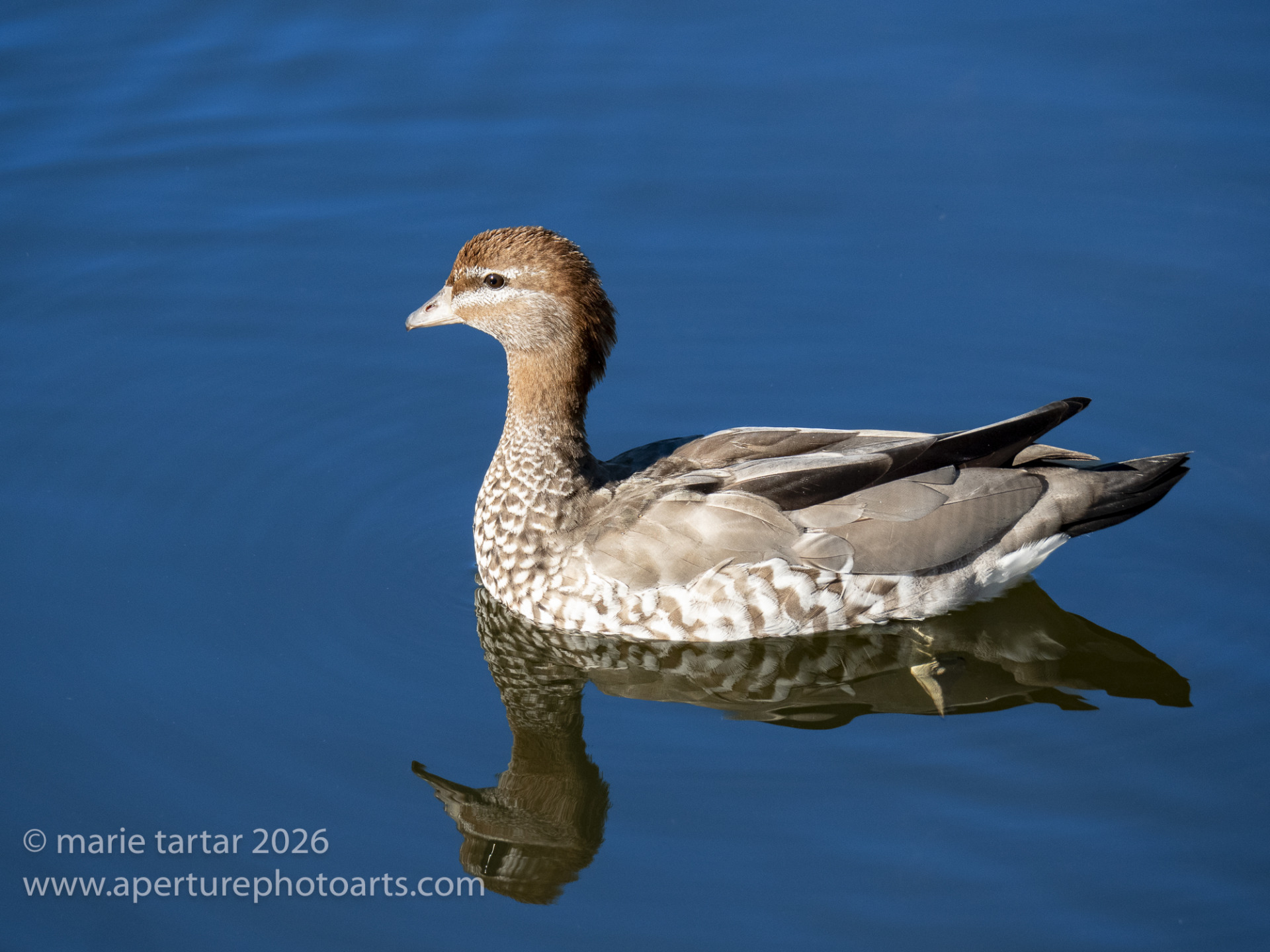
On our morning walk through the Adelaide Botanical Garden, we did see some birds, including this female Australian wood duck.
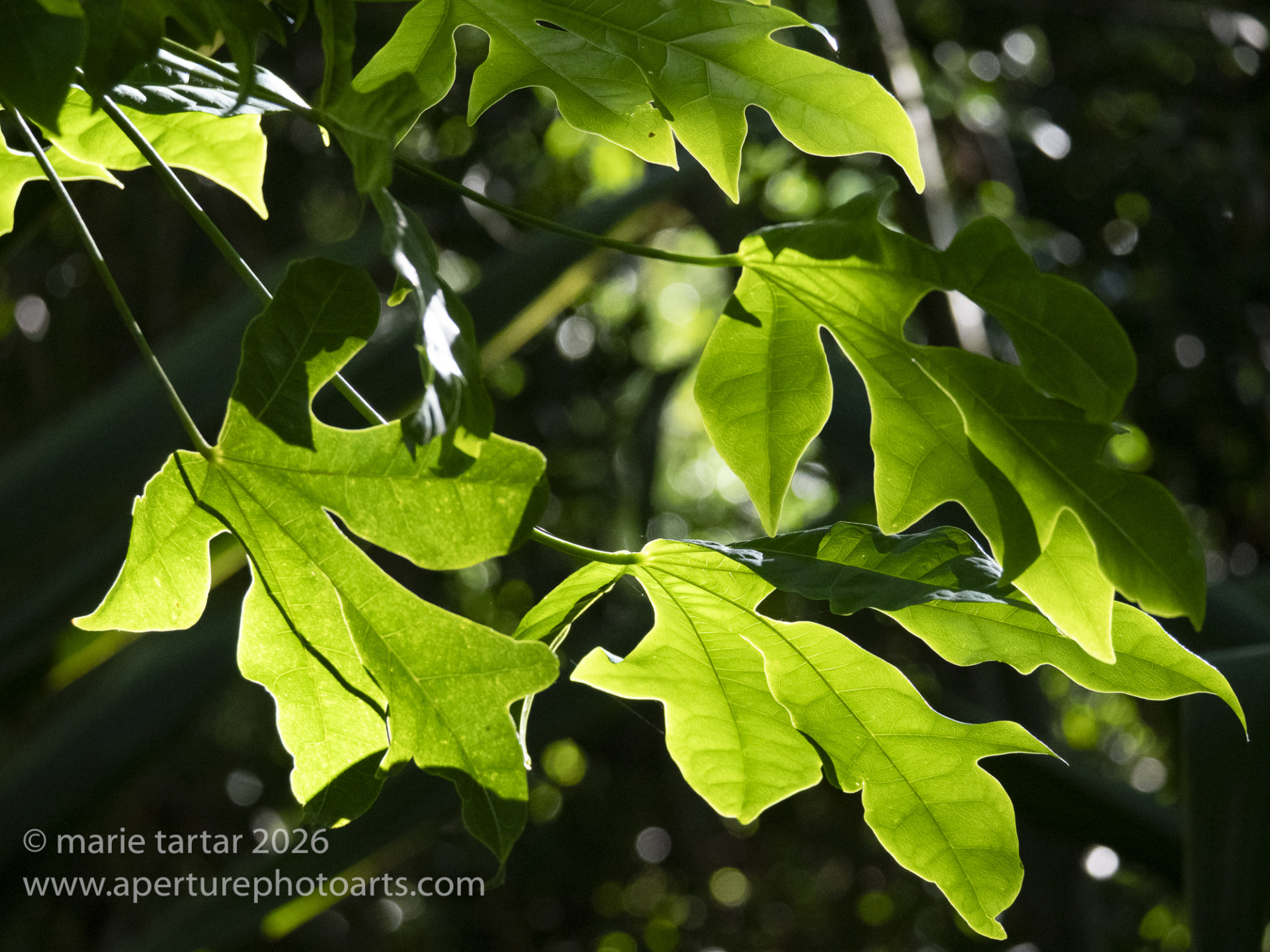
Backlit leaves during a morning stroll in Adelaide Botanical Garden.
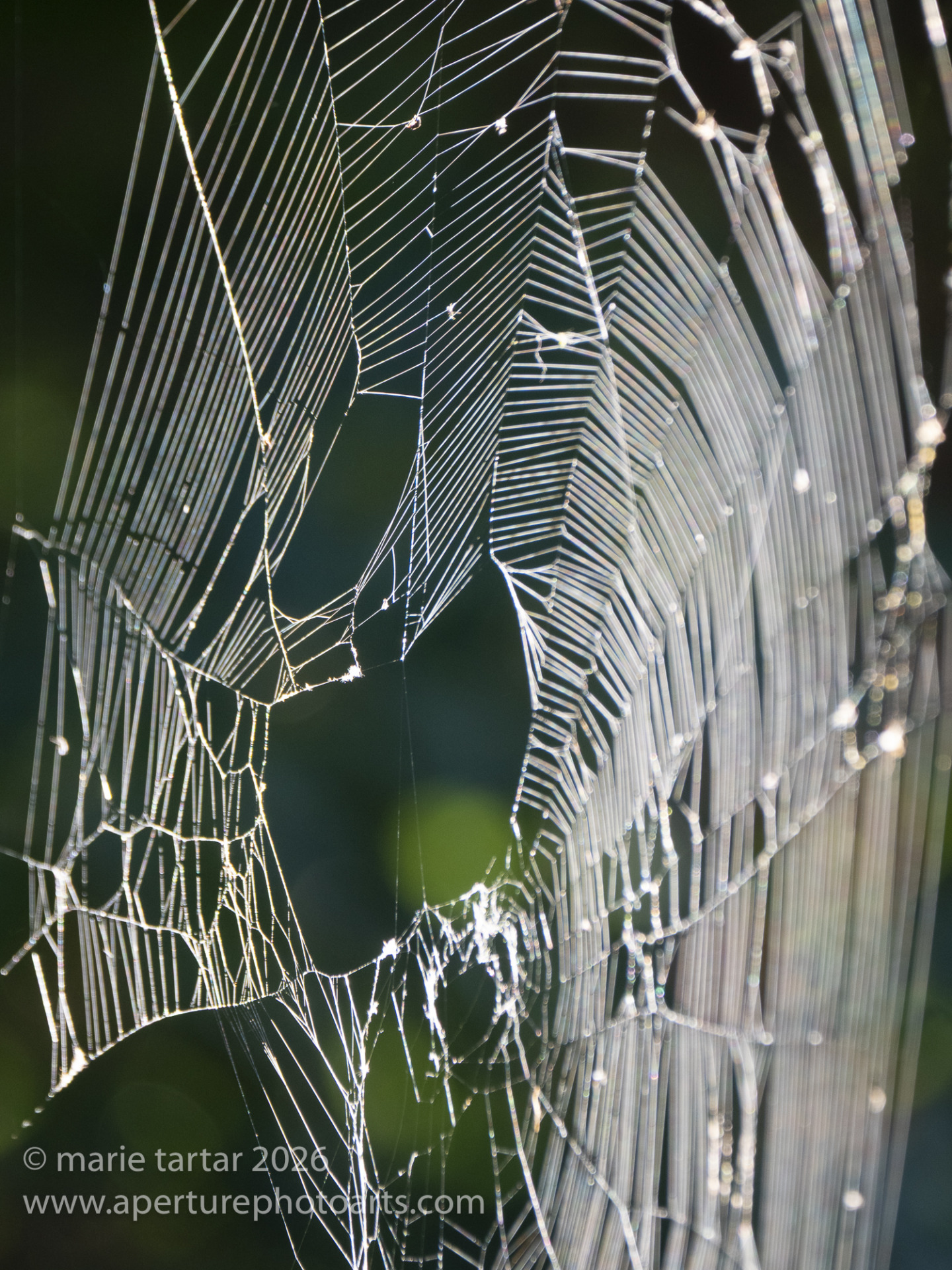
Morning light in Adelaide Botanical Garden illuminates a spider web.
We took our time making a leisurely drive to Second Valley and the Sea Dragon Dive Lodge, where we would stay 5 nights. Owners Peter and Ilona Corrigan had suggested stopping along the way to check out Christie’s Beach. We had lunch on the patio at Agatha’s in Port Noarlunga. As we were passing through a renowned wine growing region, Mclaren Vale, our final stop was at an unusual art museum and winery, the d’Arenberg Cube. Nadia from Italy was our amiable guide for the wine tasting. Several bottles were procured, including an excellent dessert wine. The only one of the Corrigan’s suggestions we didn’t make it to was the gin distillery, Fleurieu (although we picked up one of their offerings at a local Bottle Store later in our stay).
After unpacking at the Sea Dragon Dive Lodge and meeting Peter, Ilona and their adorable dog Oscar, we headed back up the road along the coast to nearby Normanville, where we had dinner at a waterfront restaurant called Aqua Blue, which was pleasant but uneven. I was full enough from the late lunch that I ordered the chicken tikka starter on saffron rice and brought half home. Greg’s lamb chops were mostly overcooked. He speculated that the one chop which was not overdone had caught on fire and was snatched off the grill by the chef early. Strangely, the unusually creamy oysters were not appealing to me or Greg.
Wednesday, April 1, 2026
Peter used to dive with clients but was finishing therapy for a health issue so he had arranged with a local expert and technical diver, Marlene, to do an orientation dive with us at Rapid Bay Jetty. We barely fit into the car with 6 tanks, gear and assembled cameras. Rapid Bay Jetty and all of South Australia had an epic algae bloom last fall, so leafy sea dragon numbers were markedly reduced. There was a 4-month period during which not a single leafy was seen in local waters, but their numbers reportedly were slowly rebounding so we were hopeful.
It took us quite a while to work out the haven’t-dived-in-a-drysuit recently kinks. Steve had updated our dive computers before our departure and our tank pods were not communicating with them. Peter gave us each 10 1-kg weights (22 pounds) which didn’t prove to be enough for any of us. We all ended up adding an additional 2 kgs for a total of 26 pounds, plus ankle weights for Steve and me. (By the end of our diving in Tasmania, I had whittled my weight down to 21 pounds, plus ankle weights, with a heated vest added under my drysuit).
I discovered while suiting up that I could no longer close my BCD while wearing Nancy’s DUI weight system, necessitating a last-minute transfer of my weights into my BCD pockets. (The following day, I adjusted the DUI weight harness so that the weight was at hip level instead of waist level and then was able to fasten the cumberbund of the BCD and divide the weight between the harness and BCD.)
Rapid Bay Jetty consists of two parallel components, a new sturdy metal pier with stairs and the old wooden jetty. Access to the old jetty is now restricted due to structural concerns from the local mine owner. It is a long walk, mitigated partially by the trolleys Peter provides, to the stairs which provide an easy entry into the water. Because the mine monitors divers’ activity, we were in for a long surface swim from the stairs to reach outside of the old jetty, beyond the exclusion zone. What we found was a shallow (about 30 feet), level seagrass bed. The water temperature was 20 degree C, about 68 F, quite comfortable in a dry suit. Steve and Greg found it warm enough they didn’t even bother to wear gloves!
Sadly, we found no leafy sea dragons.
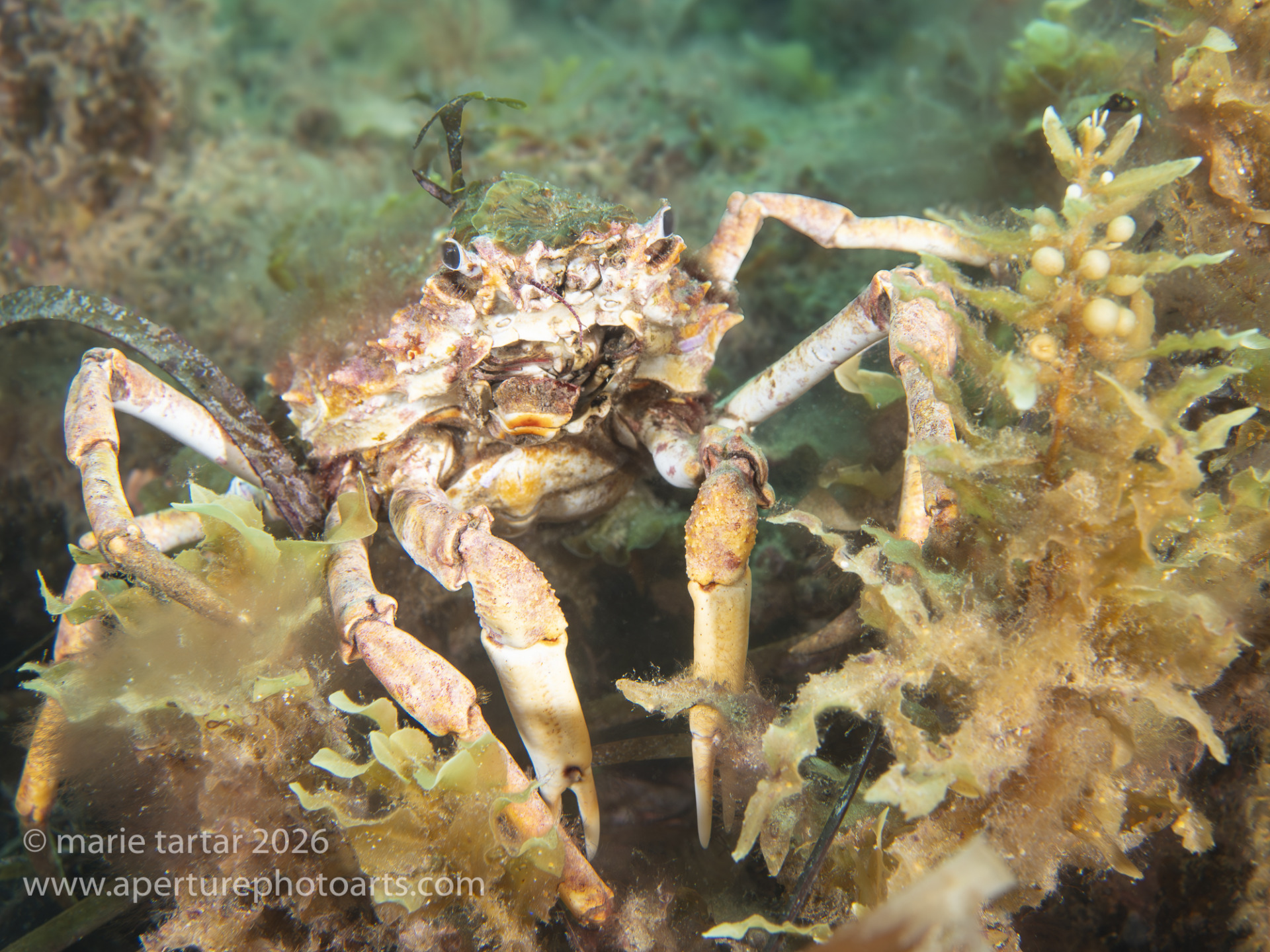
Instead of the hoped for leafy sea dragons at Rapid Bay Jetty in South Australia, we got crabs! This spider crab sports an algea headdress.
We did find spider crabs (Leptomithrax gaimardii ).
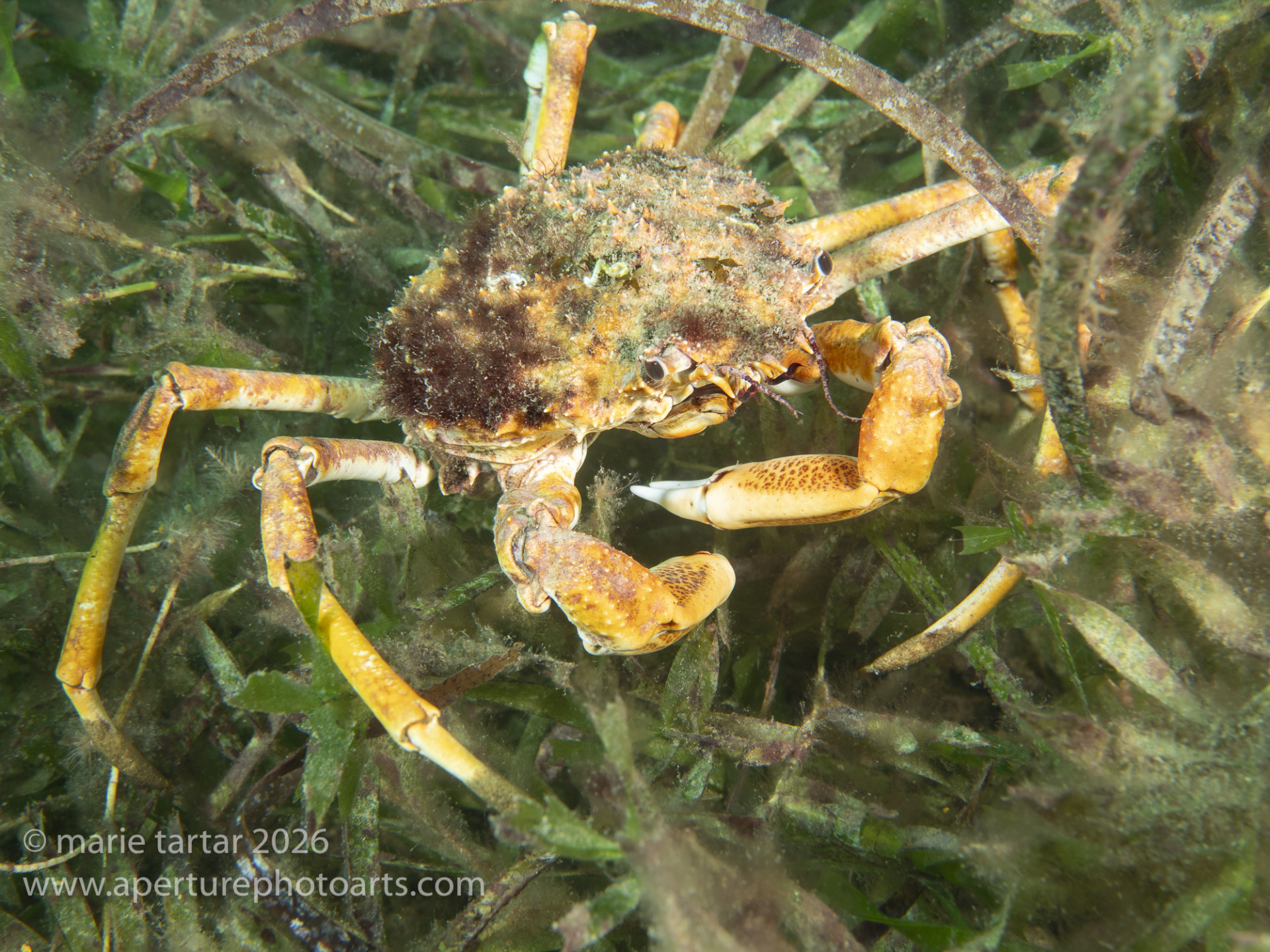
Spider crab, Rapid Bay Jetty, in sea grass bed.
These spider crabs aggregate in large numbers in winter, piling on top of each other, to undergo a mass molting, presumably a safety-in-numbers strategy. The carapace splits in back and rolling back and forth with wave action, the emerging soft-shelled crab claws its way out. In this form, it is vulnerable to predation by rays. We found 5 or so of these crabs, possibly early arrivals to the winter aggregation (it was fall Down Under on our visit).
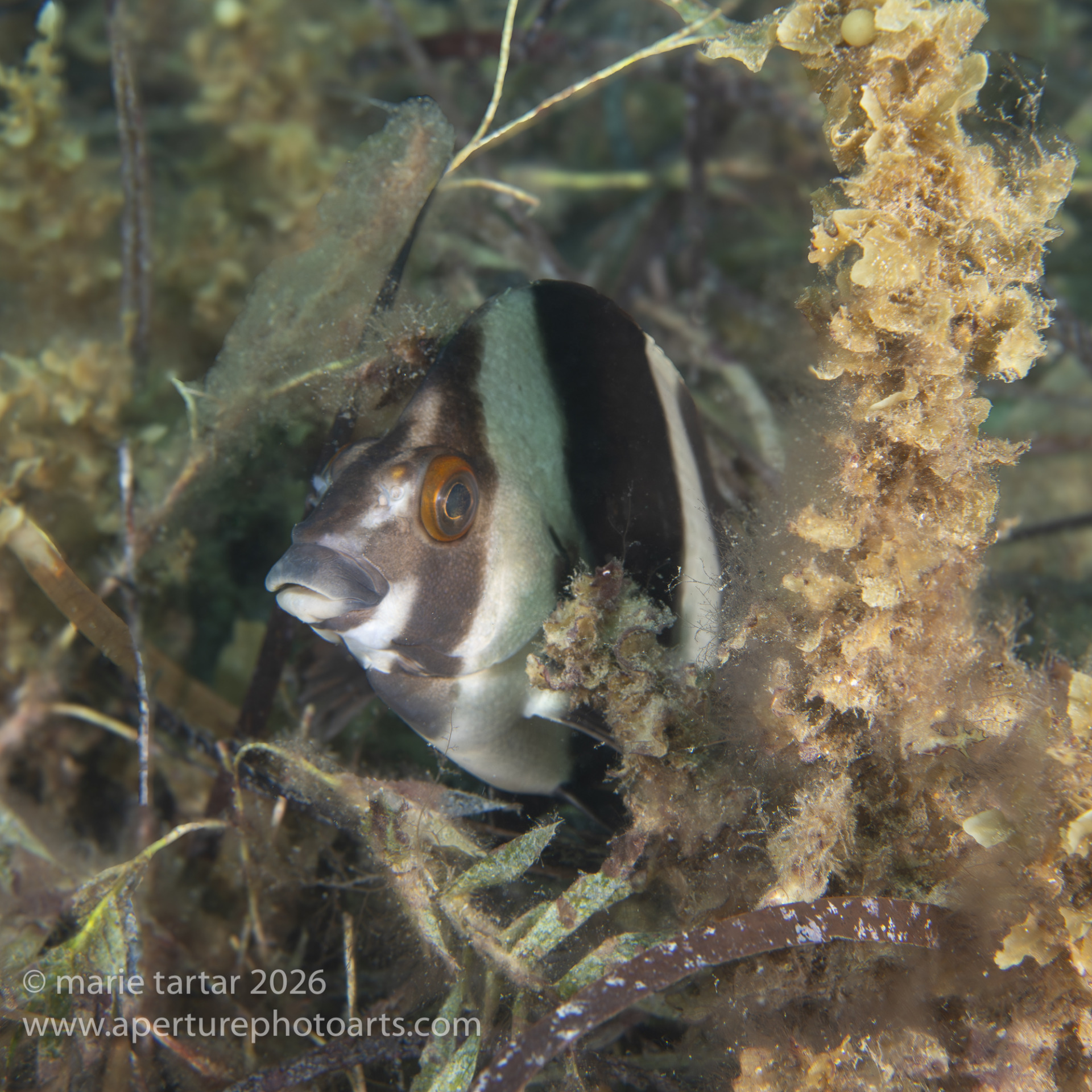
We found a few fish darting about in the sea grass bed at Rapid Bay Jetty, like this magpie perch (Pseudogoniistius nigripes), also known as magpie morwong or black-striped morwong.
Near the end of the dive, I had a calf cramp. While trying to arrest it, I found myself at the surface (the entire dive was not deeper than 30 feet). (33 ft, 72 min)
Steve wasn’t able to get a tank pressure reading and aborted early. We found him on the jetty lying down with his face covered. We decided one dive was enough for our first day.
We had a late lunch at the Yankalilla Bakery (steak and mushroom pies, mince and vegetables) and provisioned at the grocery store and Bottle Shop afterwards.
On the road between Normanville and Second Valley in South Australia, clues to the fact we are really in Australia: driving on the left side of the road and the omnipresent wildlife warning signs. Kangaroos gathered here each afternoon, near a golf course.
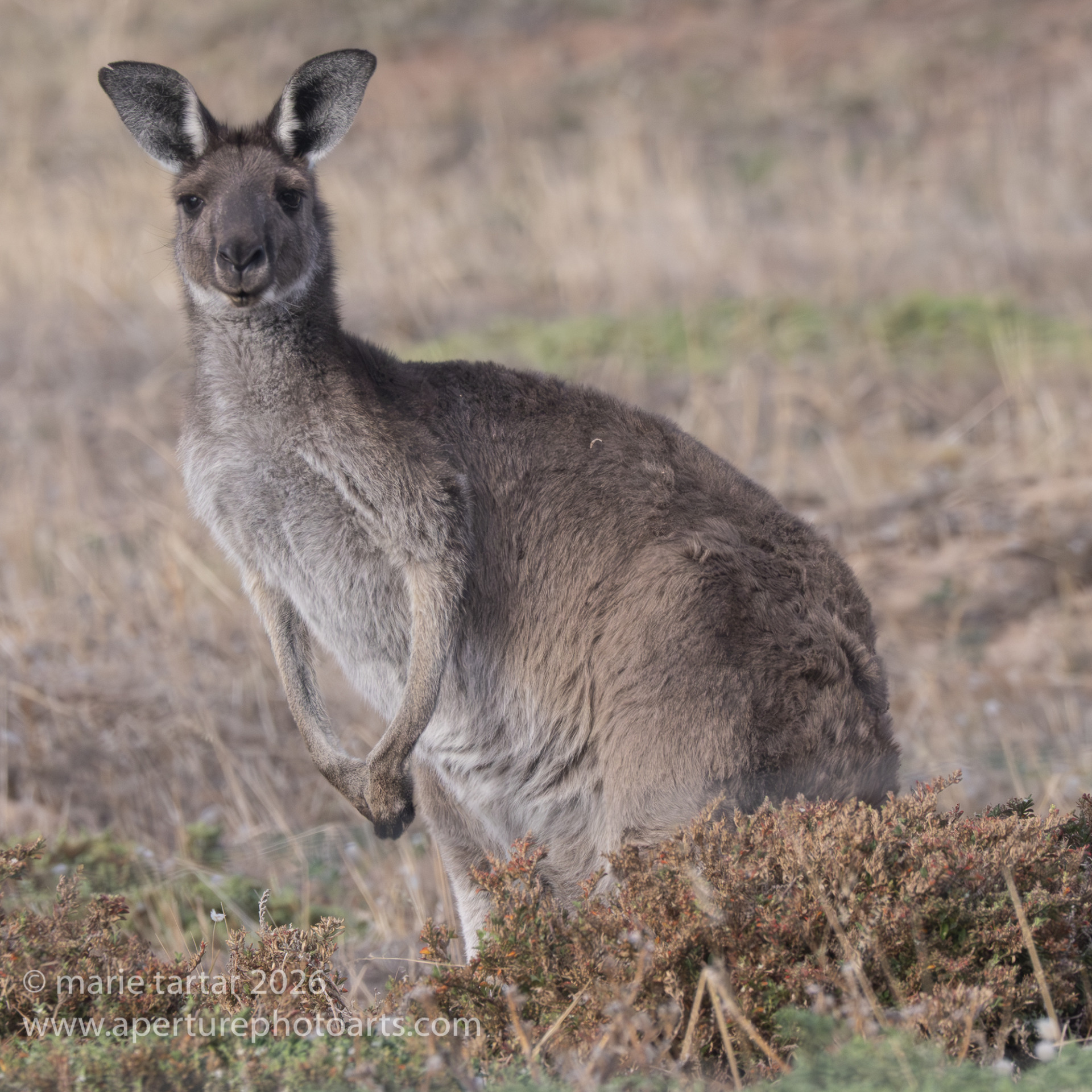
Kangaroos gathered every afternoon near the golf course on the road leading to Normanville from Second Valley.
In the late afternoon, I flew the drone.
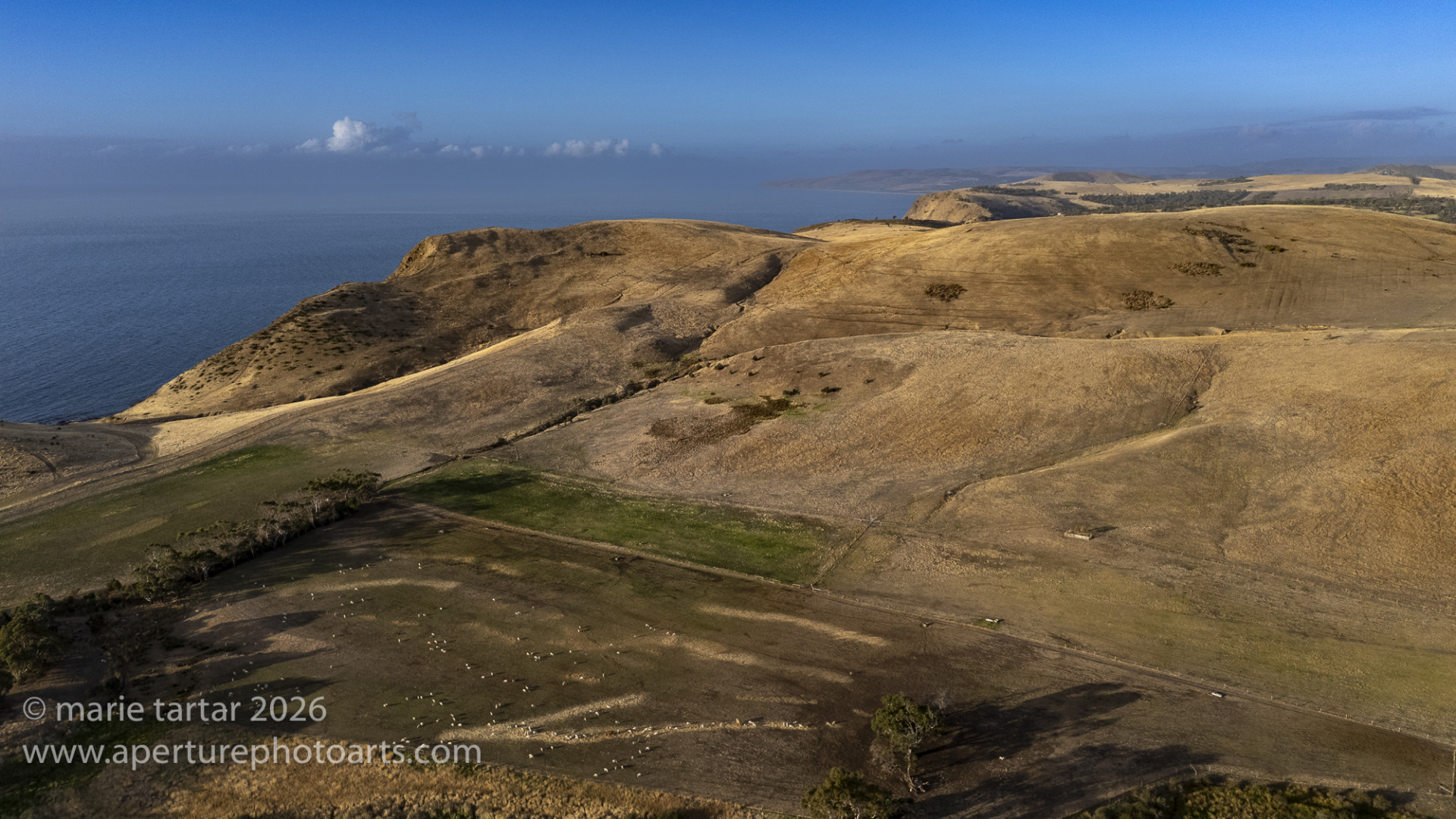
Near Second Valley, South Australia in fall: tawny hills and fields. The white dots? Sheep, which were abundant.
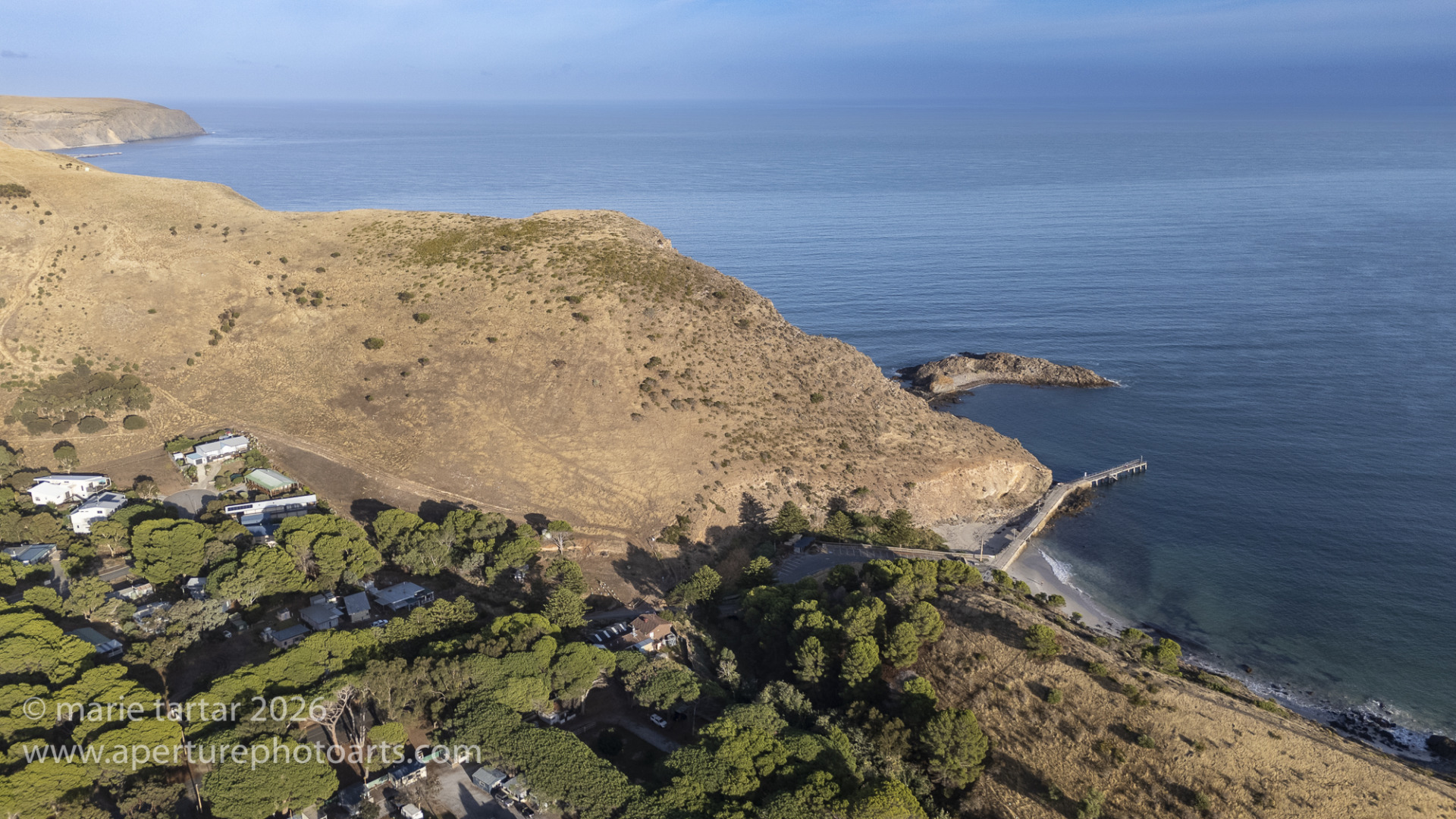
Coastal South Australia, with Second Valley in the foreground. Rapid Bay can be seen in the distance.
For the evening’s entertainment, we watched the 2010 American remake of a favorite French film from 1998, Le Dîner de Cons (English title The Dinner Game), called Dinner for Schmucks.
Thursday, April 2, 2026
Carl Charter guided us for a dive at Second Valley, 5 minutes down the road. Packing the car was easier as we planned only a single dive. We also left behind Peter’s trolleys as the walk wasn’t as far, and the “bitumen” carpark meant we didn’t really need his astroturf mats to stand on while suiting up.
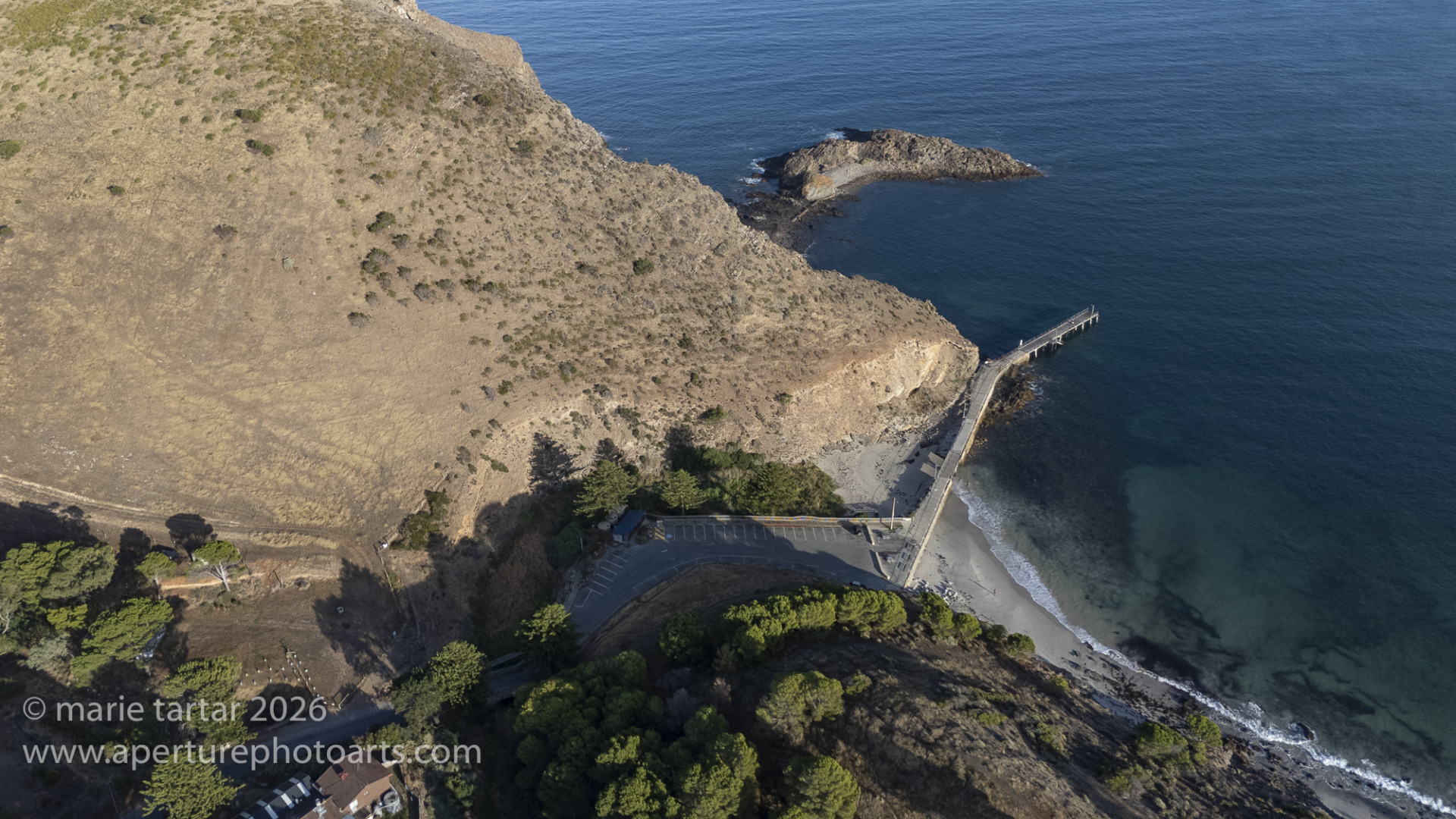
Aerial view of the Second Valley dive site: a manmade pier extends into the water, opposite a natural breakwater.
It was calm on the surface, but underneath, it was another story. The visibility was terrible. It was hard to keep the others in sight. I could catch occasional glimpses of Carl’s bright orange fins and Greg’s orange SCUBA sausage through the haze, which worsened the further we got away from the jetty. The seagrass and algae were whipping back and forth with the surge. My camera was quickly snarled with strands of grass and algae.
The only subject we found was a white crab.
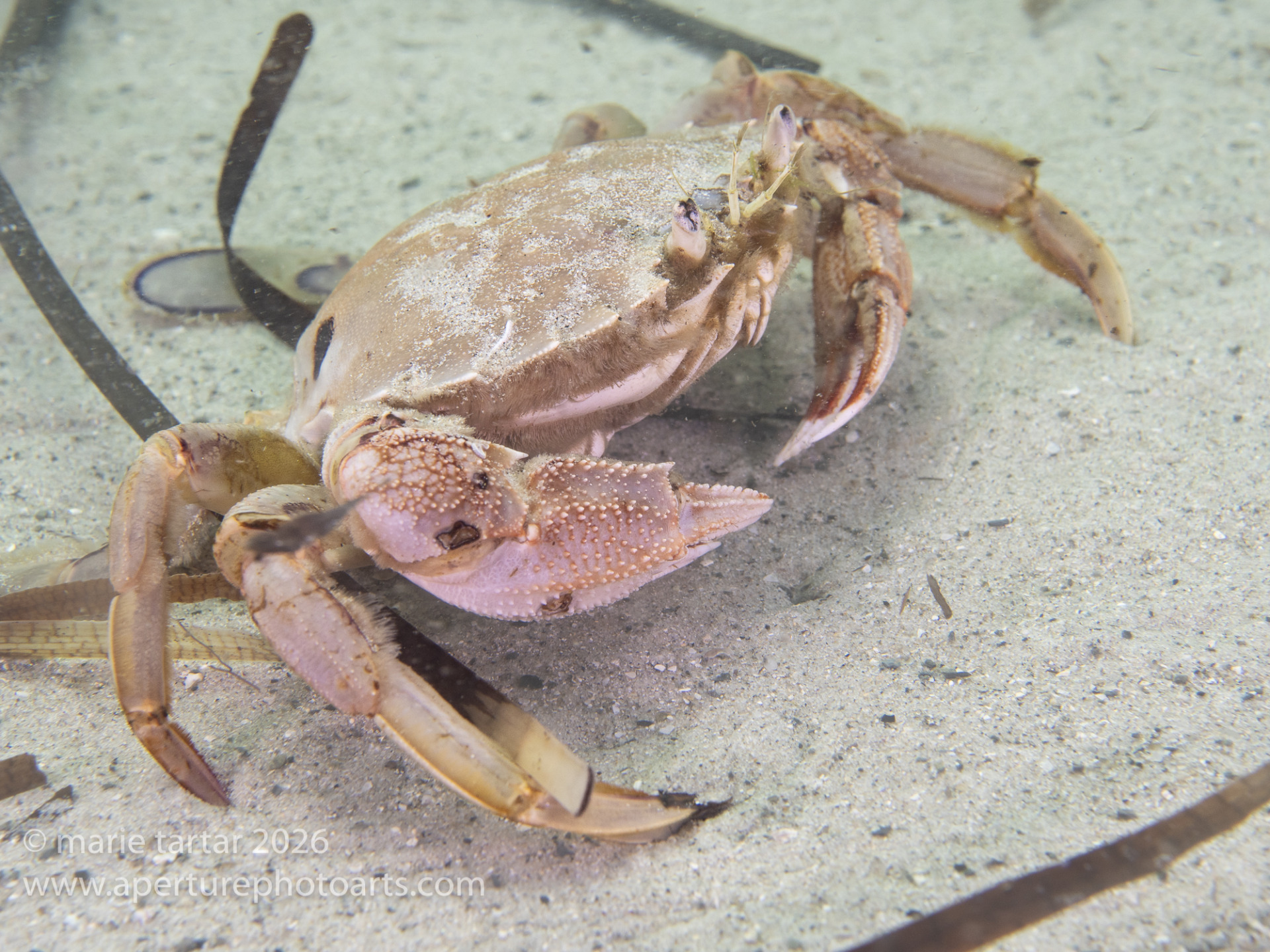
We got crabs! On our second dive in South Australia, at Second Valley, the visibility was terrible.
Back at the jetty, we surfaced. Carl asked if we wanted to continue to search in another sea grass bed where he has found sea dragons before. We all still had 1200 PSI of air left so we went for it…to no avail.
My dive computer alarmed when my tank pressure dropped to 700 PSI. In the effort to respond to it and turn off the insistently buzzing haptic on my wrist, I lost the others. I waited around for a while thinking they would reappear as they had before but to no avail. When my tank dropped near 500 PSI, I surfaced and could see them on the pier. (27 ft, 90 min)
These two dives did not produce our desired sightings, namely leafy and/or weedy sea dragons, but there was clear utility in being in the water again with dry suits. I was surprised to realize it had been three years since our Iceland Silfra dive trip, which is a long time between drysuit dives. Both days, my right foot sock was wet, suggesting a slow leak from the integral bootie. The second day, after adjusting the DUI weight system I borrowed from Nancy so that I could wear the weight at my hip level, I was able to close my BCD cumberbund. Steve managed overnight to straighten out the issue with our wrist dive computers not communicating with our tank pods. So, although as dives they were busts, there was utility working out our gear kinks before the main event, Tasmania.
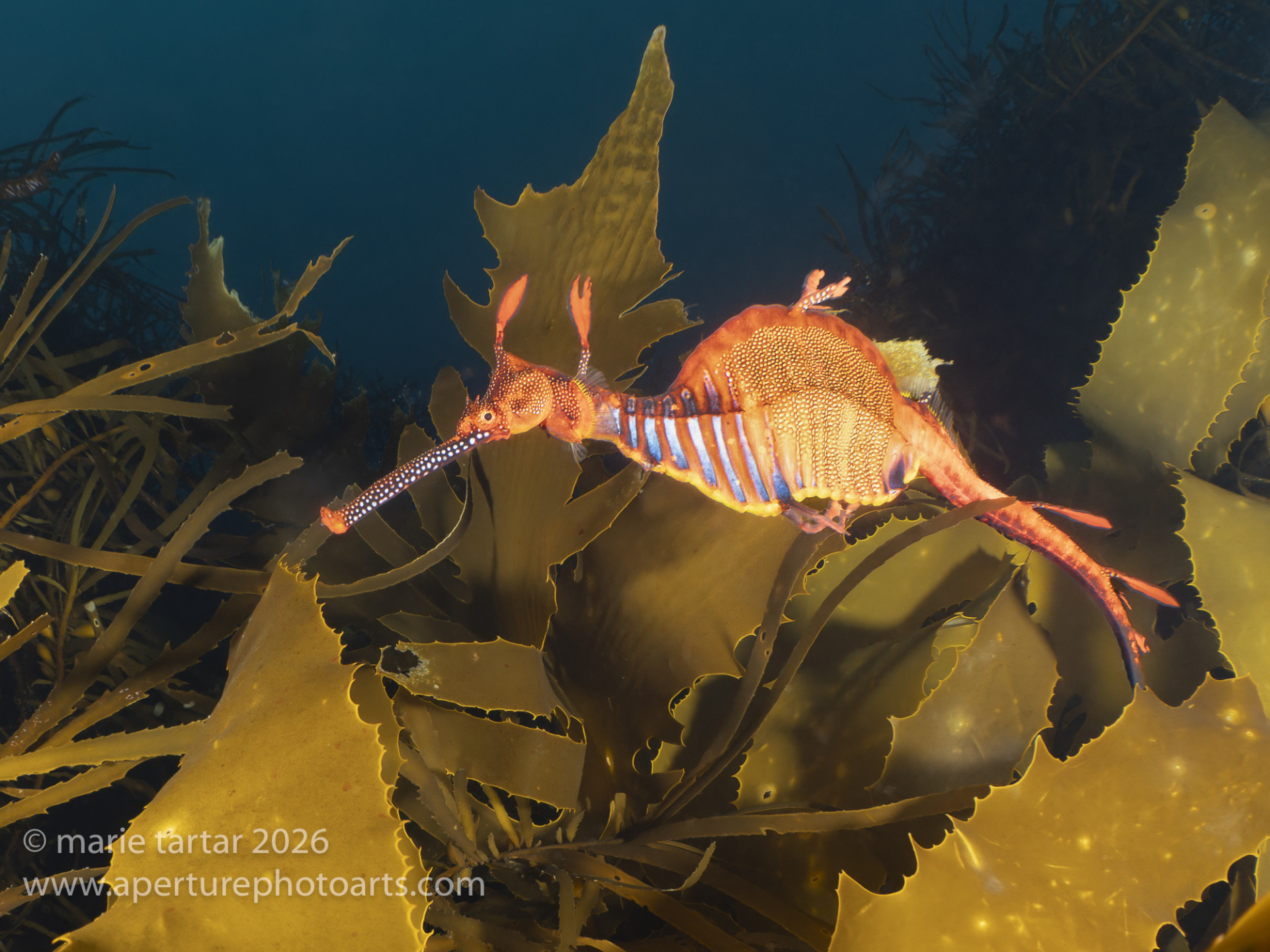
Spoiler alert! Although we were foiled in South Australia in seeing leafy sea dragons, thanks to an untimely algea bloom, we had better luck in Tasmania with their colorful cousins, the weedy sea dragon. This is a female hovering over kelp.
I was struck by how much physical effort is required to shore dive. Heavy gear, namely tanks with BCDs and regulators attached, had to be loaded into the vehicle, offloaded at the site, and either carted to the entry point or donned and walked to the start. We are clearly soft and spoiled by doing so much of our diving from boats, mostly live-aboards, where most of the swapping out of tanks is done by staff.
As we began shuttling gear back to the car, Steve attended to a young man who had managed to embed a fishhook in his finger, deep to the nail, while fishing from the pier. Unfortunately, the barb had not penetrated through and through, so Steve could not simply cut the line to pull it out easily. To add to the difficulty, the fish was flapping on the dock, pulling on the line, driving the fisherman down on his knees on the dock in pain.
Carl located some painkillers in his vehicle and I took them down the jetty just as Steve finished pulling the hook out. From the poor man’s expression, it was clear it hurt quite a bit. He and his girlfriend had apparently taken a bus from the city (we presume Adelaide) so waiting until he could get to an Urgent Care would have been a very long wait.
We had an early dinner/late lunch at Mare Bello in Yankalilla, next to the Drake’s Grocery store and the Bakery, enjoying good pizzas (Ange with chicken and Lamb kebab) and salads (pear and rocket and Caesar).

The Fleurieu Peninsula of South Australia is a sparsely populated area.
Greg started us watching a Netflix animated series called Big Mouth, with a storied cast depicting seriously confused adolescents undergoing puberty. Unfortunately, I started to feel a sore throat and sneezed in the middle of the night, heralding the onset of what I thought was a head cold.
Friday, April 3, 2026
Today was Good Friday, so the start of a holiday weekend. The prior day, we were chatting with our hosts, Peter and Ilona, about possibly going to Kangaroo Island today. They made it clear we needed to reserve seats on the ferry from Cape Jervis ASAP. That sent us scrambling to our laptops, with Steve working on the ferry reservations and me trying to line up a day tour for us. I found a small-group tour and waited, my finger poised over the Buy Now button, while Steve confirmed our transport. The 9 a.m. The Sealink ferry was a 45-minute trip, and Kangaroo Island Trails picked us up from Penneshaw for a Scenic Nature and Wildlife Day Tour.
Catlin was waiting at the ferry terminal with a sign with our name on it. Two other people, father John and daughter Erica, had already been picked up and were procuring coffees. Two other unfortunates had booked the tour but mistakenly scheduled themselves on the 10 am ferry. The distances were great enough that waiting for them was out of the question. So, we lucked out with a small group of 5 in a van holding 11.
This was an all-day affair, with multiple stops and lunch included, and hit many of the most notable features of the turtle-shaped island. KI, as the locals call it, consists of two unequal-sized components, joined by a narrow isthmus, with the smaller segment being the turtle’s head, facing to the right (east). Initially, it seemed we weren’t to see the namesake animal despite it being numerous on the island, but that changed in the late afternoon, when we began seeing kangaroos galore, as well as their smaller cousins, the wallaby.
There was a striking number of dead animal carcasses on the road, great and small, from kangaroos on down the size scale.
Our first stop was the Seal Bay Conservation Park on the southern shore. The terrain reminded both Greg and me of the Magellanic penguin colony of Peninsula Valdez in Argentina, with scrubby brush dotting miniature sand dunes, leading down to a wide beach. Australian sea lions dotted the dunes and the beach.
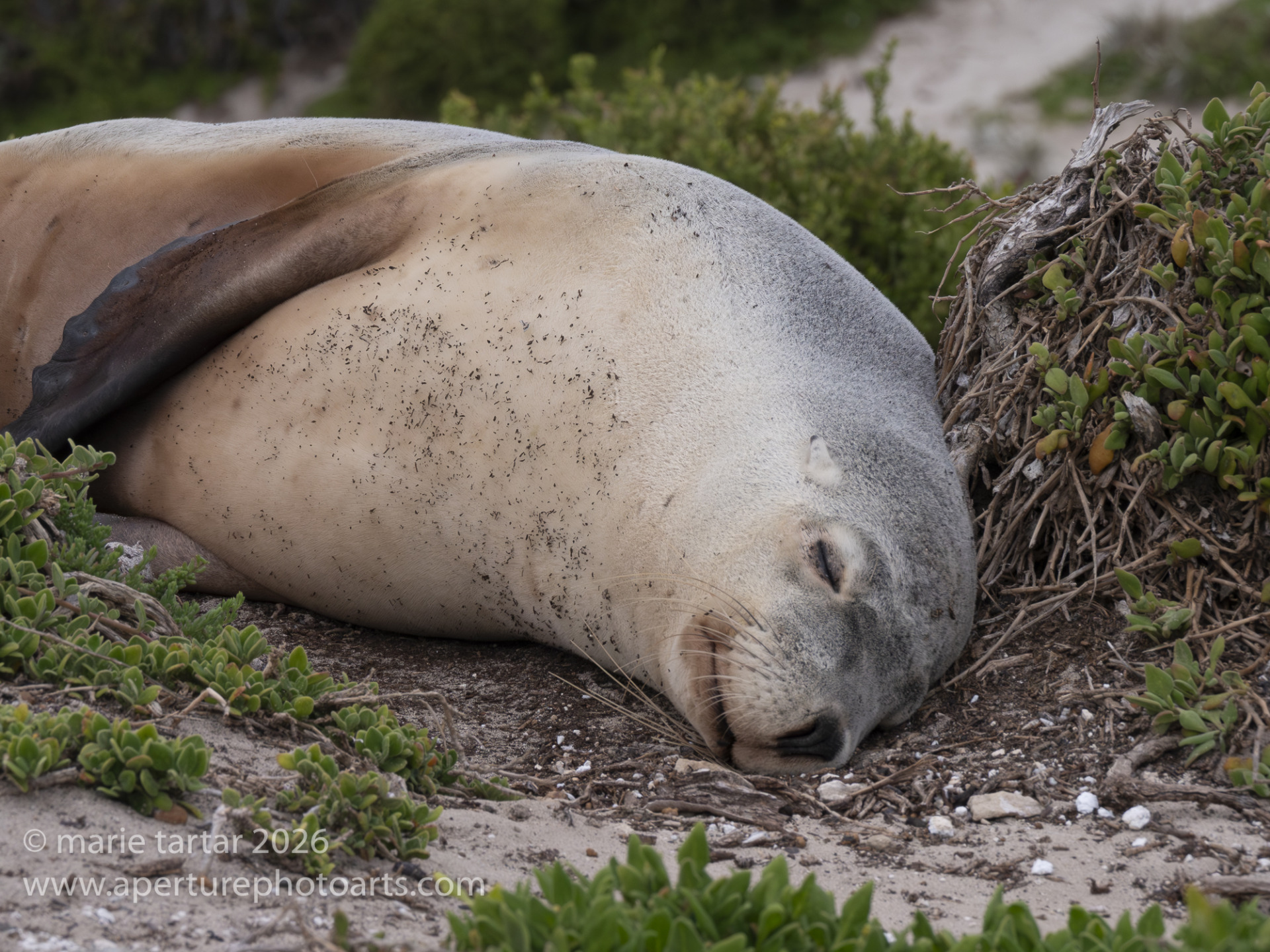
Sleeping beauty (Australian sea lion), siesta at the Seal Bay Conservation Park, Kangaroo Island, South Australia.
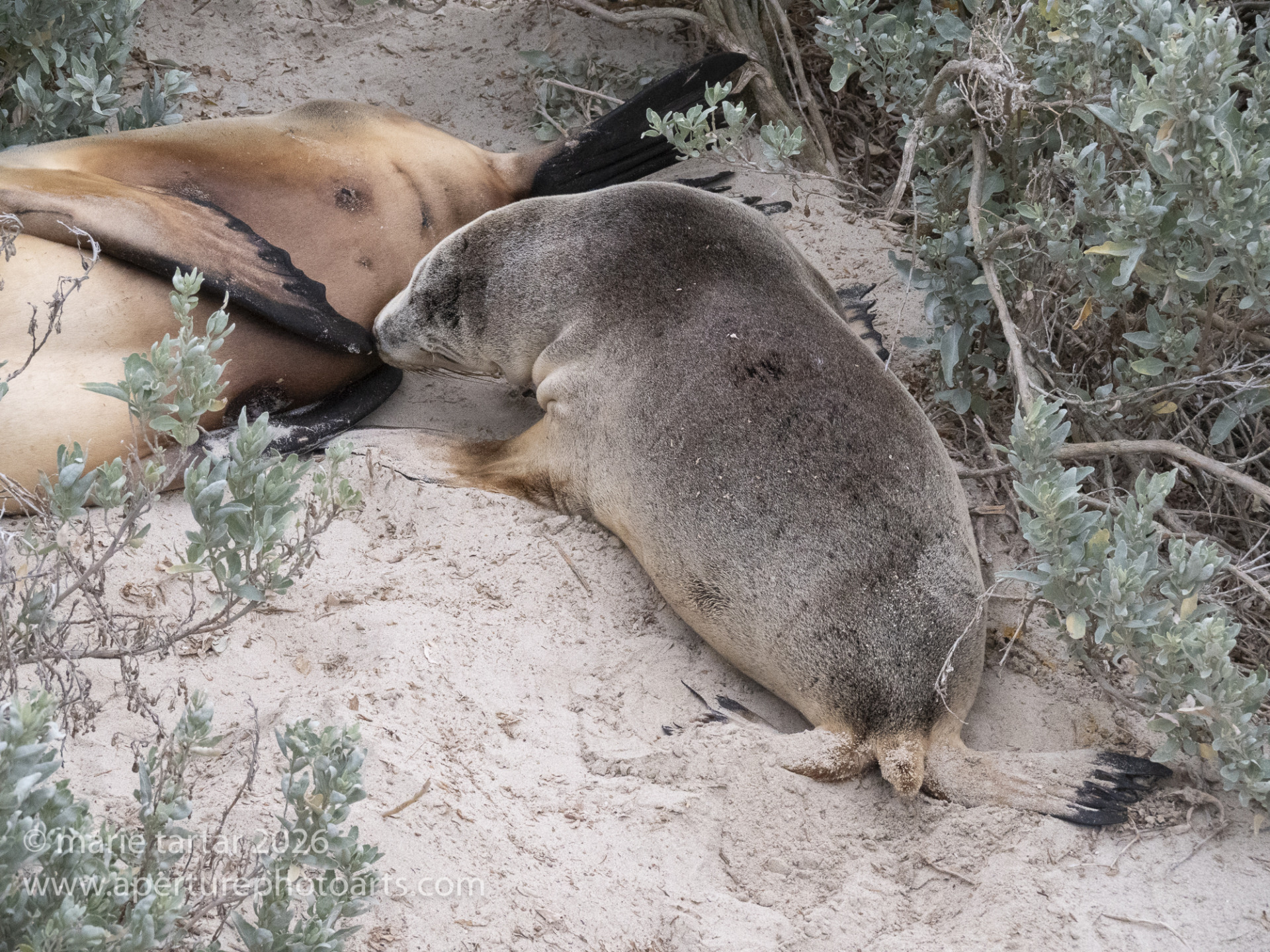
Suckling Australian sea lion pup seeks nourishment while mother is napping at Seal Bay Conservation Park, Kangaroo Island, South Australia.
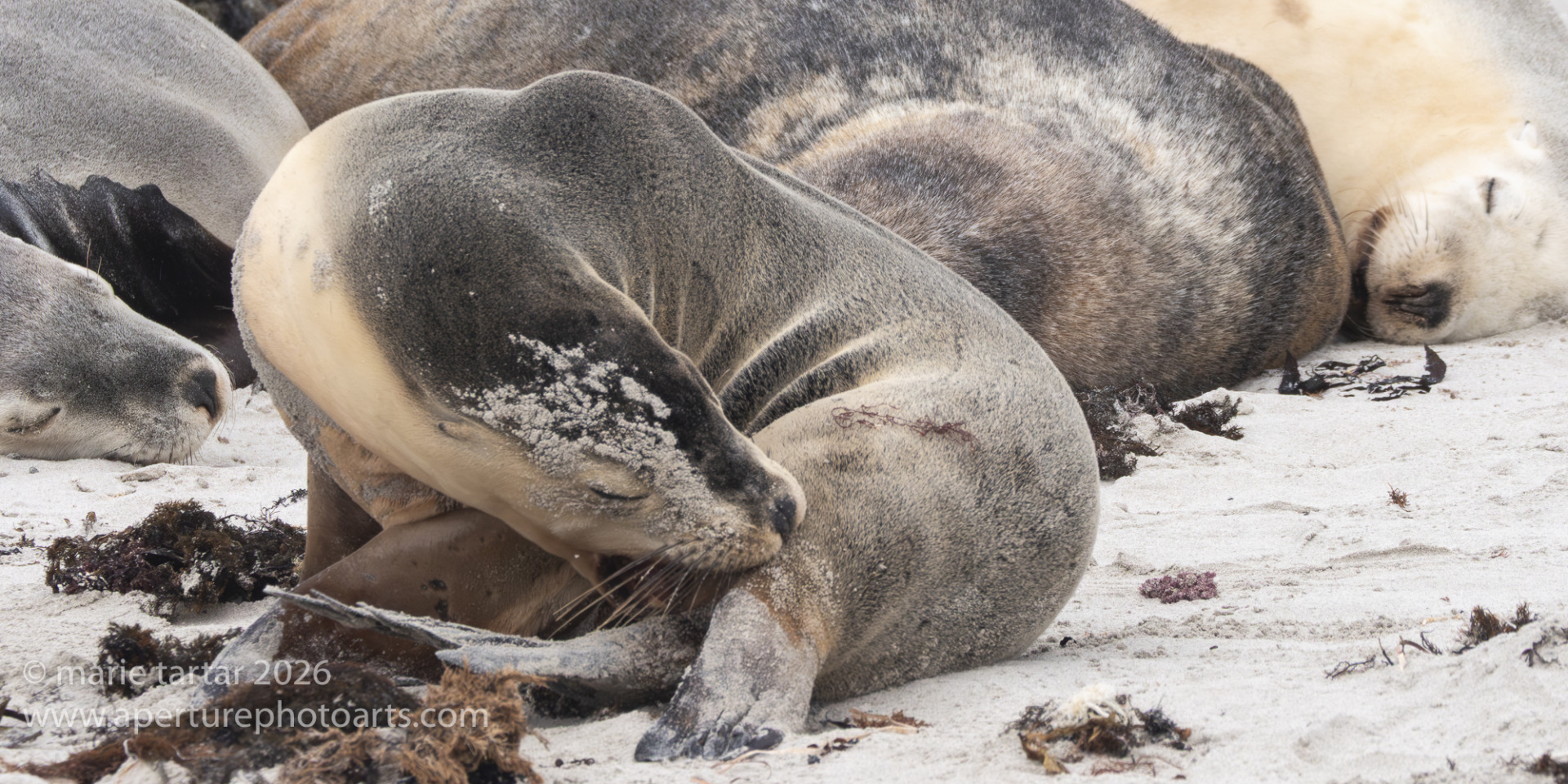
Australian sea lion slumber party on the beach at Seal Bay Conservation Park, Kangaroo Island, South Australia.
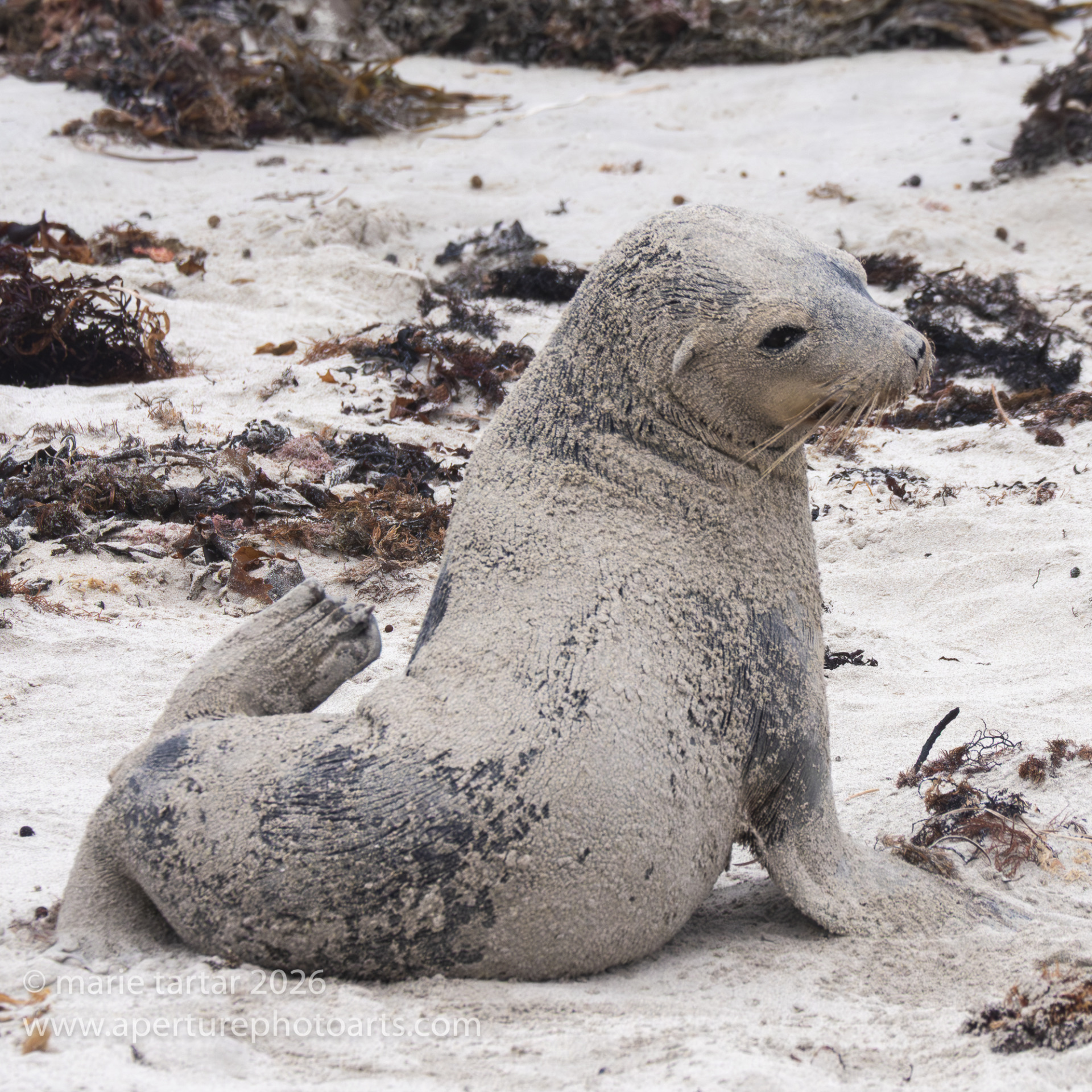
Sandy Australian sea lion pup on the beach at Seal Bay Conservation Park, Kangaroo Island, South Australia.
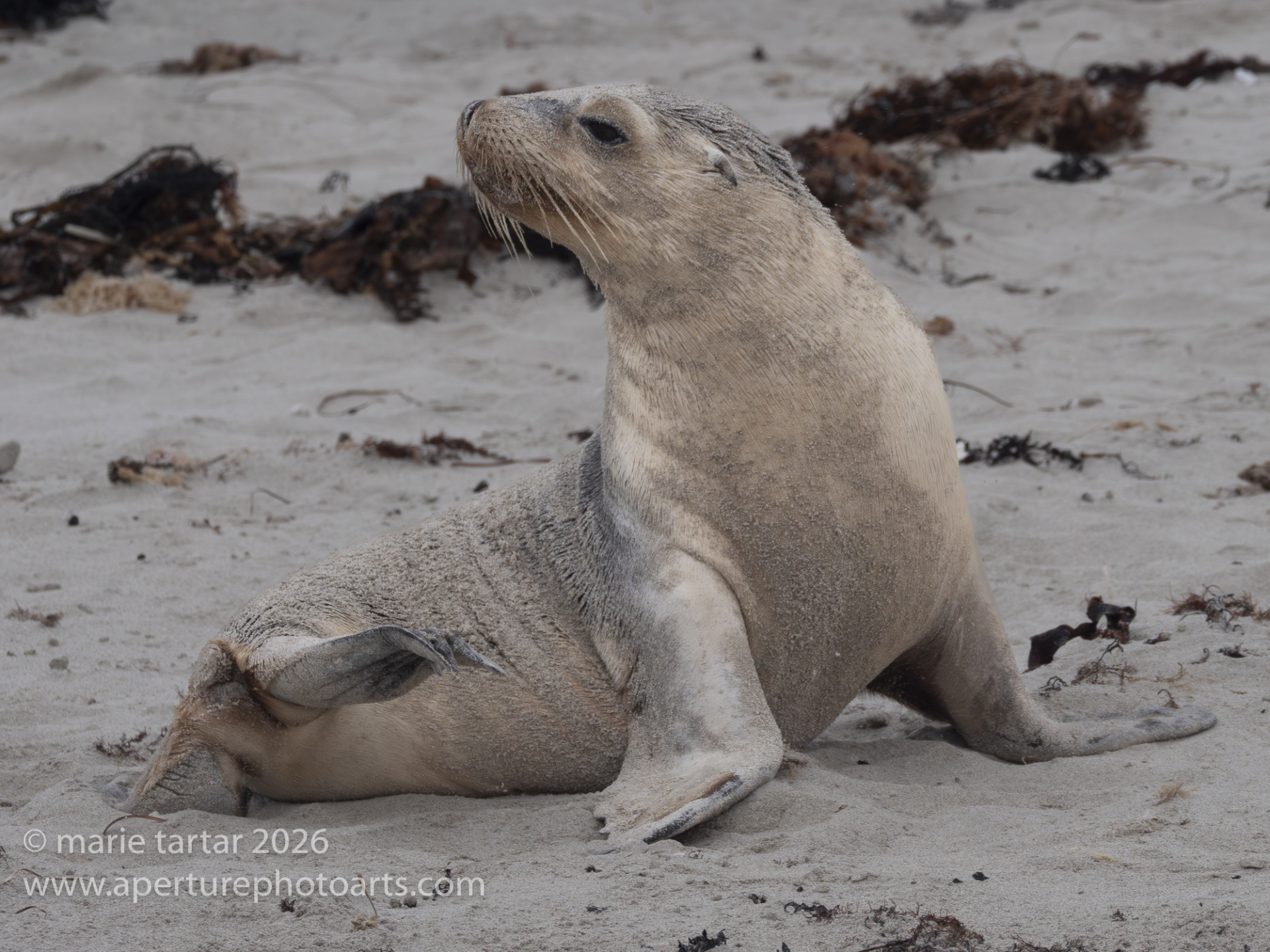
Australian sea lion pup stretch, on the beach at Seal Bay Conservation Park, Kangaroo Island, South Australia.
The brush forms alcoves where sea lions have been known to shelter, sometimes startling visitors heading to the beach.
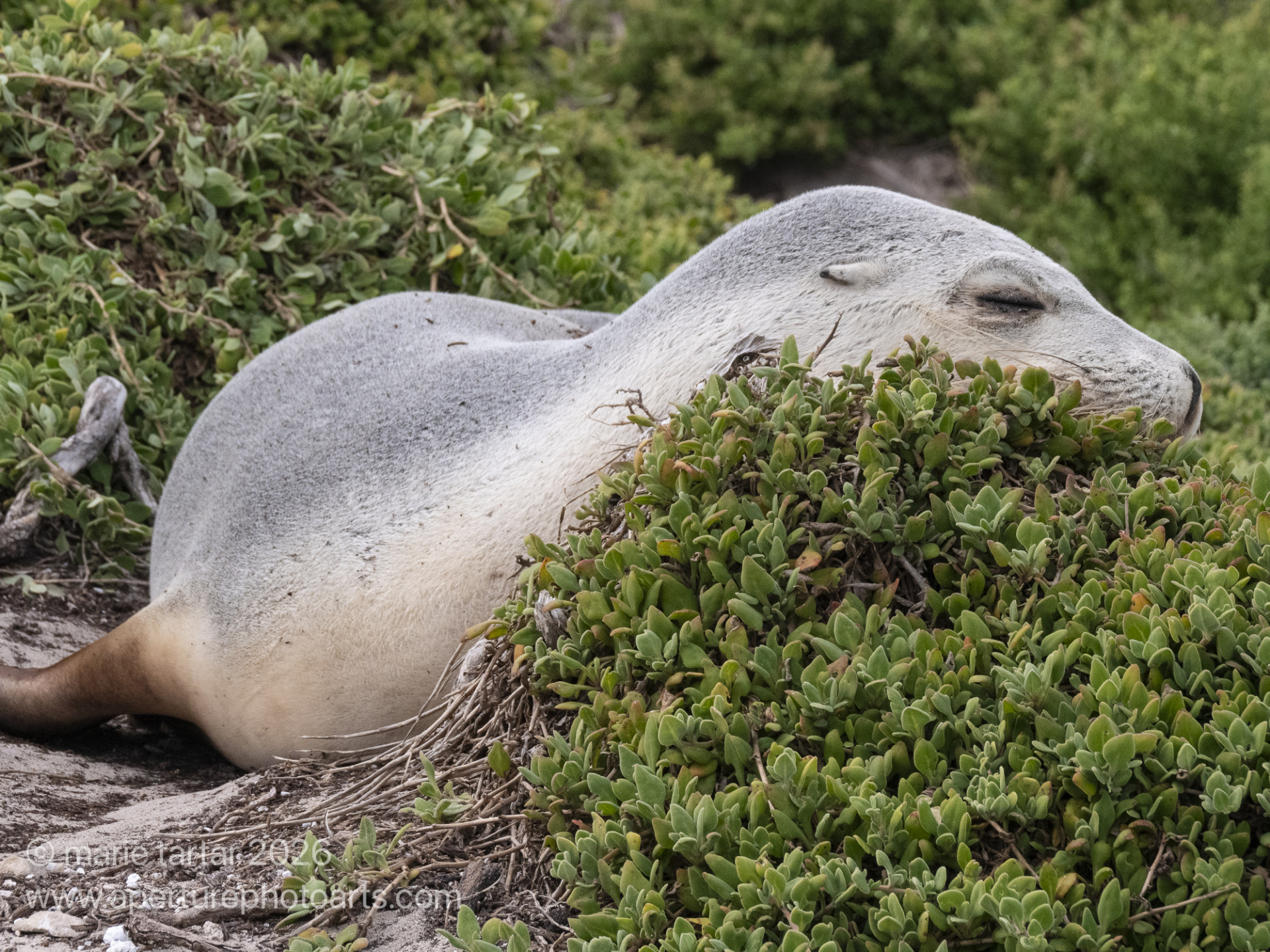
Sleeping Australian sea lion, Seal Bay Conservation Park, Kangaroo Island, South Australia.
We made a brief stop at Vivonne Bay before heading further west into Flinders Chase National Park, named for Matthew Flinders, an English sea captain who was an early European explorer of the area, mapping the coast in 1802. In need of fresh food after 4 months of deprivation and finding kangaroos easily approachable, 31 kangaroos were killed to resupply their stores. In appreciation for this bounty, Flinders named the island for these plentiful inhabitants. Today, they greatly outnumber the human population of KI (about 5000), with estimates of their numbers on the order of tens of thousands.
This huge park was severely impacted by wildfires that tore through it in 2020, burning 98% of the park. Amazingly, the vegetation has markedly rebounded, now a thick green carpet about half the height of the remaining skeletal eucalyptus.
One benefit of the fires is that many infrastructure improvements followed, such as the replaced Visitor’s Center, where we had lunch (focaccia sandwich with fried chicken, bacon and cos (lettuce)). Their delicious version of orange cake incorporated crunchy bites of nuts. We had enjoyed an excellent vegan version coming over on the ferry, as well as our first coffees in days.
The Remarkable Rocks were indeed well named. What was surprising was how propped up they are, topping a volcanic formation high above the shore. The pictures I had seen made me think the rocks were down on the shore. The Rocks had elements of the Enchanted Rocks in the Texas Hill Country, especially the long, gently sloping pink granite approach, topped with Joshua Tree-like fantastical formations.
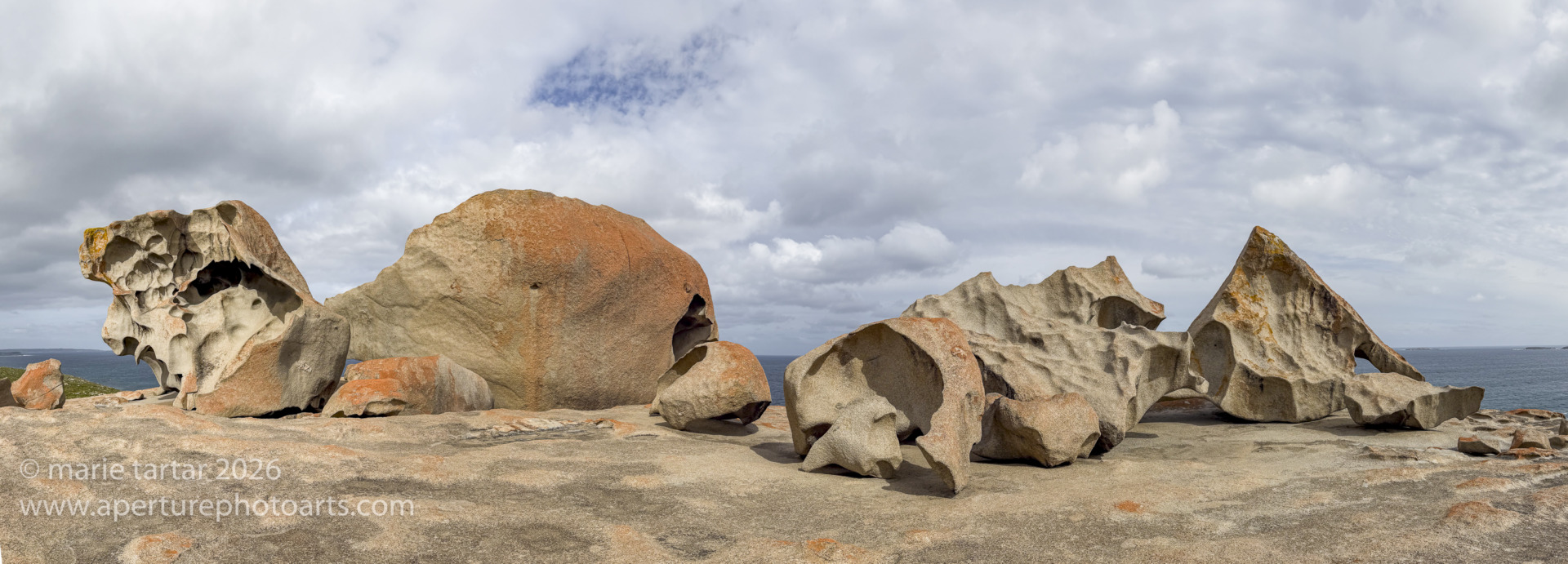
Remarkable Rocks, Kangaroo Island, South Australia: What went on here? More than 500 million years ago, molten magma pushed up through overlying layers of sedimentary rock. Eventually it cooled, becoming granite, which fissured and cracked once exposed by erosion of the overlying sedimentary rock. Ongoing weathering 200 million some years ago along the fracture lines led to formation of isolated blocks atop the granite dome, known as inselbergs or islands of rock.
Not far away was Admiral’s Arch, also reached by a boardwalk and a series of staircases. Down below, we could see a colony of long-nosed fur seals, although they were too far away to really distinguish from tawny rocks. The arch itself is an impressive structure, rimmed by stalagtites.
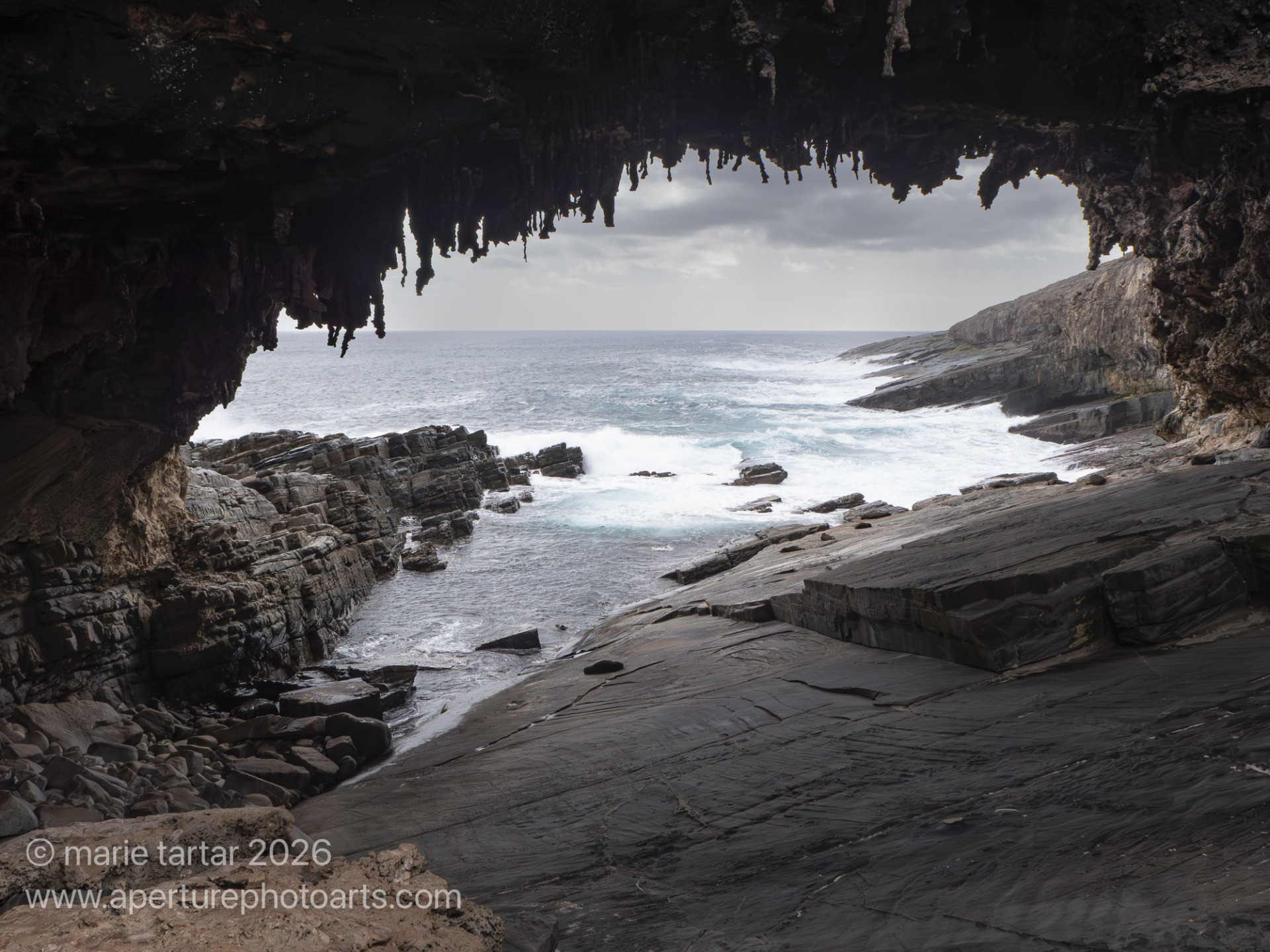
Admiral’s Arch, Kangaroo Island.
On the drive back toward the ferry, Catlin drove us through areas where she was confident she could find kangaroos, wallabies and koalas. Even as we pulled up on some farmer’s property, she spotted a koala. “It’s not so difficult-just look for a fuzzy ball in the crotch of a eucalyptus tree”. Sure enough, Erica found another and I found a third, all very high up. As we pulled out, Catlin found a fourth. Spotting them was easier than photographing them, as they were way overhead, probably 30 feet. A 400 mm lens gets heavy quickly when fully racked out and cranked up overhead.
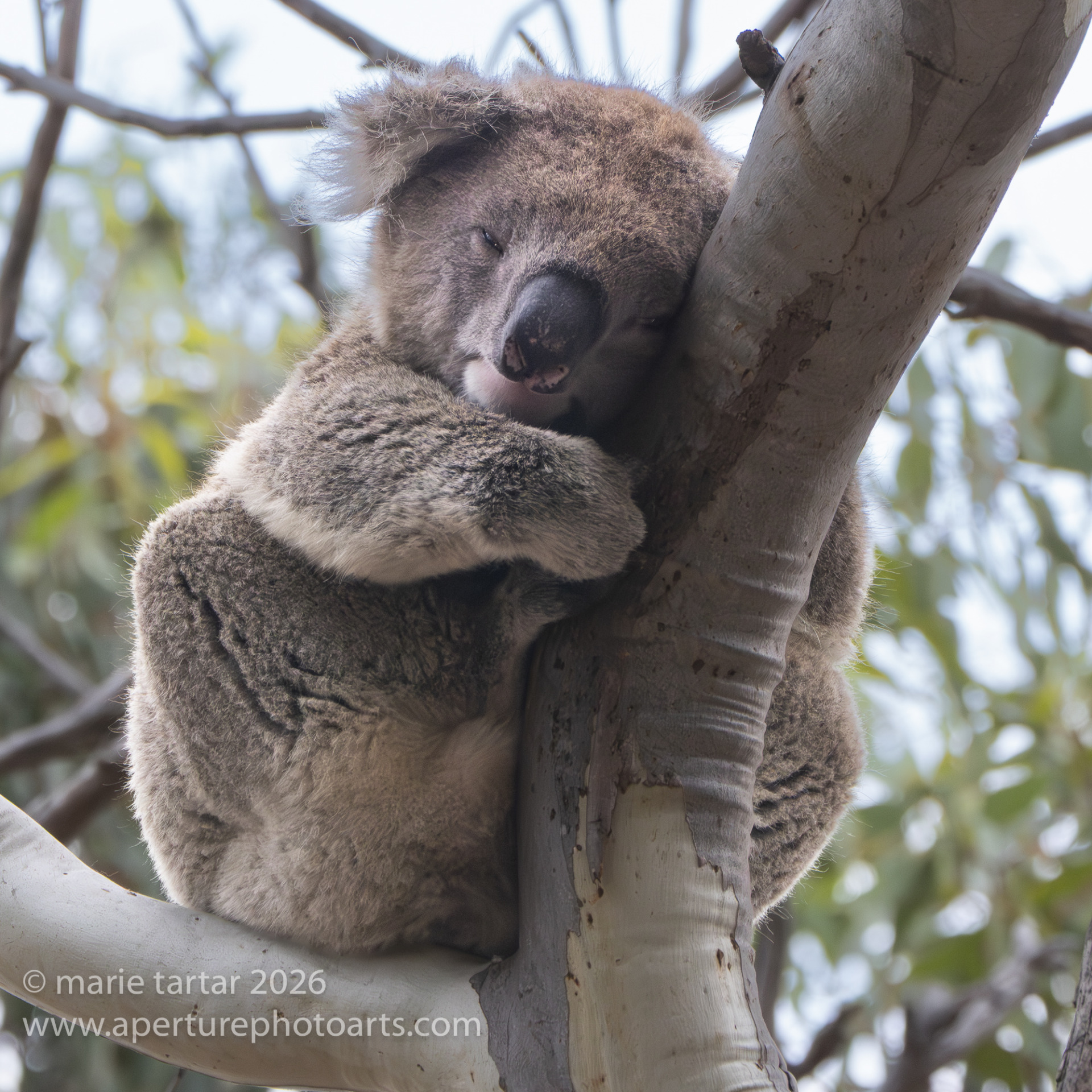
We’ve held koalas (at Lone Pine Koala Sanctuary in Brisbane, more than 20 years ago, no longer permitted) and photographed them before, but it was a real thrill to see them in their natural habitat. It was also a challenge, shooting with a fully racked-out 400 mm lens, 30 feet in the air, through leaves, having to manually focus to ensure the focus was on the eyes and not on adjacent body and tree parts… just the kind of challenge I like.
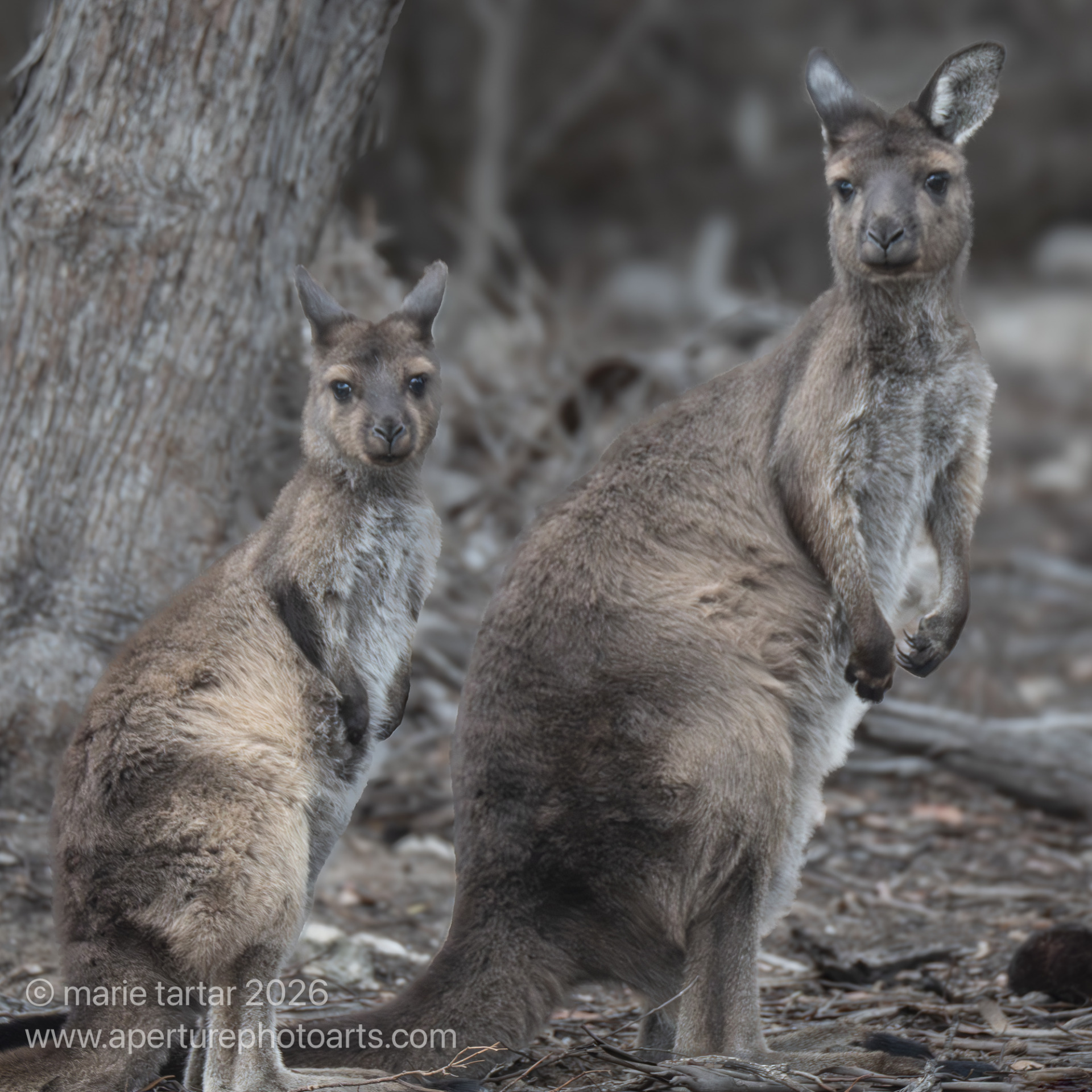
We did see kangaroos on Kangaroo Island, but had to wait until the end of the day when they ventured out of hiding. This may be a parent and a large joey.
The drive back from the ferry was remarkably dark. It was a wonderful day, even for me, having to attend to my constantly running nose.
Saturday, April 4, 2026
Between the conditions we’d encountered and my cold, we did not dive, giving our gear more time to dry out before packing it up for transit to Tasmania. Greg and I drove to town in search of more pocket packs of tissues, pseudoephedrine to dry up my faucet of a nose and saline nasal rinses. As at home, I had to produce an ID (passport) to procure the medication, which was only available as a small supply of a short-acting formulation.
Ilona had suggested checking out nearby Deep Creek National Park and nearby Raywood Nursery, which we enjoyed in the afternoon, doing two short hikes through beautiful stringybark forest, among the oldest remaining in the Mount Lofty Ranges.

A stringybark forest scene in Deep Creek, South Australia. A stringybark forest is so called because of the thick, fibrous bark of eucalyptus trees which may hang in strips, with a dry understory of shrubs, grasses and ferns.
Together, the Stringybark Loop and Forest Circuit trails totaled 4.1 km (2.5 miles). We stopped for dinner on the drive back at the Hunger-Eze Thai take-out truck, at the turnoff to Rapid Bay.
Sunday, April 5, 2026
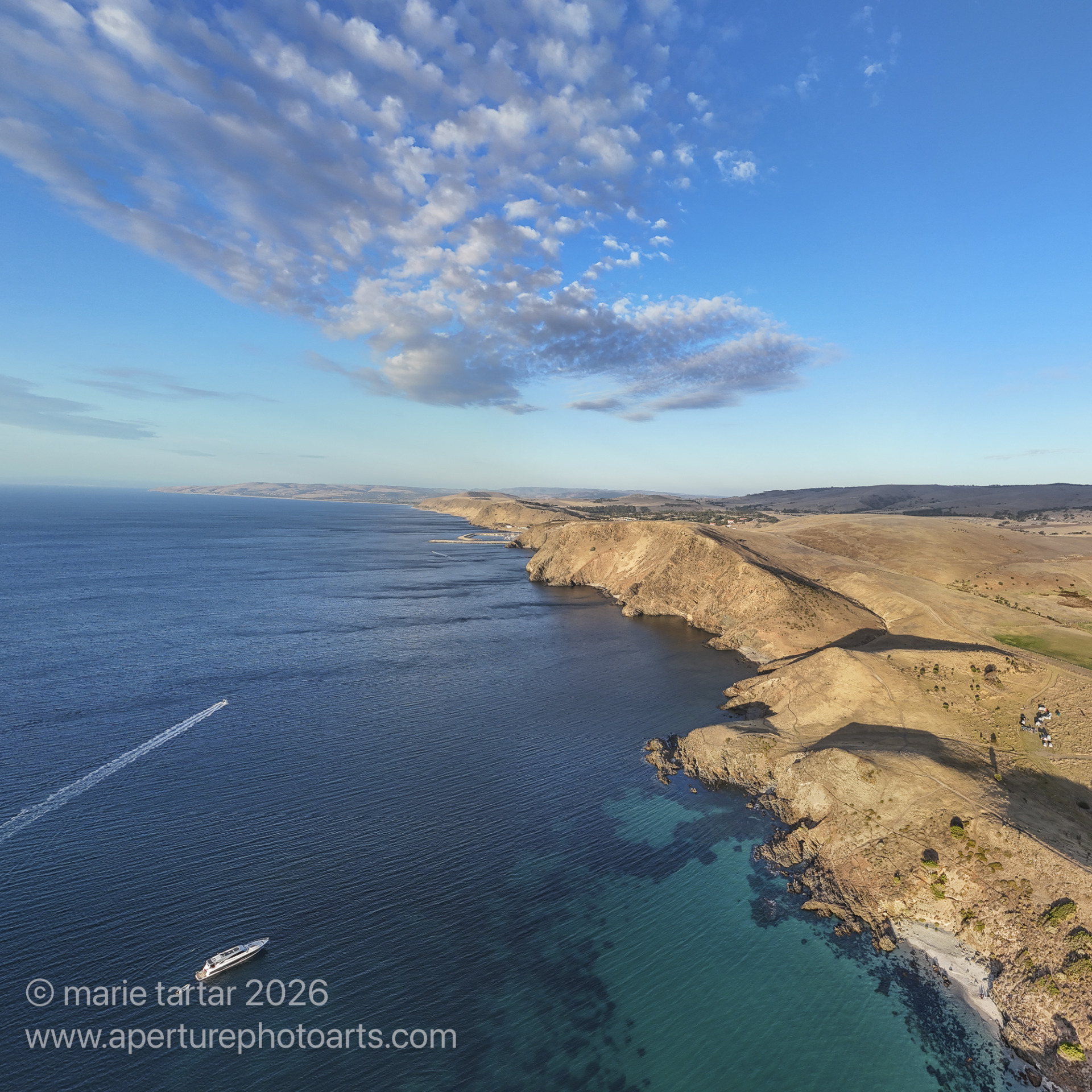
Although the diving wasn’t what we hoped and we didn’t see leafy sea dragons, we enjoyed our introduction to South Australia.
Today was our travel day to Tasmania. Our flight from Adelaide to Melbourne to catch a flight to Hobart wasn’t until afternoon, so we didn’t have to get up particularly early or stress about packing. By now, Greg made the 1.5 hour drive in rain back to Adelaide with only occasional unintentional launching of the windshield wipers. I think it was quite a relief to him to surrender the keys to the intact vehicle, knowing that driving on the rest of this trip would be someone else’s responsibility. We could almost see his cortisol levels declining.
In Adelaide, our flight to Melbourne was canceled at the last minute due to a mechanical issue. Qantas promptly rescheduled us on the next flight, in time to still easily make our flight to Hobart, thanks to a 4+ hour layover.
We were off to dive in colder and, we hoped, clearer waters. Having traveled so far only to find myself with cold symptoms, I could only hope I would be able to dive at all. Steve and Greg were unaffected and I didn’t feel terrible, other than having to be ready with an enormous stock of tissues. Of course, I did give it away already with my spoiler alert-somehow, I was able to dive in Tassie and it was all that: colder, clearer and memorable-details coming in Part 2.
-Marie