

What is it about Iceland that has compelled us to return, again and again? It is a small volcanic island, isolated in the middle of the Atlantic, situated halfway between North America and Europe, which managed to seduce us into signing up for a fifth trip, this one organized around a rare and compelling event: a total solar eclipse passing through eastern Greenland, western Iceland and Spain.
Back in February 2025, Steve, Greg, and I flew from Japan to Iceland after a highly successful Martin Bailey-organized Hokkaido winter wildlife photography trip. In April 2023, we traveled with Iceland-based Byron Conroy for a week preceding an Alex Mustard Silfra-focused Iceland dive trip, which Byron organized. That trip was our third and gave us our first glimpse of the allure of ice caves.

Incredible ice cave, Iceland, 2025.
After that introduction, we wanted more, leading to our winter stop-off in Iceland (trip number 4) for yet another week. While dodging high winds and searching for the elusive aurora that week, Byron told us about a trip he was organizing for Faith Ortins of Blue Green Expeditions, including the August 12, 2026 eclipse. At the time, I was actively researching where to be for this eclipse but hadn’t settled on a plan.

We did see the Northern Lights on our February 2025 Iceland trip, but high winds limited the actual photography opportunities.
Byron is COO of a large Icelandic outfit called Arctic Adventures, which owns hotels in addition to vehicles, gear and attractions for the active traveler. Importantly, they had already reserved the only hotel in Hellisandur on the Snaefellsnes Peninsula for the eclipse. This trip also had other attractions for us, namely a chance to photograph puffins at closer range, travel to the North of Iceland (new territory for us), as well as a thermal vent dive and wolf fish near Akureyri. Byron rated the additional diving as easier than what we had already done at Silfra, which was reassuring.
Complications arose in the weeks leading up to our departure. Exactly two weeks before our departure for NYC, where we planned a week’s stay prior to continuing on to Iceland, my right knee blew up. As Steve said, it became so swollen, he could see it from across the room. I clearly had provoked an effusion, medical-speak for “water on the knee”, although I had no recollection of any injury. Over the preceding weekend, I had been active, doing my usual work-out (sessions of strength training, jump roping and rowing, not all at once!) and a short bike rode to my book club, nothing out of the ordinary.
My first inkling that something was amiss was on a Monday morning. I was working that day and within a few steps out of bed, had the sensation that I had lost the last few degrees of full extension overnight. It didn’t hurt, so I wasn’t dissuaded from biking the 10 miles along the coast to work. Nor was I alarmed taking my usual half-hour stroll around the hospital after lunch. But by evening and especially the next day, it was clear that I had overdone something. My knee was so swollen I was hobbling by Tuesday. Suddenly all of our fall plans were in jeopardy. Walking any significant distance would be difficult, much less hiking and hoisting a steel tank on my back.
I was off on Tuesday and Wednesday of that week, which was lucky. I texted Biraj, my primary care physician, on Tuesday, who gave me an appointment the next afternoon. I already had a medical appointment on Wednesday at our northern Jefferson site, so racked up some miles shuttling between Vista up north and Biraj’s office in La Jolla. Biraj ordered knee x-rays and MRI. From her office, I headed to our department and had my knee xrayed, showing evidence of arthritis and surprise, chondrocalcinosis (soft tissue calcification). Knowing if I went through scheduling, it might take weeks to get an MRI, I called up Dave, an MRI tech we’ve worked with for decades. He said to come in that night to Carmel Valley, completing a 3-site Scripps tour in one day. The MRI showed even more arthritis, especially of the patello-femoral joint, than I ever had reason to suspect I had, as well as, of course, a lot of fluid.
The way forward was clear to me and Steve: I needed the fluid aspirated, analyzed for crystals and an intra-articular injection of steroids to calm the inflammation. Back at work on Thursday in the Breast Center, I texted Biraj. She was working on getting me an appointment the following week with her sports medicine fellowship-trained partner, with experience in joint aspiration and injection. This was exactly what I needed, but I also needed lead time. I suggested it could be done in our department (before he retired, intraarticular joint injections were a significant component of Steve’s practice). Steve was reading body MRIs and CTs in the department and went over to confer with our partner Ray (who was reading musculoskeletal studies that day) and Paula, a technologist we’ve both worked with for years. They added me on to the schedule at noon, so I hobbled over on my lunch hour. Ray pulled out 18 cc of clear yellow fluid and instilled a steroid and lidocaine mixture, and I limped back to work upstairs more easily than I had come.
The results were nothing short of a modern medical miracle! By the weekend, I was walking normally, albeit cautiously and could again see proceeding with this trip. To be sure, I was not bounding down stairs without a thought and did not bike to work or jump rope, lest I stir my knee up again. In NYC the week preceding our departure for Iceland, I was able to walk 6-8 miles/day without difficulty.
Meanwhile, Greg was dealing with a convergence of dog care issues. Normally, he has two of his four dogs go to a doggy spa and two stay at his house with a sitter. But the sitter had recently dislocated her shoulder and the older dog was developing symptoms of renal failure. This dog weighs 70 pounds and needed to be helped in and out of the house. Ultimately, he ended up forfeiting the trip, not able to arrange suitable care for the dogs with such short notice. Greg was with us on three of our four prior Iceland trips, so this was disheartening, although understandable.
Tuesday, August 4, 2026
Flights to Iceland leave the East Coast at night, and arrive in the early morning at Keflavik, an airport built by the US military during WW II. We had successfully bid on an upgrade to Icelandair’s first class, which gave us a larger and more comfortable seat and a surprisingly good meal. However, the seat is not lie-flat, so there was no sleep for me. Instead, I indulged in 4 episodes of the second season of The White Lotus. I was effectively comatose on the Flybus trip into Reykjavik.
Bleary-eyed at the Hotel Skuggi reception, I was overjoyed to be offered early check-in. Yes, we would gladly pay the 30 E cost, a bargain! We did exactly what is not recommended but what our bodies craved, immediately donning eye masks for a restorative nap.
We roused in time for orientation by Byron at the Arctic Adventures office complex, where introductions were made and required paperwork was completed. We were a large group, double the size of Faith’s second group, who would start their trip with the eclipse which would end ours. Dan and Betty Orr were our leaders. I knew of them from our mutual friends Howard and Michele Hall, having heard from the Halls about their Wyoming eclipse experience at the Orr’s Driggs, Idaho home, across the Tetons from where we marveled at the August 12, 2017 eclipse.
Effectively, we were two groups, traveling in two Mercedes Sprinter vans. Siggi, an Icelander from Reykjavik, was our driver-guide for the English speakers, including Dave and Connie from Alberta, Canada (who we knew from our only prior Blue Green trip, to Tasmania in April), cave diver and Atlanta Aquarium volunteer, Jim and his wife Sharon, retired Marshfield Clinic physicians Rebecca and Tom, and Gordon, a wine enthusiast retired in the Pacific Northwest who came specifically for the eclipse. Rebecca, Tom and Gordon were all veterans of a prior Faith trip to Iceland, as were Dan and Betty. The other half of the group was French-speaking, from Canada, and had Ronan, from the south of France, driving them and providing a lively commentary in French in the other vehicle. They were led by Mario from Montreal and included Marysel and Christian, Thierry, Suzanne, Lisa, Isabelle, Roch and Sylvie, and Annie and Matt. Dan accompanied the English speakers in Siggi’s van and Betty tried to make sense of Ronan’s commentary in French using Google Translate, which led to some interesting linguistic malapropisms (more about them later).
The groups would have been even larger had Greg been able to come. Friends of Jim’s (his cave diving partner) also canceled at the last minute, she having sustained a fracture and one day later, he learning his prior cardiac history of valve intervention 9 months before disqualified him from diving Silfra and up north (despite his clearance from his personal physician and resumption of diving at home).
Back in town, Steve and I dined at a long-time favorite, an Indian restaurant called Austur-Indiafjelagid. It is the oldest Indian restaurant in Iceland, going strong for 3 decades. We’ve enjoyed their cuisine on every trip to Reykjavik, usually more than once, starting with our first trip back in 2011. This trip was no exception. We shared crispy lentil and rice pappadoms, with a trio of chutneys, lamb biryani, and lasooni lobster, tandoor-grilled with ginger, garlic and garam masala.
Wednesday, August 5, 2026
Steve couldn’t sleep from 3:30 am on, so occupied himself in the lobby finding us a dinner reservation.
The 16 divers were divided into two groups for the day. Our half of the diving group (me and Steve, Connie and Dave, Rebecca, Roch, Suzanne and Isabelle) left the hotel at 8 am for our check-out dive at Davíðsgjá, a fresh water glacial fissure near Silfra, also in Thingvellir. The name roughly translates as David’s Crack, which cracked up the English speakers, sounding funny and rudely anatomic. David’s Fissure probably would be a better translation, less likely to induce chuckles. This is a shore dive in a large natural lake with a rocky, gradually sloping entry. We did a shallow dive, mostly to confirm drysuits were staying dry and we were properly weighted. Steve and I had again arranged to rent 3 mm steel backplate BCDs, rather than haul our aging jacket-style BCDs to Iceland. The dive (32 ft 37 min) features a rocky, algea-covered substrate and clear glacier-filtered water. I did see one sizable fish on our return.
The other half of the diving group (Mathieu and Annie, Maryse and Christian, Thierry, Mario and Jim) visited Golden Circle attractions during our morning dive and did their check-out dive in the afternoon, while we swapped places. Our first stop was Gullfoss, a mighty waterfall. Gullfoss (Icelandic for golden and foss means waterfall) was formed by glacial runoff carving out a deep canyon in the Hvítá River.
The final component of the Golden Circle trio of attractions easily reached from Reykjavik is the geyser field. Geysir itself, the plume which lent its name to the world, is mostly dormant, but its neighbor, Strokkur, issues a dramatic eruption every 4-10 minutes without much warning for photographers.
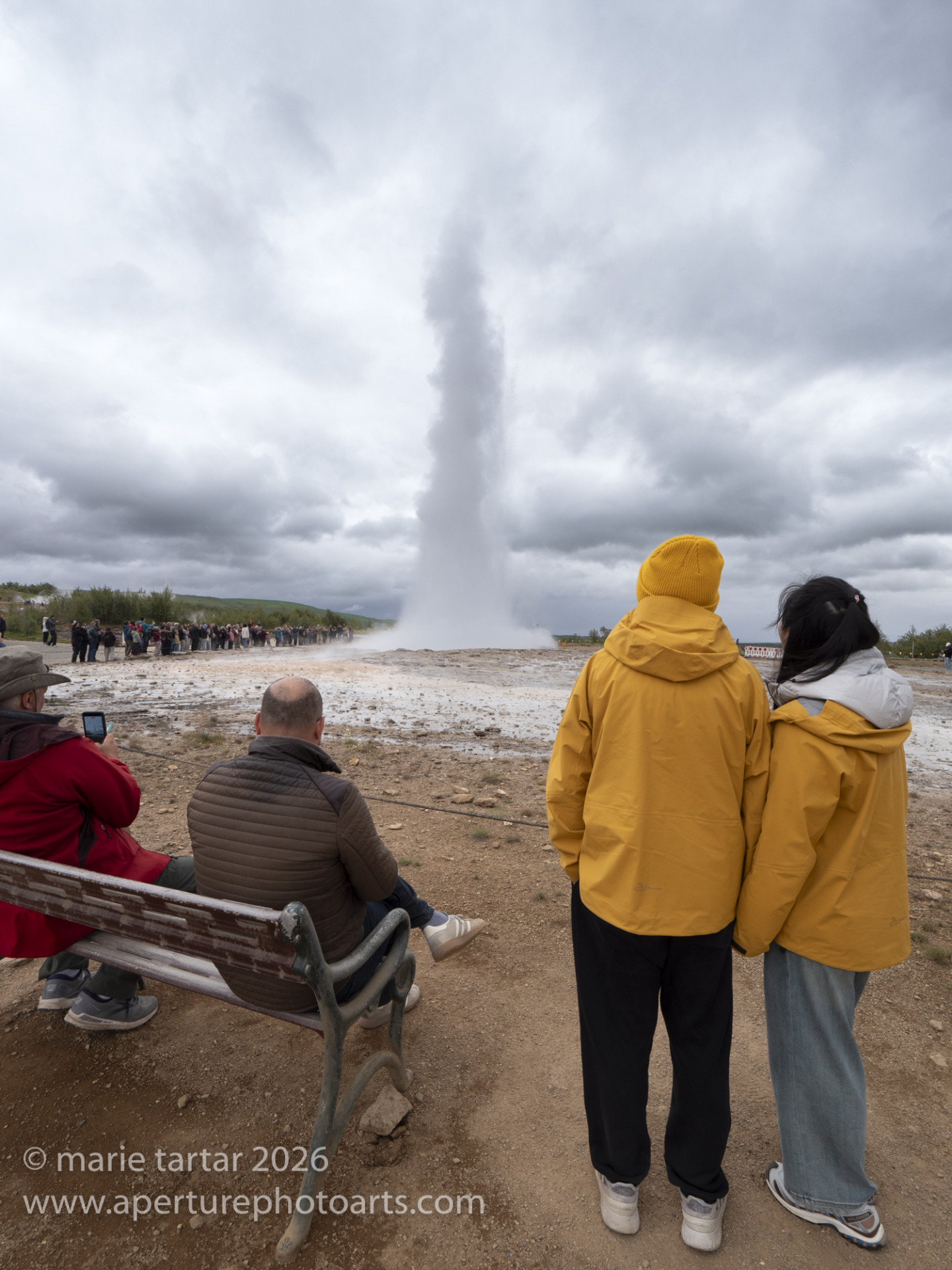
Strokkur’s irregularly timed but frequent eruptions draw an admiring crowd on the Golden Circle of Iceland.
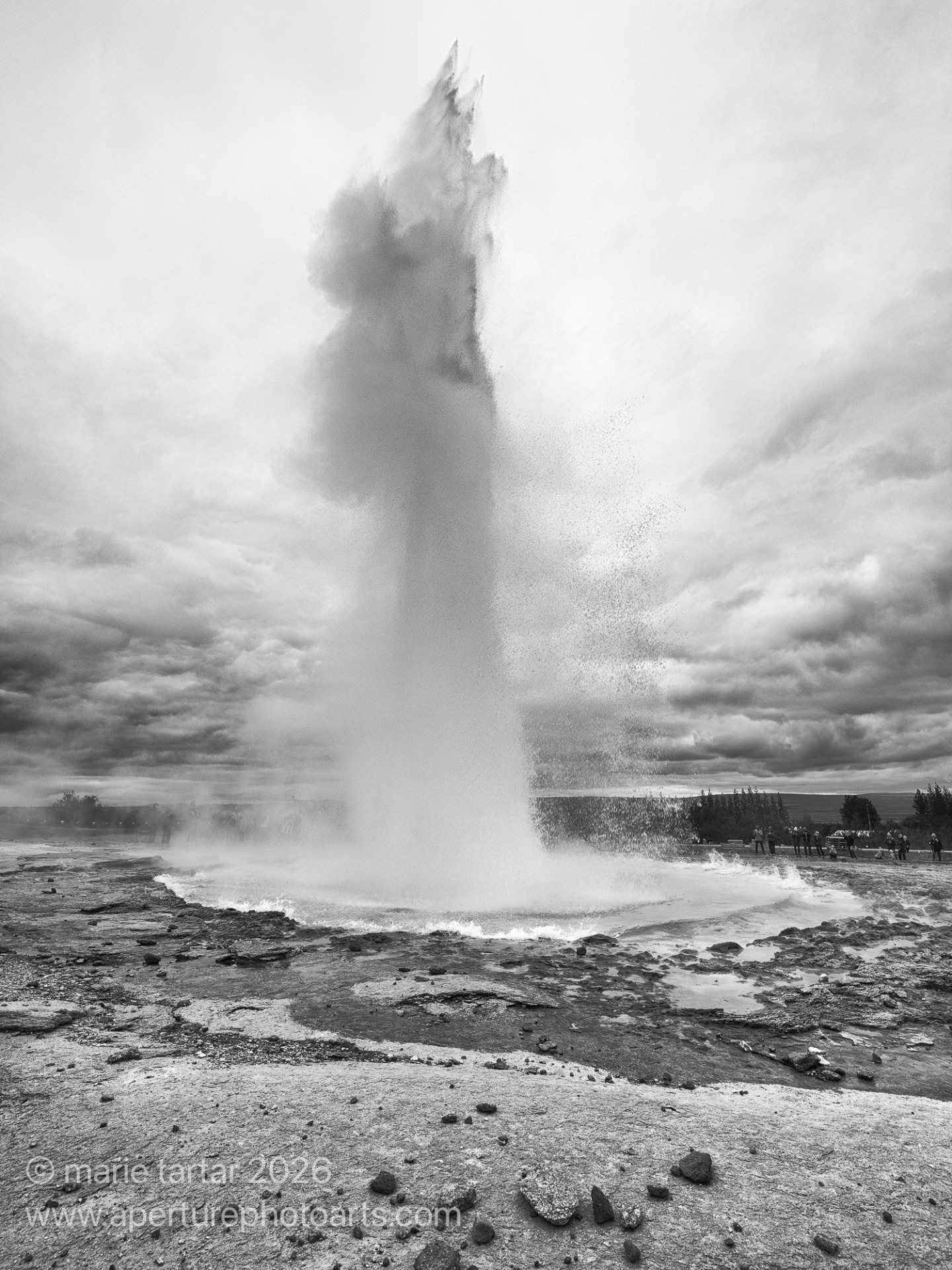
Strokkur, a reliable geyser in Iceland’s Golden Circle, goes off every 4-10 minutes.
Steve and I had a longer walk into town for dinner at Lola, an attractive, newer Michelin guide restaurant near the harbor, featuring Italian-inflected cuisine. We launched with Dill Appello cocktails and Lola’s focaccia, with walnut and harissa spread (Muhammara), followed by a trio of hand-dived scallops.
Both of our main pasta courses were very rich and saucy (lobster linguine for me and fig ravioli with pine nuts for Steve). It was an enjoyable, albeit pricy, evening (32,000 Kronor or about $264).
Thursday, August 6, 2026
The agenda for today was two dives at Silfra. For several people in the group, Silfra was why they had learned to dry suit dive and come to Iceland. Steve and I had dived Silfra 6 times already, in 2023, during an Alex Mustard workshop devoted to diving Silfra, so revisiting its crystal clear glacial waters was icing for us.
We made an earlier start, leaving the hotel at 7:30 am, trying to beat the crowds of snorkelers who dominate Silfra today. Years back, the regulations governing diving Silfra and dry suit training were quite lax and so many more people dived Silfra than do today.
Byron’s plan was for us to be the first in the water. He would be guiding and modeling for us. These good intentions were foiled by the incessant rain. The truck, with the drysuits hanging inside, was crowded with everyone trying to don their underwear and drysuits at the same time. Steve couldn’t even find his borrowed thickly padded Waterproof jumpsuit for quite a while, as the racks were jam packed with drysuits. When we were here before in April, a less crowded season, there was an extra warming truck, but in high season, with an eclipse, there was no spare vehicle.
Steve and did the first dive together, mostly alternating shooting Byron and his bright torch, trying to stay out of each other’s frames. Silfra is a shallow dive and in places, one has to practically crawl over shallow rocks to continue. Evidently, approaching the surface so closely confused my dive computer, which credited me with 6 shallow dives on this day. As near I can figure, we probably had a maximum depth of 25 ft and did a 38 minute dive.
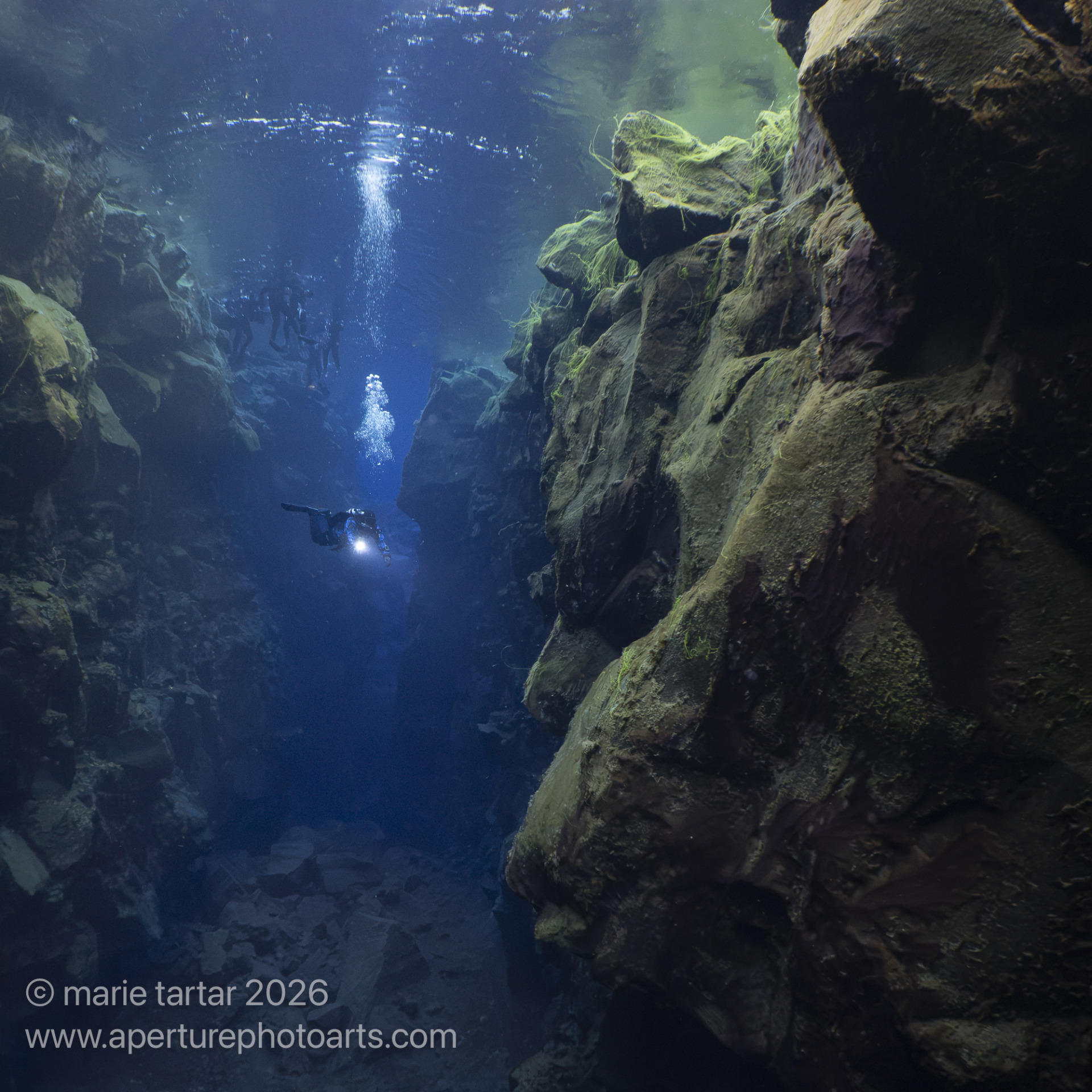
A group of snorklers hangs on the surface behind Byron, our guide and model at Silfra.
Steve had a leaking left glove and a cold, numb hand by the end of the first dive and opted out of the second, as did half the group. Even hearty Canadian cold water divers Connie and Dave opted out of the second dive. Many were probably done in by the long walk in gear from the exit back to the entry. My slow trudge was considerably aided by Byron grabbing my camera and dashing ahead up the path.
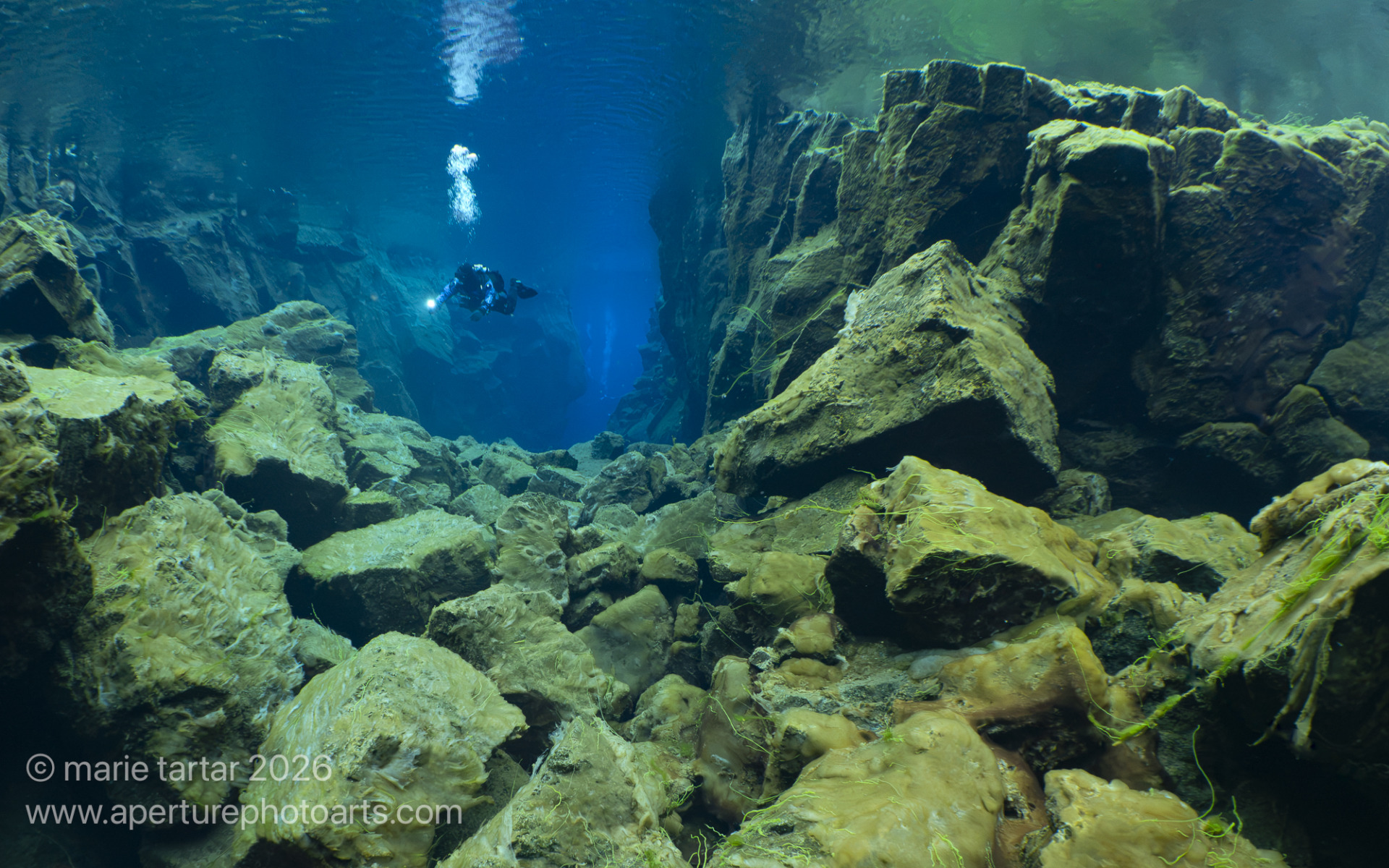
Silfra is renown for the remarkable clarity of its glacial water, filtered through volcanic rock 30-100 years.
Thanks to the addition of a heated vest, I was more comfortable than on our prior foray, so decided against undressing to go to the bathroom. Byron swapped my tank out (although I still had 2000 lbs left, Silfra being a very shallow dive). At the entry, the population had soared, with mobs of drysuited snorkelers in a long line. I took an uncomfortable seat on the bench and we waited, probably for an hour. The way my tank was positioned, I couldn’t rest it on the bench without doing a number on my back. It was cold and rainy and miserable enough that I seriously considered, every few minutes, bagging the second dive.
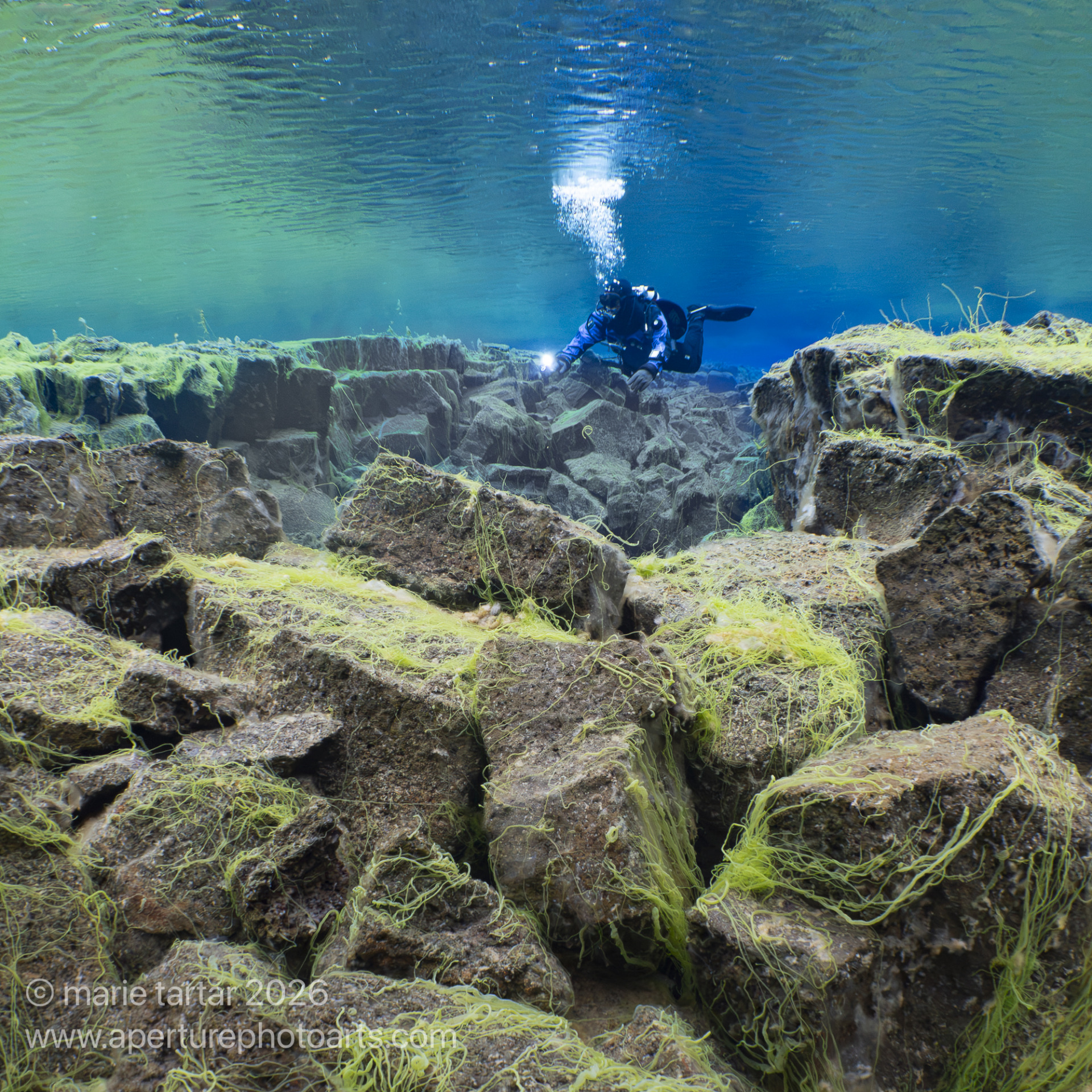
Algea-draped rocks near the end of the dive at Silfra (Little Silfra).
I had cold hands by the end of the second dive (halfway through, I felt a big haptic vibration at my waist, my heated vest’s way of saying “Adios!” or out of battery and shutting down). This was a marked improvement over our prior Silfra experience, where my hands were in agony within a few minutes of entering the water. The big change from before was the heated vest under my drysuit and wearing two pairs of thermal gloves (and a Hothand) under larger dry gloves. Again, this was a shallow dive, to 26 ft for 19 minutes.
In the afternoon, I received an email from a favorite Michelin-starred restaurant in Reykjavik-we cleared the waitlist for dinner at Dill, for that evening. Treating ourselves to dinner at Dill has been our tradition since our first trip to Iceland in 2011, at which we’ve dined every trip except our last, short winter trip in 2025. As it happens, we recently celebrated our 37th wedding anniversary and this very month was 40 years since we met in a reading room as residents (Steve second year, me first) at Mallinckrodt, the radiologic arm of Washington University where we did our radiology training. It’s good we had such a momentous milestone to justify this dining extravaganza. I’m amazed (reading back through an earlier Iceland blog) to realize how much more expensive this pricey meal has become through the years. In 2011, when Dill was located in the Alvar Aalto designed Nordic House, a 5 course meal was $85 and the wine pairing was another $85. The current tariff, admittedly for a series of tiny exquisite dishes (I actually lost count, on the order of 20!) has ballooned to $325/person! Suffice to say, our final bill, including the wine pairing for Steve and wine and non-alcoholic beverage pairing for me, was equivalent to a car payment.
It was a delicious blow-out dinner. Starting in the entry with a version of harðfiskur (dried fish, a tradition Icelandic snack), we were then ushered into a lovely lounge for several courses and finally, into the dining room for yet more delightful dishes. The menu, presented afterwards, is cryptic. For example, there were two pork dishes, one described as pork cheek, nasturtium and pancake and the other as pork belly, parsnip and rose.
Friday, August 7, 2026
We checked out of Hotel Skuggi after a final breakfast of pickled herring, a spoonful of tuna salad, toast, melon and grapefruit. We were off on the road to Iceland’s scenic south coast. It was raining and overcast gray all day.
I elected to ride in the French-speaking bus, as driver-guide Ronan speaks very clear French. Our first stop was at Seljalandfoss. I hiked up behind the falls with the tripod in search of a sheltered spot from the waterfall’s spray and thought I had found one, but it proved to be virtually impossible to keep lens clear enough to shoot, with the wind shifting and the rain coming in sideways. I fared better using the Iphone’s long exposure mode.
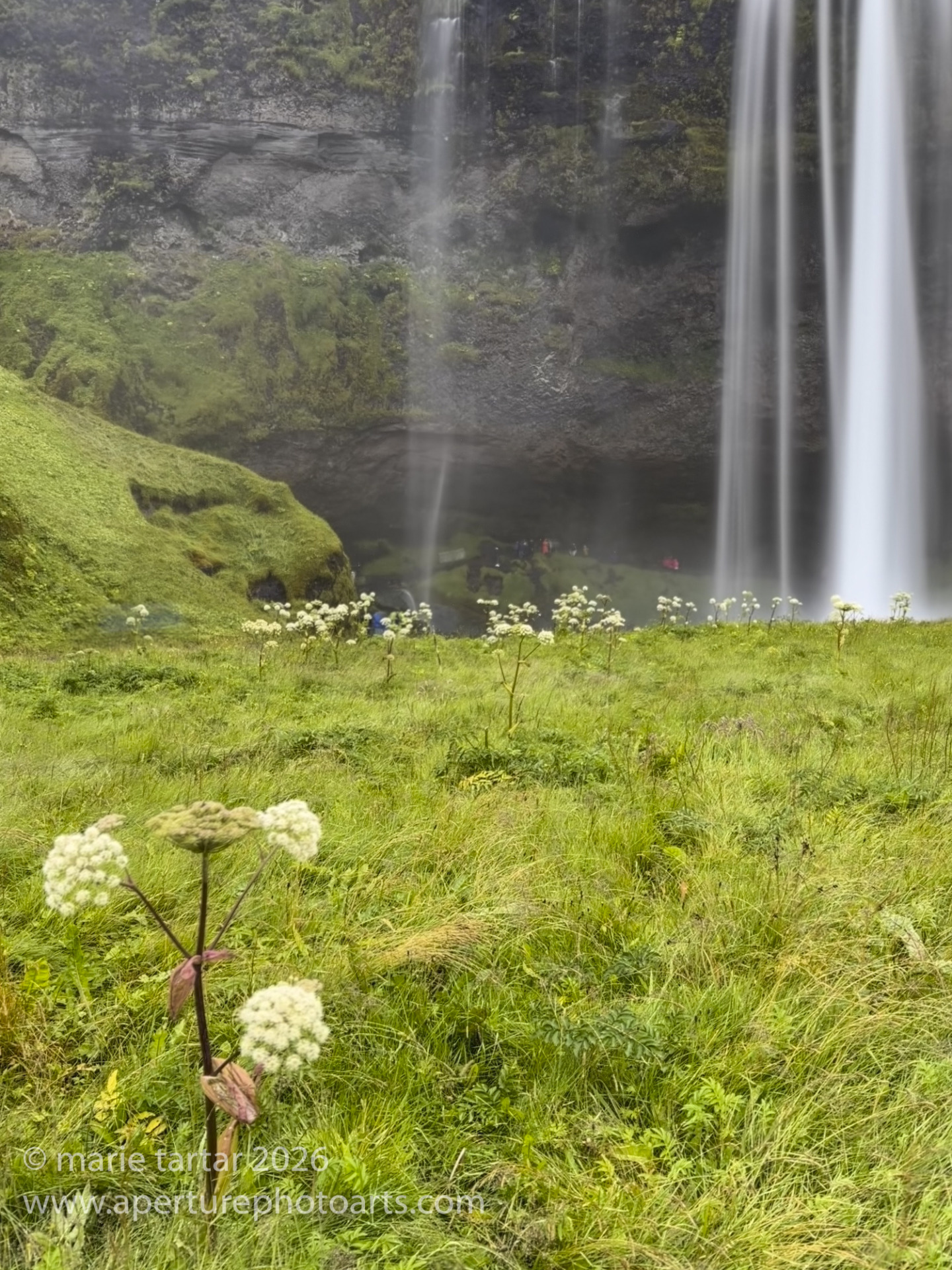
There are tiny people visible through the falls (Seljalandfoss, with angelica field in front of falls).

Seljalandfoss at sunset, during better weather than we experienced this year.
The shooting situation was much the same at Skogafoss.
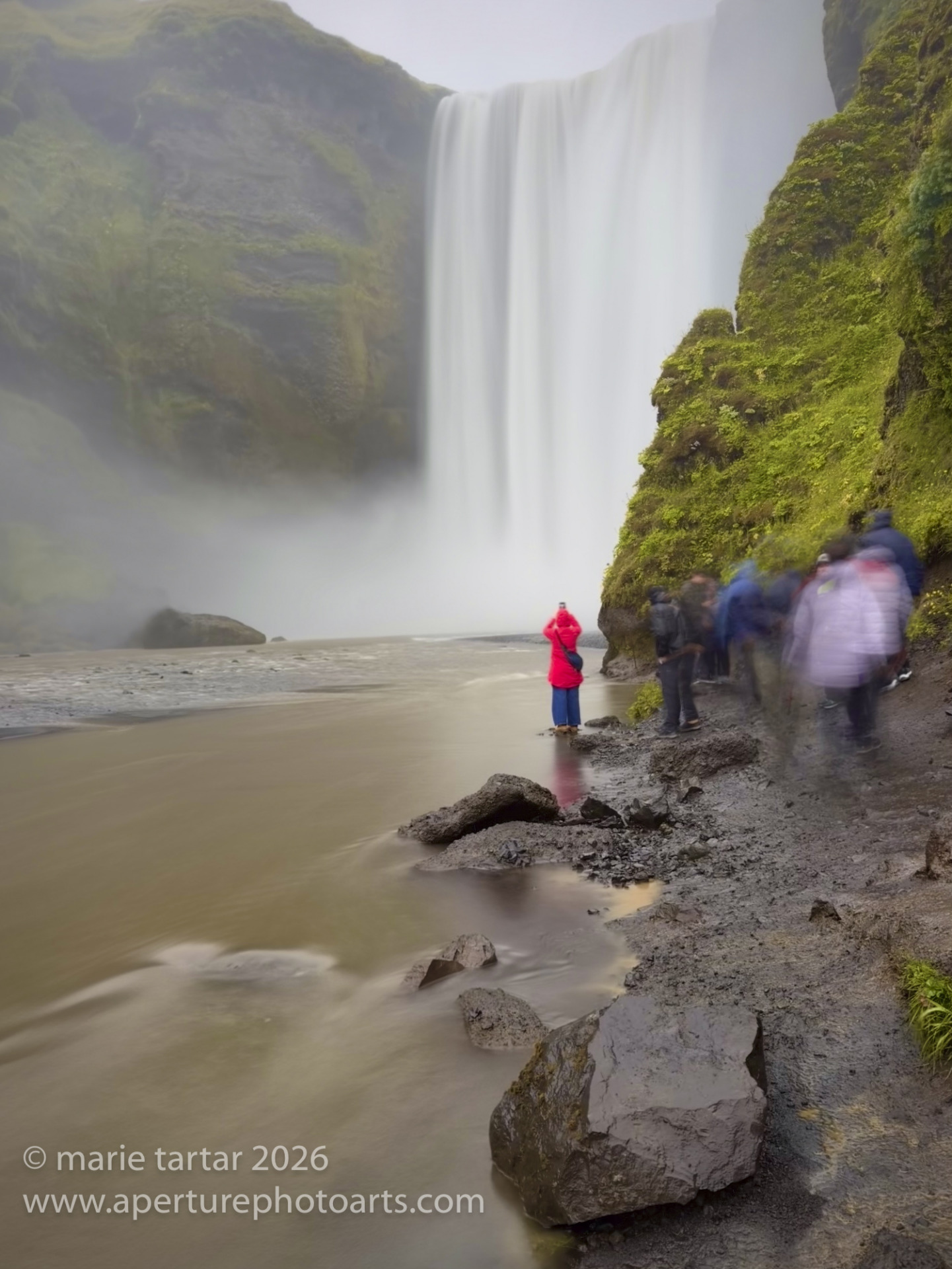
Rainy day at Skógafoss, south coast, Iceland.
Rainy days make for good museum days, so after lunch at Freya Cafe, we spent the afternoon at Skógar Folk Museum. The complex includes artifacts from earlier eras of Icelandic life, including traditional turf-roofed houses, as well as a fishing boat, rescue vehicles and a taxidermied two-headed sheep.
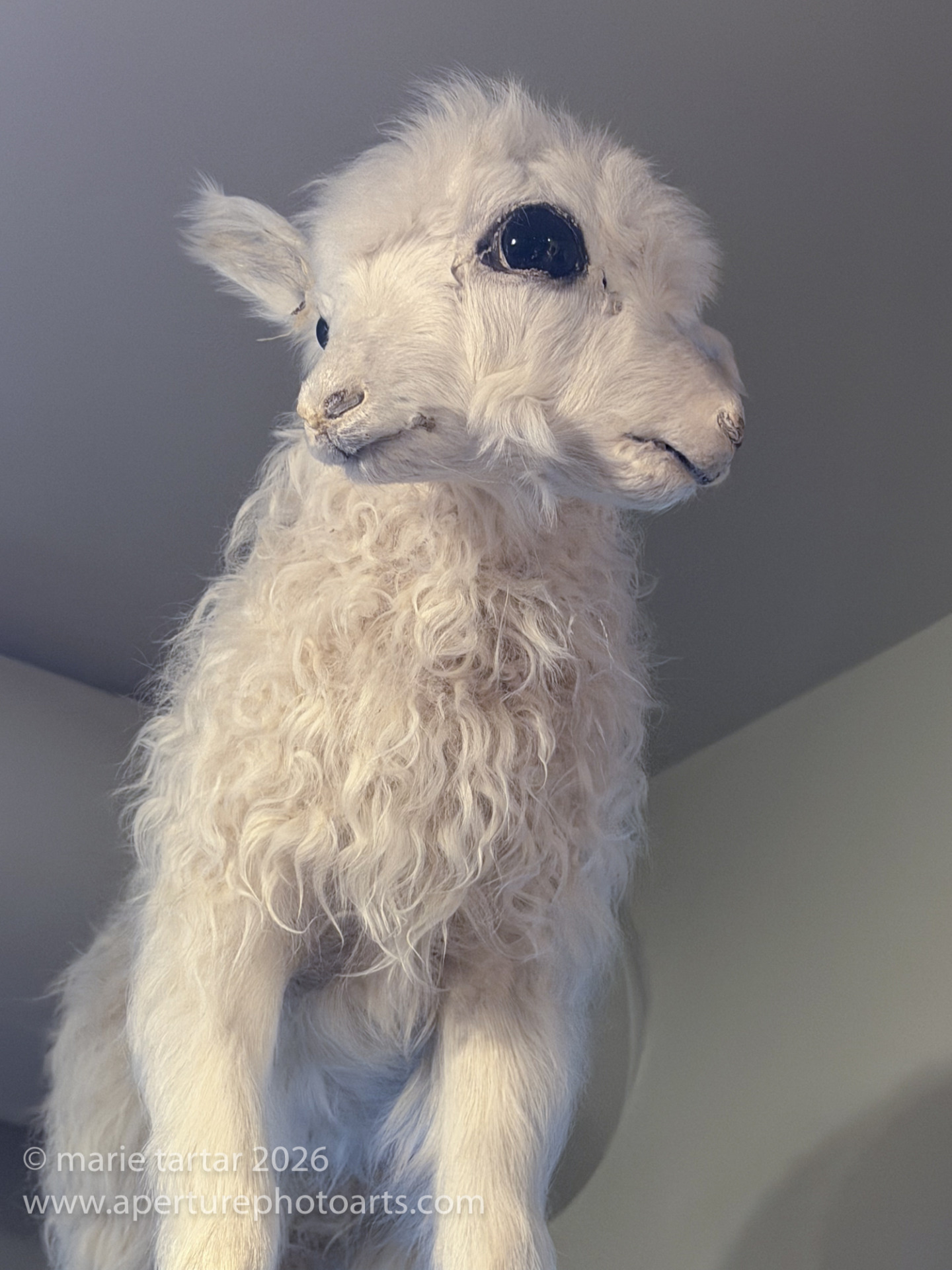
One of the stranger (and among the most memorable) artifacts I’ve seen displayed at a museum: a taxidermied 2-headed sheep. (Skógar Folk Museum, south coast, Iceland)
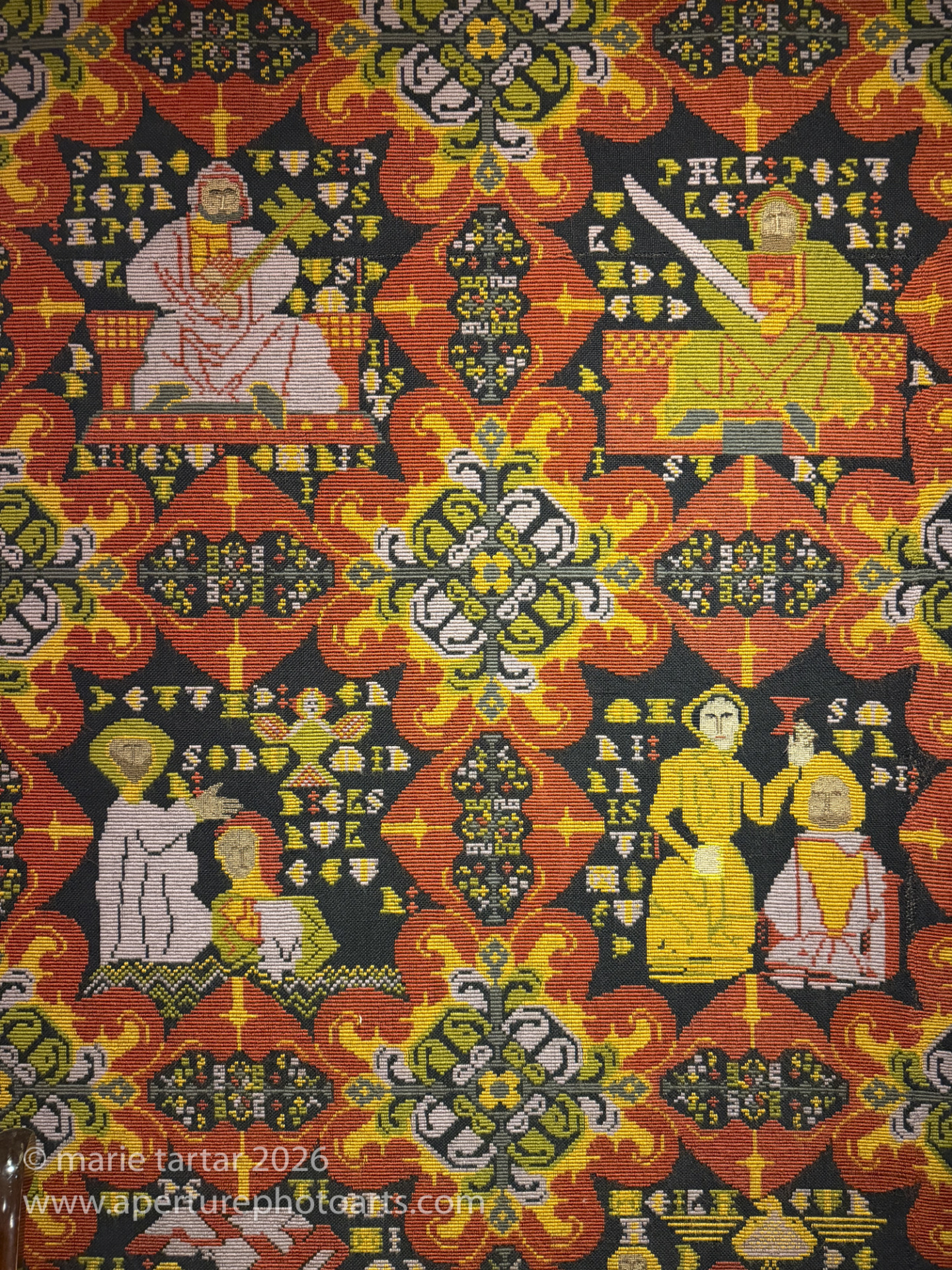
One of the most beautiful artifacts on display at the Skógar Folk Museum, a tapestry embroidered by Sigríður Einarsdóttir of Dufpaksholti in 1965.
Despite the rain, a robo-lawn mower zoomed up and down, mowing the wet grass outside.
We made a quick stop at Reynisfjara, the famous black sand beach near Vik. Ronan initially missed the turnoff, busy answering an inopportunely timed question. Before releasing us, he issued stern warnings about not turning one’s back to the ocean: “Every year, someone dies here” due to “sneaker waves.” I really enjoyed his lively commentary, as he evidently is quite the student of history. Approaching our hotel for the evening, Hotel Laki, he began a detailed discourse on major volcanic eruptions and their effects on world history. Who knew the eruption of Laki, which began in June 1783 and continued into 1784, was a factor contributing to the French Revolution of 1789? The sulfurous haze and resulting climate disturbances led to poor harvests, severe food shortages and high bread prices for both French peasants and urban workers, exacerbating a tense political situation in an already unstable France.
Saturday, August 8, 2026
Today was a long and tiring but ultimately, a satisfying and eventful day. It was moody, foggy and cloudy in the morning at Diamond Beach and Jökulsárlón (literal meaning: glacial river lagoon). For Steve and me, this was our fourth visit to arguably the most scenic corner of Iceland. Diamond Beach was truly worthy of the nickname on this foray, with the black sand beach strewn with sparkling and sculptural icebergs and bergie bits, more than I had ever seen. Steve was so enamored, he stayed at the beach while the rest of us headed across the street to the lagoon.
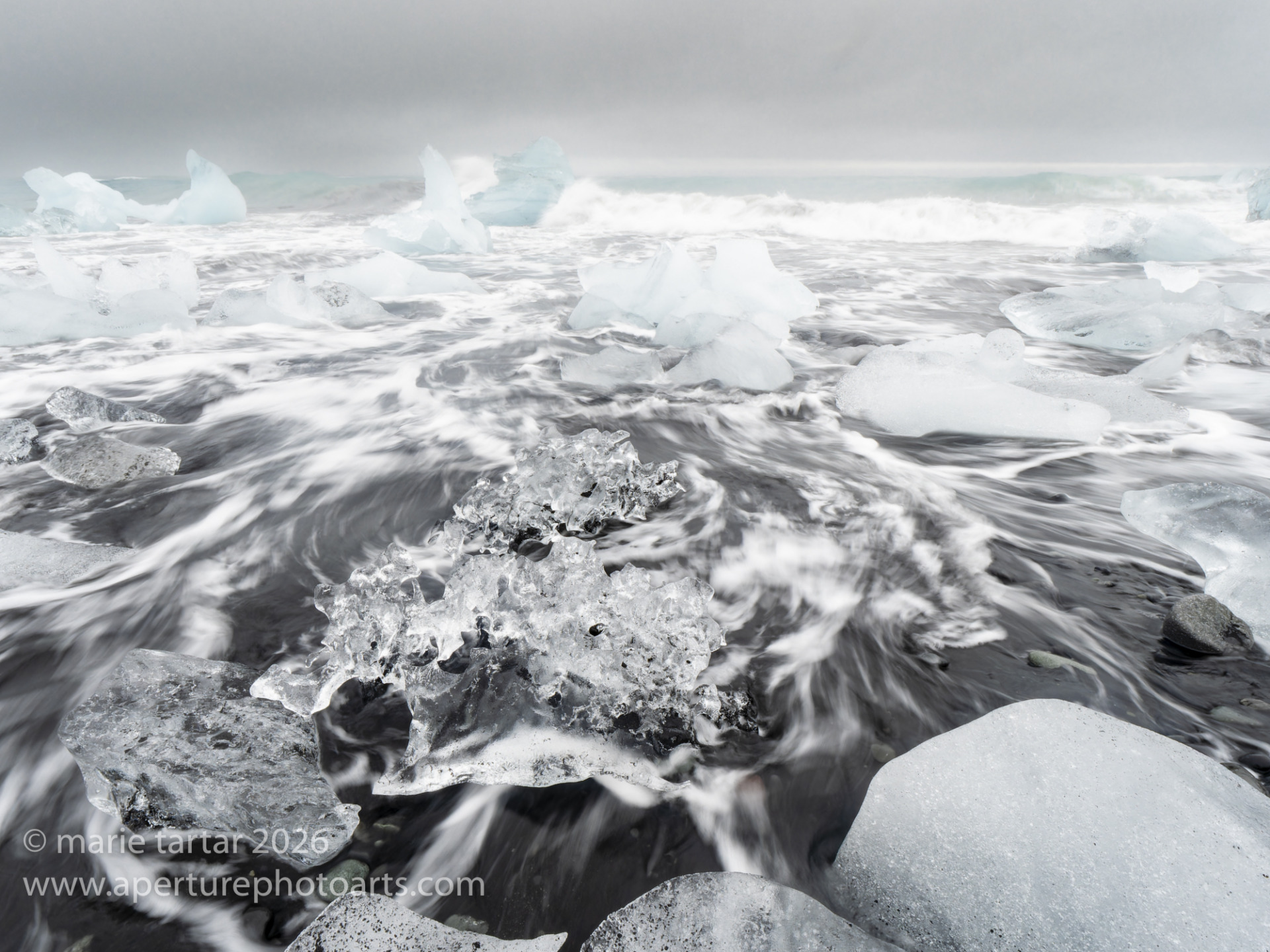
Diamond Beach, strewn with jewels, icy bergie bits broken off the Vatnajökull glacier, which wash out with the tides from the Jökulsárlón glacial lagoon onto the black sand beach and are polished by the ebb and flow of the waves.
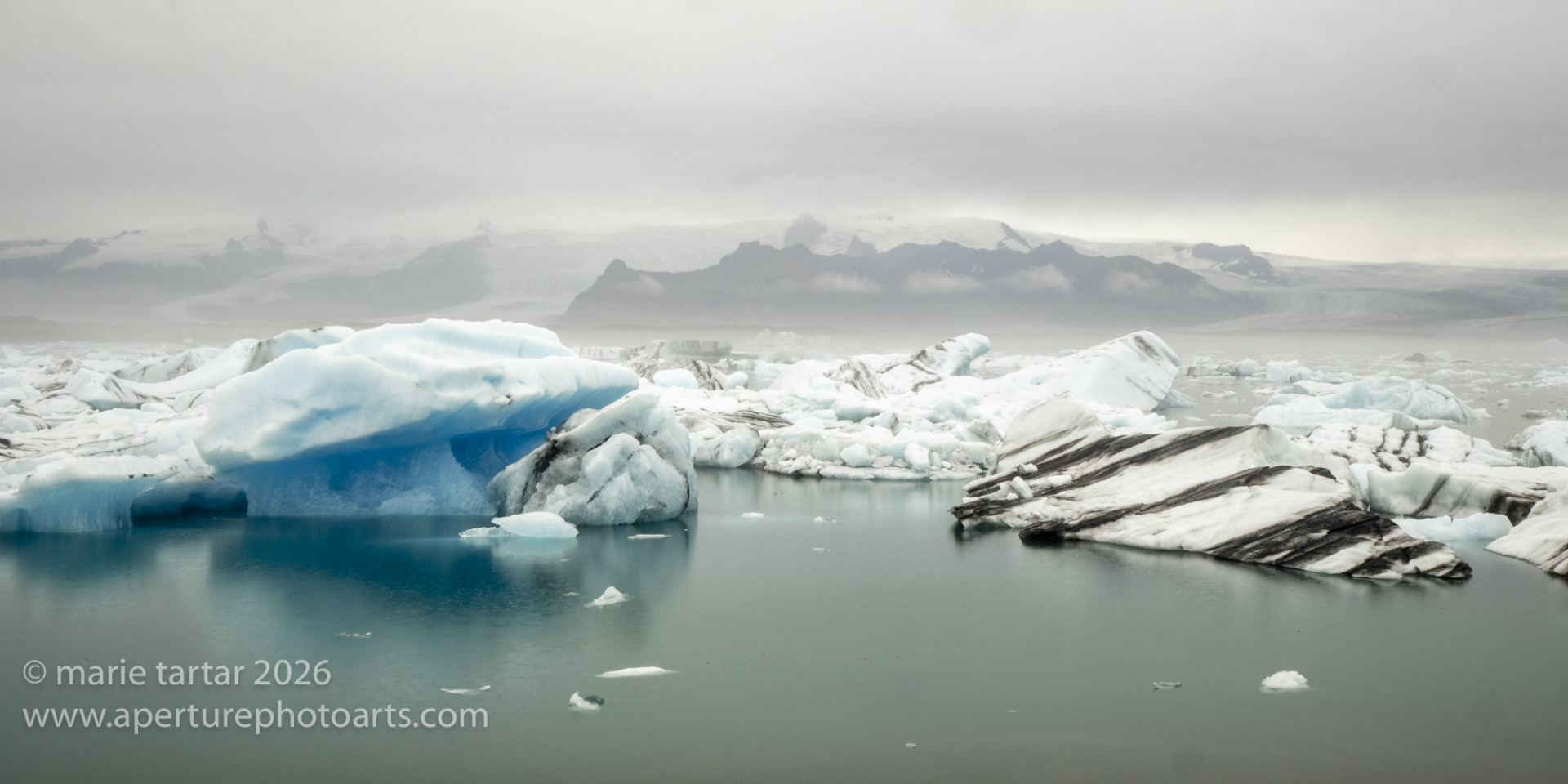
Moody and mysterious morning at Jökulsárlón, Iceland.
Heading north along Iceland’s east coast, we stopped at a windy and chilly coastal lighthouse (Hvalnes, where we flew our drones with Byron on our last trip).
Along the way, Ronan mentioned we might see reindeer in the area. As he described in French how les rennes came to be in Iceland (they were imported from Norway by royal decree in late 1700s in an attempt to boost the local economy after harsh conditions and sheep diseases decimated local agriculture; only the population in this area survived). Poor Betty, coping with Google translate, heard how queens (les reines) graze the local fields (yep, in the plural version, the pronunciation is identical).
Exiting out of the parking lot, Ronan hit a large pothole. A few miles down the road, it became apparent we hadn’t gotten away with it. Christian in the back heard the tell-tale rattling of a flat tire. As Ronan eased the vehicle to a stop, Christian confirmed “Le bruit a arreté!” (The noise has stopped!)
Thankfully, it proved to be one of the luggage trailer’s tires, not the van’s, but it was still a problem, as there was no spare. I was impressed how quickly this problem was remedied. Siggi took his crew to the next town, Djúpivogur, while the tire repairman was summoned from the last town. After dropping the English-speaking group off in the small, attractive fishing town, Siggi doubled back for us while Ronan stayed with the disabled trailer. I had a warming bowl of soup at the Hafið bistro before joining up with Steve, Jim, Sharon, Connie and Dave at the Faktor Brewery in which they were installed.
Sadly, this delay meant we didn’t have a chance to stop in to see or photograph Vestrahorn. As it happens, it was so foggy I had already texted Greg to say that I doubted we would be seeing it.
Our destination for the evening was Egilstadir. We did a quick turnaround and piled back in the vans for an hour’s drive further east and north to a puffin colony at Hafnarhólmi. En route, the conditions seemed highly unpromising along the curvy mountain road, with heavy rain and dense fog, but the prospect of photographing puffins is a powerful motivator. Ronan’s comments in French on the puffins (macareux) misled Google translate as he related seeing a falcon catch a “macaron” in full flight.
It was cold and rainy at Hafnarhólmi marina in Borgarfjörður eystri , but still light, so we eagerly climbed the boardwalks and stairs to a small windowed building with windows on either side, situated to keep people off the burrows and placing us within close range for photography of the photogenic puffins.
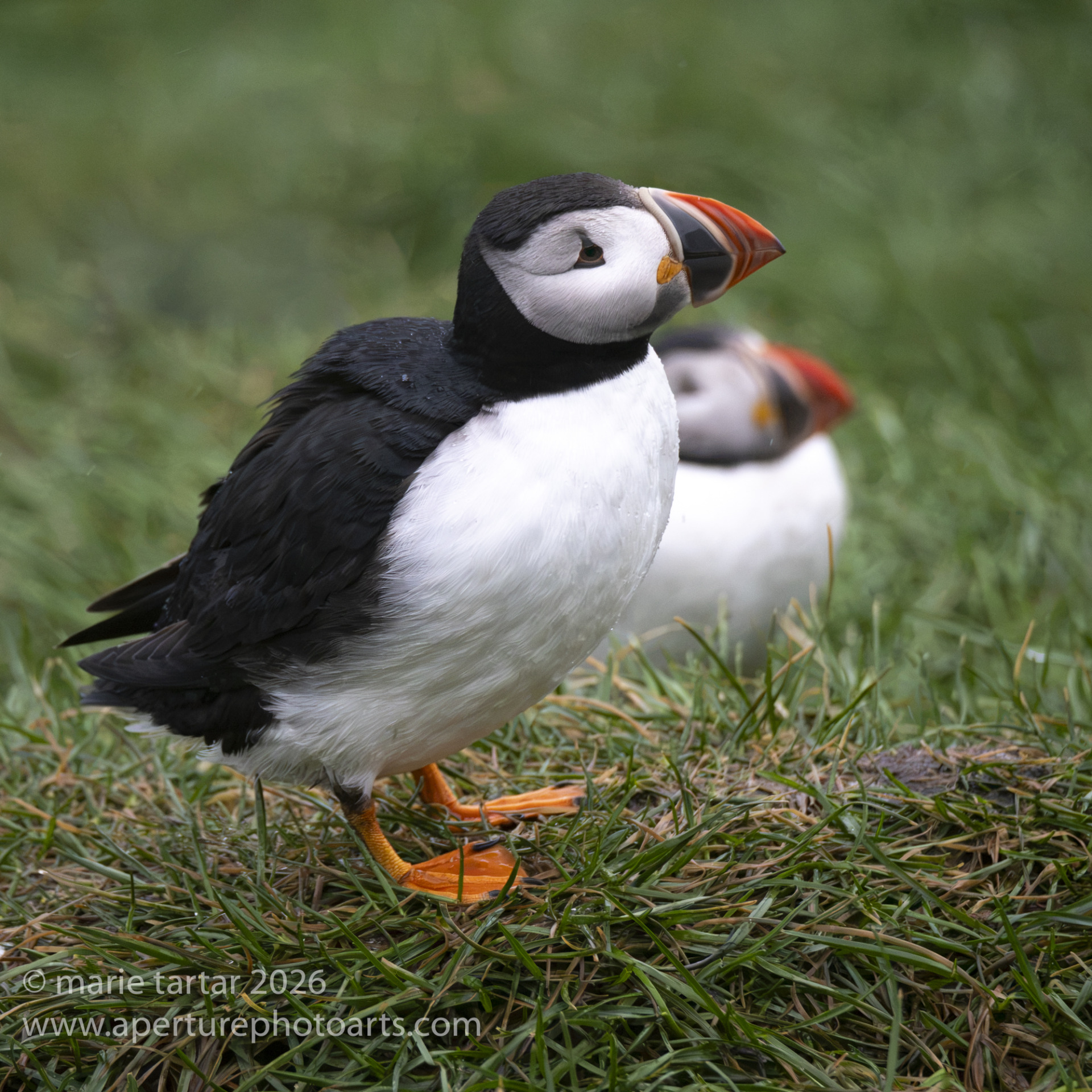
The only thing better than a puffin at close range: a pair!
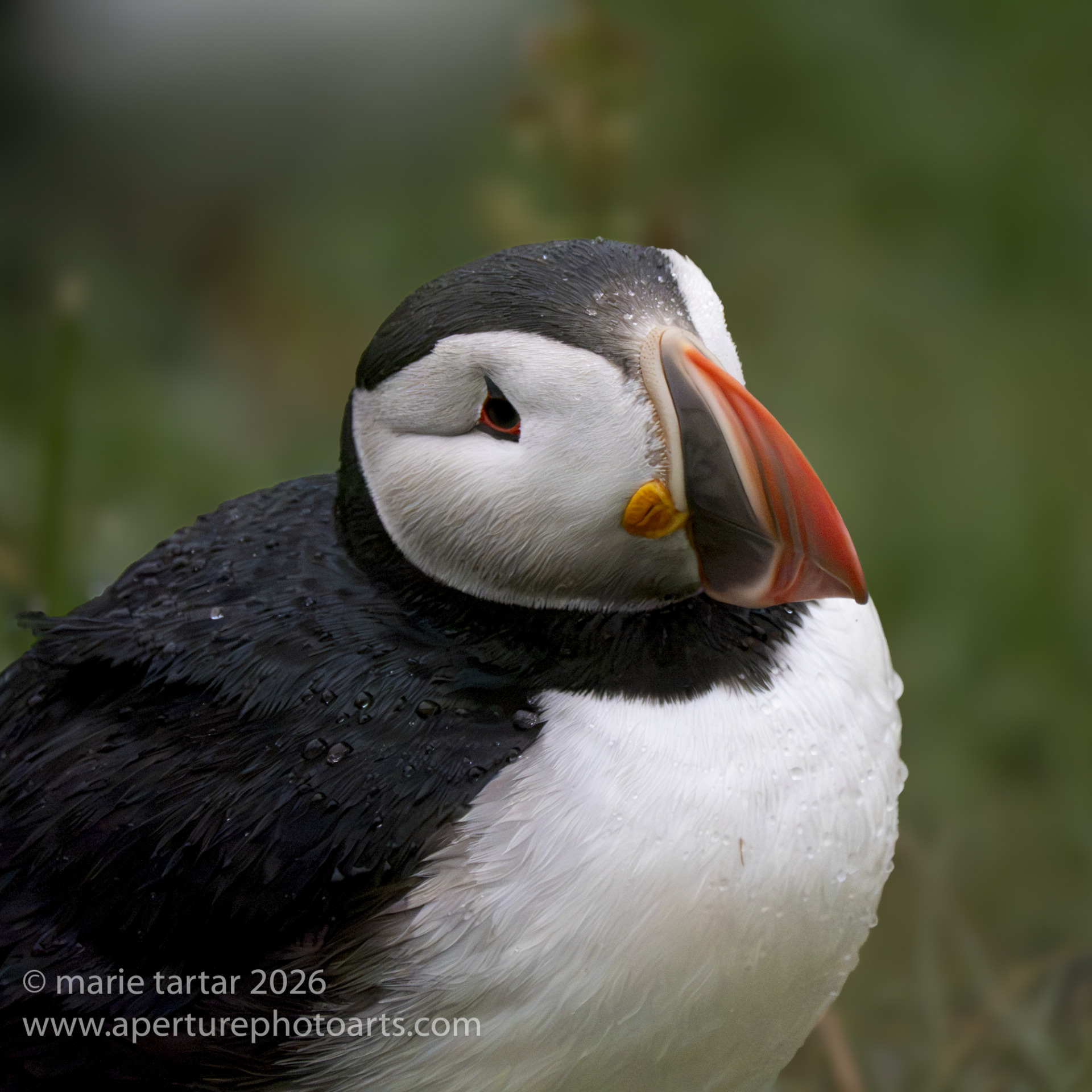
Raindrops dot the head of a puffin, Borgarfjörður, eastern Iceland.
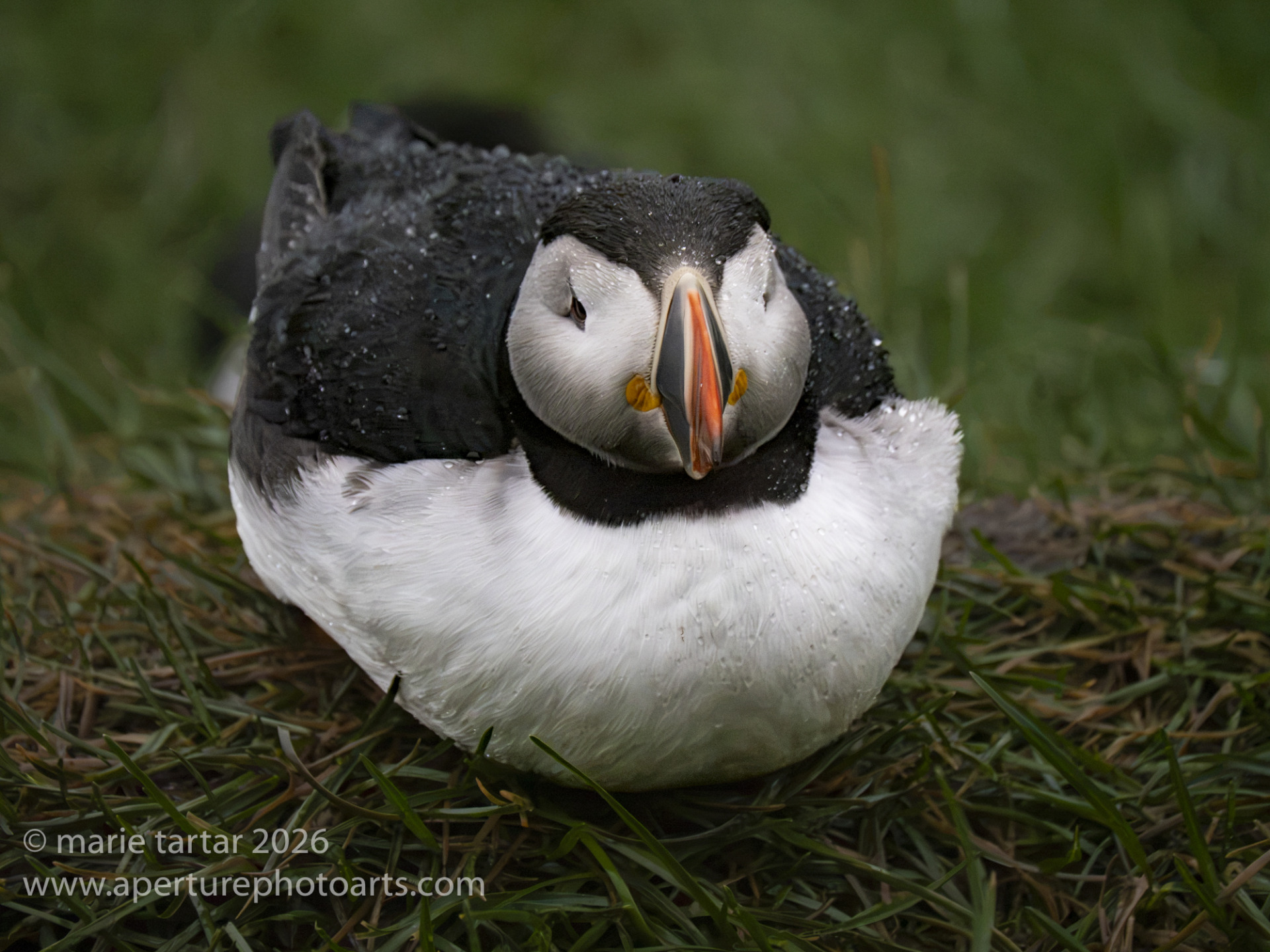
We were cold and wet, too (it was 6 degrees C! 43 degrees F!). Only puffins could exert such a magnetic pull to lure us out in those conditions.
After being hunched over shooting my long lens through a window at the small hut blind, my back seized up but good when I straightened up. This was to make every subsequent bounce of the bus and transition from sitting to standing a tortuous exercise for much of the rest of the trip.
The original plan had been to have dinner in Borgarfjörður after our puffin powwow, but the flat tire incident necessitated picking up our dinners to go afterwards. I savored my foil-wrapped curry-accented fish stew specialty, plokkfiskur, in the bus on the way home. It is basically a baked mashed fish and potato casserole in a béchamel sauce, often topped with cheese. I had several more versions during the trip but this one was the best (possibly the camping effect contributed, as it was late and it had been a long and tiring day).
Sunday, August 9, 2026
At last, the sun was shining, at least intermittently, with peeks of blue sky. Today, the driving was easier, with regular stops for sightseeing almost every 40 minutes, for waterfalls (Rjúkandafoss), a geothermally active area (Námafjall), clustered pseudocraters (Skútustaðagígar) and an early lunch (delicious vegetable soup).
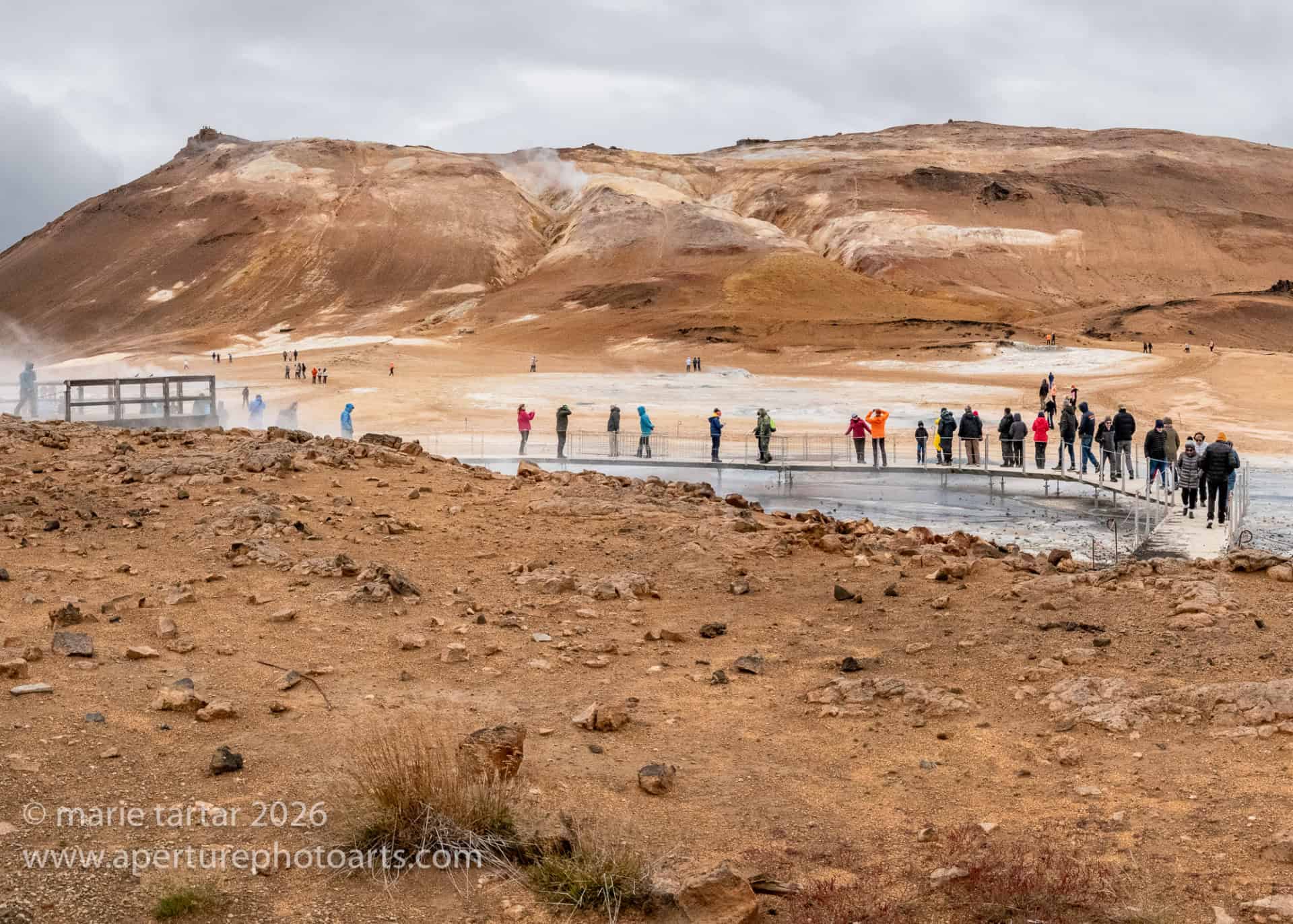
Námaskarð geothermal area, also known as Hverir, in northern Iceland.
Our final stop was a mammoth waterfall, Godafoss.
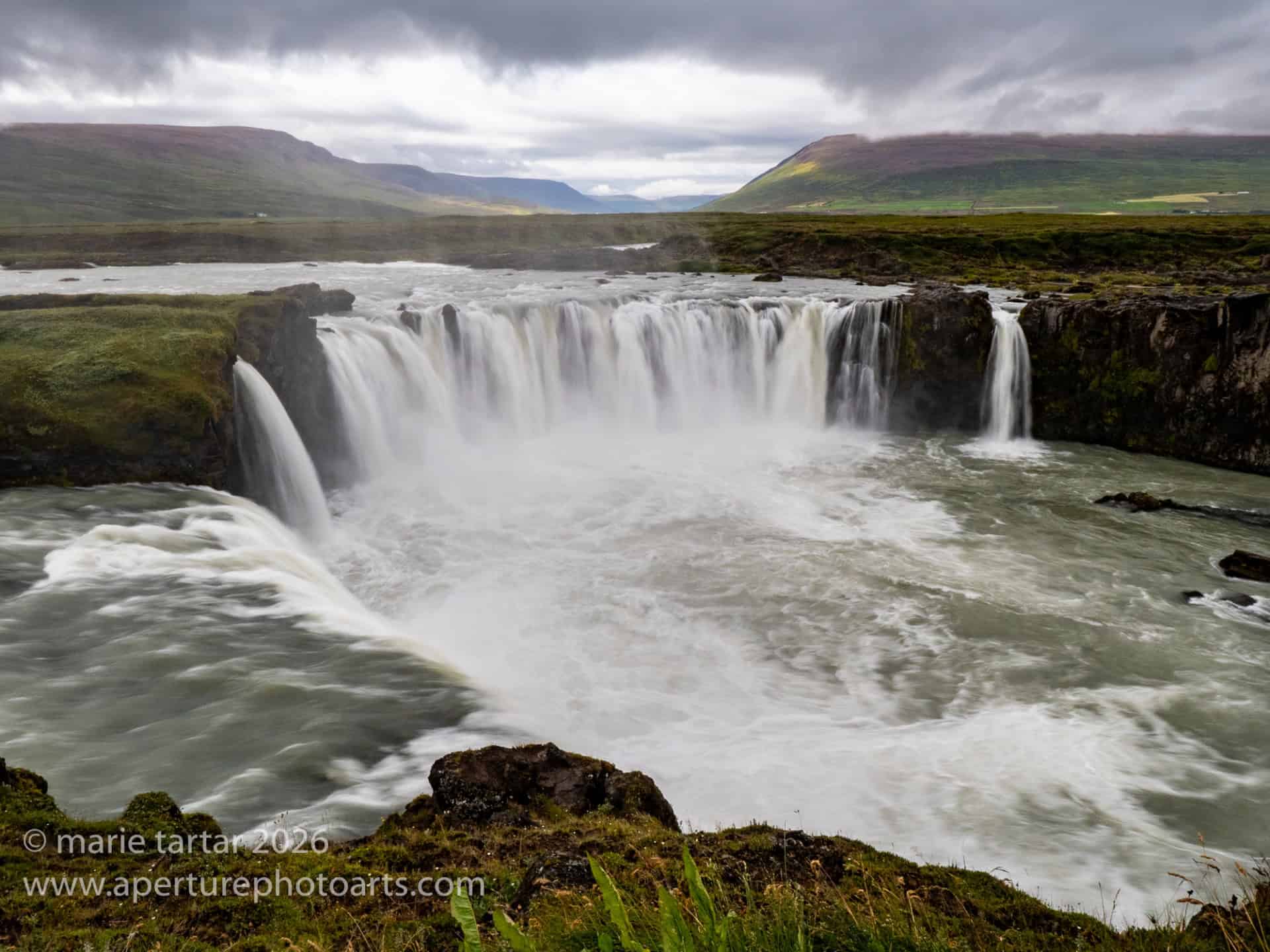
Godafoss, northern Iceland.
We saw Akureyri well before we arrived there, an attractive town, viewed from across elongated Eyjafjörður Fjord. Our home base for the next 3 nights was a self-catering cabin with a kitchen and hot tub on the outskirts of town. The hot tub instructions could have benefitted from editing by a native English speaker. We did manage to get it to fill the first night, which my seized-up back really needed.
A notable feature of Akureyri are the heart-shaped red traffic lights, installed by a former mayor as a moral booster to the populace in the wake of the 2008 economic crisis.
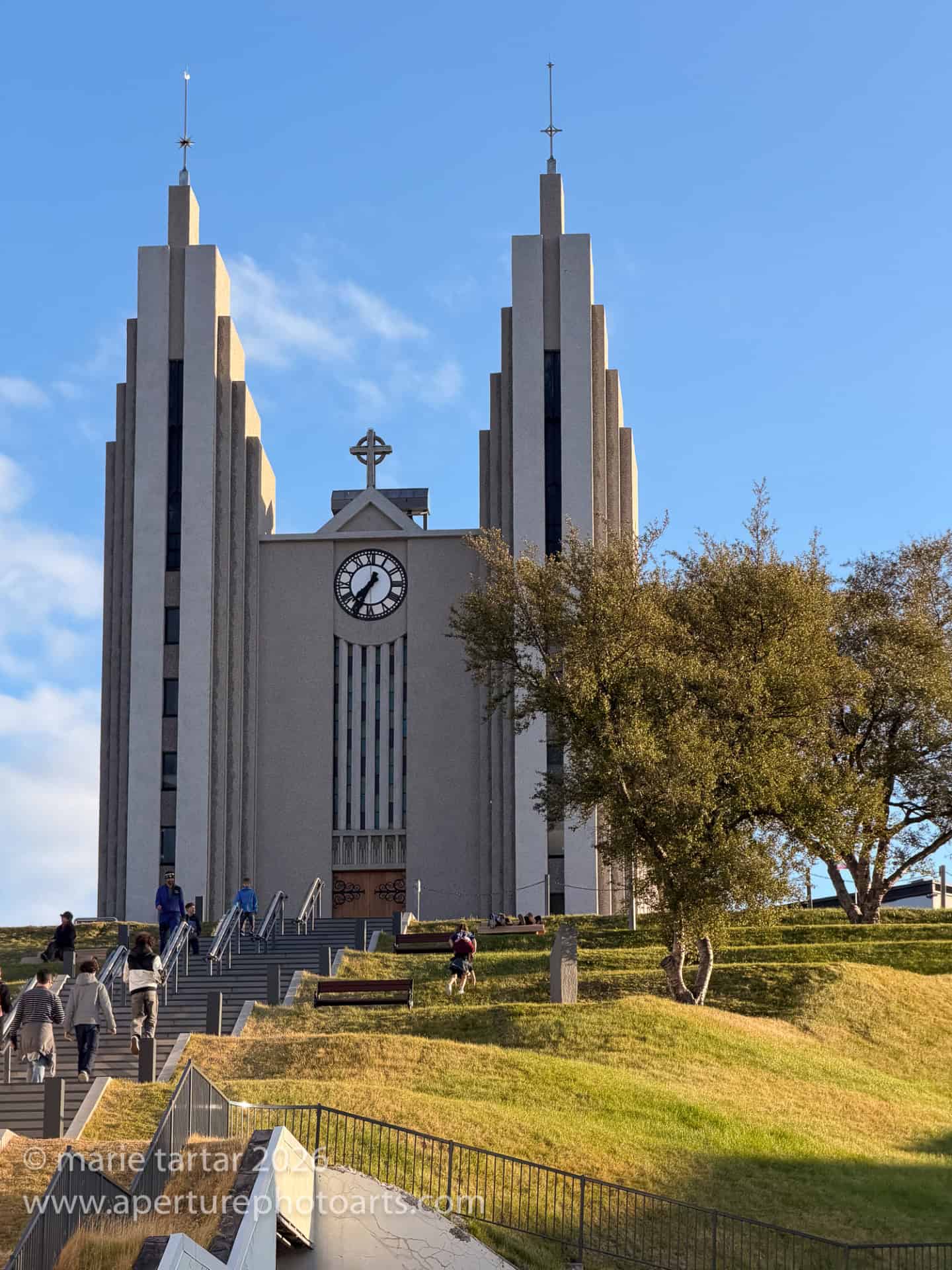
Akureyri has a church as distinctive as Reykjavik’s, by the same architect, Gudjon Samuelsson. The church was consecrated in 1940..
We were ferried into town for dinner. Byron had suggested a pizza joint, a short walk outside the town center, which was so besieged, we made a reservation for the following night and walked back to town. We had a quick, tasty, satisfying dinner at Strikið on the 5th floor in the center of town: salmon with broccolini and Jerusalem artichokes with a beurre blanc sauce for me, and a hamburger and fries for Steve, with an IPA.
Monday, August 10, 2026
We spent a day at the dive center north of town. It was a glorious sunny day. This would be an ocean dive in salt water, so we needed to add a little weight as a dress rehearsal for the planned thermal vent dive the following day. Our check-out ocean dive was a shallow shore dive, an easier entry than our dive at David’s Crack (mostly sand, small rocks, and a gradual slope).
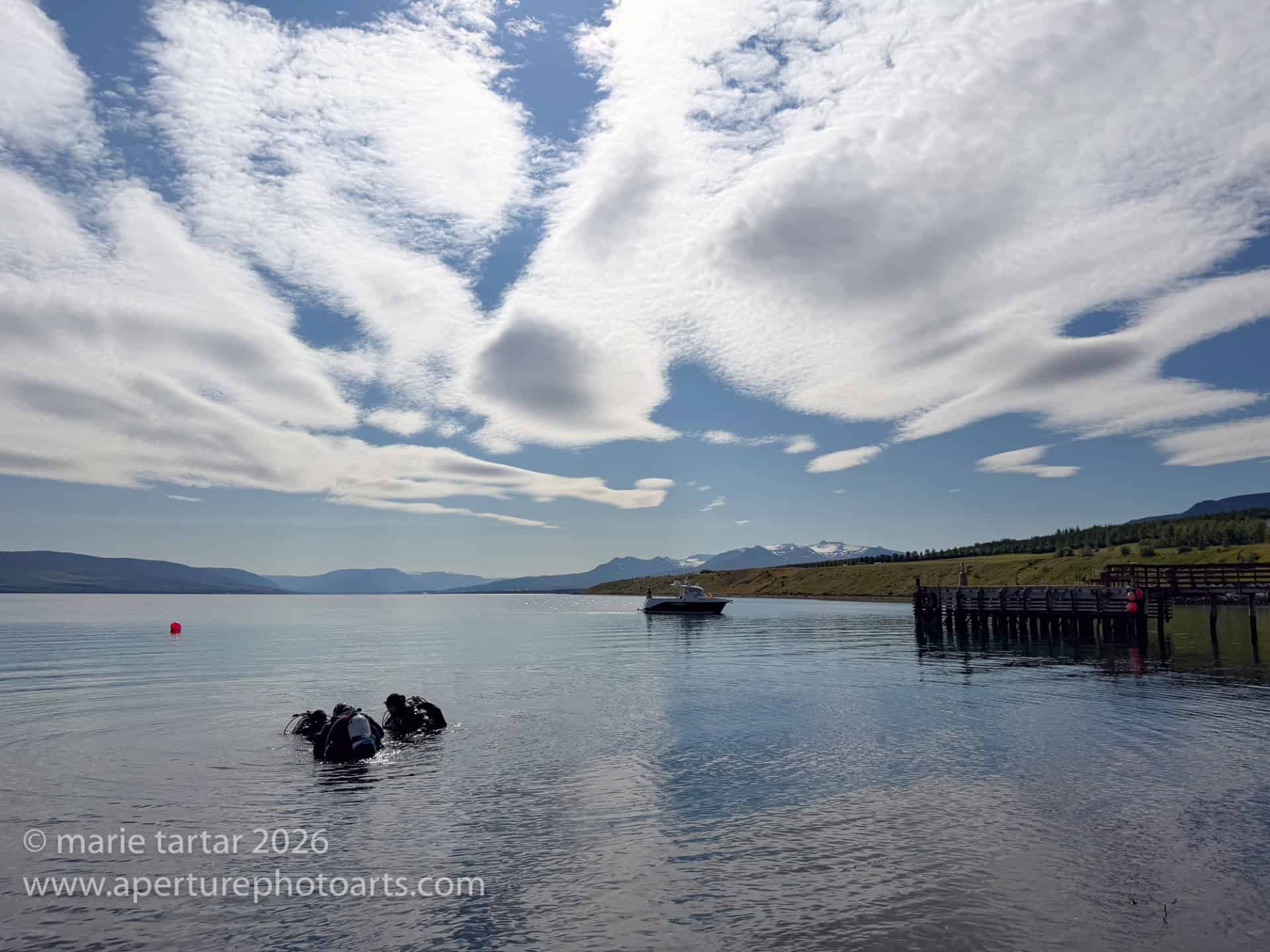
It was a beautiful calm day for a dive at Strýtan Dive Center in northern Iceland but the visibility was about 6 feet!
Byron had driven up to join the group and dive with us. The visibility was poor, although Byron said it was markedly improved from previous days! We did a square profile, out 30 feet, a right turn towards the dock, under which we passed and doubled back, closer to shore. (31 ft 48 min)
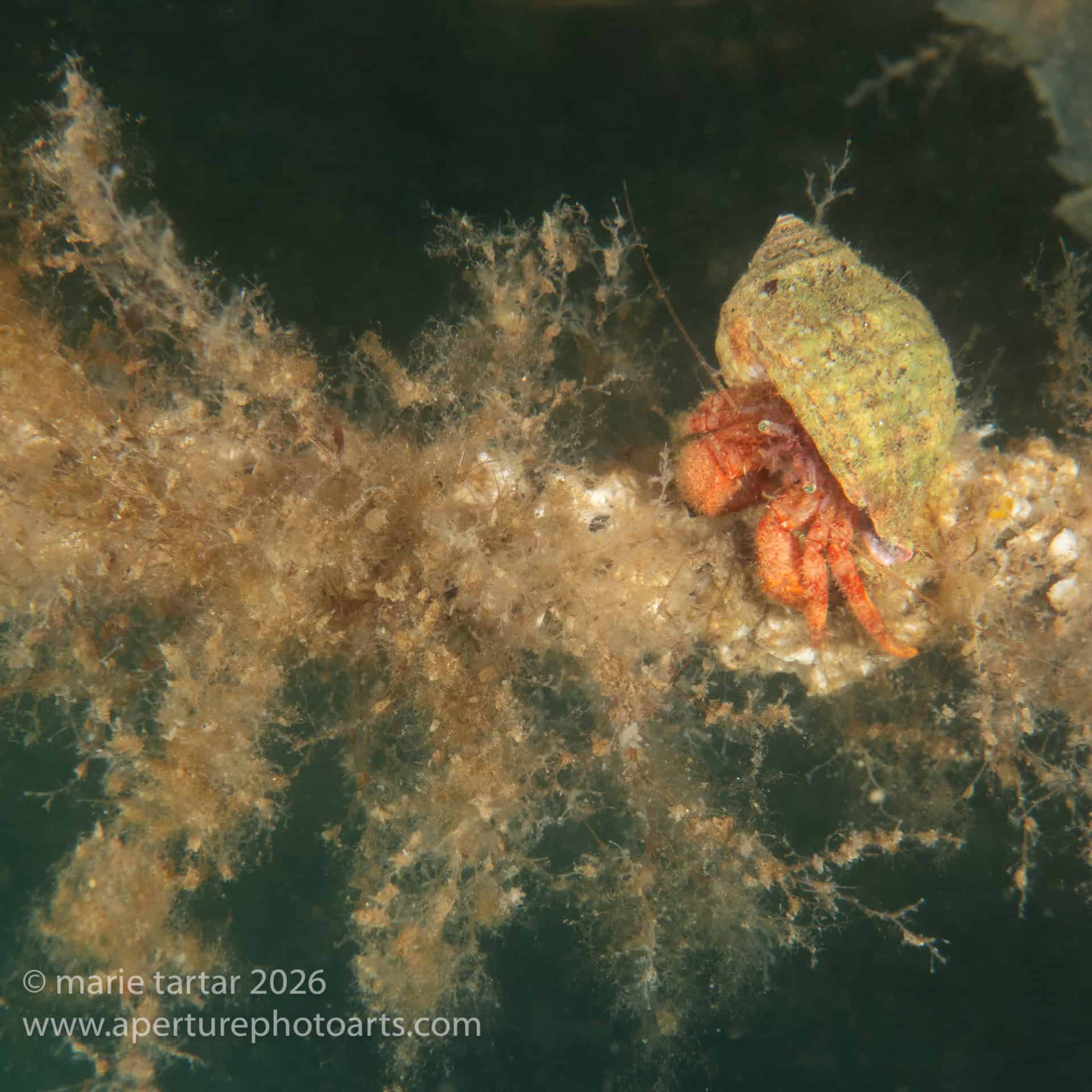
The visibility was terrible the day we did a shore dive at Strýtan Dive Center. This crab is about all I have to show for it.
Lunch was a barbeque at the dive center, featuring Iceland’s famous lamb hotdogs, including the crispy onions. The camping effect was probably prevailing, as I was hungry enough to have two (I generally have a hotdog once a decade)!
We opted not to do a second dive; Byron had to head back to Reykjavik to meet the second incoming group. Our friends Margi and Eric were in the second group and already had run into trouble en route, namely a forced overnight at the LAX Marriott when their flight to JFK was canceled.
I might have done a second dive had I known we’d be at the dive center all day, especially after I learned the tiny lumpfish was sighted on the pilings on the second dive. We learned late in the afternoon that the visibility was terrible, less than 3 feet, for the planned thermal vent dives the following day and so we wouldn’t be going out on the boat. For Rebecca, the thermal vent dive was the raison d’être for making this trip. Alternate plans were made for us to go whale watching in the morning and to the Forest Lagoon spa in the afternoon.
We vanned into town in the evening. Our dinner at Greifinn (lobster pasta and plokkfiskur) was disappointing. Most of Byron’s recommendations are gold but maybe we should have quizzed him on what exactly to order there.
Tuesday, August 11, 2026
Today was another stunningly sunny day.
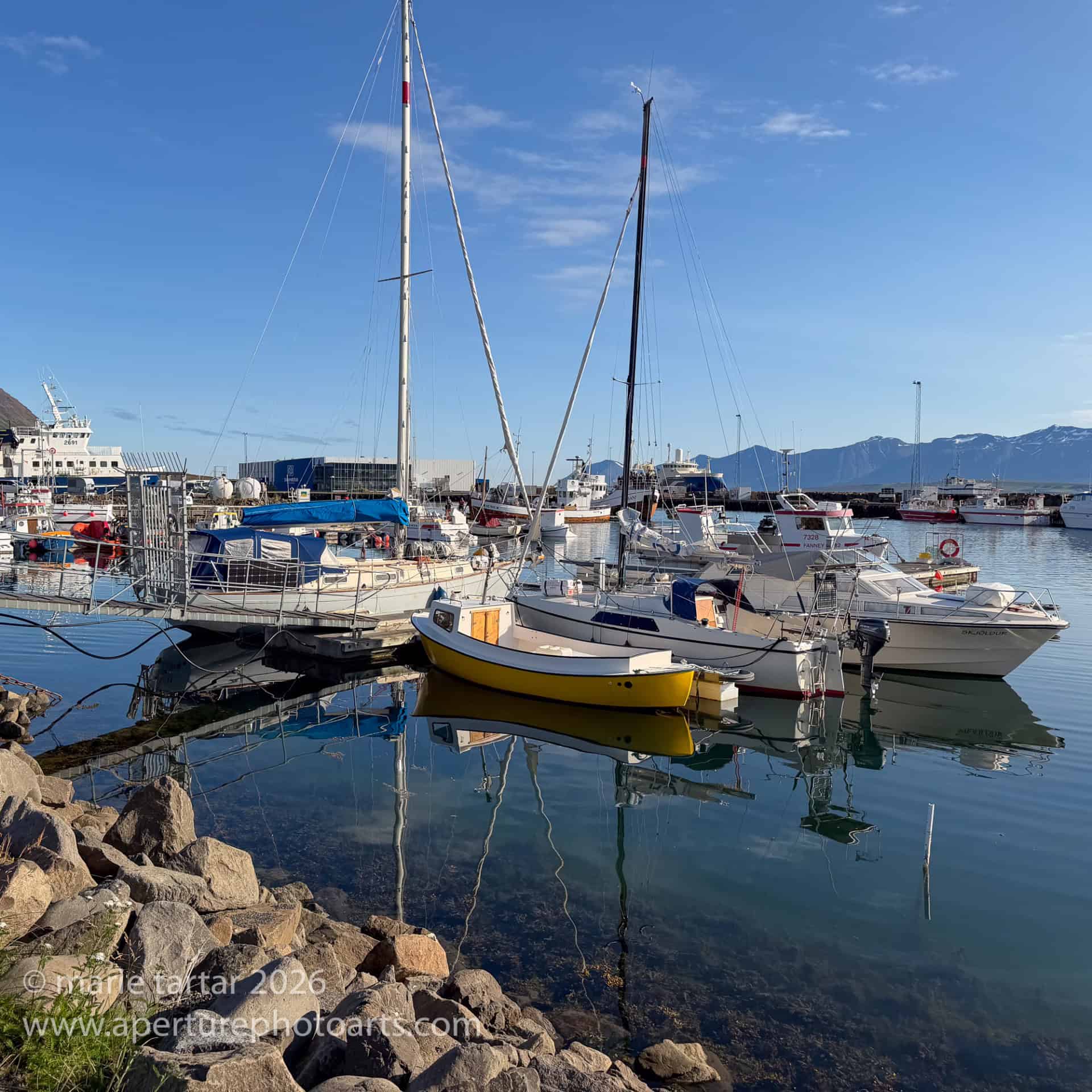
A 3-hour tour: Setting off an a morning whale watching excursion from Dalvík in northern Iceland.
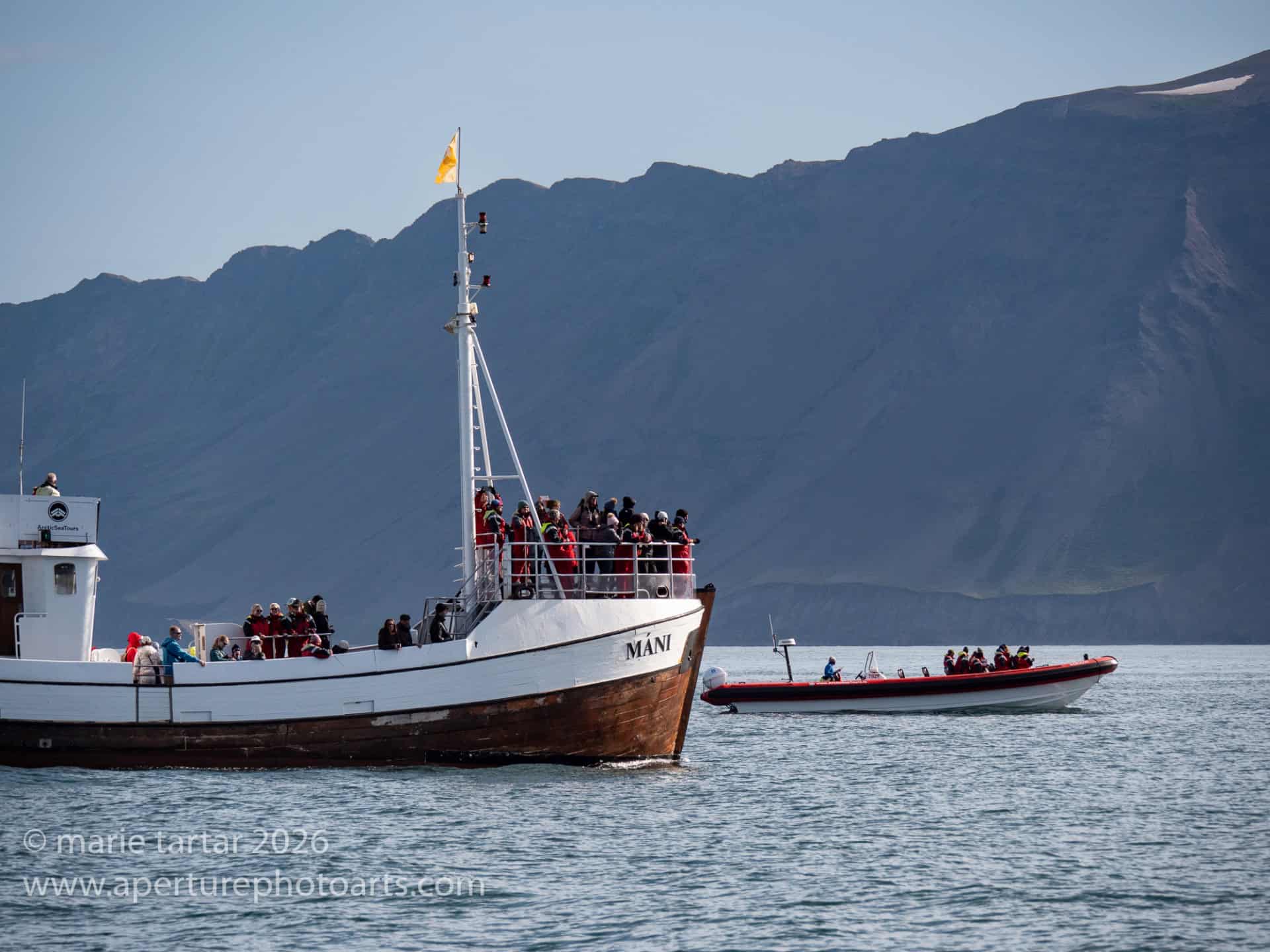
Whale watching boats north of Akureyri, Iceland.
We took advantage of Arctic Sea Tours’ Regatta Norwegian Lifeguard puffy red jumpsuits, which were cozy and warm.
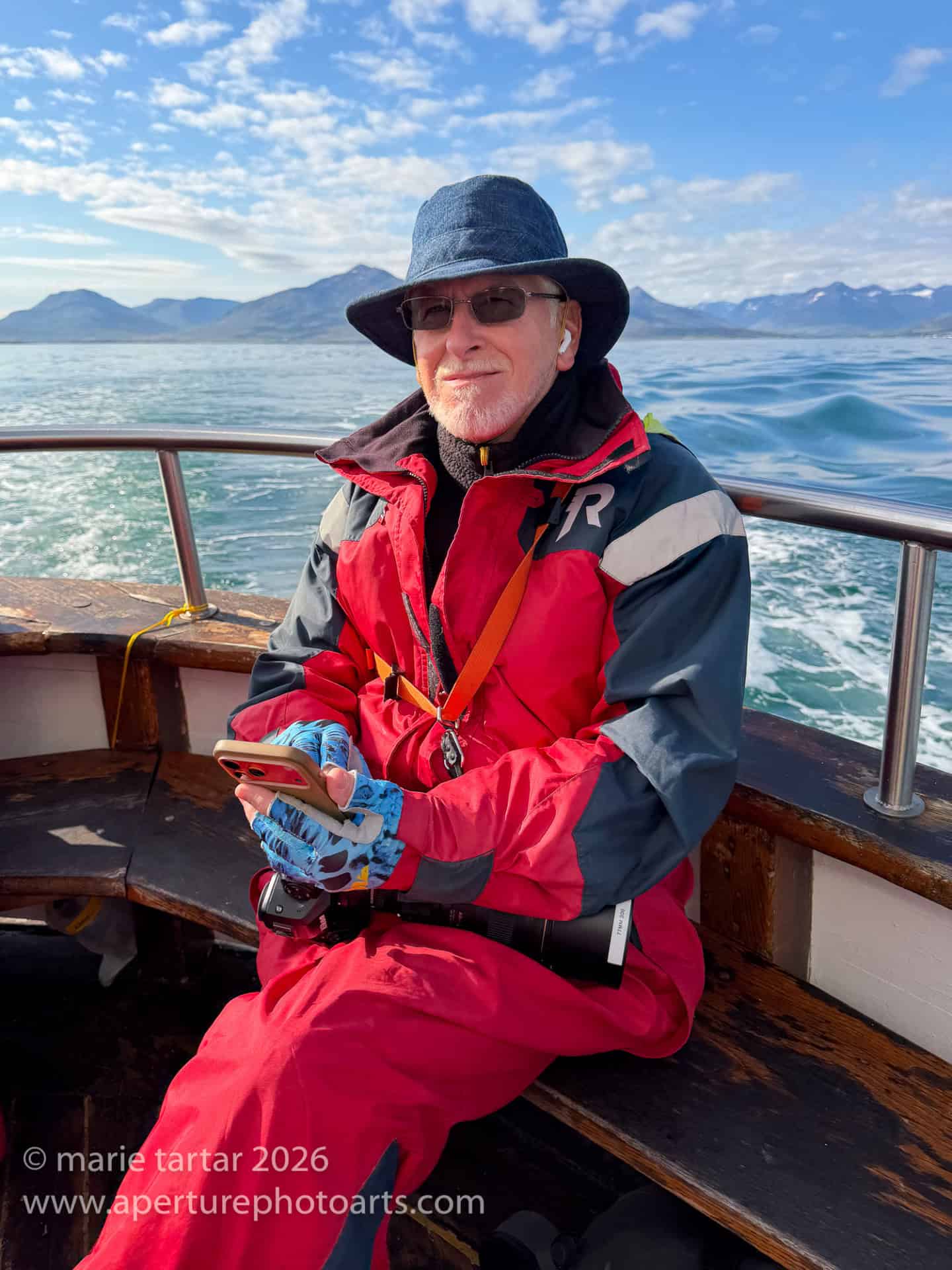
What the fashionable Arctic Sea Tours whale watcher is wearing this season: a puffy down jumpsuit, big enough to go right over all our other layers.
One leisurely cruising humpback whale was our reward for a 3-hour tour by boat.
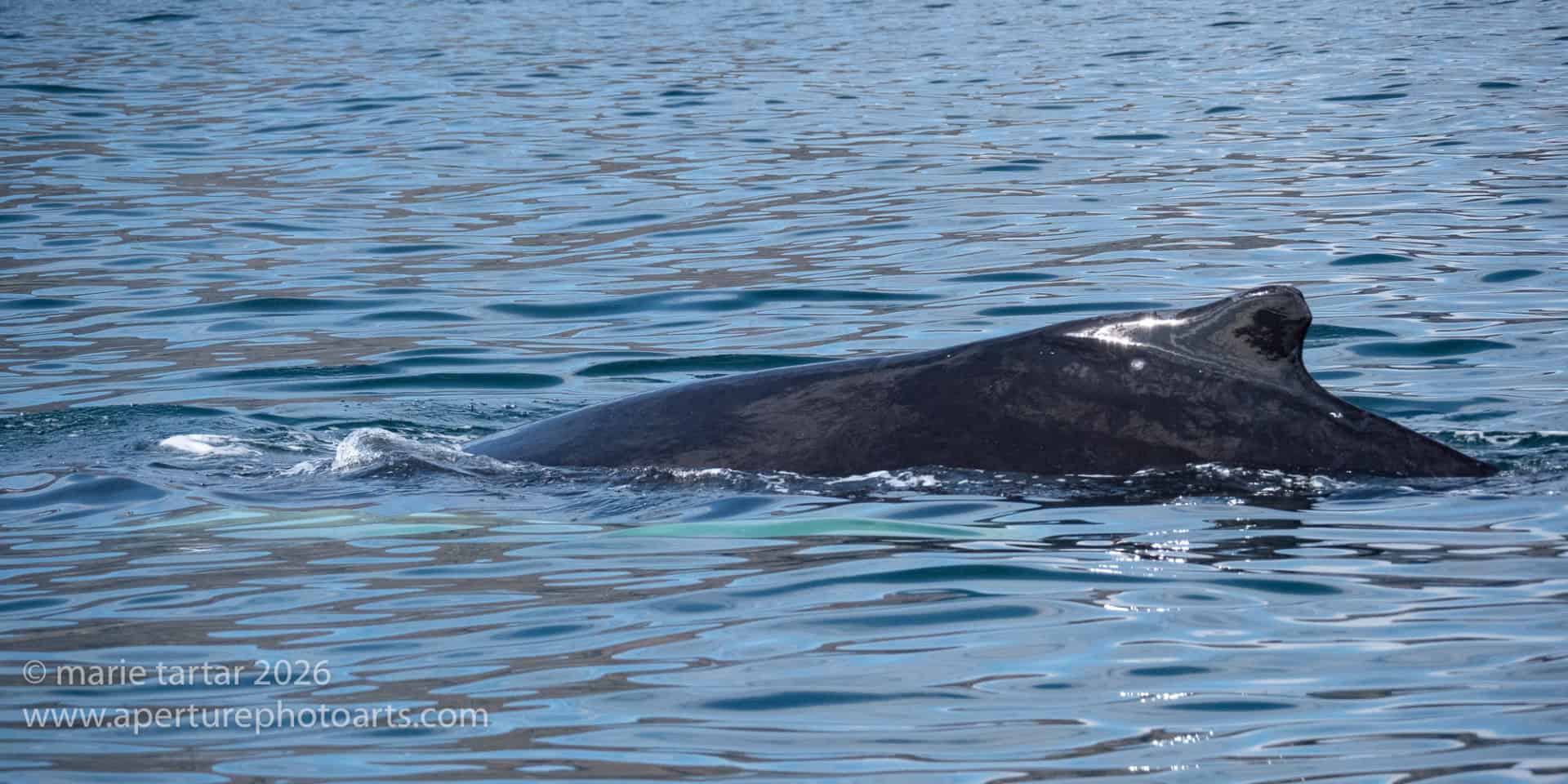
A humped back and a final tail were all we saw of this whale in northern Iceland.
(Steve’s succinct Akureyri summary: “Worst ocean dive and whale watching ever!” A little context: The last whale watching excursion we did, near Cabo San Lucas last December, featured breaching humpback whales and a pair of competitive tail-slappers. So, yeah, we’re spoiled.)
We had an excellent lunch upstairs at a family-run restaurant known for its fish soup, Bakkabræður café, also known as Café Gísli, Eiríkur & Helgi, after three brothers.
We spent a delightful late afternoon at the Forest Lagoon Spa, though we had to delay our entry because too many cruise ship passengers were present (we arrived 45 minutes before our 3 pm appointment). This gave some of us (me, Christian, Mayrse, Lisa and Annie) a chance to stroll in the forest itself.
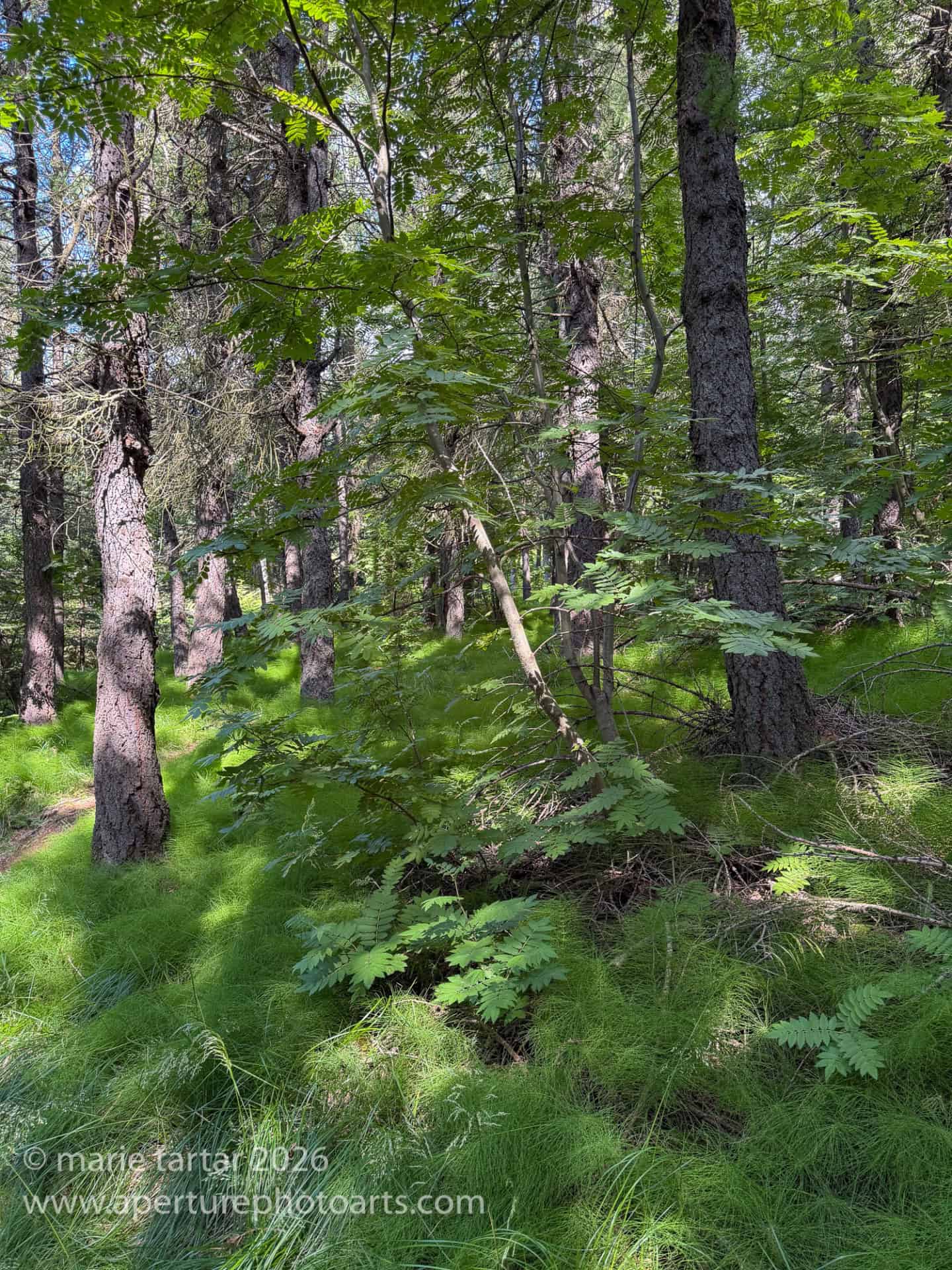
There isn’t much first growth forest in Iceland. Vaðlaskógur forest, where the Forest Lagoon Spa is located, is an example of reforestation, with some of the tallest birches currently found in Iceland.
The Forest Lagoon was delightful, beautiful to look at and a well-run operation. The complex was designed by BASALT Architects, an Icelandic firm who also designed the Blue Lagoon facilities. As at most Icelandic spas like this, we had to shower in the nude with soap first, then don our swimsuits. We stored our clothes in a bracelet-operated locker. The main pool was wonderfully warm. After an initial halting, unsuccessful try, with considerable encouragement from Connie and Dave (“just keeping walking in; don’t stop!”), I succeeded in submerging myself fully in the cold plunge pool (12 degrees C, about 53 degrees F or literally breathtaking!). I first warmed up in the sauna to the point of sweating to psyche myself up to do it. But they were right, once in the cold plunge pool, the key was to remain motionless (to not stir up any cold currents).
We had a tasty dinner at Eyja, which Jim and Sharon had enjoyed the night before (cauliflower steak with hummus, grilled carrots, romanesco and roasted hazelnuts for me and duck confit flatbread for Steve).
Wednesday, August 12, 2026
Eclipse Day started early, with a 6 am departure from Akureyri. There were reports of road closures and roads changed to single-direction travel for the eclipse so the group was taking no chances of being caught up in eclipse-related traffic snarls. I was up at 4:45 am, having spent a miserable night, up every hour, tormented by biting flying insects, tiny black dots which landed on my face at regular intervals. We had left the windows open to counteract the warmth of the geothermally heated cabin.
Siggi guided the English-speaking bus expertly to the Snaefellsnes Peninsula, taking the northern route, including a section of gravel road. We arrived midday and walked to the Visitor’s Center for lunch. After a quickly slurped lunch of wild mushroom soup, I darted off into the adjacent lava field to scout out a foreground to shoot the eclipse. A roped-off section for the group sat in a field next to the Adventure Hotel, but a quick survey showed no foreground of interest.
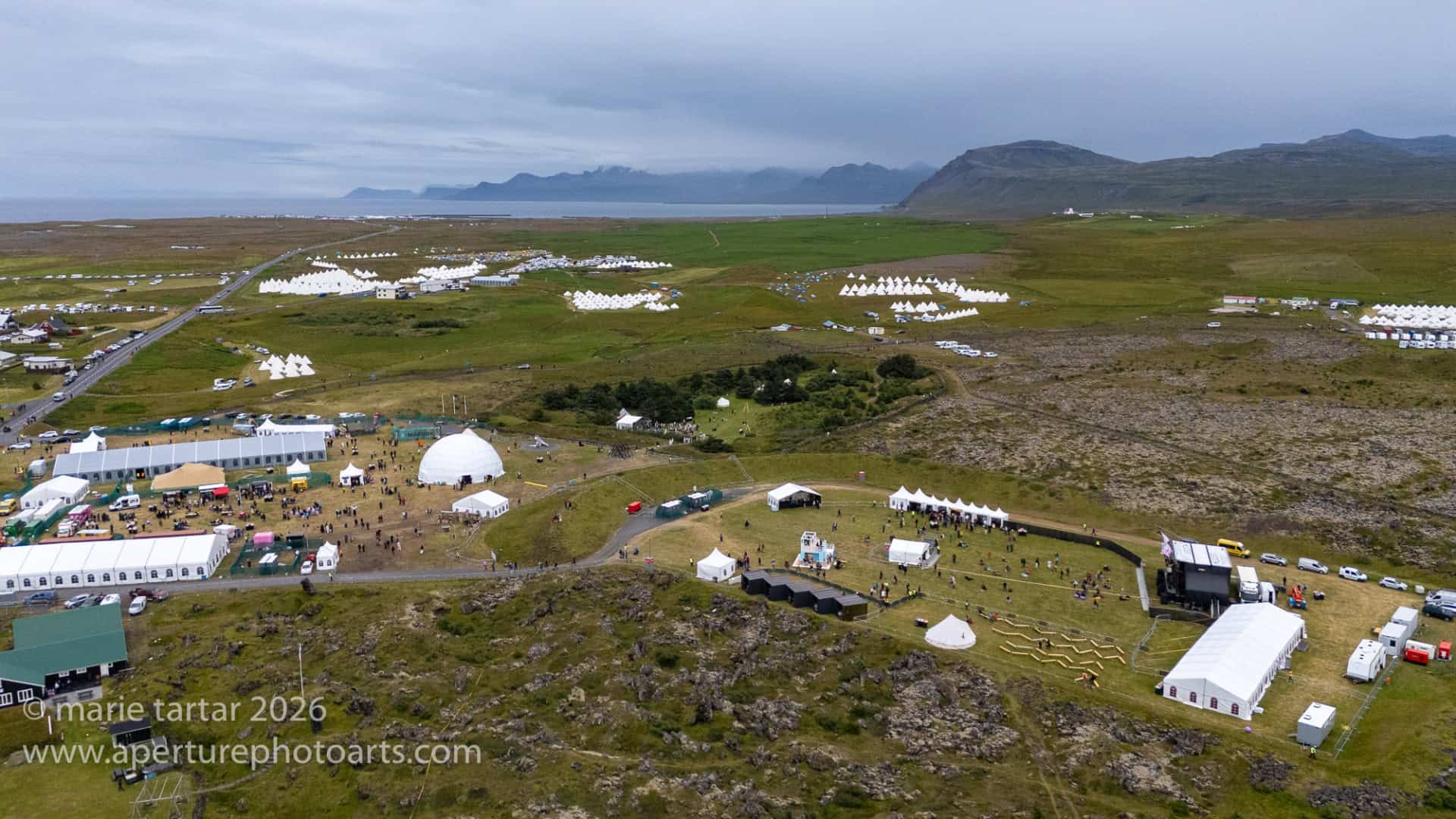
Hellissandur, Snaefellsnes Peninsula, eclipse day, August 12, 2026: The rain held off just long enough for me to launch the drone. A multiday music festival venue can be seen, as well as multiple teepee temporary shelters erected for the event.
It rained lightly throughout the afternoon. The lava fields are beautiful but treacherous, with jagged rocks and uneven footing. I later learned Steve tripped and injured a wrist. Steve approved my selected area, then promptly disappeared into an adjacent hollow with a different orientation. I set up my tripod using Photopill’s prediction of the sun’s trajectory, then waited and hoped. I couldn’t deploy the sunfinder, as the sun stayed completely obscured by clouds all afternoon.
That was the situation, until the absolute 11:59th hour. The sun was so shrouded with clouds that at first I didn’t believe my unshielded eyes when I began to dimly perceive the sun with a moon bite in it. Could it be? I put on the solar filter and couldn’t be sure.
For a few precious seconds, certainly less than a minute, there it was, the thinnest crescent of the sun as the moon nearly completely covered it. I managed to dig out the up-to-this-point useless camera, located the crescent, and focused, before all went densely dark during totality. Weirdly, the cloud cover was so thick, I could only focus and see the eclipse with my eyes and couldn’t see it at all with the solar filter on. Unfortunately, that was the last we saw of the sun, which was completely obscured during totality. There would be no corona close-ups this eclipse.
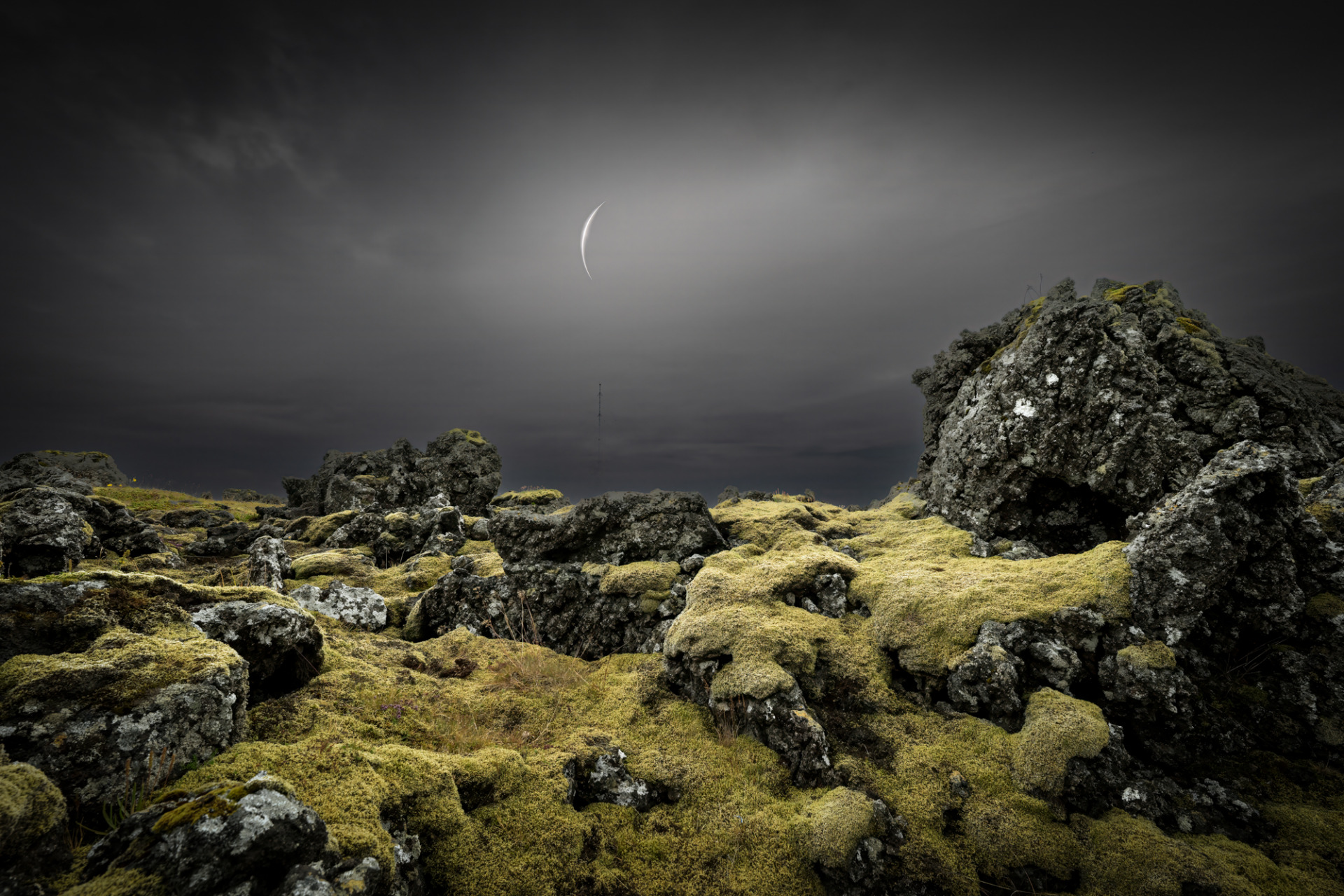
An Aperture Photo Arts collaboration: Iceland eclipse, August 12, 2026. Steve captured the foreground in the lava fields near Hellisandur while I managed to capture the almost fully eclipsed sun during its very brief appearance.
Cheers erupted from the crowd at the music festival next door during the sun’s brief appearance and again as the world plunged into inky darkness for 2 minutes.
Walking back to the Adventure Hotel, the parking lot was absolutely jammed with Arctic Adventures Sprinter vans.
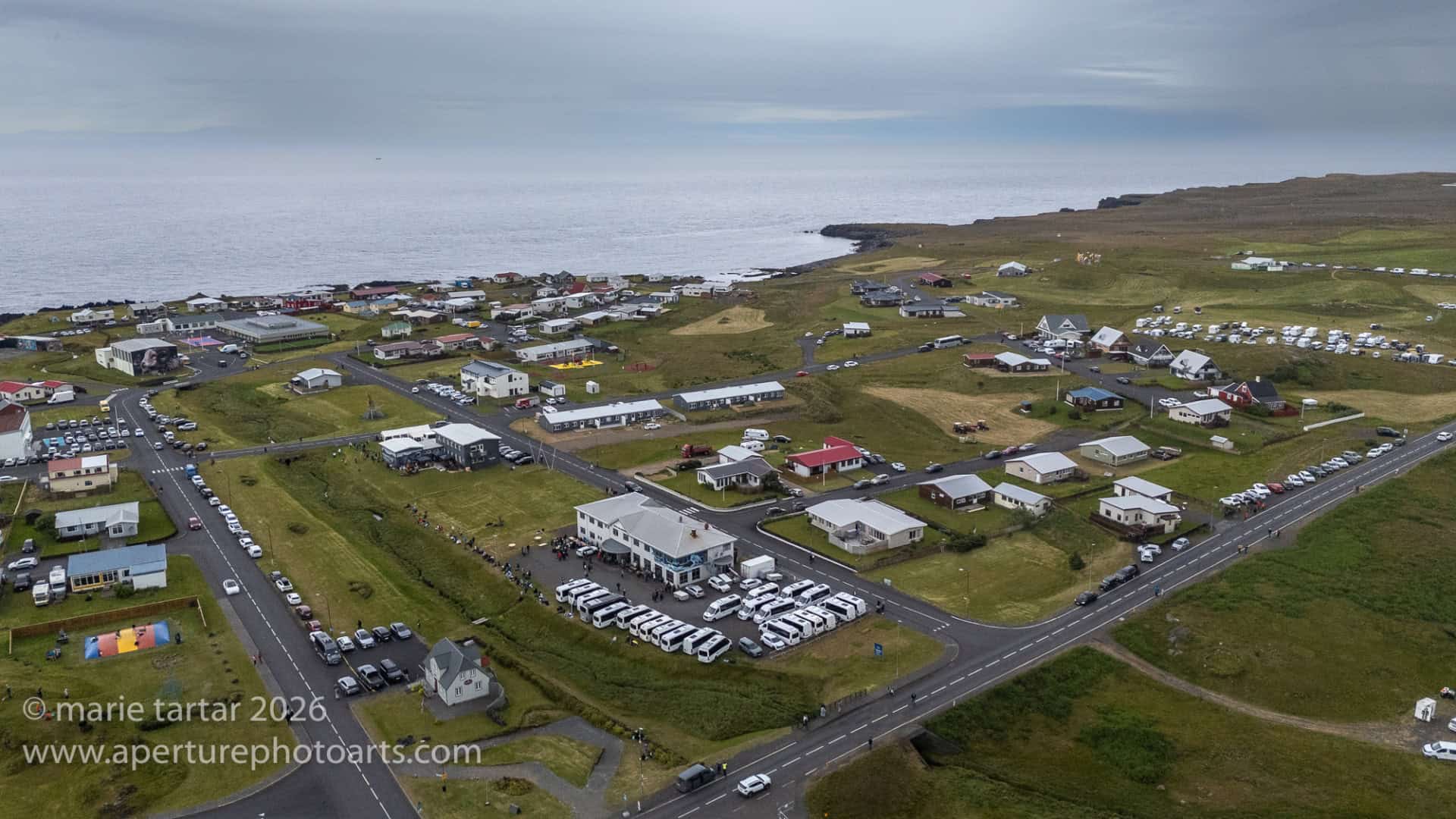
Hellissandur, Snaefellsnes Peninsula, Iceland, on eclipse day. The only hotel, where we stayed, is the largest building in the center foreground, with the parking lot jammed with Arctic Adventures buses. The field just beyond, towards the ocean, was reserved for hotel guests during the eclipse. We opted for the more picturesque lava fields.
Byron later told me that 70 of their 75 vehicles were deployed on Eclipse Day, with many coming from Reykjavik for the eclipse, making for a very long day. The day trippers started leaving at 7 pm; the first to return to Reykjavik made it by 11:30 pm, while others straggled back at 1 am.
Meanwhile, those of us lucky enough to have a room at the hotel indulged in a buffet dinner. The lobby and dining room were decked out in black and gold balloons, one of which blew up behind me when I was checking in, at eardrum-blowing volume.
Thursday, August 13, 2026
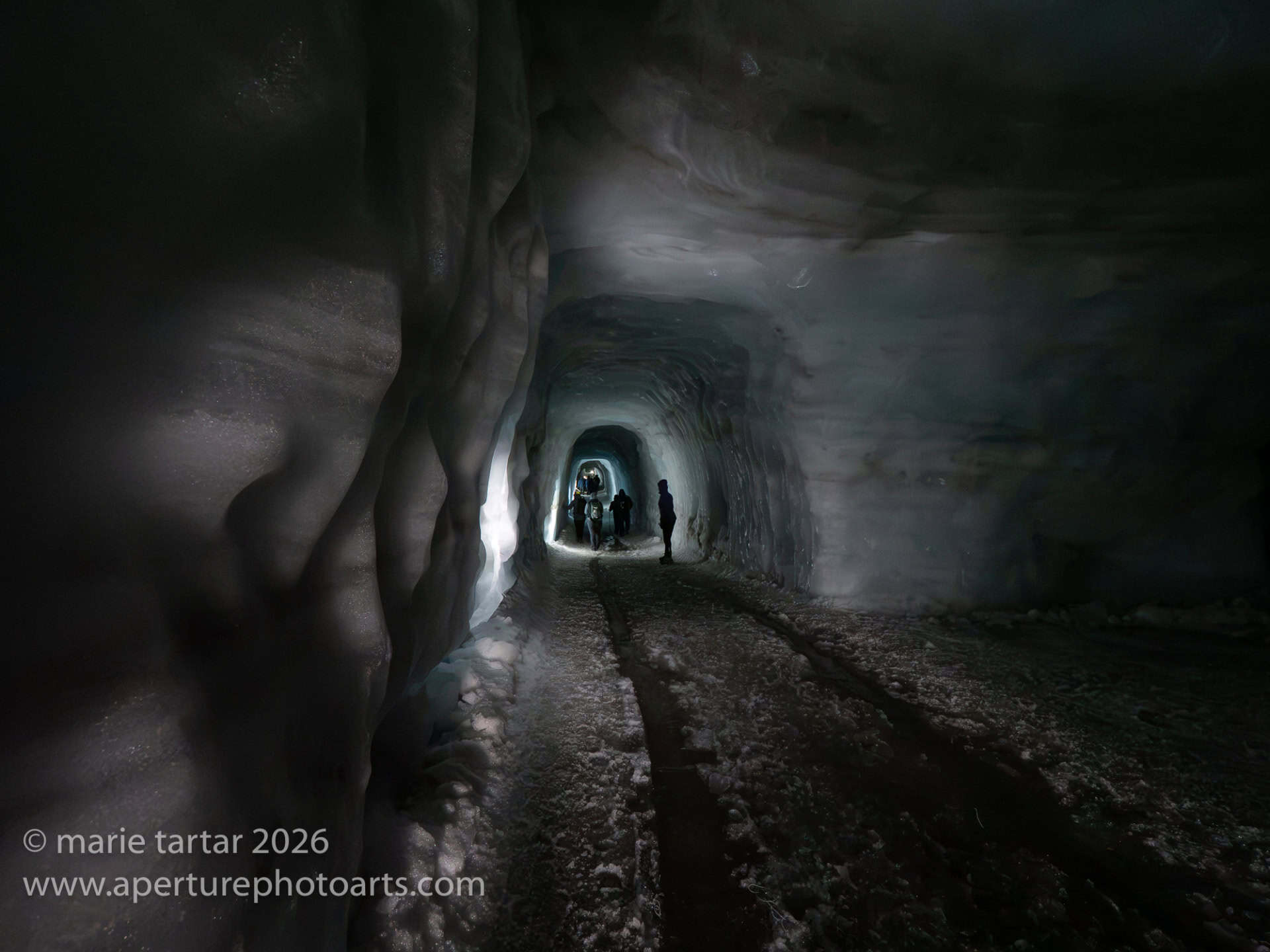
Into the Glacier is a manmade tunnel into Iceland‘s second-largest glacier, Langjökull.
We had a “spicy” ride (Byron’s words) up a deeply rutted snowy glacier to Into the Glacier, a manmade carved tunnel through cap of Iceland‘s second-largest glacier, Langjökull, near Husafell. Microspikes were fitted over our footwear as we clomped gingerly into the glacier, which took four years to plan and carve and is the world’s longest ice tunnel. This is a nice alternative for those whose knees or other body parts preclude a glacier walk. It doesn’t compare to a visit to a natural ice cave, which are carved into the edges of glaciers by glacial rivers, geothermal water, or volcanic activity, but at this time of year, only Katla (near Vik) would be open.
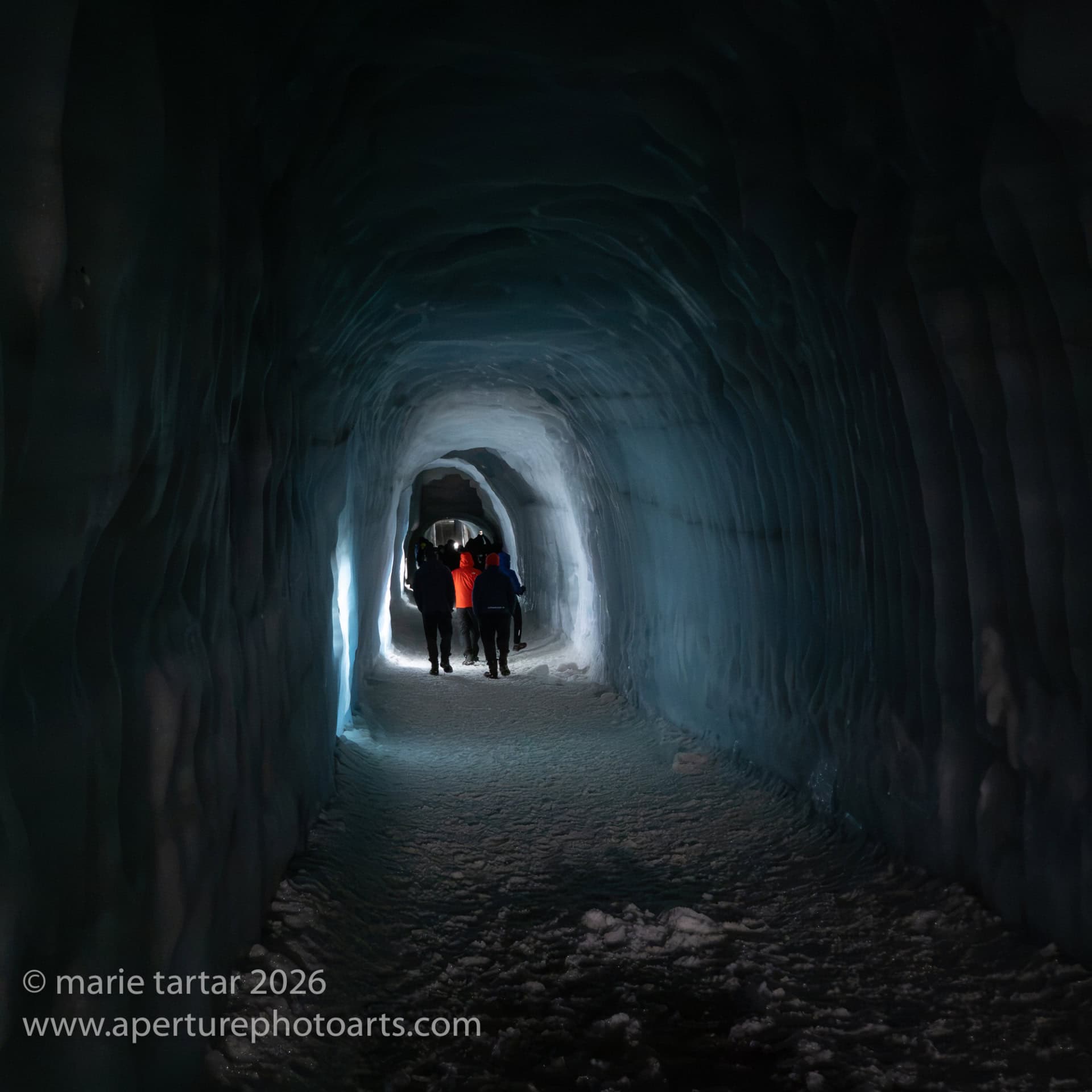
Reminds me of a childhood favorite TV show, The Time Tunnel. This ice tunnel was created by bulldozing into a glacier.
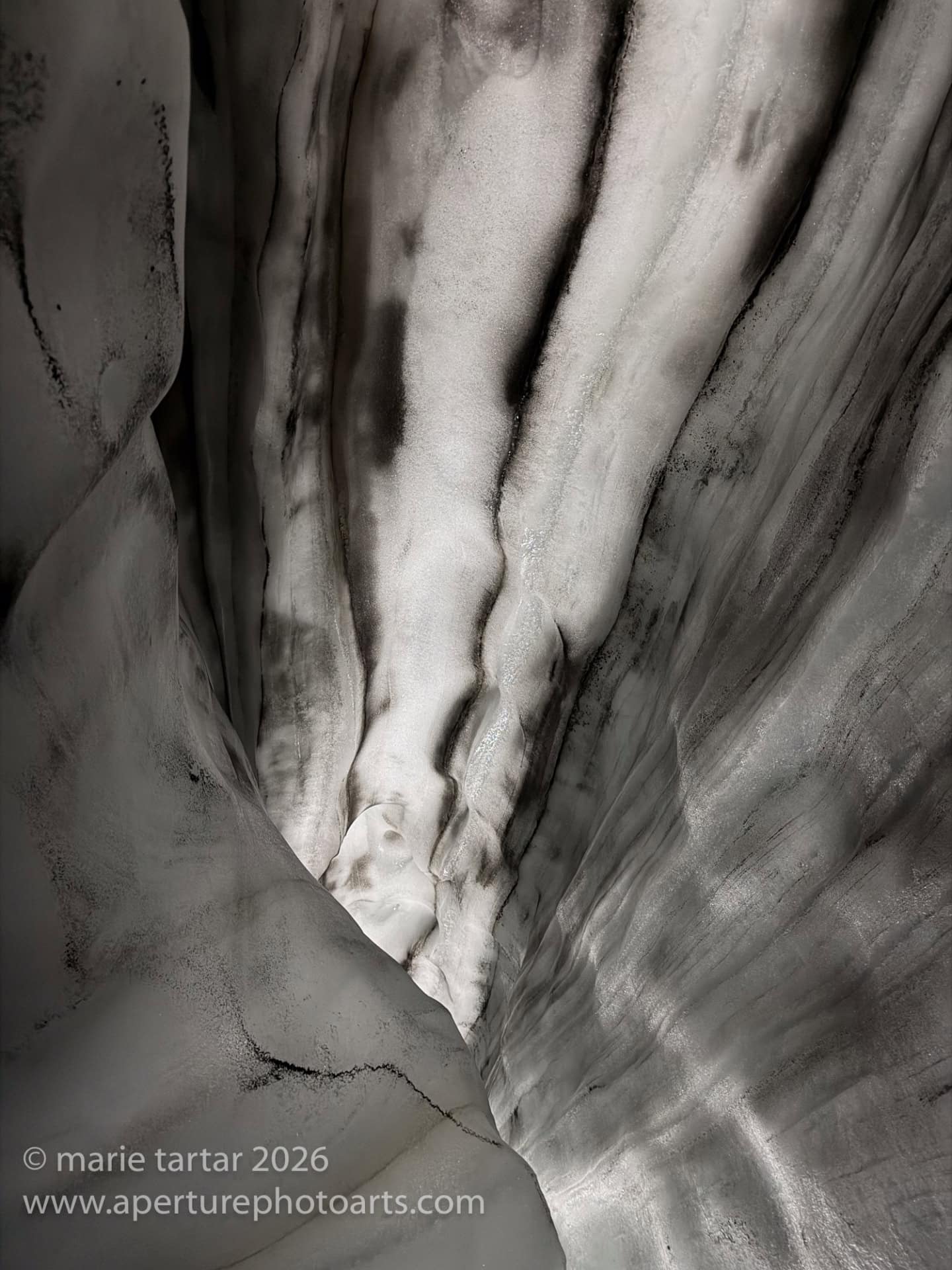
Glacial ice and ash striations at Into the Glacier.
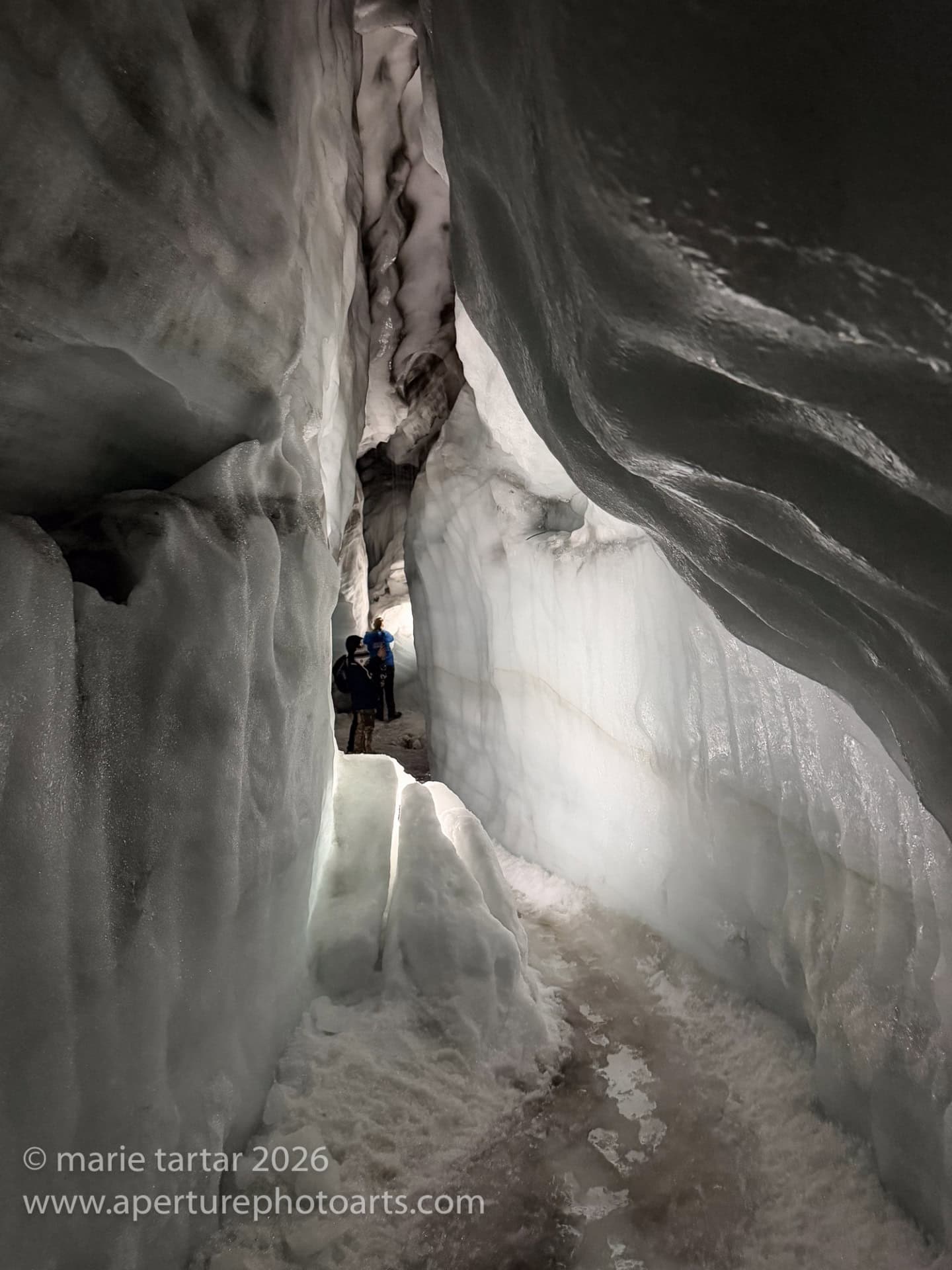
Into the Glacier.
Afterwards, we stopped at a geothermally active area, where I slipped into a greenhouse adjacent to a concession to slurp the lamb soup I had bought at the Husafell Cafe, a throwback to our stay in Harpa’s mother’s cabin nearby during our first trip to Iceland in 2011. Weeks later, reviewing my credit card bill, I understood better why I was offered an additional container for seconds on the soup, as well as bread and butter to accompany it-$29 for a bowl of the ubiquitous lamb soup!
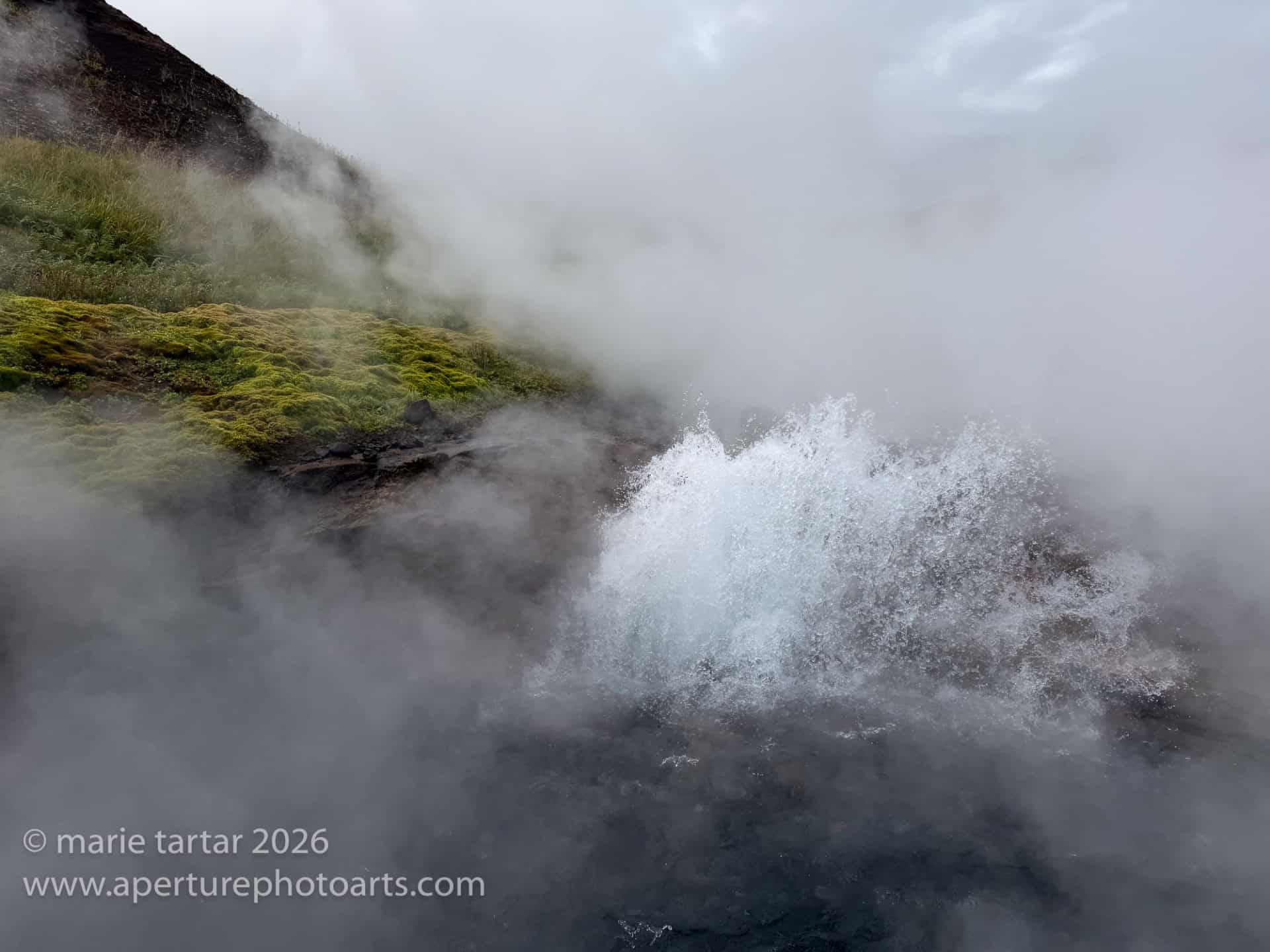
Bubble, toil and trouble! Steam and boiling water issue energetically from a geothermal hot spot in Iceland.
Our last stop was at that iconic site, Kirkjufell (Church Mountain).
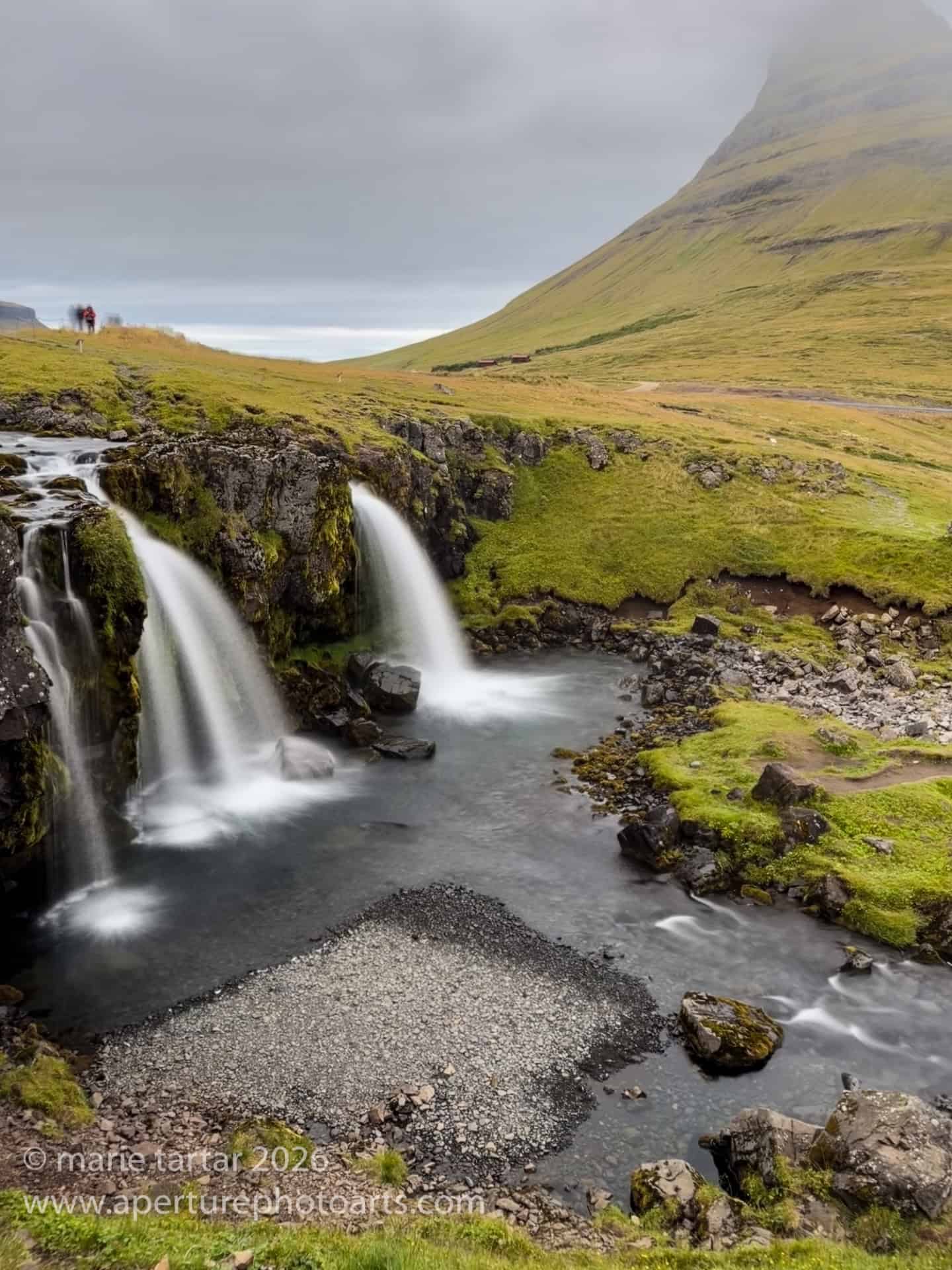
Iphone long exposure mode shot of Kirkjufellsfoss (Church Moungain Falls) with Kirkjufell beyond. The weather wasn’t wonderful during this last visit: fog, rain, mist and gray.
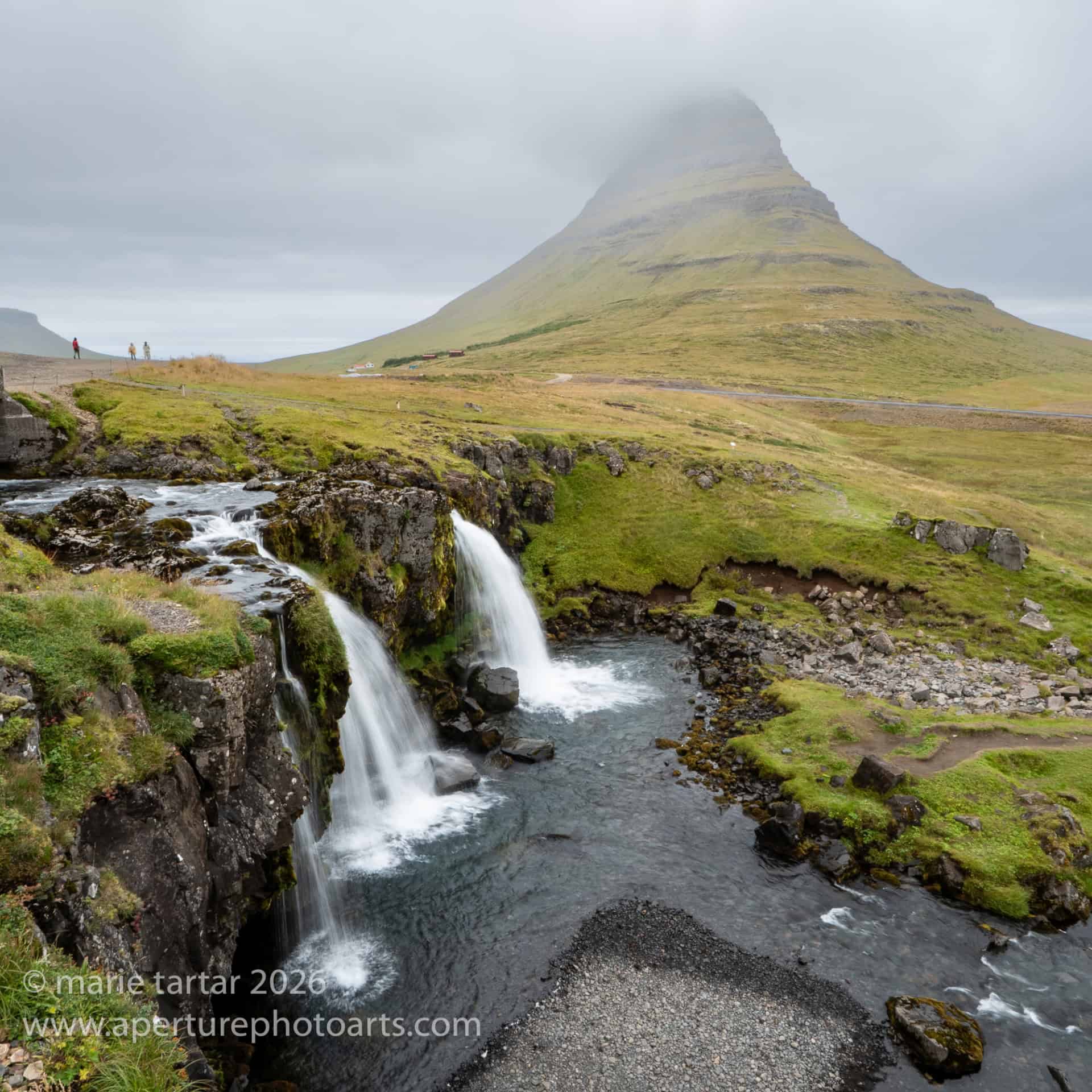
“Real camera” on a tripod version of Kirkjufellsfoss and Kirkjufell beyond. The tiny people in the distance are sharper. The differences between would become apparent in larger format print versions.

Still my favorite of my images of this iconic site (Kirkjufellsfoss and Kirkjufell), from 2014.
After checking with Siggi, I flew the drone despite being admonished by a passerby.
Him: “I don’t think drones are allowed here.”
Me: “I asked my guide and he said it was OK here. It’s not a national park. ”
Him: “You’re not supposed to fly over people.”
Me: “I’m not going to fly over people!” (gesturing toward the open expanse of land behind the falls).
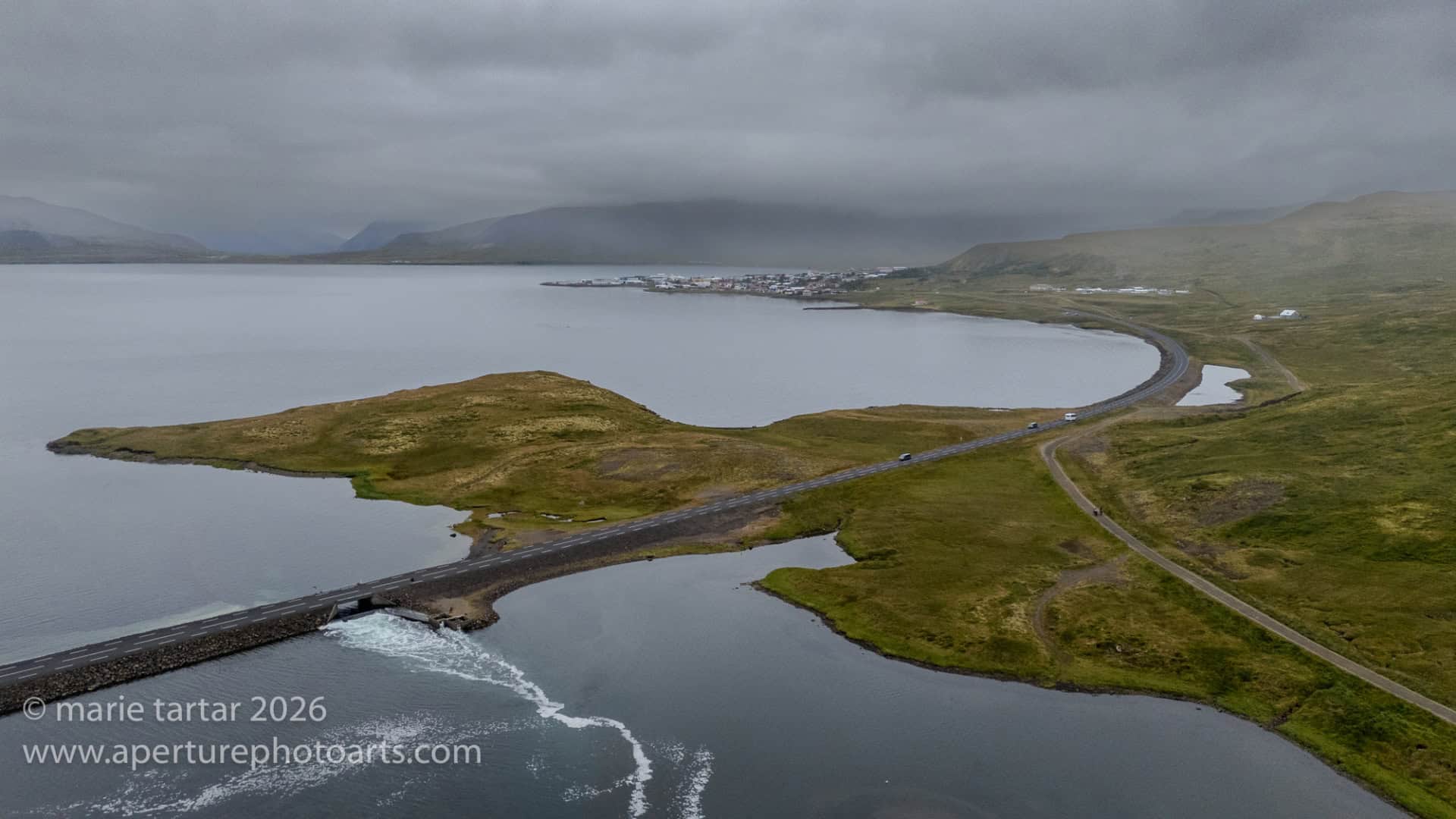
The town of Grundarfjörður on the Snaefellsenes Peninsula of Iceland, is seen in the distance on this aerial shot from near Church Mountain (Kirkjufell).
Back at the hotel on our final evening with the Blue Green Expeditions group, Dan and Betty hosted a farewell dinner. I elected the carrot soup, lamb with potato puree (with a hint of white chocolate), cabbage salad, and snagged the last passionfruit mousse.
Friday, August 14, 2026
The group dispersed this morning. Steve and I were off at 9 am with Byron in his capable Toyota Landcruiser truck. I had decided it made sense to extend our stay a few days when I saw how jacked up the flight prices were to fly home immediately after the eclipse. Ronan left at 7 am with the half of the group with the earlier airport departures. For a while, Siggi’s second load heading for Reykjavik paralleled us as we headed off the peninsula before turning north to the Westfyords. Byron had warned us that he couldn’t vouch for the hotel for the night and the food along the way would probably be crap.
These proved to be dire predictions. We made the 5 + hour journey to Patreksfjörður and checked into the small waterview Hotel West by 2:30 pm, where we relaxed with coffees while our rooms were readied. We had a pleasant and tasty early dinner at 5 pm down the street at Stúkuhúsið. I had the wolffish special, served with a sweet chile sauce and root vegetables. The rhubarb cake was a cut above.
We drove an hour to Látrabjarg mostly along a graded dirt road which followed the curves in and out of the fyords.
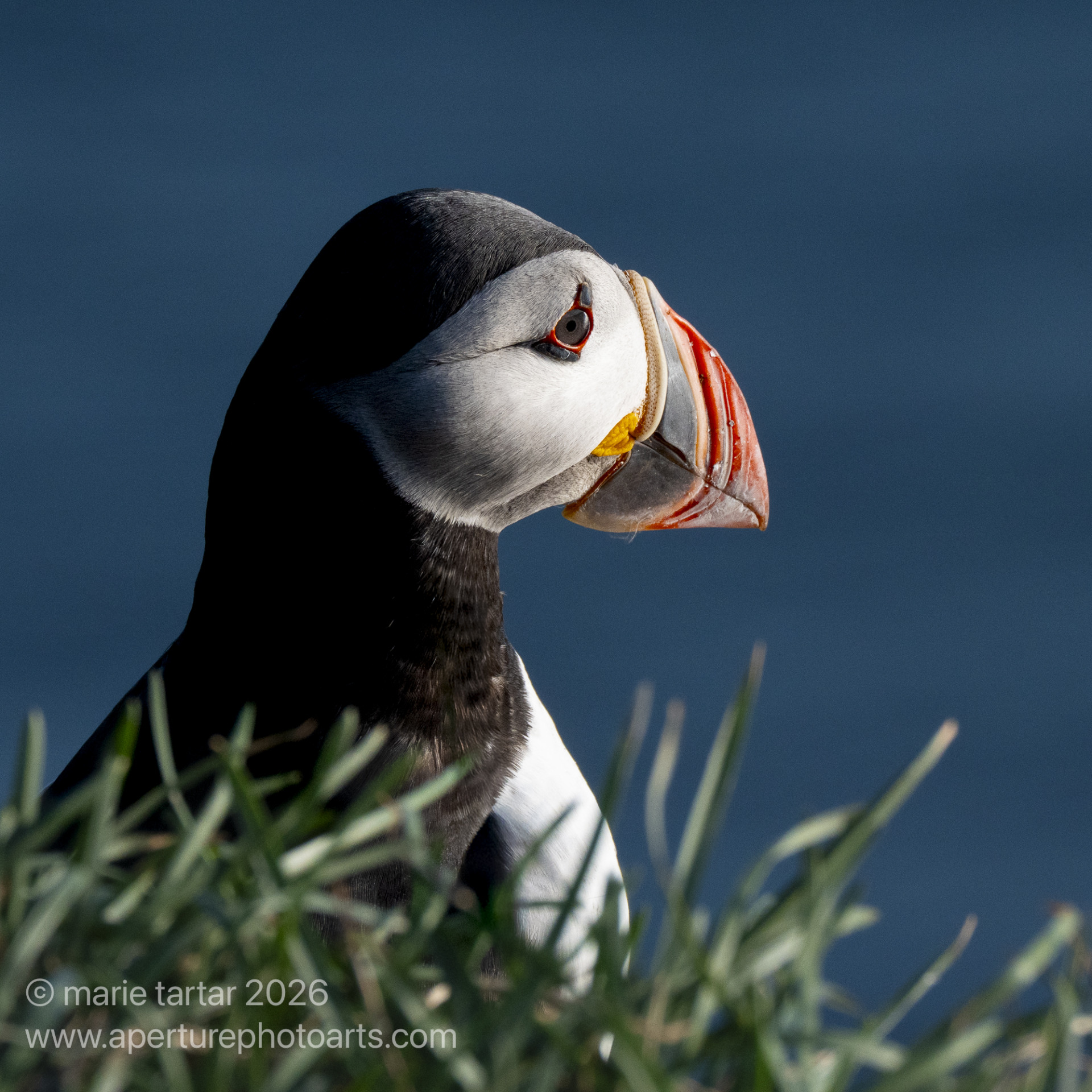
Puffin profile, Látrabjarg, Westfyords, Iceland.
The light was golden when we arrived and continued to improve throughout a magical evening. We found isolated puffins a few feet away on the path climbing up the cliff, where seabirds soared and landed in continuous arcs.
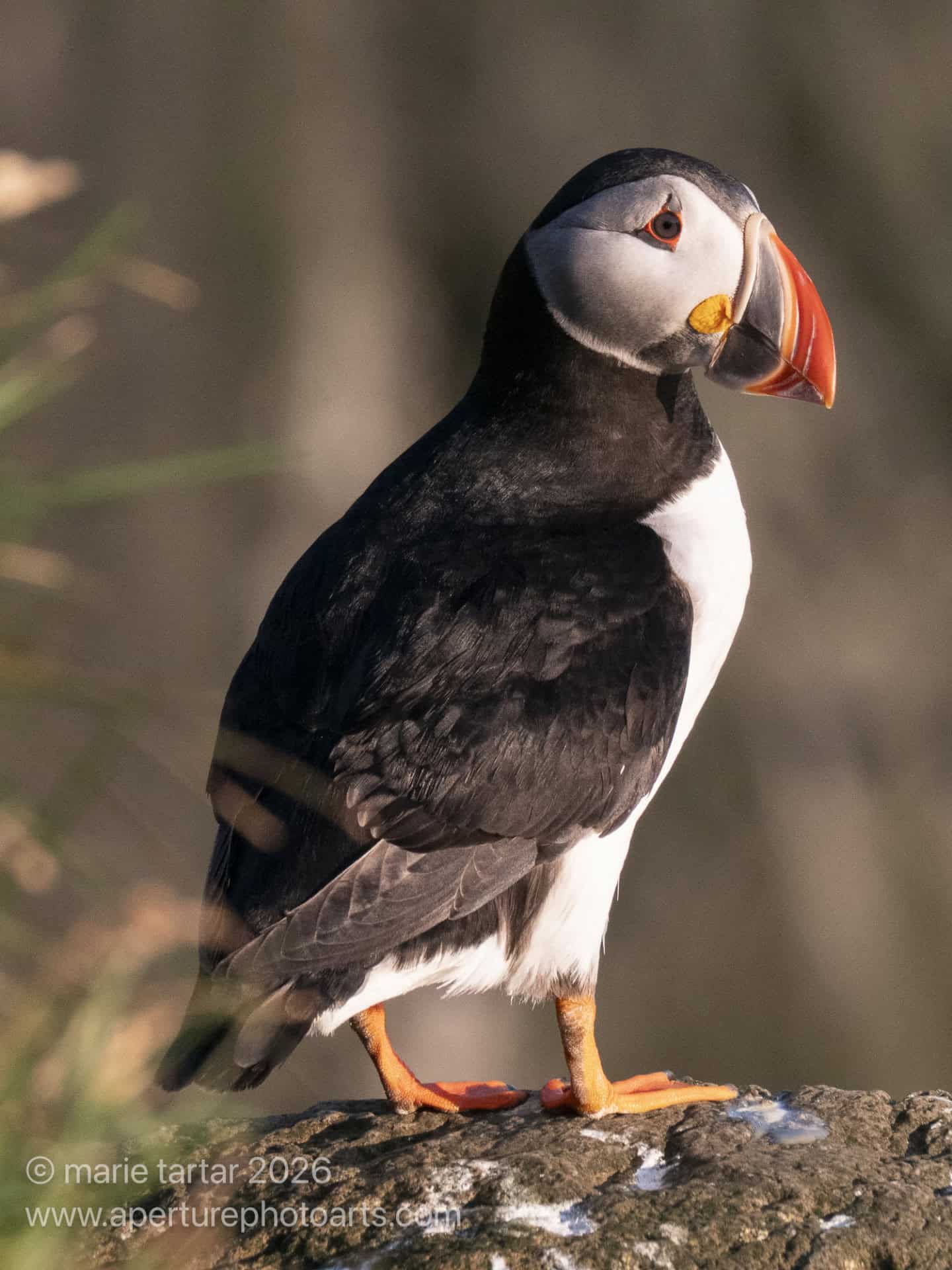
Atlantic puffin (lundi in Icelandic), Látrabjarg, Westfyords, Iceland.
More and more puffins arrived throughout the evening. Here’s a little video clip to vicariously be there.
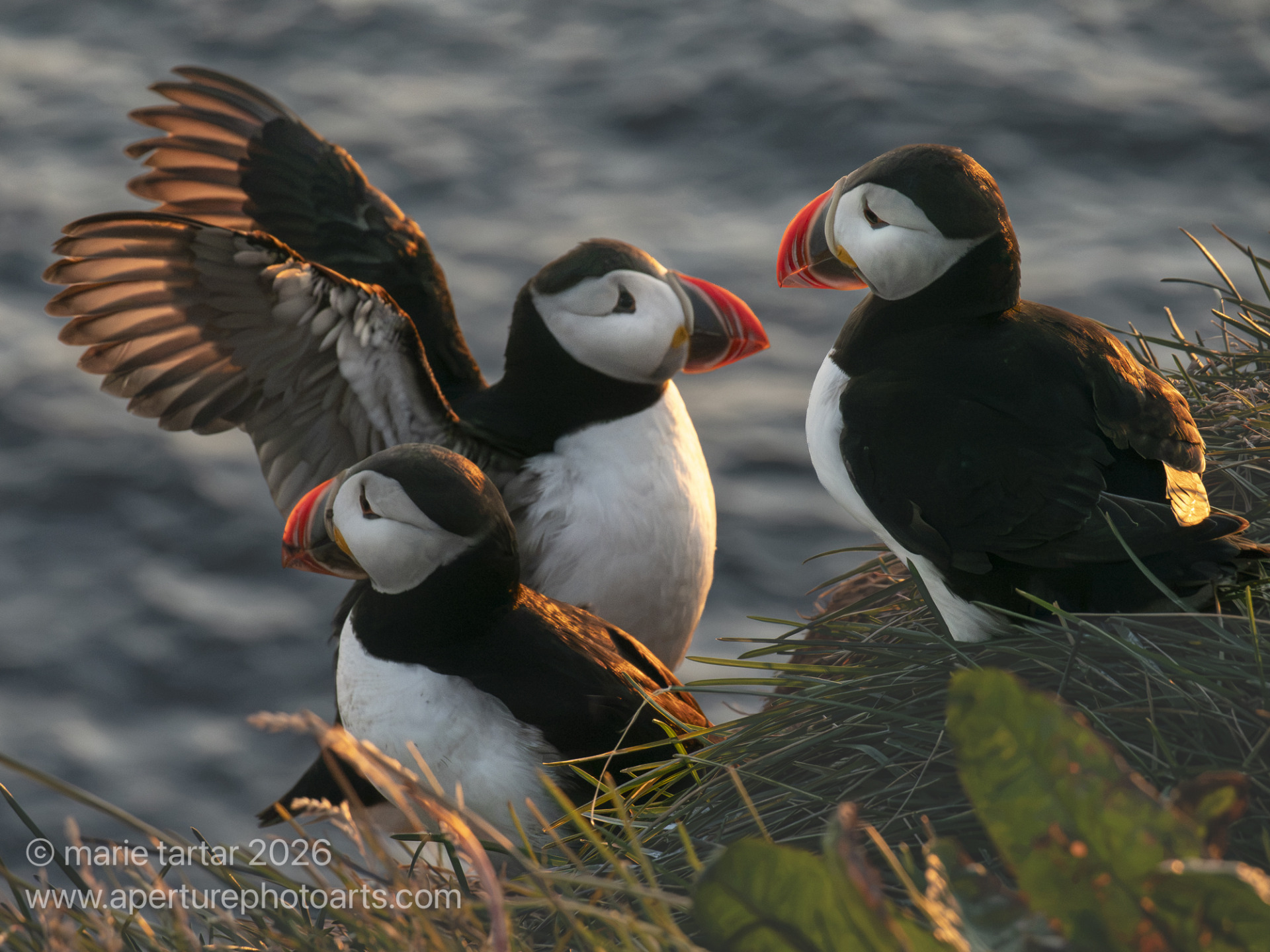
Puffin powwow, Látrabjarg, Westfyords, Iceland.
It was by far the best shooting situation we’ve ever had for photographing the charismatic birds and we stayed until the light failed, close to 11 pm.
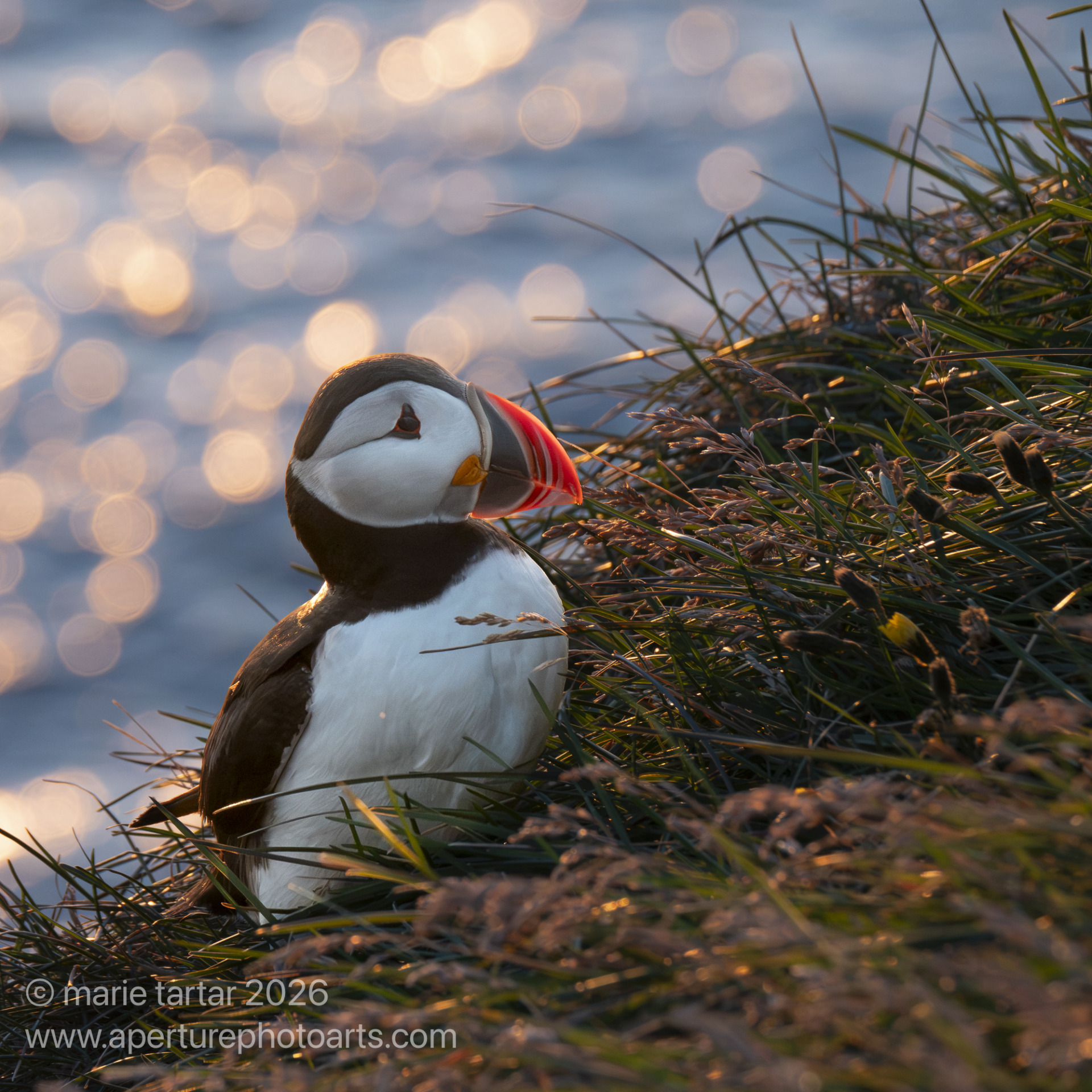
Puffin at sunset, Látrabjarg, Westfyords, Iceland.
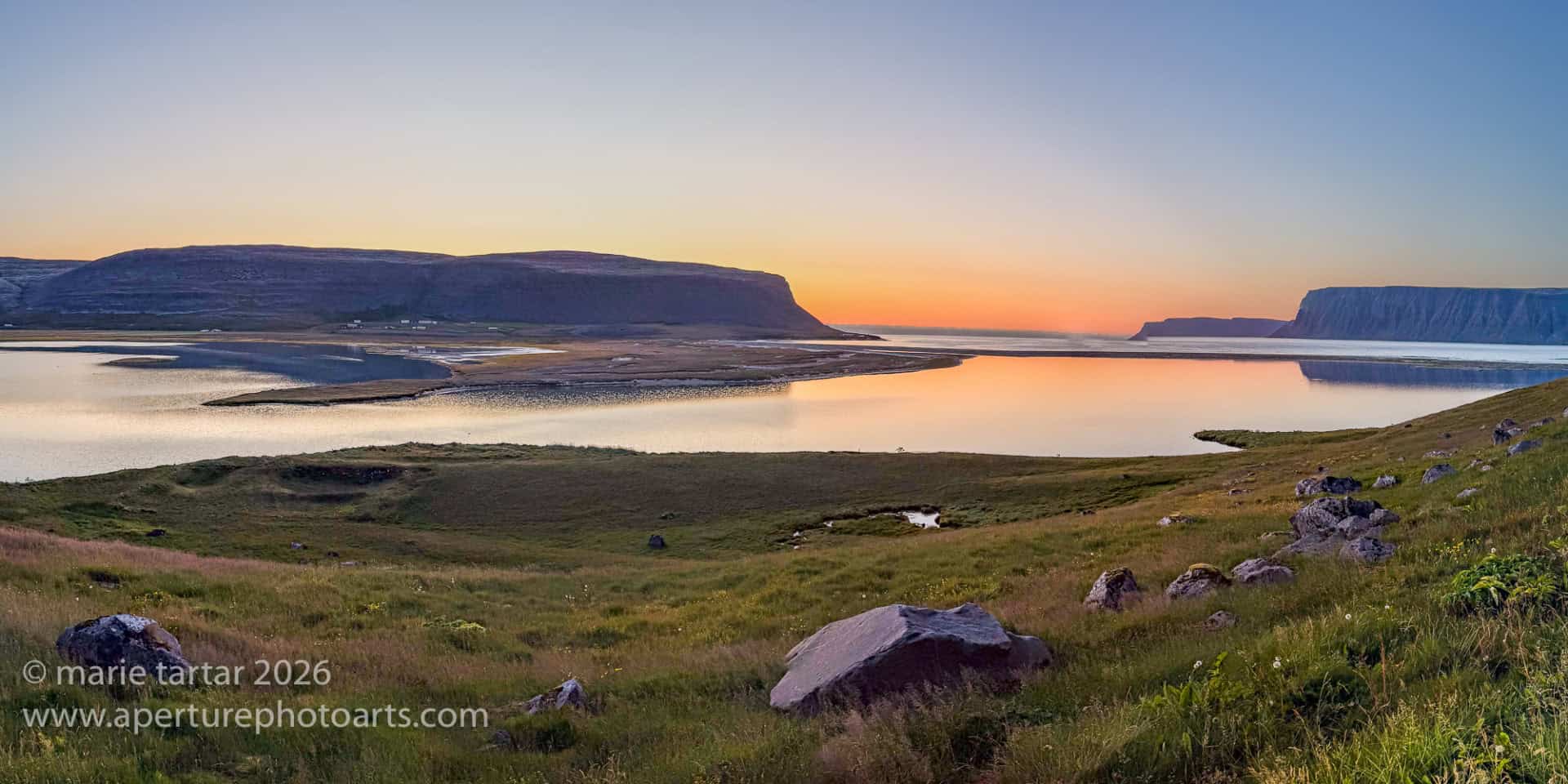
Sunset panorama, Westfjords, Iceland.
Saturday, August 15, 2026
We continued north, winding in and out of fjords towards the capital of the Westfjords, Ísafjörður. We stopped en route at Iceland’s multitiered (6!), largest waterfall, Dynjandi and found plenty to shoot until it was time to depart at 12:20. It is a cascade of waterfalls, including Háifoss, Úðafoss, Göngufoss, Hundafoss and Bæjarfoss.
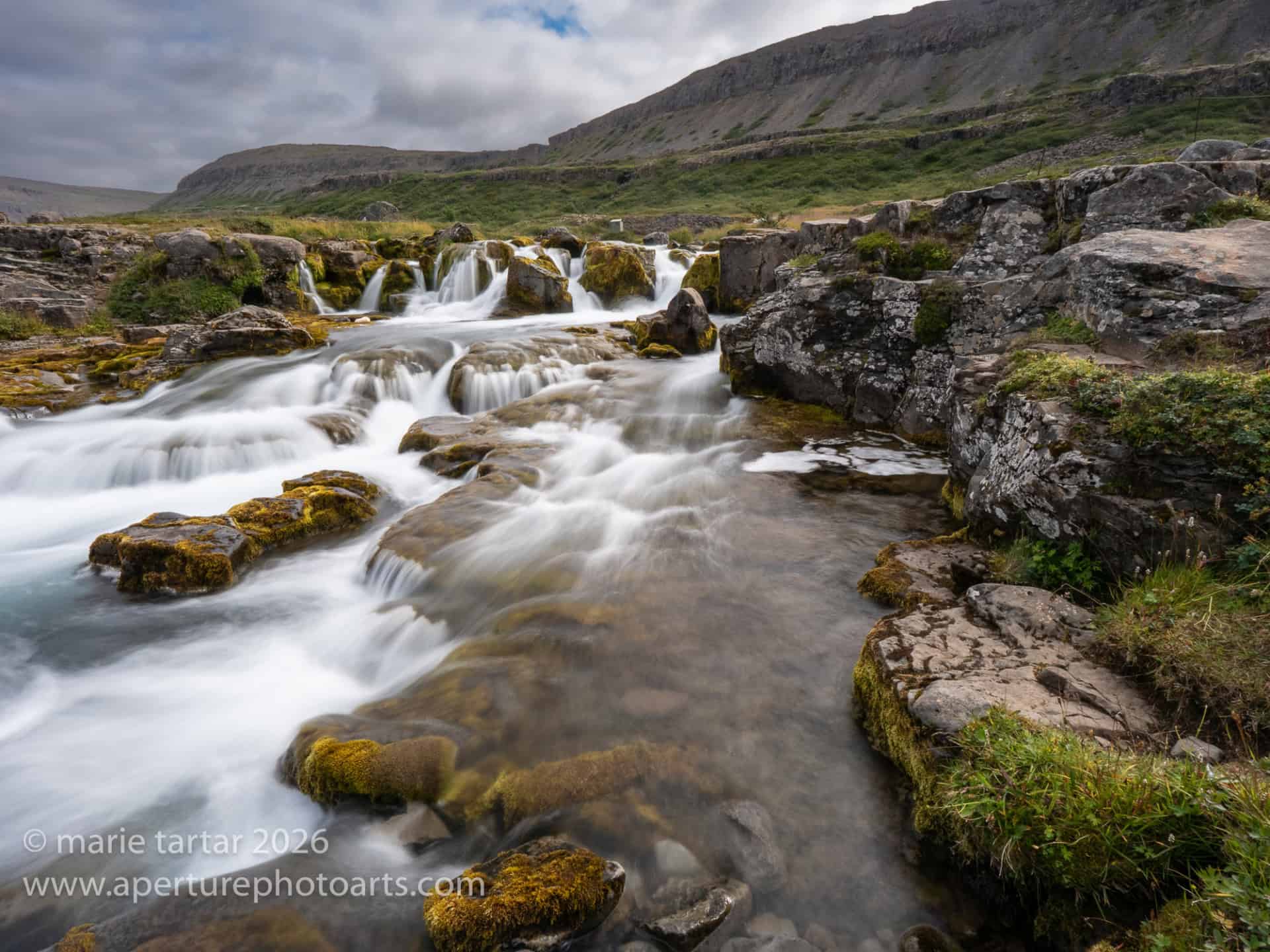
Jusr one section of Dynjandi, Hundafoss.
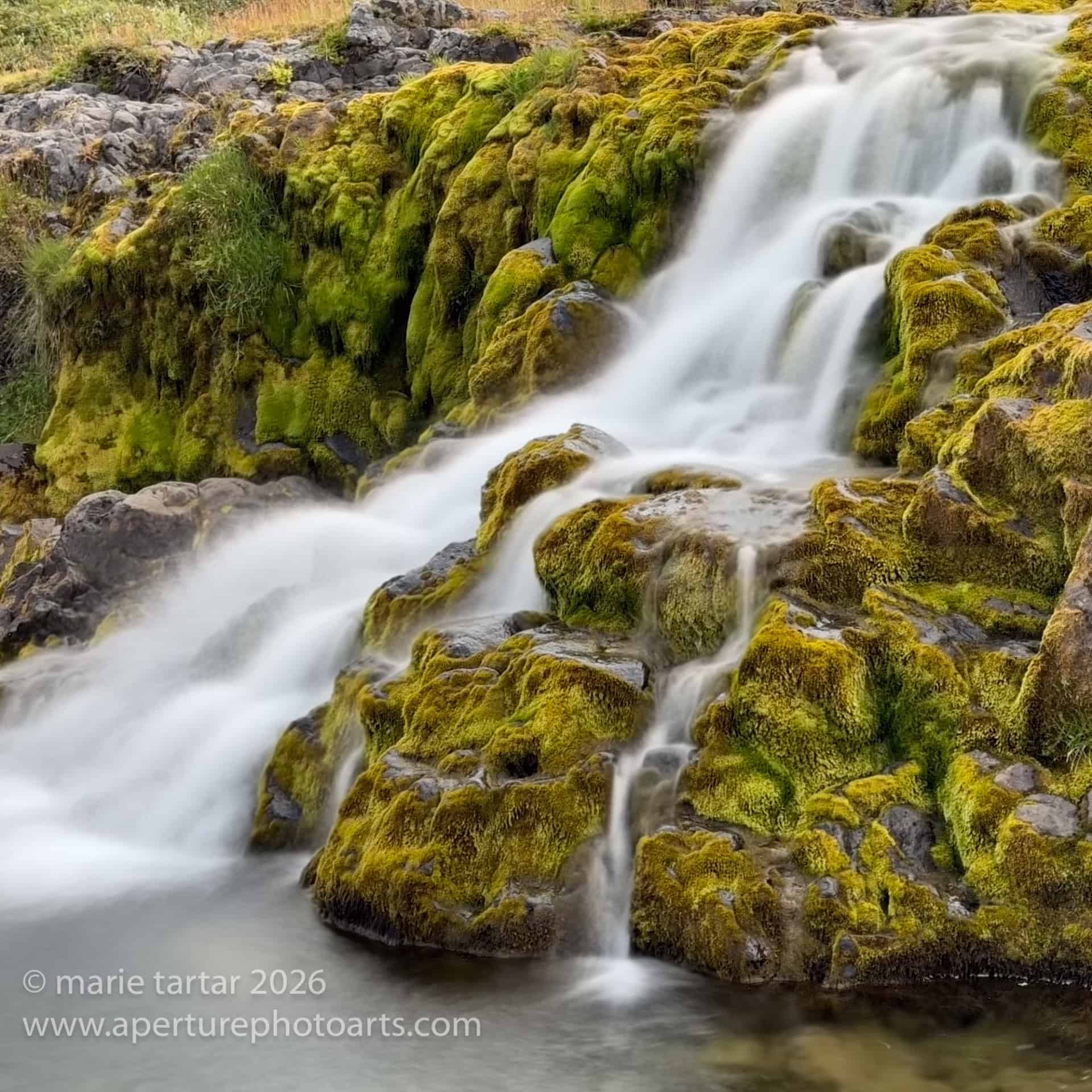
Another particularly photogenic section of Dynjandi: Hrísvaðsfoss. (Iphone shot)
Our departure was in time for the 50-minute drive to our 1:30 lunch reservation, at Tjöruhúsið, a famous seafood restaurant Byron knew about from friends but had never had a chance to try. It was housed in a wooden, low-ceilinged structure. The bread and herbed garlic butter were so tasty it was hard to stop at two pieces. Halibut and langostine soup was the next course, equally delicious. The entrees were served buffet-style and all-you-can-eat. An apple and fennel salad balanced the many fish preparations. My favorites were the salmon, arctic char, and ling cod. I had no room for the chocolate or cookies.
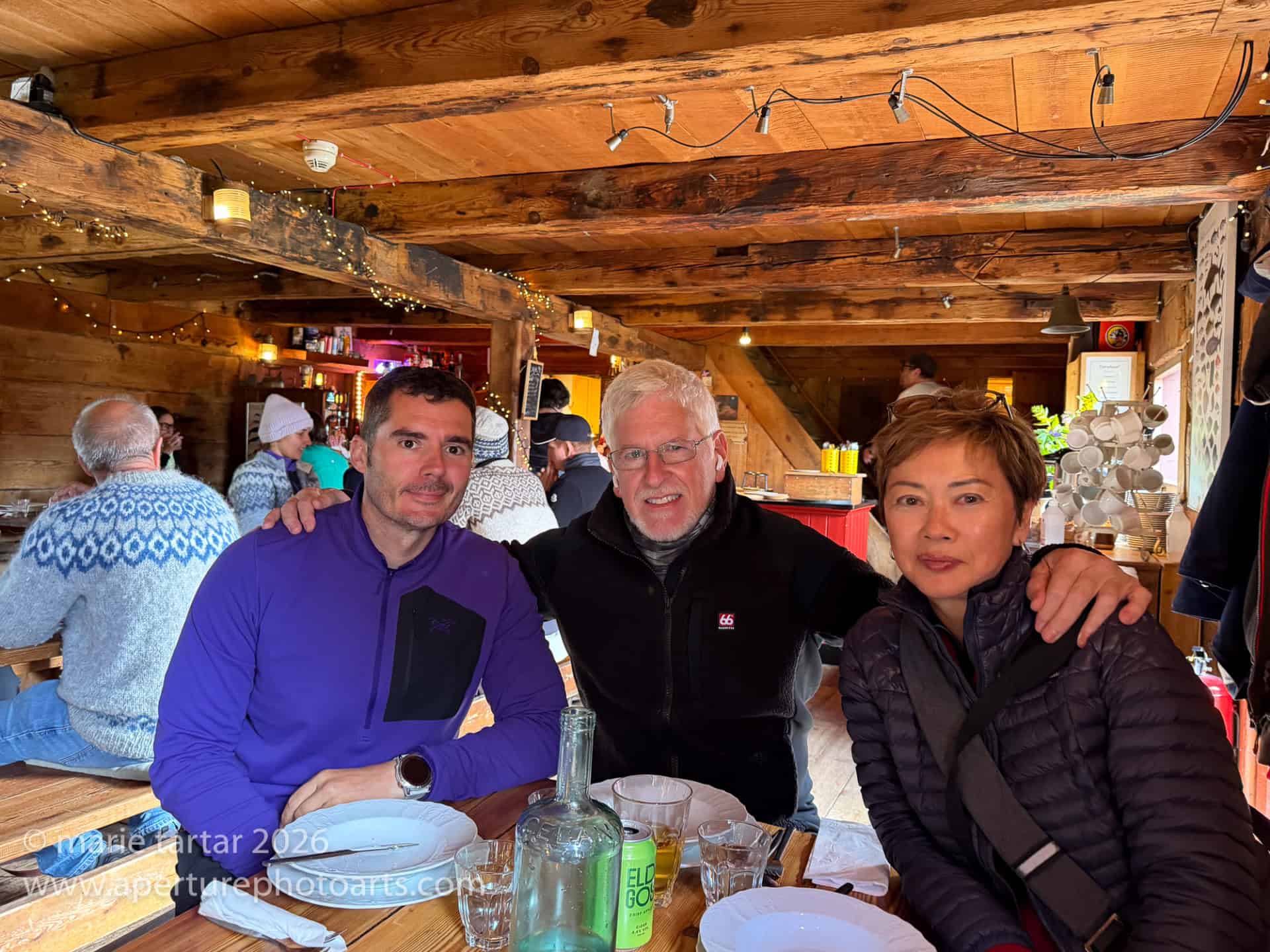
Journeying to the Westfjords with Byron gave us all the chance to indulge in a particularly satisfying seafood lunch, Tjöruhúsið.
After reluctantly pushing ourselves away from the table at Tjöruhúsið, we went to check out the Arctic Fox Center in the next town, Súðavík. The Center currently is housing only one rather sad-looking female named Mia, whose parents were killed by farmers (which is legal in Iceland). The small museum is interesting, with a good film playing.
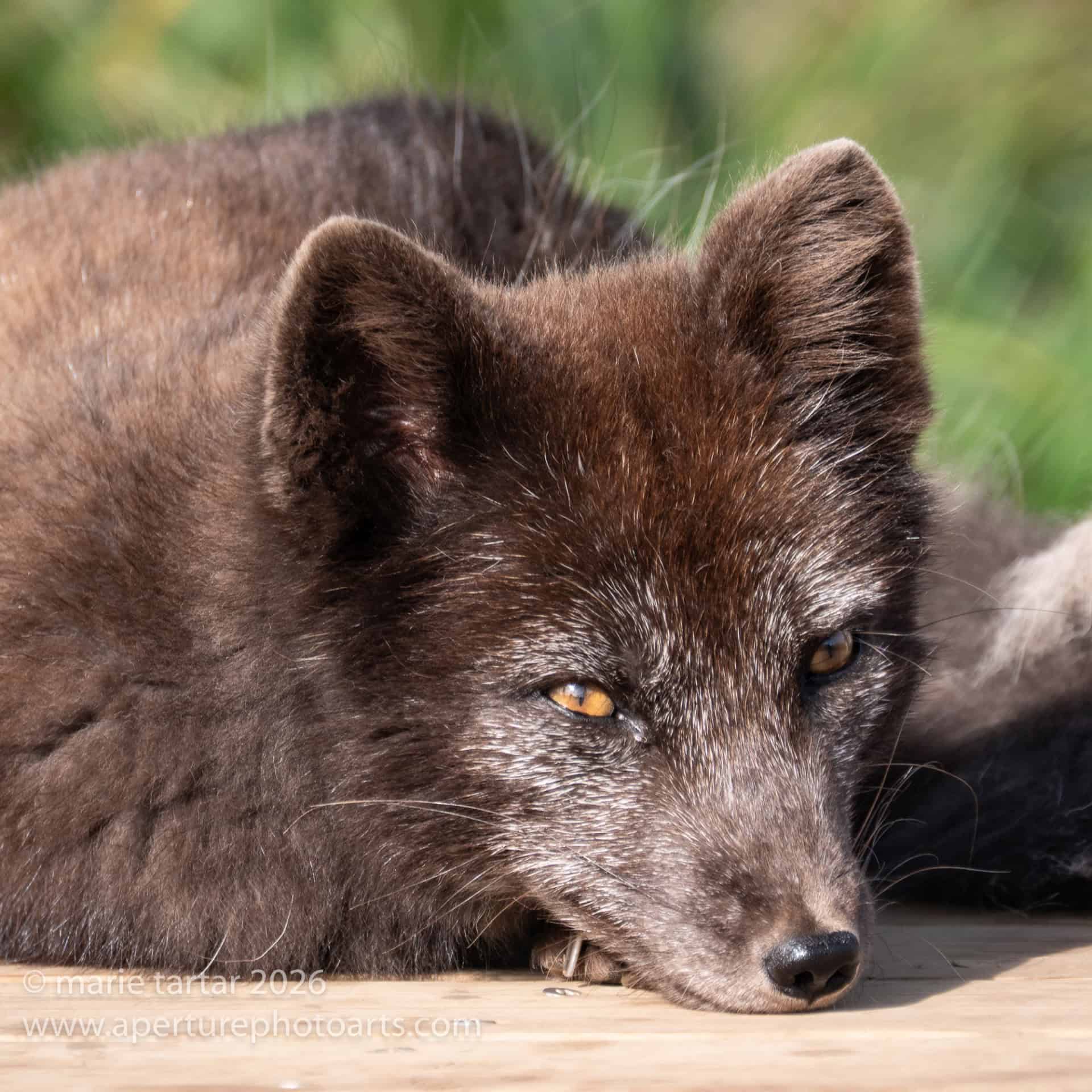
Mia, a sad-looking orphaned Arctic fox, the only resident of the Arctic Fox Center at the time of our visit.
Later, we went for a drive to check out Bolungarvik, a dramatic drive curtailed by thickening fog. We made a few stops along the way for a photogenic pair of horses and nice light on the headlands backing Ísafjörður.
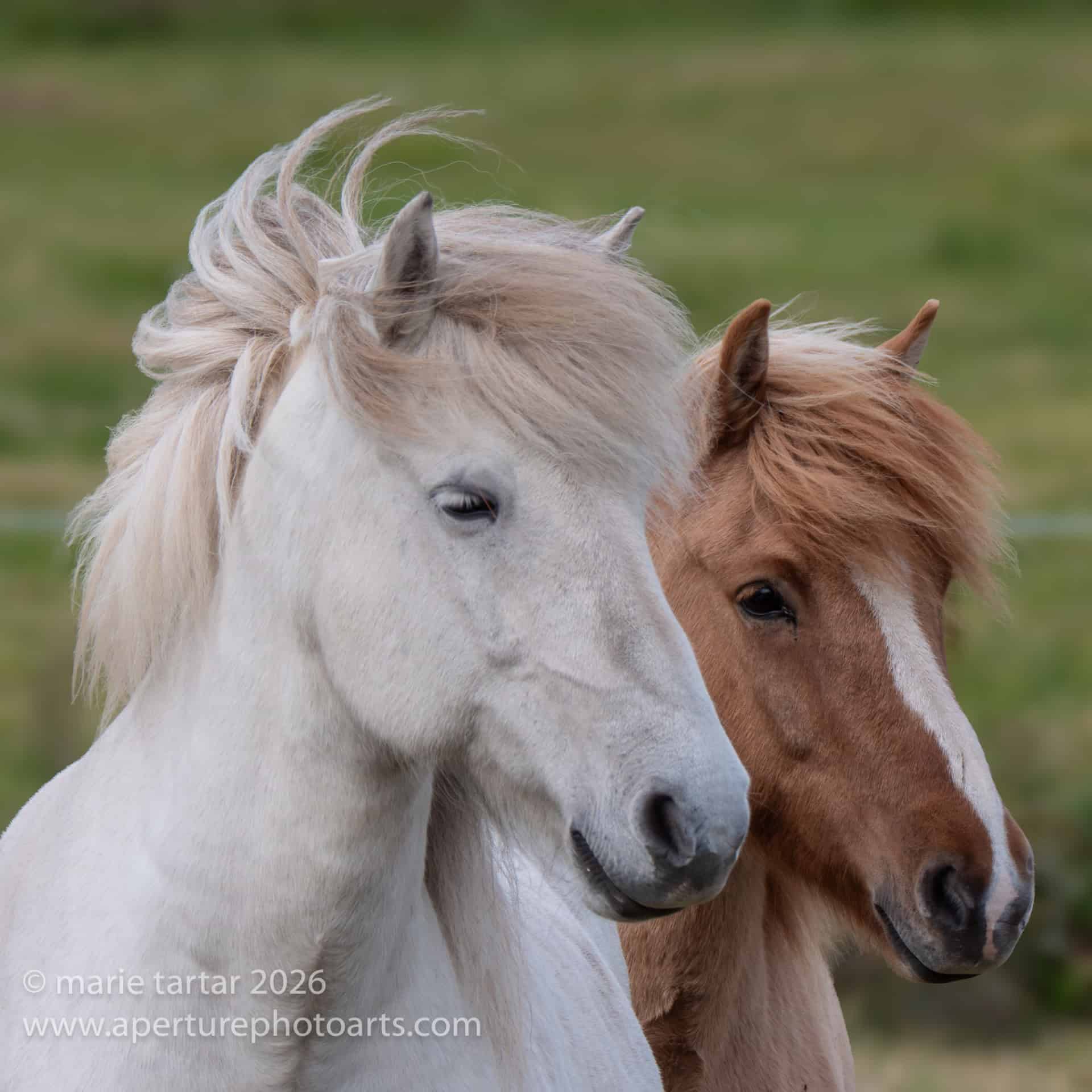
Stop the car! Icelandic horses in the Wesfjords.
Steve and I had a light dinner (pumpkin soup for me and hummus and bread for him) and gin and tonics at the sister hotel of our accommodation (Hotel Horn), Hotel Ísafjörður.
Sunday, August 16, 2026
It was a long haul back from the Westfjords to Reykjavik, starting at 8 am, and an even longer day for Byron, who planned to pick up dive guide Doris and drive up to Akureyri to meet Faith’s second group, who were doing their check-out ocean dive today. He would log at least 11 hours of driving in total, with each trip taking at least 5.5 hours.
The fjords were calm with glassy water and gorgeous reflections of the cliffs. We wound our way in and out of the coast’s convolutions, taking the northern route and completing our introductory circuit of the remote area.
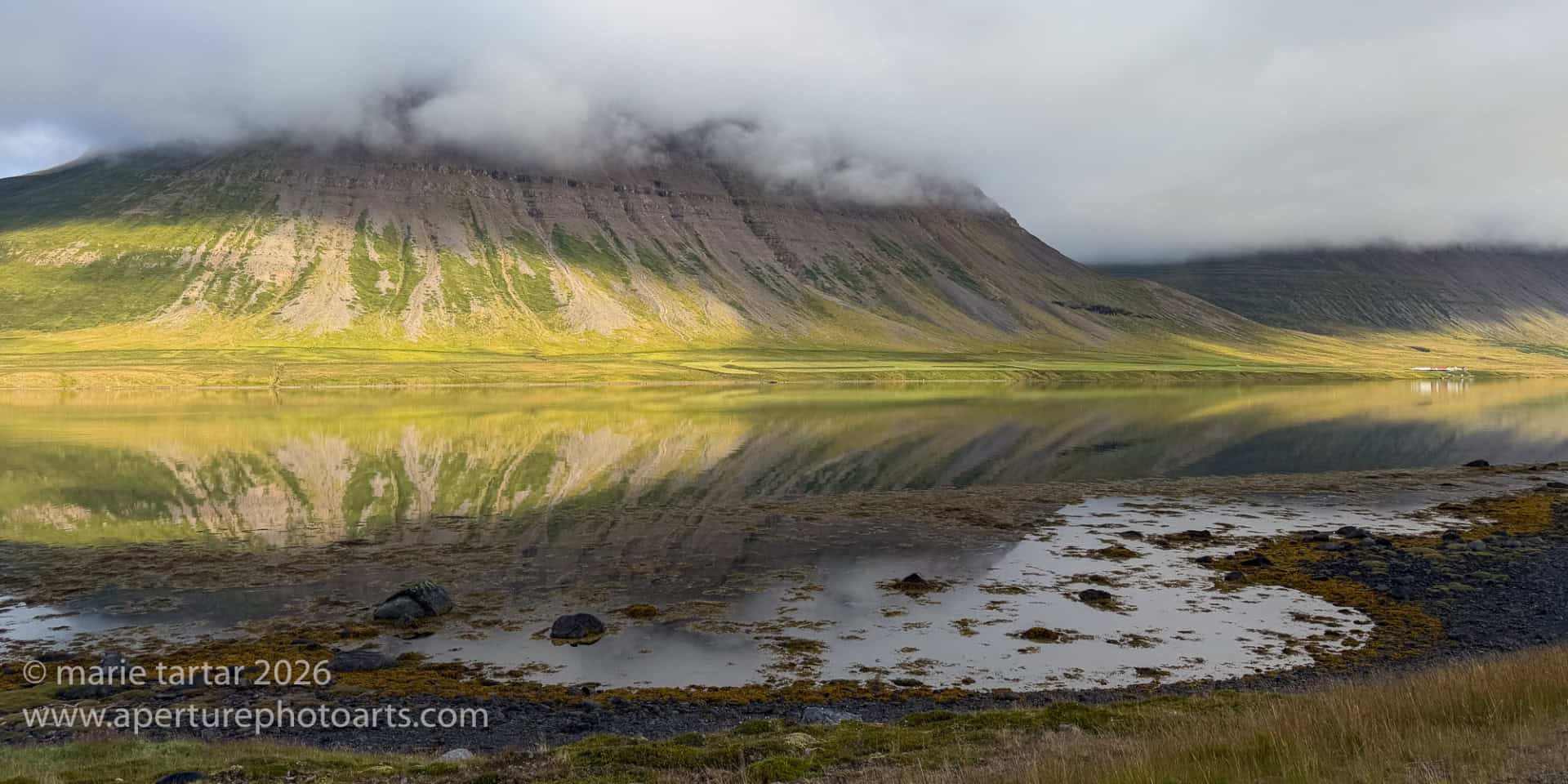
Beautiful light on our drive out of the Westfyords of Iceland.
At Arctic Adventures’ office, Byron collected the thick, warm drysuit underwear jumpsuits and steel backplate BCDs we had used. He had brought along a tank and gear for each of us, as the original plan included a scallop dive on the way back. My back was improving but still flinchy and Steve’s wrist was also on the mend, but doing a dive would mean our gear would be wet and make Byron’s day even longer, so I decided the better part of valour would be to forego the shore dive. All I needed would be to twist an ankle or tweak my recently symptomatic knee and the rest of our fall travel plans would be in jeopardy.
Back in Reykjavik, we settled into the Hotel Eyja (Eyja Guldsmeden Hotel), where we stayed a few trips ago. I like this cozy boutique hotel with dragonfly emblems. It’s a little further out from the center of town than the Hotel Skuggi but still an easy walk in.
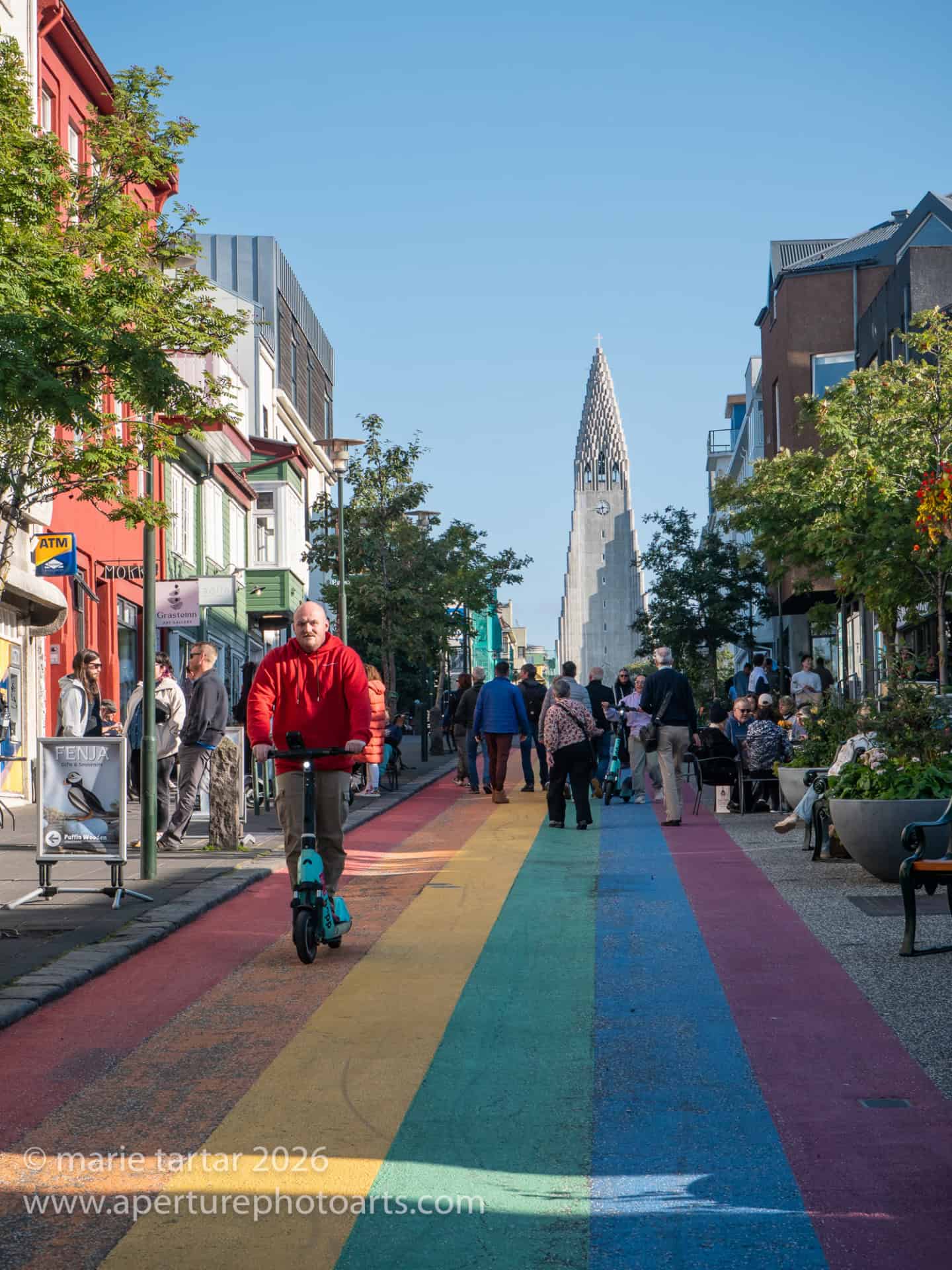
Reykjavík, Iceland’s famous pride-painted street, Skólavörðustígur, widely known as Rainbow Street, leads to its most famous landmark, Hallgrimskirkja Church.
Dinner saw us return to our perennial favorite, that elegant Indian restaurant, Austur-Indiafjelagid. We indulged in cocktails (Mescal Manali for Steve and gin-based Knockout Nights for me) and shared a vegetable benaresi saag and spicy lamb achari ghosht, as well as a delicious bread, Masala Kulcha.
Monday, August 17, 2026
Breakfast was nice in the Eyja’s cozy dining room, in spite of an annoying Asian woman loudly carrying on a conversation on her cell phone, pacing back and forth the length of the otherwise calm dining room.
We walked to Flyover Iceland, which is an immersive flight-simulating film, with seats that shake, really making one feel they are soaring over peaks and into canyons, narrowly dodging the walls and obstacles.
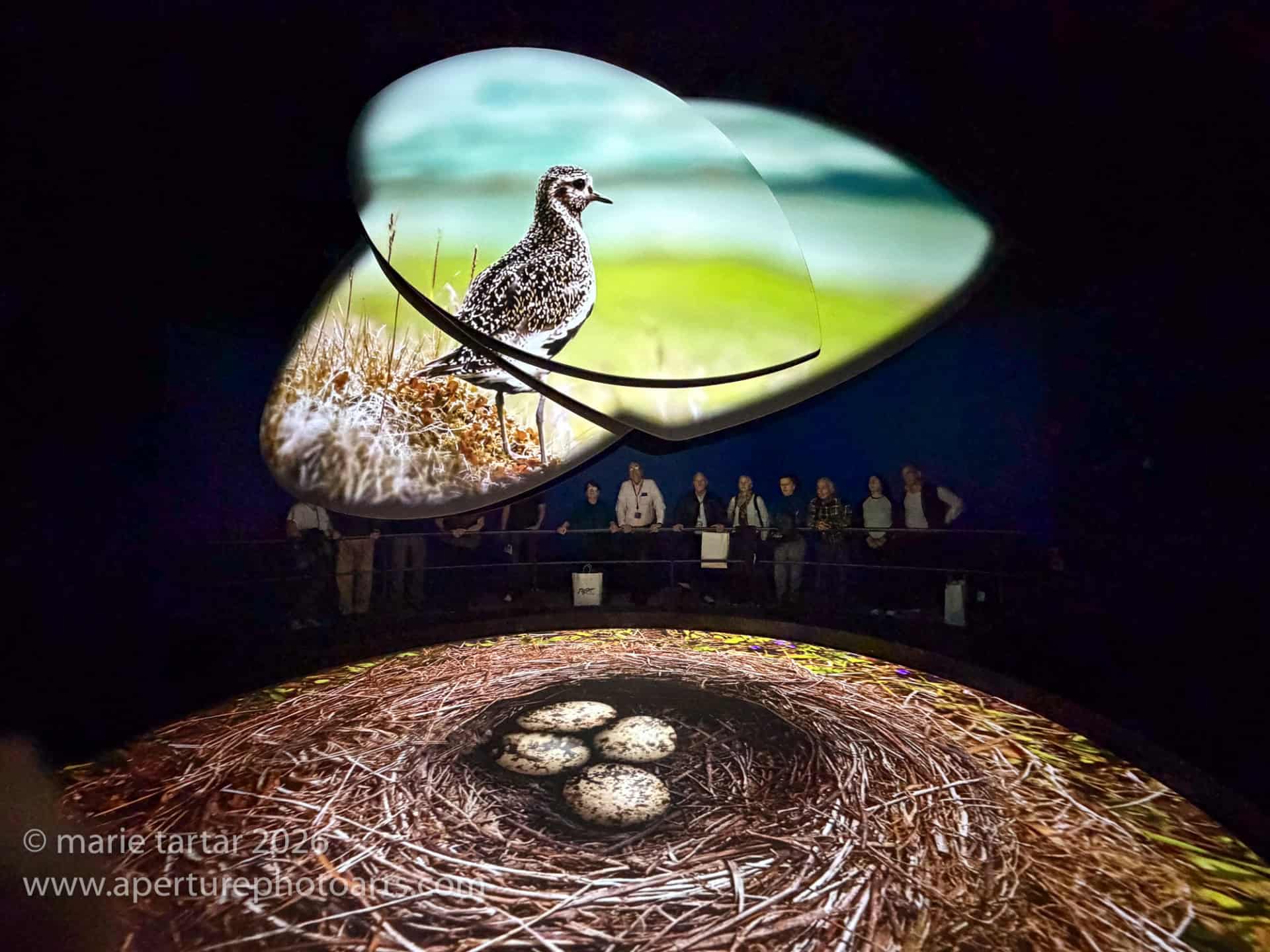
A prelude to FlyOver Iceland, a thrilling aerial “ride” over the scenic country.
It is but a 10 minute “flight” but what a trip! Steve was nearly motion sick, as our “plane” swooped over cliffs and erupting volcanoes.
We had a nice catch-up over a delicious chicken salad lunch with Chris Lund and Maria Ellingsen at their house near the city center. Chris had been guiding an eclipse photography group from the US for Backcountry Journeys while we were on our Blue Green Expeditions trip. Their group went to the Westfyords for the eclipse, but apparently didn’t get even the 15 seconds we had.
For our last evening in Iceland, we decided to spend it at Sky Lagoon. We should have listened to Chat GPT that public transportation was not the best way to go there. After a ridiculously drawn-out, double city bus ordeal with a transfer, we eventually made it. We did enjoy our visit. Their ritual includes a cold plunge, hot dry steam, a cool drizzle and a salt scrub. Our return by Reykjavik Excursions bus was much easier. I especially loved the hot steam room as I was still trying to unknot my back.
At the end of our trip, we took stock of our casualties. My back was still knotted up over a week after our first puffin shoot. In Akureyri, Steve complained of aching thighs, painful enough to disrupt his sleep. He ultimately diagnosed himself with meralgia paresthetica, which can produce burning pain in the outer thigh due to compression of the lateral femoral cutaneous nerve. Presumably, too many hours cooped up in a cramped seat in a bus wearing a seatbelt (It is the law in Iceland that bus riders must wear seatbelts) produced his symptoms, which abated once we switched to Byron’s Toyota Landcruiser. Steve tripped in the lava field during the eclipse and injured his wrist (thankfully, not so badly that he couldn’t handle our luggage at the airport). We both had itchy red welts from being bitten by no-see-um midges at Akureyri. Ironically, it was so cold and windy when we stopped at the actual Midge Lake (Lake Mývatn) that we weren’t really bothered by the usual swarms of relentless insects.
For a trip including what Steve characterized as “the worst whale watching and the worst ocean dive”, we had a really good time…even without our butler (Greg). It wasn’t the eclipse we had hoped for, but neither rain, nor cold, nor clouds really dampened the overall experience. Conversely, we couldn’t have wished for a better puffin photography session than we had with Byron in the Westfjords.
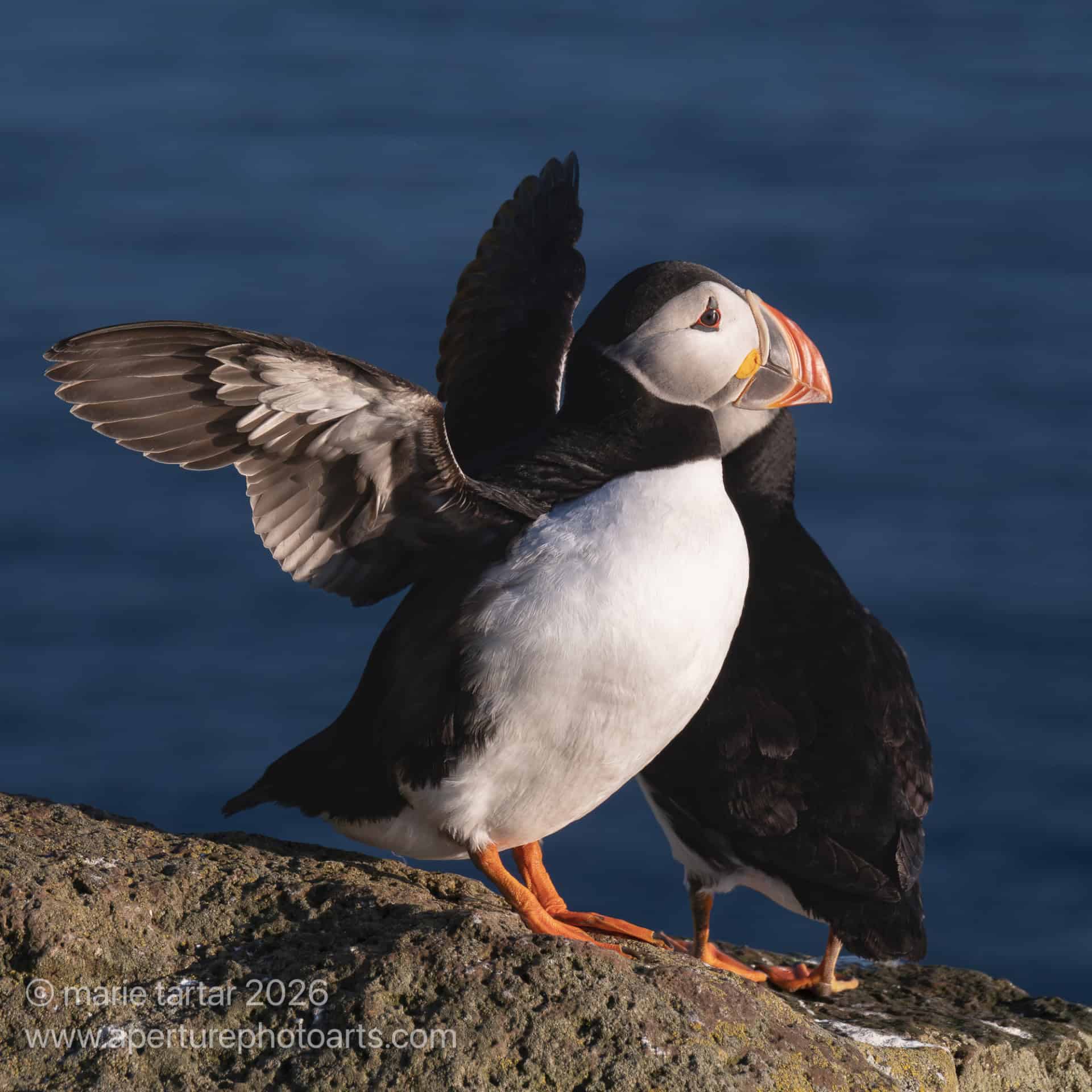
Yeah, we do have a thing for cute black and white birds. Puffins at sunset, Látrabjarg cliffs, Westfjords. Iceland. Mid-August is the near the end of puffin nesting season in Iceland. They spend the other 8 months at sea, returning in April to breed, lay their eggs and nurture their fast-growing chicks.
Is there a 6th trip to Iceland in our future? I can’t rule it out…we never did get to meet either the lumpfish or the wolffish!
-Marie