

Every year has its highs and lows and 2025 was no exception. This was our first full year of semi-retirement, enabling us to travel widely, often and for extended stretches of time, truly the greatest luxury. We didn’t give up working entirely, but it was slotted in, between trips and on our schedule. This year, we had cause to want to decamp frequently, especially in the second half of the year, escaping a long-planned remodelling project which started May 1 and seemed to stretch on interminably. It was approaching being done at year’s end, far outstripping the original projected finish date of August 1. During the year, we lost two dear members of our extended family, our New York firefighter brother-in-law Aaron Clark and my sister Clarissa’s mother-in-law, Claire Harootunian.
A few of the more memorable moments, facts and figures from the year:
Most bizarre incident: Terrorist threat at Death Valley, of all places (see January).
Days in Sedona: 34, including Sedona International Film Festival (9 days), 9 days in early June, 6 days in August, 10 days in November
Days in New York: 33, including 3 days in February, 10 days in April, 5 days in late June and 5 days in early August (bookending July in the Dolomites and Paris), 3 days in early September, 7 days in late October
Most books read by a single author (Chris Pavone): After reading The Doorman, I was launched on a non-stop Chris Pavone reading jag, including The Expats, The Paris Diversion, The Travelers and The Accident.
Dive trips: 2 (Philippines in May and Papua New Guinea in September)
Countries visited: 8 (Japan, Iceland, Philippines, Papua New Guinea, Australia (albeit briefly, coming and going to PNG), France, Italy, Mexico)
Longest stretch of continuous travel: 5.5 weeks (NYC, Milan, Dolomites, Verona, Paris, NYC)
Nicest surprise: 65th birthday party for me, at Juniper and Ivy.
January
We started the New Year our traditional way, enjoying a gourmet meal at Tatiana and Miles’, along with Victor and Julie and Tatiana’s twin sister Lora and her husband Bill. The evening’s screening was a French comedy Pas de Probleme, a 1975 film with a plot driven by the problem of an inconvenient dead body.
Winter is the most comfortable time to be in scenic Death Valley, beckoning us north for a 5-day jaunt, meeting up with our friend Dave, down from Seattle. We made the most of the drive there, stopping en route to fly the drones at Dumont Dunes, driving Twenty Mule Canyon and shooting the sunset at Zabriskie Point.

Sunset in winter, Zabriskie Point, Death Valley.
My phone was pinging as we pulled into the Inn at Death Valley’s parking lot. An attendant waved us down, just as I was pulling up texts saying the Oasis (both the Ranch and the Inn) was on lockdown and guests should stay in their rooms.
Me: “Is this for real?”
Just then, a text from Dave came in, saying there was “a terrorist threat against the Death Valley Inn and Ranch (Oasis). Rangers have both properties closed. No restaurant service.” A second text from the property said “We are not currently checking in any new guests until further notice.”
We connected with Dave at the nearby campground and thought we’d wait out the situation, going to dinner at Stovepipe Wells, assuming the “credible threat” being investigated wouldn’t pan out and we’d be able to check in within a few hours.
There was no resolution to the situation when we had finished dinner, even after dawdling over another round of IPAs. Before leaving Stovepipe Wells for the half hour drive back toward the Oasis and Dave’s car and campsite, we inquired whether there was a room available there. That property was completely sold out. A young Asian couple waiting in the lobby was in the same boat. A wing of rooms was being renovated and the manager was seeing if any were at all close to being habitable. We left our phone numbers and drove back to the Oasis.
After dropping Dave off and wondering whether we might also be sleeping in our cars (although less prepared to do so than Dave), we stopped back at the Inn. There was no update and the authorities still weren’t letting people onto the property. After hanging out in the parking lot for a few minutes hoping for a reprieve, we decided to drive in the other direction, towards the Nevada stateline, where there was lodging at the Long Street Casino (“where we go to decompress” per the man guarding the parking lot). It was another half hour drive in the opposite direction. The casino lit up the night sky. The front desk of the hotel also functioned as the check out for the 24 hour convenience store attached to the property. A few male guests milling about looked like recently released parolees.
Only a $200 King Suite remained. It was huge and clean. Through the paper-thin walls, a loud domestic dispute from next door came clearly into our room. The shouting and cursing was accompanied by a dog barking. Just then, the phone pinged again.
Steve: “The all-clear just came through.”
I didn’t believe him at first. We had just set our bags down but hadn’t started unpacking in earnest. I marched out to the front desk and was pleasantly surprised the front desk gal instantly started processing our refund. I asked if they had received many other people affected by the Inn incident.
“Quite a few” she replied.
After another half hour’s drive back in the dark, we were finally installed at the Inn, where our truncated night’s stay was comped.
After that unforgettable start, the rest of our stay in Death Valley was filled with more conventional pleasures, hiking Mosaic Canyon, sunrise and late afternoon photography at Mesquite Dunes, and revisiting the ghost town of Rhyolite. Having two cars enabled us to do a one way hike from Zabriskie to Golden Canyon. A short hike, Natural Bridge, featured a dry waterfall, like a tall stone chimney. We investigated Devil’s Golf Course for the first time, as well as the Keane Wonder Mine, an abandoned but once successful gold mine.
.
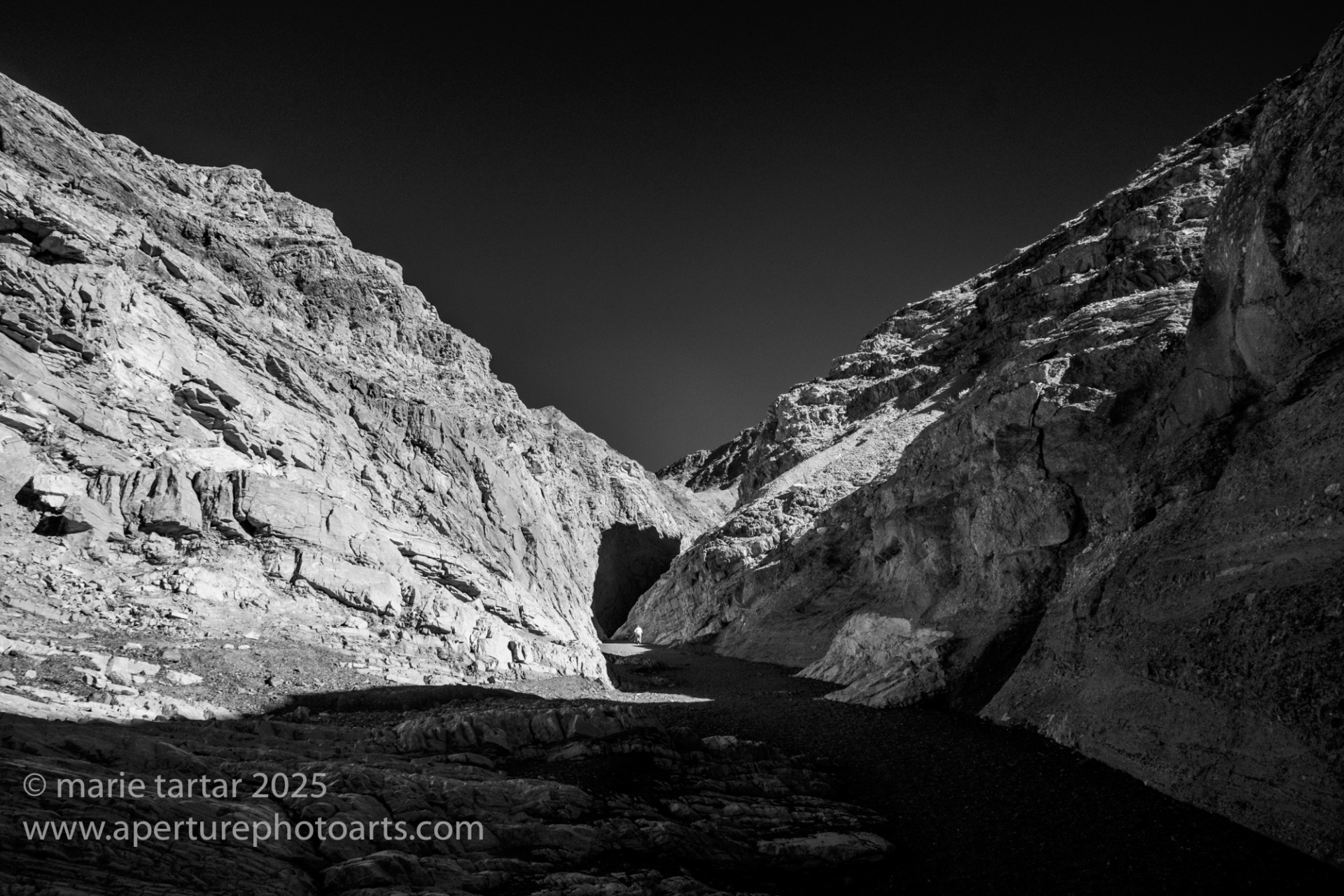
Mosaic Canyon, Death Valley, Infrared (IR).
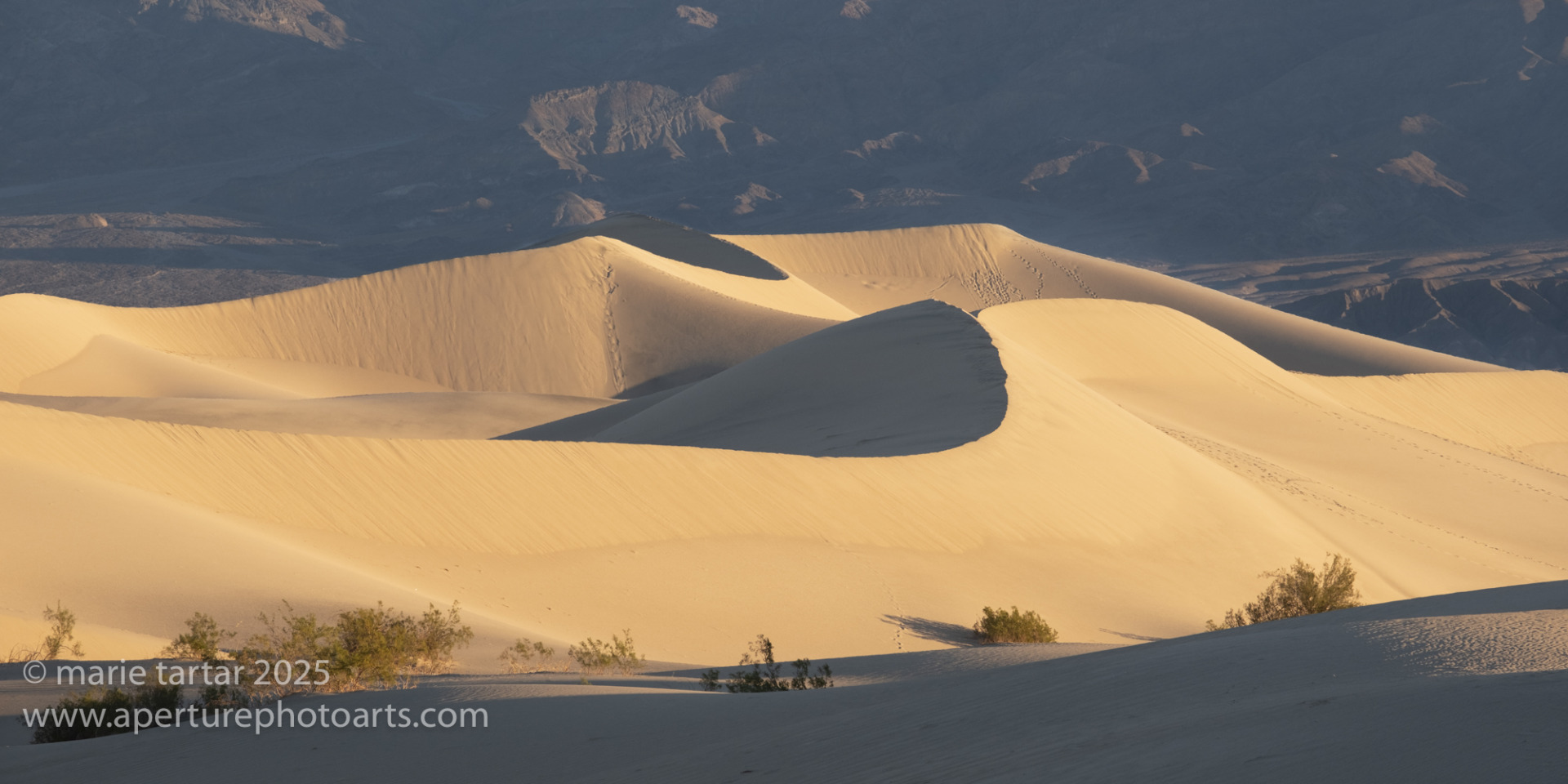
Mesquite Dunes in the early morning in winter, Death Valley.
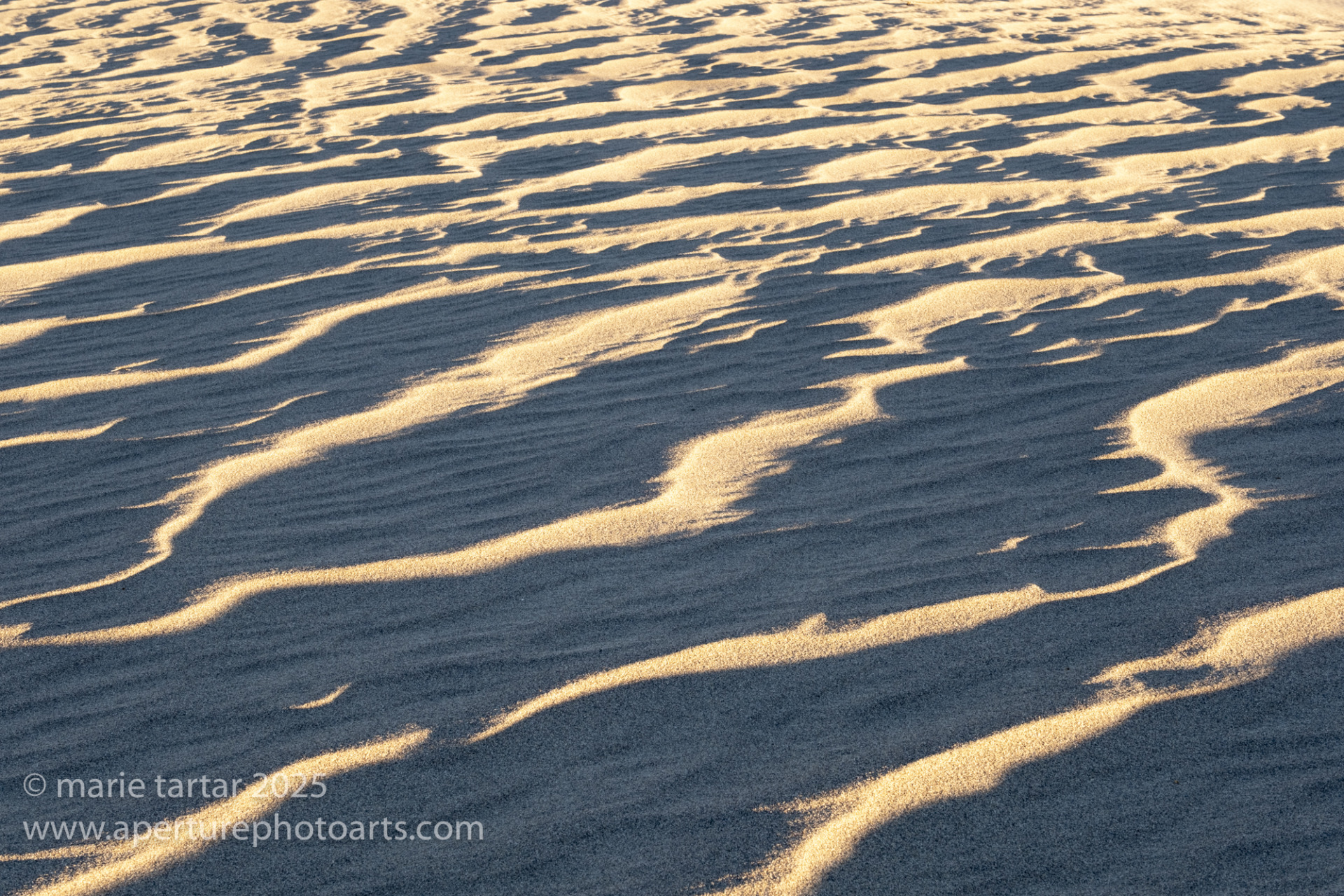
The overnight wind creates new patterns of sand ripples at Death Valley’s Mesquite Dunes, revealed by the early morning sun in winter.
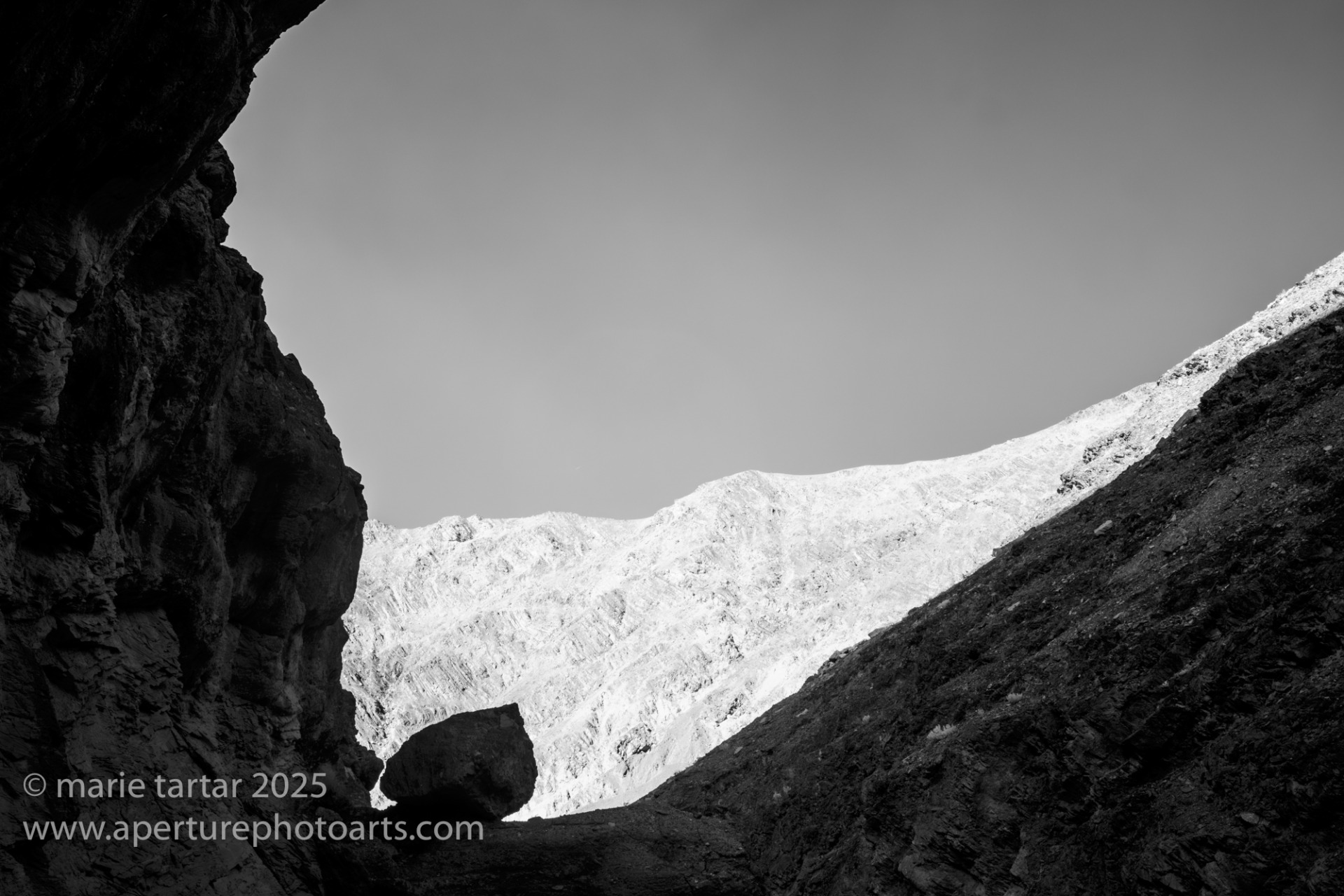
Natural Bridge hike, Death Valley, IR.

Remnants of a once flourishing gold mine near Death Valley (IR).

Keane Wonder Mine remnant, Death Valley.
We encountered a family of 5 burros just at the turnoff to Rhyolite, including two young. The Bottle House, which we had last seen decades ago, was now encircled by a fence.
Dave came back to San Diego with us. The conditions were perfect, sunny and breezy, for the three of us to tackle a famous San Diego hike, the so-called potato chip hike (Mt Woodson summit). This was a strenuous but not technically difficult hike through giant boulders to a thin tongue of protruding rock which looks very insubstantial but is a magnet for people to climb out on. I climbed toward it but decided not to risk an ankle injury (the actual tongue required a leap from an adjacent boulder). It took us 4 hours to complete the 7.3 mile hike, with 2129 feet of elevation gain. We made it back down with a half hour to spare before the gate to the parking lot closed at 5 pm.
February
Snow monkeys, whooper swans and sea eagles, oh my! We finally made a long-awaited return to Japan in winter. This trip was organized by Martin Bailey, with whom we journeyed to Namibia in 2022. Martin has lived in Japan for decades and although we thoroughly enjoyed our first trip to snow monkey country and Hokkaido in 2018, this trip was superior in every way. This trip was photographically very productive and spawned three blogposts, as follows:
Here are my favorite images from a wonderfully memorable journey:

Snow monkey (Japanese macaque) baby

Red-crowned cranes (and a bonus duck) in snow, Hokkaido, Japan.
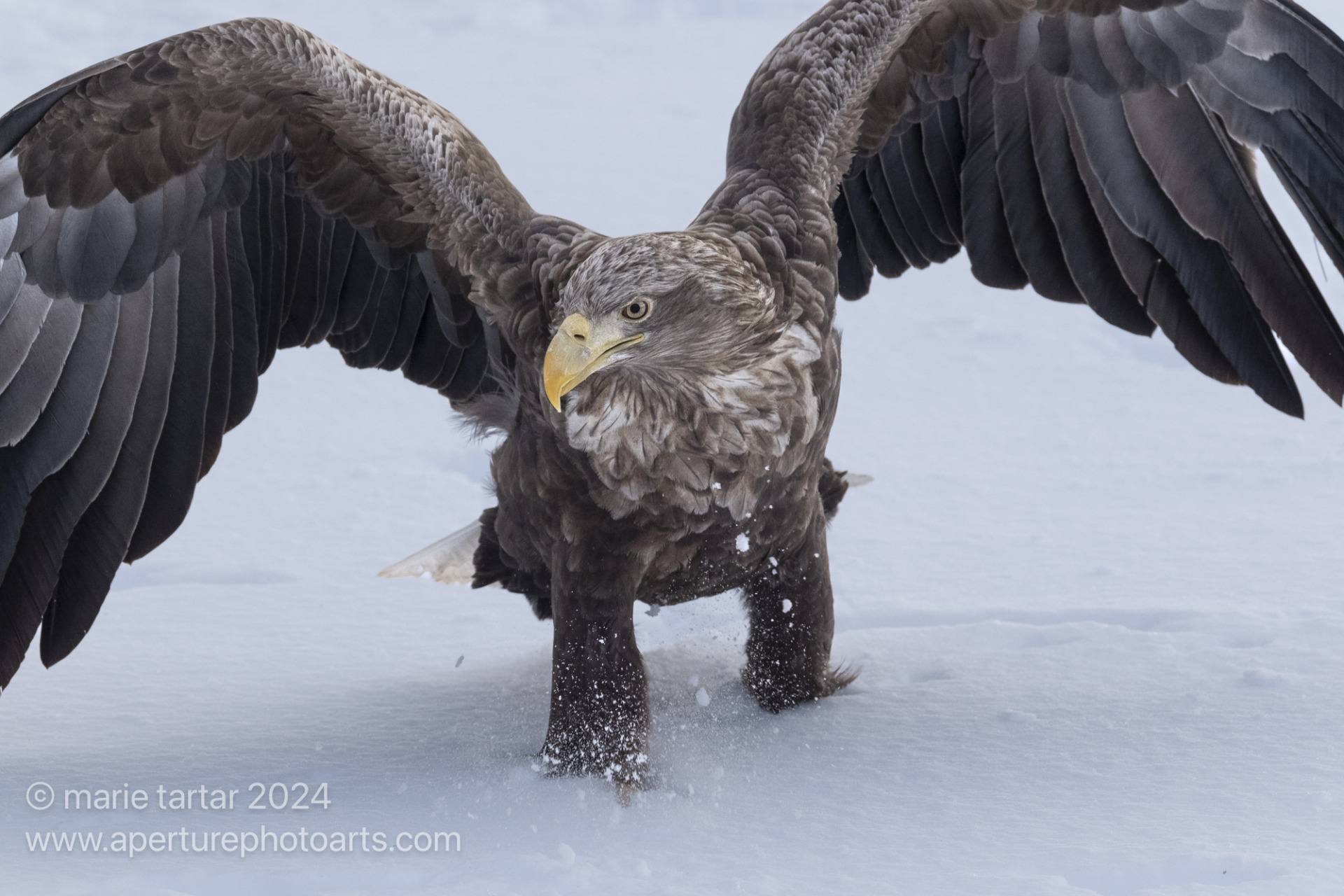
White-tailed sea eagle coming in hot, in pursuit of free fish, on a snow-covered jetty in Rausu, Hokkaido, Japan.
We kept travelling east from Japan on an around-the-world ticket. After overnighting in London, Steve, Greg and I met up with Byron Conroy, in hot pursuit of aurora borealis and more ice cave time. This February was productive in terms of ice caves, but the aurora was elusive and challenging, especially with 80 mile/hour winds! At year’s end, I still haven’t managed to finish a post dedicated to this week in Iceland, so here’s a few favorite moments from then:

A powerful motivator to go to Iceland in February: ice caves!

A reason to hike in the dark by headlamp, in the freezing cold, feeling the way with your feet: aurora borealis. We stalked it for a week. This night at the glacier lagoon (Svinafellsjokull) was the best combination of aurora, scenery and some protection from fierce winds.
The penultimate stop on our around-the-world winter trip was New York City, where it was painfully cold, actually more uncomfortable than either Hokkaido or Iceland! This gave us a chance to see a few shows (Sunset Boulevard with Nicole Scherzinger as an unforgettable version of screen star Norma Desmond) and catch up with friends, as well as enjoy some delicious meals. The meal highlight was Michelin-starred Korean small plate restaurant Kochi, with Les. We also were able to meet up for lunch at the Russian Tea Room with San Diego musician friends violinist Kate Hatmaker and cellist Alex Greenbaum, in town to perform with The Knights at Carnegie Hall. They arranged for us to attend a rehearsal for their concert (which was sold out), featuring a singer-songwriter new to us: Aoife O-Donovan, performing with a youth choir of girls a song cycle America, Come, inspired by Carrie Chapman Catt and her and other suffragist’s efforts to pass the 19th Amendment in 1920 (only 105 years ago!).
February, as always, finished with a flourish, attending the Sedona International Film Festival. Miles and Tatiana joined us for the first half and Chris and Threasa came for the second half. Many evenings of the preceeding fall had been devoted to screening prospective films submitted for consideration for the festival, our 3rd year to be narrative reviewers. Several of our favorite films from the week were films we screened and recommended for inclusion and liked enough to see a second time, including a French art world drama, Auction, a NYC-based comedy set in a doorman building (Bad Shabbos) and a searing French language drama highlighting conflict over what can and can’t be taught in a French high school, Amal. Other terrific films we enjoyed with Miles and Tatiana included Blind at Heart, a WW II drama set in Berlin and a Canadian sibling comedy, Drive Back Home. WW II was the backdrop for additional excellent films, Never Alone, set in Finland and a documentary on the controversial filmmaker, Riefenstahl. Photography featured largely in a pair of wonderful documentaries we saw. Two Strangers Trying Not to Kill Each Other is a dual portrait of 84-year-old photographer Joel Meyerowitz and his 75-year-old wife, Maggie Barrett. In A Photographic Memory, filmmaker Rachel Elizabeth Seed tries to piece together a portrait of the mother she lost as a young child, using material left by her mother, photographic journalist, Sheila Turner Seed, who died at age 42 of a brain hemorrhage. Her mother was interviewing a series of celebrated photographers (Cornell Capa, Henri Cartier-Bresson, Gordon Parks, Bruce Davidson among them) for a series called Images of Man. My favorite films from the second half of the festival were another WW II drama, The Performance, starring Jeremy Piven and My Motherland (Ma France a Moi) starring gorgeous Fanny Ardant as a Parisian widow who takes in an Afghan refugee, a young man named Reza. Altogether, we saw 19 films (22 if we count those we saw as screeners but didn’t re-see during the festival).
During film festival week, our burly and indefatigably energetic and cheerful firefighter brother-in-law in NYC, Aaron Clark, underwent a grueling surgery, a Whipple procedure, a potentially curative procedure after 5 rounds of chemotherapy and immunotherapy.
March
This month was notable for my Medicare birthday. During film festival week, while I was hiking with Miles and his new knee, Tatiana and Steve conspired to plan a surprise birthday dinner party for me at Juniper & Ivy. We took a car service south for dinner with Miles and Tatiana at Juniper & Ivy . Tatiana appeared just after we checked in at the hostess stand and said that because they were such regulars there, we were to be seated in the quieter upstairs private room, where we had celebrated Miles’ 70th birthday. I followed her up the stairs, totally buying her explanation and relieved Steve would be able to hear. To my complete astonishment, it was a surprise birthday dinner party…for me! Waiting upstairs were Ralph and Gail, Ellen and David and Lucille and Ron, as well as Miles with a rosé champagne to start off the festivities. The food was delicious and very abundant. Most of us were full after the starters (wagyu butter biscuits with smoked chive butter, smoked eggplant with pomegranates piled on a brioche and a bluefin tuna handroll in a sesame leaf). We shared the miso black cod and lamb kafta, not realizing there was still more to come…much more. I could barely manage tastes of the apple and burrata and beet salads, much less the soya steamed rose snapper and crusted ribeye with asparagus. And then there was dessert!
The theatrical highlight of March was 3 Summers of Lincoln, a new musical at La Jolla Playhouse, which I suspect will be Broadway-bound. Abraham Lincoln (Ivan Hernandez) is agonizing over the slow progress of the Civil War in the first summer of 1862. His cabinet is intractable and the Union Army commander, George McClellan, ignores Lincoln’s orders, sent via telegraph. Meanwhile, Frederick Douglass (Quentin Earl Darrington) is infuriated by Lincoln’s indecision. Lincoln’s telegraphic missives are brought to life by tapdancers Evan Ruggiero and Alaman Diadhiou. Mary Todd Lincoln (Carmen Cusack) is immobilized by grief over the death of her son, Willie. Her dressmaker and friend, Elizabeth Keckley (Saycon Sengbloh) prods her into action.
April
We spent 10 delightful days in NYC, seeing terrific theatre, museum shows, friends and family.
We had so loved Branden Jacobs-Jenkins playwriting in Appropriate last year, that we couldn’t miss his Purpose, a Steppenwolf company production. Beneath the surface of a seemingly idyllic family of Black activist superhero parents and their two grown sons lurks a festering mess of secrets and struggles. The cast was superb, with Latanya Richardson Jackson as the matriarch Claudine Jasper, Harry Lenix as patriarch Solomon (Sonny), Glenn Davis as namesake eldest son Solomon “Junior” and Jon Michael Hill as the narrator and youngest son Nazareth “Naz”. A family dinner for Claudine’s birthday is also attended by daughter-n-law Morgan (Alana Arenas) and Naz’ friend , Aziza (Kara Young).
Maybe Happy Ending was a delightful musical rendezvous with robots-Korean helper bots, to be precise, models nearing obsolescence and left behind by their owners in a high-rise retirement home for bots. For years, Oliver (Darren Criss) has patiently waited for his owner James (Marcus Choi). Across the hall lives Claire (Helen J Shen, Broadway debut role), a more advanced model, capable of driving the car her owner left her. From this seemingly unlikely premise emerged a touching reflection on relationships, love and connection. I don’t think I have ever cried so much at what was essentially a happy story. Dez Duron was excellent as a Sinatra-style crooner who is James’ (and Oliver’s) favorite singer. He comes to life as Oliver, to whom James left his turntable and LPs, reminisces about his former life with his owner.
The Curse of the Starving Class featured quite the all-star cast, with Calista Flockhart playing the mother of a family on hard times. The father is a drunk who in the first scene has stormed and nearly destroyed the run-down kitchen where the action is centered. He looked familiar to both of us but only later did we realize the actor was Christian Slater! The son also seemed familiar-he proved to be Cooper Hoffman, son of the late great Philip Seymour Hoffman. The only cast member who didn’t have to shout most of their lines was a lamb named Lois.
Sarah Snook, larger than life thanks to multiple black-clad cameramen and women projecting her onto giant video screens, morphed from one character to another (26 in all) in The Picture of Dorian Gray. This classic Oscar Wilde tale, of a young man who sells his soul to stay youthful forever, was his only novel, published in 1891. Dorian Gray descends into a life of depravity, which manifests only in a painting of him in his youth, which he keeps hidden away.
Moulin Rouge is an over-the-top entertainment extravaganza. As Jason commented, one can see where the money was spent, with lavish sets and costumes, including a giant blue elephant protruding from a turret. Boy George had recently joined the cast as Harold Zidler, who leads a threadbare theatrical troupe that needs a serious cash infusion. Andy Karl plays a slimy Duke who can bankroll the enterprise, with lead performer Satine (Solea Pfeiffer) as his primary interest. Satine actually loves a composer, Christian (John Cardoza), who is orchestrating a new show for the performers.
We also caught part of the New Directors, New Films festival, including the opening night presentation of Familiar Touch, starring Kathleen Chalfant. Director Sarah Friedland and Chalfant introduced the film, which is a touching tale of an octogenarian entering a memory care facility. We also enjoyed the quirky and funny meditation on grief, Invention. Director Courtney Stephens and star Callie Hernandez collaborated on Invention, which utilizes archived material left by Hernandez’ doctor father. Callie plays a woman trying to piece together who her father was after his death. He left her a patent on a healing device of questionable efficacy, recalled by the FDA.
We also made our way to the Metrograph, an interesting movie house with an afternoon screening of a 1955 French black and white psychological horror classic, Diabolique, starring Simone Signoret as the mistress and Vera Clouzot as the wife of an abusive school headmaster (Paul Meurisse). The two women conspire to murder their mutual love interest, Michel, taking advantage of a school holiday and a trip away as an alibi.
I took Clarissa out for an early birthday lunch at Çka Ka Qëllu, an Albanian/Armenian/Kosovan restaurant on 31st Street, sharing a cucumber and cherry tomato salad with shredded feta , a red pepper and eggplant ajvar spread, mantia (veal-filled dumplings) and sarma, a stuffed cabbage dish with rice and ground meat.
We met Sarah and Aaron for dinner upstairs at Wagayama in Nomad. This was our first time to see Aaron since he had the Whipple procedure 5 weeks before. He appeared pale (probably due to anemia) but otherwise was very much himself. The meal was tasty (bao buns with mushrooms and eggplant, chicken and pork gyozas, tuna and avocado on crispy rice squares).
At MOMA, we thoroughly enjoyed the Jack Whitten retrospective. I remember admiring his textural canvases at MCASD’s 2014 show Jack Whitten: Five Decades of Painting, a career survey show. He died in 2018. I found the audio commentary interesting, especially Whitten’s observations that he was an art world oddity, not really fitting in with white or black artists as a Black man whose work is largely abstract (almost exclusively then the province of white painters). And since his work wasn’t really engaged with the struggle for civil rights, he wasn’t seen as a true black artist in the eyes of other black artists. He clearly was engaged with the Black community and issues at large, with his Black Monoliths series, beginning in the 1980s, paying homage to a variety of African-American giants. He relied on his background in carpentry to devise specialized tools to push layers of acrylic around on his canvases. An enormous 12-foot wide rake-like instrument he called “The Developer” was on display. These works, especially those from the 1970s, brought early Gerhardt Richter works to mind for me. His later work utilized cut and/or broken pieces of dried acrylic paint as tiles, employed much like mosaic.

MCASD was represented in MOMA’s exhibition as a very nice canvas called Chinese Sincerity, 1974, which was acquired with the aid of the collector groups.
At ICP (International Center of Photography), we (with our friend Les, after brunch at Essex Market favorite Shopsin’s) enjoyed a Weegee exhibition entitled Weegee: Society of the Spectacle. Weegee (born Arthur Fellig, 1899-1968) was a well-known photographer of crime scenes in New York of the 1930s and 1940s. He listened in on police radios to be among the first to arrive at a murder, fire or other spectacle. Later, he would photograph Hollywood premieres and celebrities, again often including the spectators in these images.
Another evening, we met up with San Diego friends Ron and Lucille at their fabulous apartment in the distinctive Zaha Hadid apartment building. We had seen it when it was nearing completion, with architect Jennifer Luce, but now it was completely appointed with beautiful furnishings and artwork. Afterwards, we dined at a Danny Meyer restaurant, Ci Siamo. The restaurant is beautiful and the food delicious, but its popularity (packed on Monday at 6 pm!) meant it was noisy and hard to hear each other. Nevertheless, we shared cast iron focaccia with tomato conserva and a scrumptious green salad, followed by entrees of wood-fired trout with pine nuts and mustard greens for me (loved it!), skirt steak for Lucille (I tasted a piece which was tender and succulent and Lucille left with enough for sandwiches the following day) and mandilli for Ron and Steve (a pasta dish with dandelion greens and lamb sausage).
While we were in NYC, the final details connected with selling the next door apartment were (mostly) sorted and the sale closed soon after our return home. On the flight home, I finished listening to Amor Towles’ 2011 New York-set novel, Rules of Civility, which revolves around a formative year (1938) in the life of Katey. She recalls the events of that year when decades later, she spies a familiar face from that era in a Walker Evans museum exhibition of subway riders, photographed surreptitiously in the 1930s.
The rest of the month was spent packing for an upcoming dive trip to the Philippines. This was complicated by having to simultaneously complete the first of a series of moves required after finally embarking on a major, long-planned house remodel. Our primary bathroom would be demolished while we were in the Philippines. To keep the dust and mess confined, our closet upstairs and multiple rooms would be sealed off and inaccessible…for months. Effectively, we had to partially evacuate the bedroom and bathroom, moving clothes, toiletries, and shoes we anticipated needing over the coming months down to the guest room, where we would decamp…for many months. We also had to put away ceramics and objets d’art which might be damaged with workmen banging around.
During all of this upheaval, mostly while driving, I enjoyable listening to another Amor Towles novel, The Lincoln Highway. It is a road trip and coming-of-age tale set in 1954, centered around two orphaned brothers, Emmett and 8-year-old Billy, making a fresh start in life.
May
Our dive trip to Philippines was a 3-segment extravaganza, beginning with a blackwater add-on in Anilao, with Greg, in which we hired and dived with a wonderful guide, Dennis Corpuz. I missed an unusual number of dives, due to GI and ear issues, but still managed to rack up enough images to take weeks to process.
We had never seen thresher sharks, so were excited to travel to Malapascua.
We loved our final stop, at Amun Ini, a remote resort on Bohol, a fabulous setting with a fantastic restaurant, beautifully appointed accommodation and excellent dive operation.
My favorite images from this trip to the Philippines:

I never tire of anemonefish (Anilao, Batangas, Philippines).

Particularly cute porcupinefish, posing in a matching barrel sponge, hard to resist. (Anilao, Batangas, Philippines).
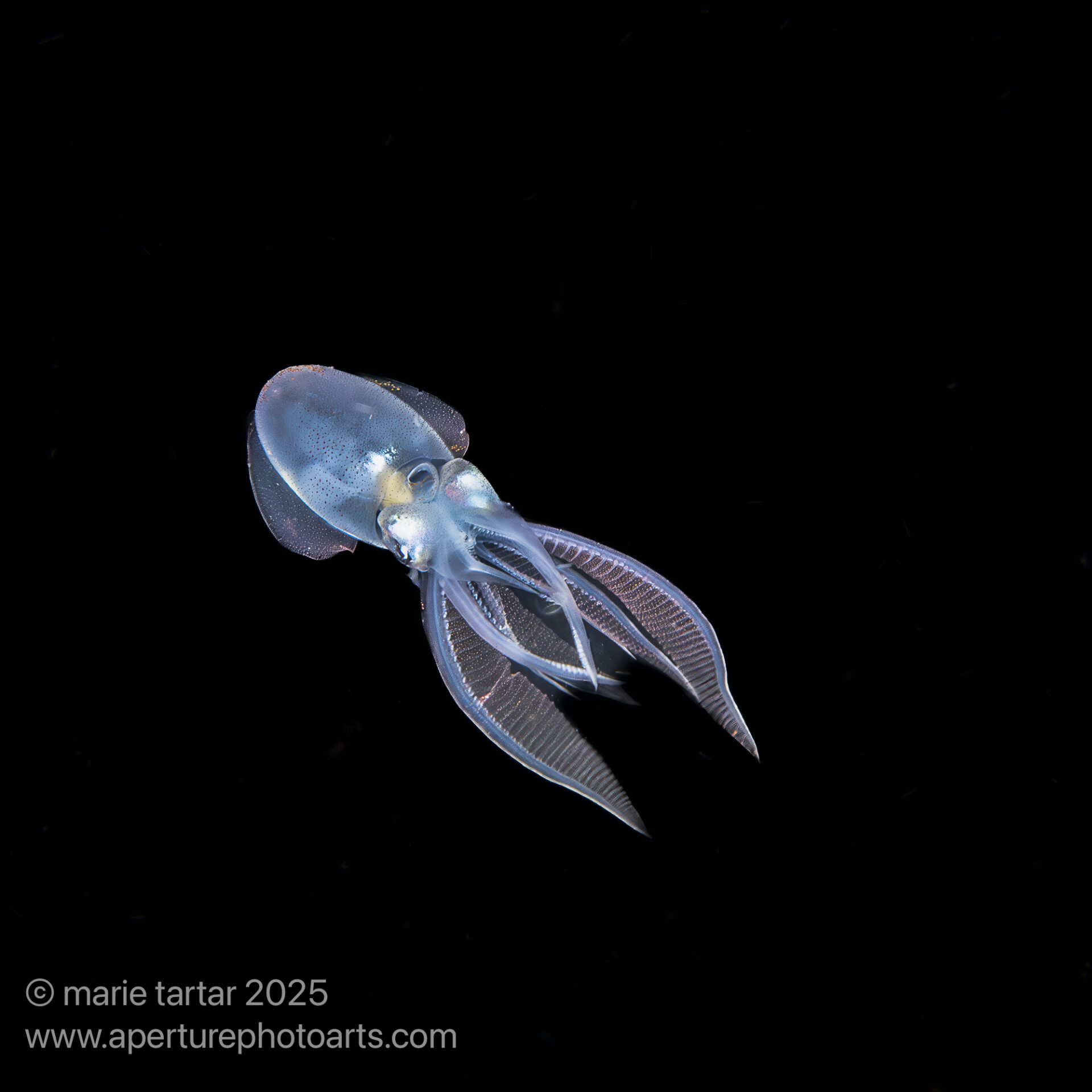
Blackwater star for this trip: a tiny diamond squid (Anilao, Batangas, Philippines).
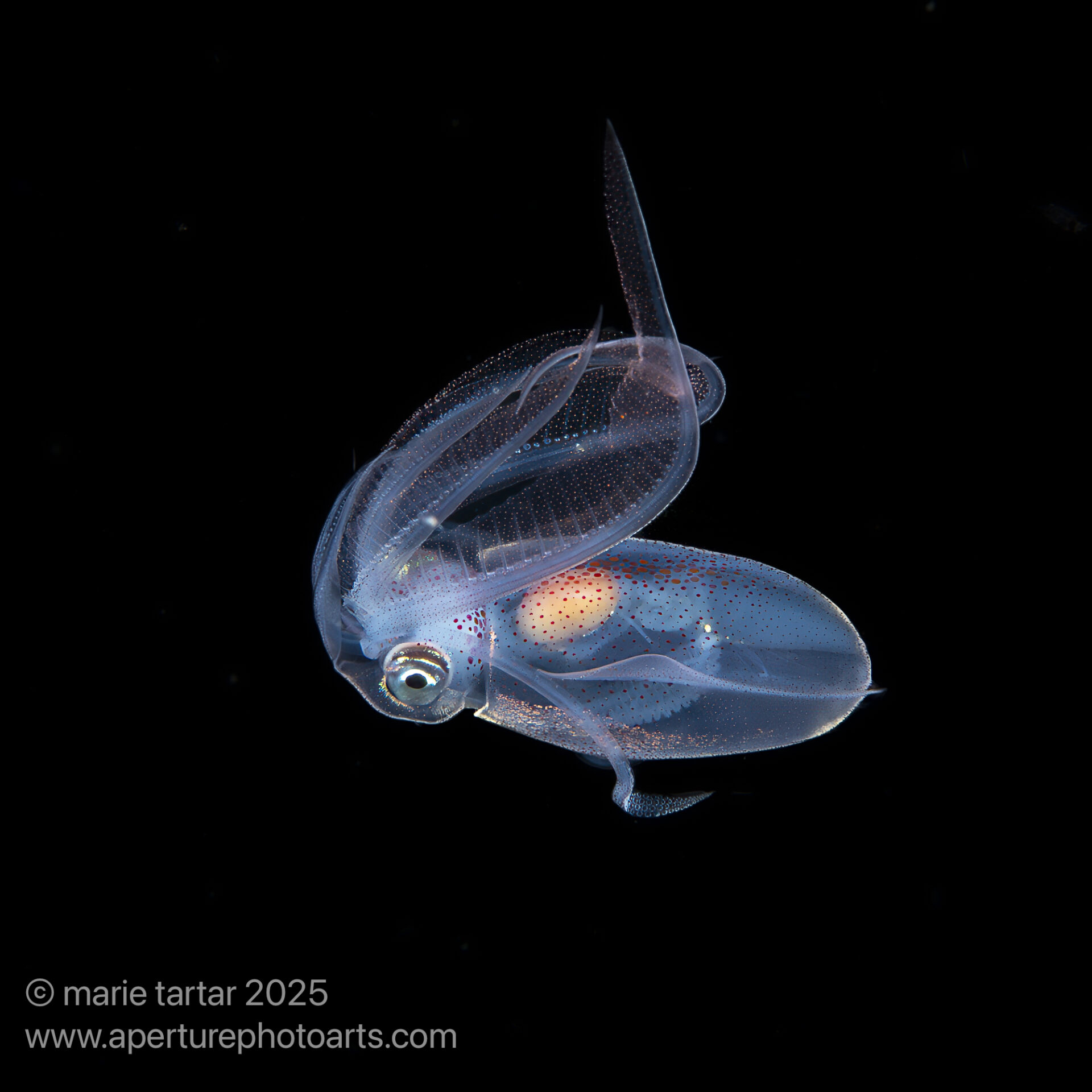
Diamond squid (Anilao, Batangas, Philippines).
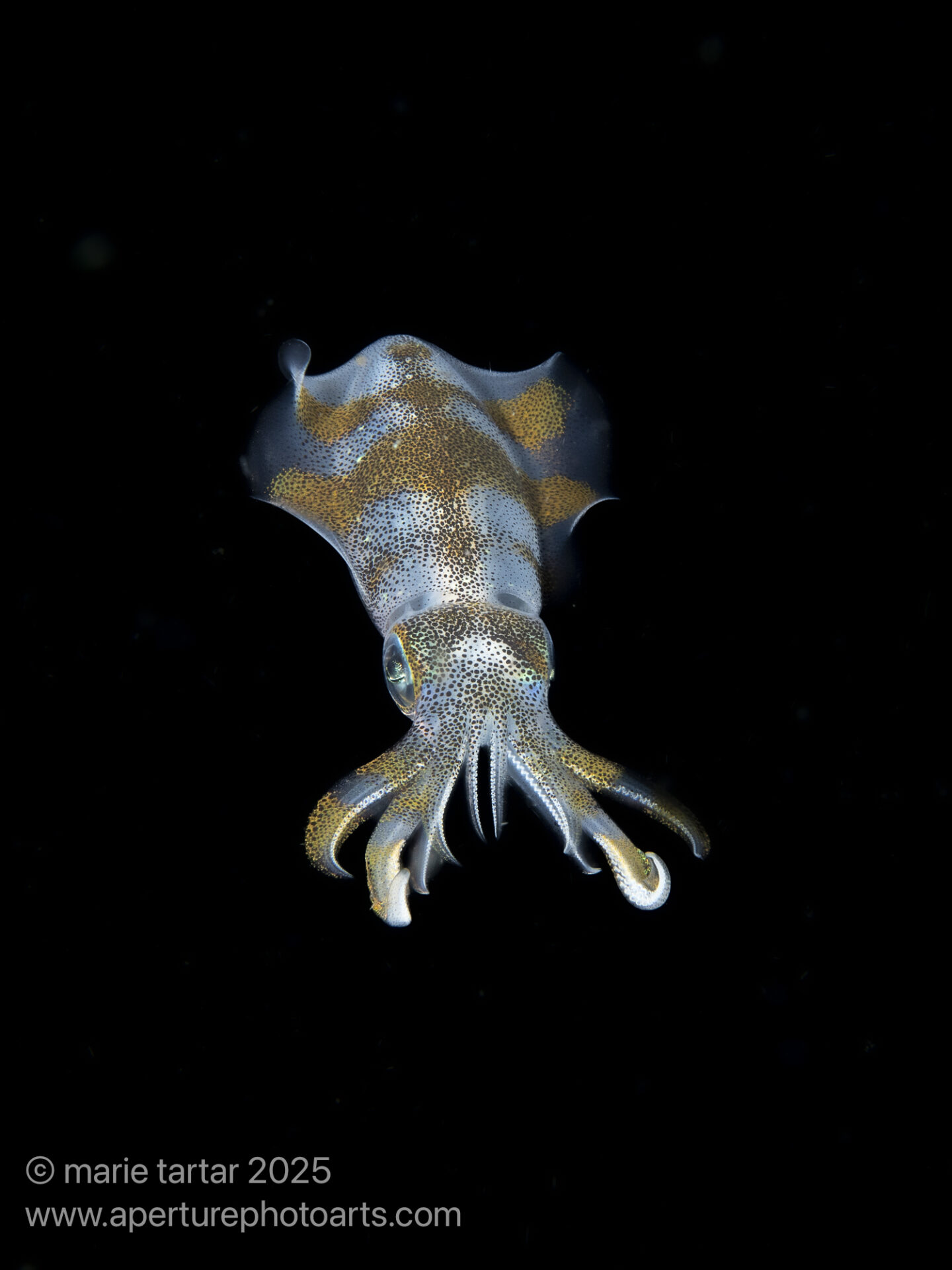
Bigfin reef squid (Sepioteuthis lessoniana), blackwater, Anilao, Philippines.

Seeing a thresher shark underwater at Malapascua used to require diving at dawn in the deep dark (90 feet depth). During the pandemic, the thresher sharks shifted to a shallower home, where their beautiful glow and long tails can be be more easily admired.

Another diver admires a thresher shark near Malapascua Island, Philippines.

A particularly beautiful nudibranch, heron ardeadoris (Ardeadoris egretta), Anda, Bohol, Philippines.
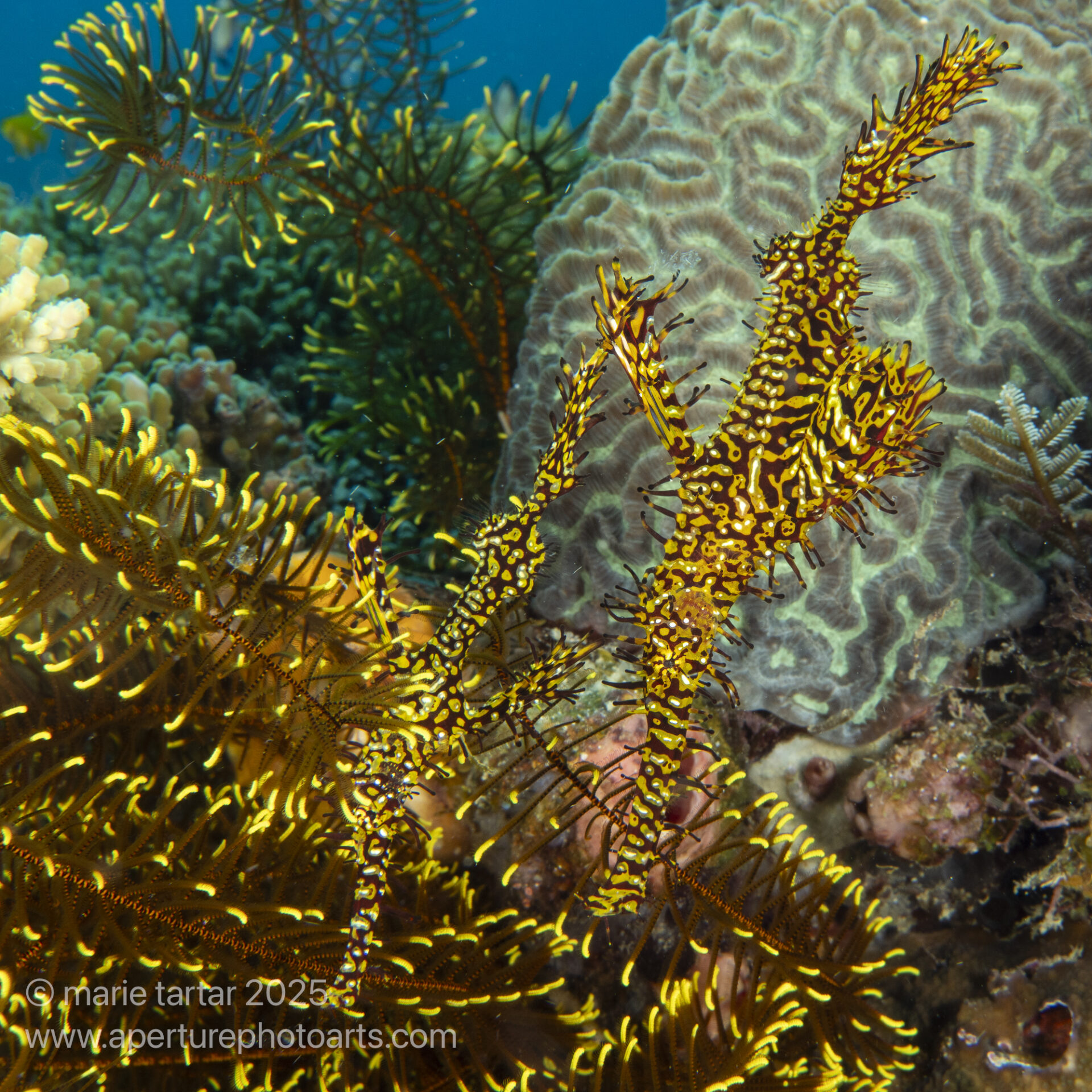
A pair of spectacular ornate ghost pipefish, wonderfully matched to their crinoid hangout. Anda, Bohol, Philippines.
Even the trip to the airport home was wonderful, visiting a sanctuary for this endangered creature:

Philippine tarsier, a tiny primate that could easily fit in the palm of one’s hand.
Fortified from a fabulous Philippines sojourn, we returned mid-month to a transformed house: garages enshrouded in scaffolding, the new 18-foot window safely installed and a giant bulldozer in the driveway. There was bad news from New York: only 2 months after undergoing months of pre-operative chemotherapy and immunotherapy and enduring a grueling Whipple surgery at the end of February, Aaron’s imaging showed new liver lesions and biopsy confirmed metastases.
Camped out on the guest side of the house with ongoing construction, we escaped to Sedona for a relaxing week, hiking and watching movies, as well as worked, caught up on life (doctor’s appointments, etc) and theatre. The best show we caught was Jaja’s African Hair Braiding at La Jolla Playhouse. We had missed it on Broadway, so were happy the Playhouse brought Broadway director Whitney White to La Jolla to direct this gem by a Ghanian-American playwright, Joselyn Bioh. All of the action takes place in a hair braiding salon in Harlem. The hair braiding takes hours, giving the patrons and stylists long stretches of time for conversations and occasional fireworks. This particular day is to be the green card wedding of Jaja, the salon owner (Victoire Charles). She makes an appearance in her wedding regalia, but for the day, the shop is being managed by her aspiring college student daughter Marie (Jordan Rice). A long-time stylist, Bea (Claudia Logan) is insulted and threatened both by a newcomer to the salon and the desertion of a long-time client looking for a change, and even clashes with Aminata, another long-termer she doesn’t think is supportive enough of her (Tiffany Renee Johnson).
We also enjoyed a comedy at the Old Globe, a hilarious first play by Gloria Calderon Kellett, One of the Good Ones. Parents (Angelique Cabral and Benito Martinez) of a recent college grad, Yoli (Cree) are preparing to meet their daughter’s serious boyfriend, Marcos (Nico Greetham). The LatinX family confronts a series of surprises when Marcos turns out to be white, although he identifies as Mexican, having been born and raised in Mexico and being fluent in Spanish.
At the end of the month, en route to Europe, we spent a few days in NYC. We saw more movies than theatre, catching four films at the Metrograph by Japanese director Mikio Naruse, including Late Chrysanthemums (1954), Flowing (1956), Daughters, Wives and Mothers (1960), and his last, Scattered Clouds (1967). We did enjoy Gypsy, with Montego Glover as Rose. The refreshed and expanded Frick Collection was a delight to visit.
July
Our 36th wedding anniversary was celebrated at Gramercy Tavern with Sarah and Aaron. I’d requested a patio table but showers in the late afternoon prompted the restaurant to move us inside. Aaron was less pale than when we saw him in April and was his usual hearty self. He was receiving every other week chemotherapy and this was his off week. These were temporizing measures while his T cells were being cultured in a lab for infusion later (CAR-T cell therapy).
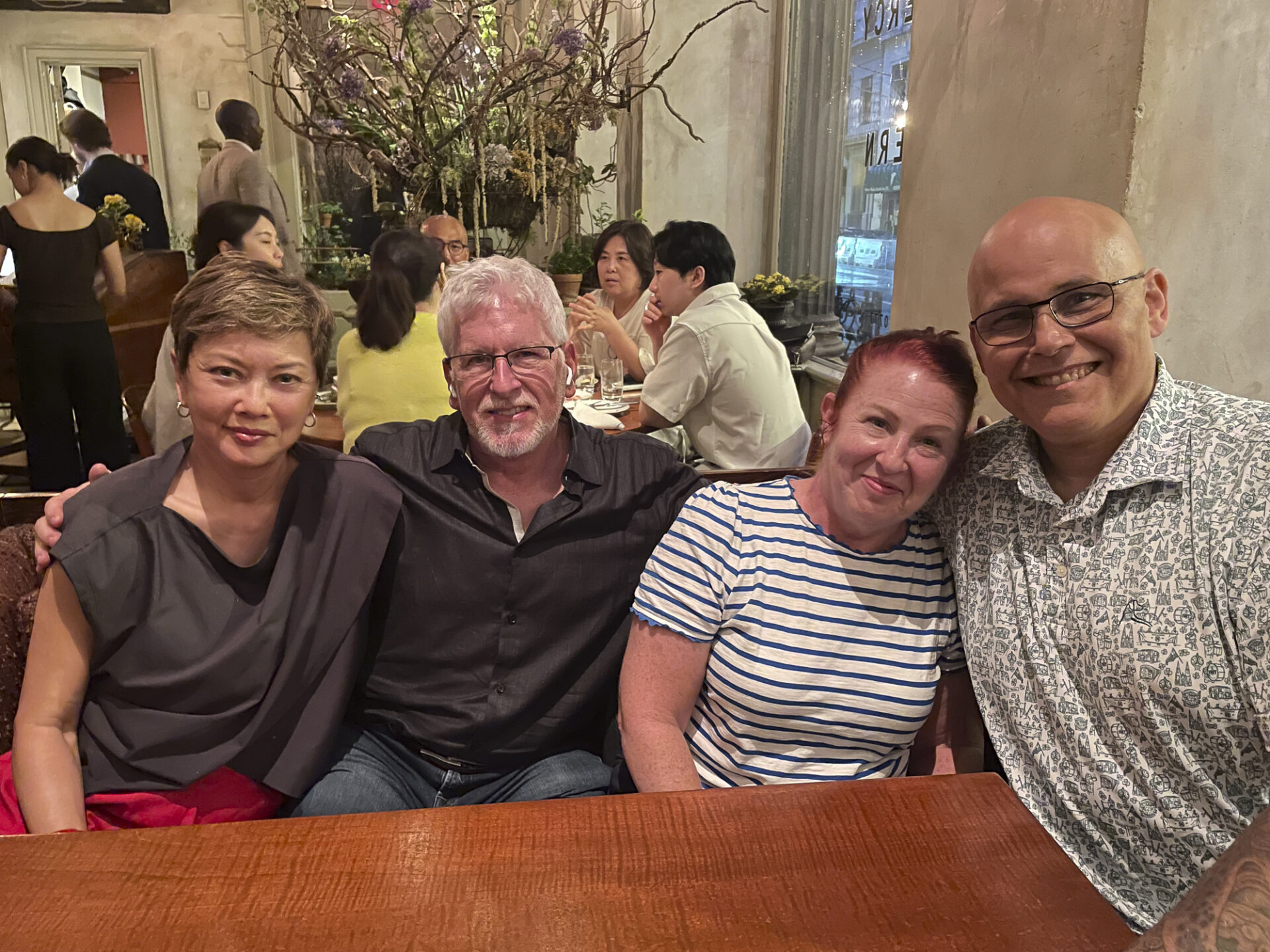
July 1, 2025, Anniversary dinner (36 years!), celebrated at boisterous Gramercy Tavern, with Sarah and Aaron, the last of many good meals we enjoyed together over the nearly 30 years since he entered and enriched our lives. Pancreatic cancer would take him from us too soon, less than 3 months later.
We spent the rest of July in Europe, with a few days exploring Milan before heading to Bolzano, gateway to the Dolomites and a Ciclismo Classico cycling circuit. We loved the Duomo, the Galleria and a Milanese food walking tour.
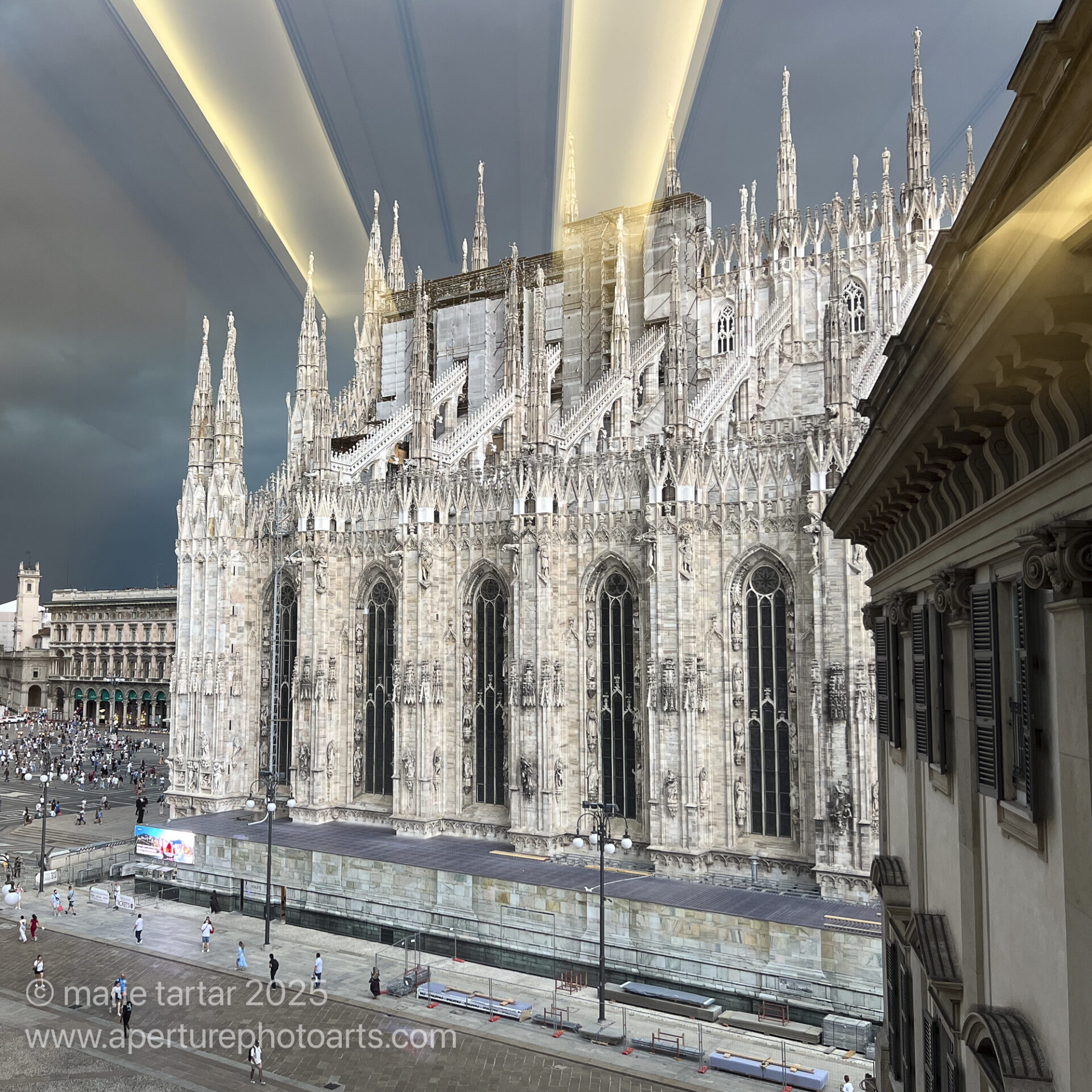
Unusual view of Milan’s Duomo, with apparent god rays emanating from it, just before the onset of an epic rain storm, so violent it emptied the plaza. Actually, these are reflections, as this was the view from a nearby museum.
A nice couple from Phoenix, Steve and Debby, were the only other clients on the bike trip, which was led by veteran guides Enrico and Gianpaolo (aka GP). The other Steve was a cycling machine, but the e-bikes we rented were great equalizers and enabled us to actually enjoy cycling up to 50 miles a day, including some GIro d’Italia worthy mountain passes.

Cycling in the outskirts of Bolzano, gateway to the Dolomites in northern Italy, with tremendous views.
We loved this area, the scenery, the cuisine, the viticulture, and the centrality of cycling in the culture.

Our first Dolomites ride, around Bolzano, took us on small farn trails right through the many vineyards.
Dedicated trails for cyclists and pedestrians linked many of the small towns we passed on this circuit. From Bolzano, we cycled in a clock-wise circle, north and east and south again to Cortina d’Ampezzo, where we laid over an extra night for a hiking respite, before completing the circle and ending up back in Bolzano.

Gorgeous ceiling of a baroque cathedral in Bressanone, a picturesque village we cycled through on our second day of riding in the Dolomites.

Detail, of the Bressanone cathedral ceiling.

Lago di Braies, the crown jewel of Fannes-Senes-Braies Nature Park and arguably, of the Dolomites, was well worth the extra mileage to see it (53 miles that day!).
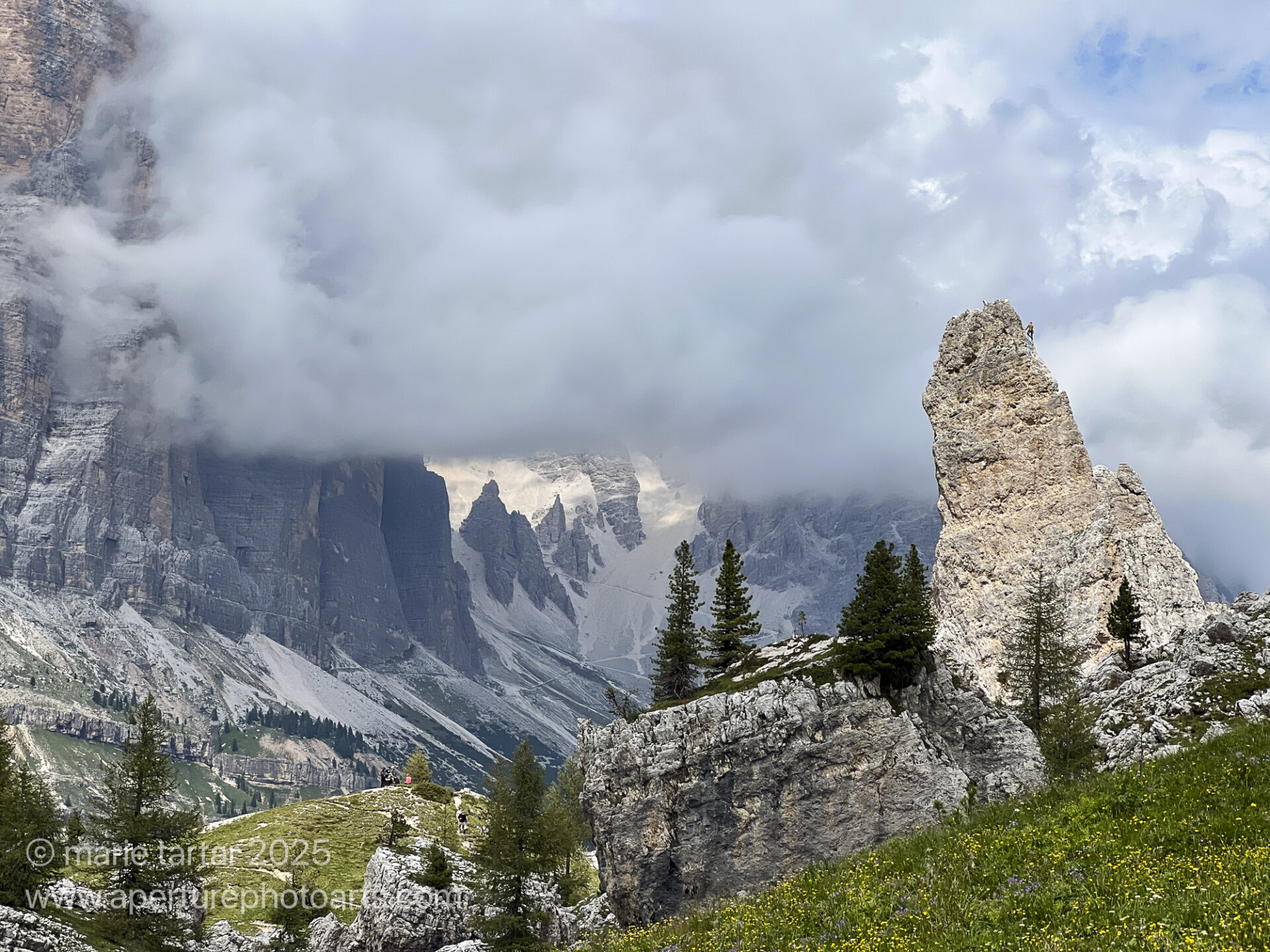
Cinque Torri (5 Towers) area. We reached it via gondola on a hiking day off from cycling. A tiny climber can be seen atop the sculptural torri on the right.
We ended our Italian sojourn with a short visit to Verona, where we did as the Italians do and went to the opera, a modern production of Aida, in the 2000-year-old Roman amphitheater.
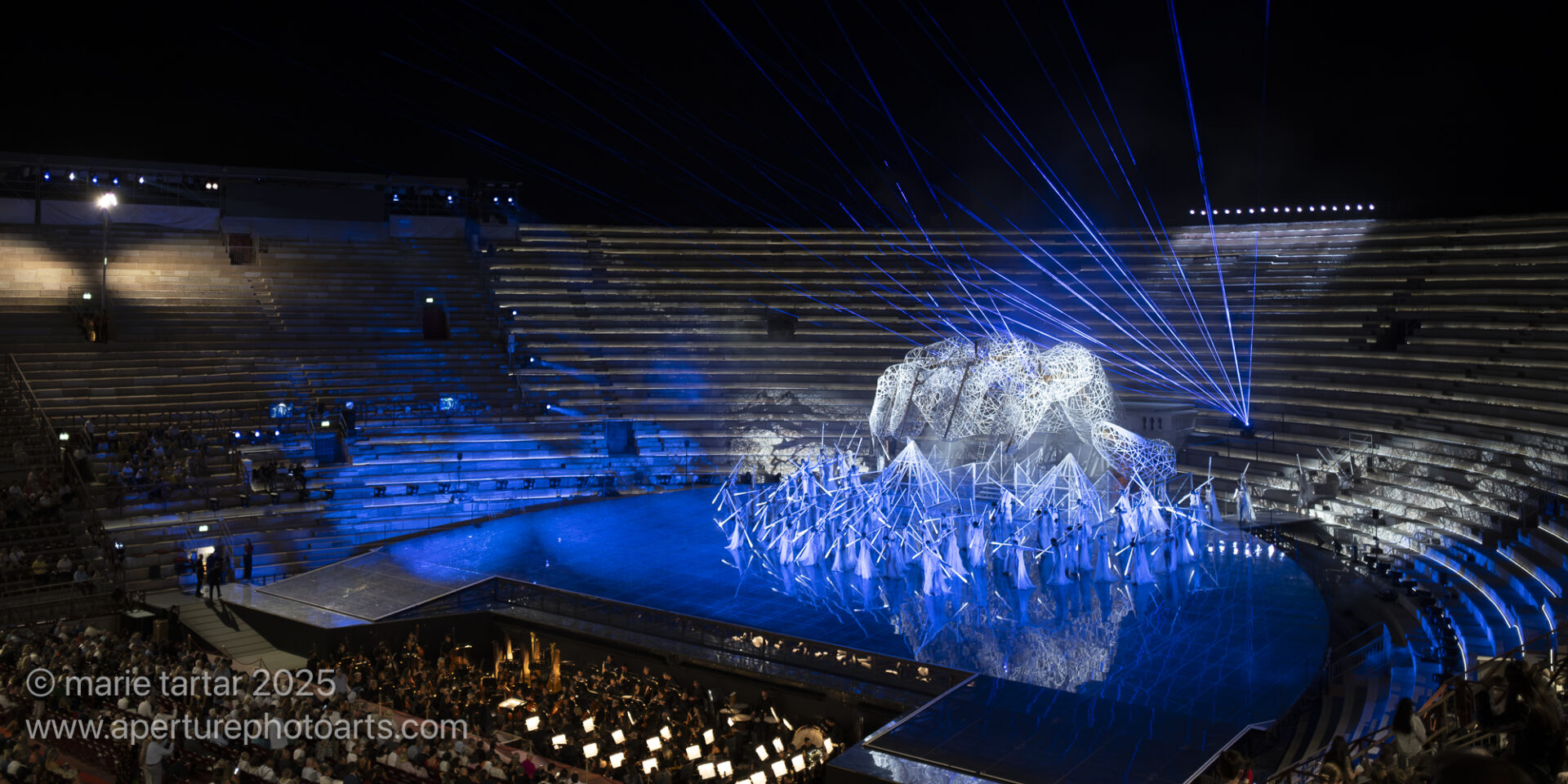
Space lasers? Opera, en plein air, in Verona. We’d been persuaded when checking into the hotel to book seats in the stone perimeter of the arena (35 E, but 25 E for us seniors!) and were reminded that the hotel had cushions for us, which proved to be important. The next morning, Steve suggested we should have worn bicycle shorts! This version of Aida is called “crystal” for its glittery costumes and high-tech lighting effects.
The rest of July was spent in Paris, on our first floating weeks stay in the apartment, which coincided with the twice-yearly soldes (sales). We enjoyed our three favorite “M”s, which organize most stays in Paris: museums, meals, and movies. We met up with our friend Patricia at Fondation Henri Cartier-Bresson, where the entire In The American West show by Richard Avedon was on display. This was originally commissioned by the Amon Carter Museum in Fort Worth, where we had seen it years back. This exhibition marked the 40th anniversary of the landmark book’s publication.
Another artistic highlight was the David Hockney 25 retrospective at Fondation Louis Vuitton, concentrating on the past 25 years of his storied career. Some early work from his art school and early career in the 1960s was included, but the focus was on the multiple bodies of work he has generated in moves from Los Angeles, back to his native England and more recently, to Normandy.
Jacquemart-Andre Museum, a luxurious former private home (hotel particulier) with an amazing art collection, was hosting a show of the work of Artemisia Ghentileschi (1593-1653), an Italian painter of renown during a time when women painters were few.
Bourse de Commerce, home of the Pineault contemporary art collection, is housed in a building which is an attraction in its own right, with a circular concrete insert by Tadao Ando inside the historic former stock exchange, creating a large central gallery and surrounding alcoves. The circular Rotunda gallery had been transformed into a shallow blue pool, with ceramic bowls floating in the pool, gently bumping into each other and emitting musical tones. It was quite mesmerizing, the work of French artist Céleste Boursier-Mougenot. It is called clinamen, a term from physics describing the random motion of atoms.
I savored the textures and workmanship of the couture pieces scattered through the Louvre in the Richilieu wing, in the Napoleon period rooms and rooms filled with beautiful and rare objets d’art. It was a veritable fashionista treasure hunt, pairing masterpieces of design with equally splendid period-room backdrops in the former royal palace.
Another enjoyable afternoon was passed at the Musée d’Art Moderne de Paris with an exhibition of Henri Matisse called Matisse et Marguerite (Le regard d’un père), which brought together decades of painted and drawn portraits Matisse made of one of his favorite and most constant models, his daughter Marguerite.
I also enjoyed an exhibit at the Musée d’Art Moderne de Paris of the work of Gabriel Münter, a German artist and founding member of the expressionist movement Der Blaue Reiter. I learned much about the extent of her decade-plus-long personal and professional association with Wassily Kandinsky. I also found it very interesting learning how she preserved the legacy of their artistic partnership, hiding her work and that of Kandinsky and other members of Der Blaue Reiter in her house in Germany during WW II, when Modernist styles of painting were denounced by the Nazis.
On the Movie front, we did a deep, dark dive into film noir, as well as into neo-noir, seeing some terrific overlooked gems (Otto Preminger’s 1944 film noir classic, Laura; 1957’s Sweet Smell of Success (Le Grand Chantage); a great early Stanley Kubrick film set at a racetrack, 1956’s The Killing (L’Ultime Razzia); David Lynch’s surrealist neo-noir 2001 film, Mulholland Drive; 1958’s La Soif du Mal (Touch of Evil), with Orson Wells writing, directing and starring in a dark and sinister US-Mexico border story of corruption and Martin Scorsese’s Taxi Driver, from 1976).
The final M in our Paris trilogy, Meals, were indulged in at old favorites (Semilla, Breizh Cafe, Tavline, Le Tajine, Miznon) as well as enjoyed at several new (to us) discoveries (Le MaZeney (recommended by Rick) and Tekés, with Chris and Michelle).

It wasn’t all movies, museums and meals in Paris in July! Thanks to our friend Patricia, I caught a bit of the finale of the Tour de France, as the cyclists raced by in a tight formation near the Tuileries!

French patriotism on display, a delightful surprise, with fighter planes roaring overhead during the finale of the Tour de France.
August
We capped off our summer escape from construction by stopping off in NYC on the way home from Paris. In NYC, we caught a couple of Broadway shows. Having just been in Verona and steeped in Romeo and Juliet lore, I thought it high time we saw & Juliet. The audience was dominated by young girls, which was our first clue that we probably weren’t the target demographic. & Juliet imagines that Juliet decides to live on after Romeo’s death, a clever riff on a classic. Gianna Harris was a beautiful and energetic Juliet. Shakespeare (Drew Gehling) and his wife Anne Hathaway (Alison Luff) engage in a tug-of-war over which direction the evolving play should go. The music by Max Martin and collaborators is a panoply of pop music hits. The dancing was non-stop, almost frenetic. I did admire the steampunk crossed with hiphop Renaissance costumes and the expressiveness and comic timing of Juliet’s nurse (Jeannette Bay Ardelle deserved her Tony nomination for this supporting role).
We were both pleasantly surprised how much we enjoyed Hell’s Kitchen, which is a semi-autobiographical story set to Alicia Keys’ music, based on her experiences growing up in NYC in a rent-subsidized building for artists. Amanda Reid played the lead role of Ali, the 17-year-old at odds with her strict single mother (Jessica Vosk). Trying to rein in Ali, her mother calls for help from Ali’s pianist father, played by Christopher Jackson, who we saw as George Washington in the original Hamilton cast 10 years ago. Kecia Lewis from the original cast stood out as Miss Liza Jane, a pianist who lives in the building and teaches Ali how to play, while serving as a surrogate mother to her. She was outstanding, well deserving of the panoply of acting awards she received for this role, including a Tony.
While in New York, we had a chance to see a few friends. Mary Ann hosted an apero with us, Karen and Scott, and we had lunch at Cafe d’Alsace with Annasue from my bookclub and her husband John.
The artistic highlight of this stay was the Amy Sherald exhibition at the Whitney. Her subjects are ordinary and extraordinary Black Americans, most notably Michelle Obama.
Back at home, it was clear that the original deadline for completion of our remodel (August 1) was (as I had originally thought) over-optimistic. We escaped by working, errands, doctor’s appointments and a week in Sedona, hiking and mountain biking. In Sedona, we made a new friend, under admittedly strange circumstances. We were at home in the morning when a woman dressed in hiking gear came to the door. She introduced herself as Judy, a neighbor living a few blocks away. We were horrified to learn her husband, Britt, a tall (6’4″) endurance athlete, well known around town for riding on an ElliptiGO upright bicycle, had been struck and knocked off his bike, by a white van pulling out of our driveway. The man who was driving and his young female companion stopped, but were reassured by Britt that he was okay; he lived only a few blocks away and could walk there. It wasn’t until he arrived home that the shock wore off and medical evaluation soon confirmed he had multiple fractures. We were horrified to hear the extent of his injuries. (At this writing, in January 2026, he has largely recovered.)
On Tuesday, August 19, part of our world started to spin off-axis. Our brother-in-law Aaron was supposed to be admitted the prior day for his Hail Mary CAR T-cell treatment for his progressive pancreatic cancer. An elevated bilirubin derailed that plan. Instead, he underwent MRI to see if there was an obstruction that could be addressed to get him back in criteria for treatment. The next day, a text from Sarah delivered devastating news: Aaron was not going to undergo the T-cell therapy and palliative care was planned. As if that wasn’t enough, their dog Pancake developed difficulty breathing, was diagnosed with pneumonia, started treatment but soon relapsed and had to be put down.
Two weeks to two months was the estimate given for how much time Aaron might have left. We were scheduled to leave soon for 3 weeks in Papua New Guinea. We decided it was better to see Aaron in person than to attend a memorial service. I found a 4-day stretch where we weren’t scheduled to work. I quickly rescheduled or canceled weekend plans and accelerated the packing schedule for PNG to make room for a quick trip to NYC to see Aaron.
September
Our difficult impromptu NYC weekend started off roughly. We were on our way to the airport, still in our neighborhood, when we were notified that our non-stop flight was cancelled. We had the driver turn around and take us home to regroup. I ended up booking a one-way on American (two flights, changing in Charlotte, instead of a non-stop). Both of these flights were delayed but we made it to the apartment a little after 1 am on Sunday morning. This was our first glimpse of the new, improved LaGuardia.
Aaron was jaundiced, with muscle wasting visible on his once-muscular upper arms, but he was still very much himself. His abdomen was distended with ascites and the ventral hernia his Whipple procedure left him with. It hurt to see the effort it cost him to stand up to hug us.
We passed Sunday and Monday afternoons hanging out and reminiscing with Sarah and Aaron, mostly in the living room. Aaron was barely eating anything and climbing the stairs was now too monumental of an effort for him. He occasionally retreated to the sun porch for a nap, although it he couldn’t easily sleep or rest either, as no position was comfortable for him. On Monday, the rain had given way to sun and we passed some pleasant hours on the back porch with Sarah, with Aaron joining us there later.
A week later, we flew to Brisbane, Australia, to overnight before continuing on to Port Moresby, the capital and gateway to Papua New Guinea. We made the most of our day in Brisbane, revisiting Lone Pine Koala Sanctuary (after more than 20 years) and climbing the Story Bridge in time for sunset and the city lights of twilight.
In New Guinea, we met the rest of the group for birding in the highlands at Kumul Lodge, where we spotted two birds-of-paradise.

Brown sicklebill is one of three species of birds of paradise which can be seen reliably at Kumul Lodge in Papua New Guinea.(Female, Epimachus meyeri)
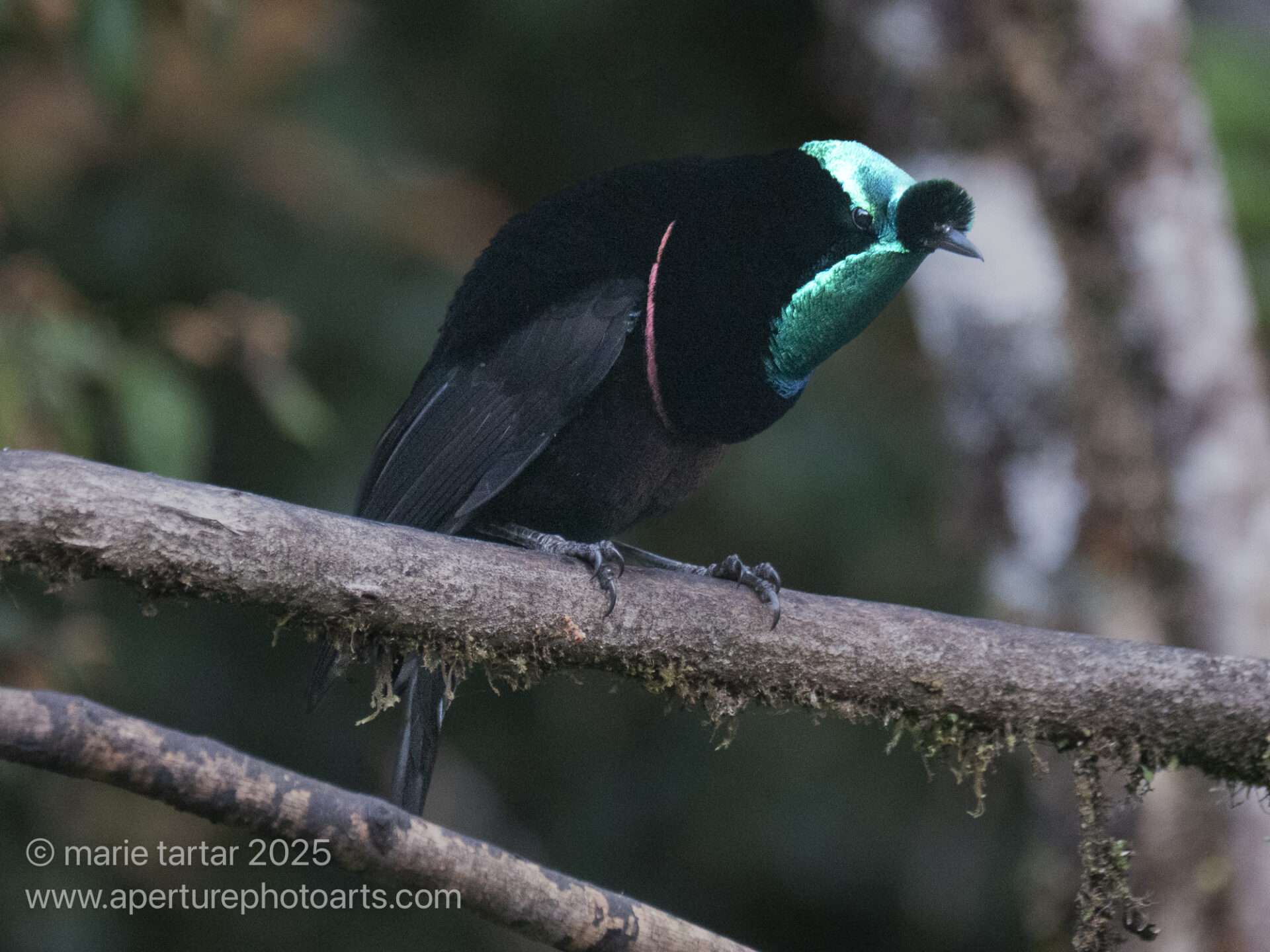
A beautiful bird of paradise, the male ribbon-tailed astrapia, at Kumul Lodge in PNG. (Shaw Mayer’s astrapia (Astrapia mayeri))
The following day, we were off to Goroka in the Highlands for a sing-sing, a cultural showcase of traditional tribal decorations and dances. On the way, we visited the Skeleton Tribe and the Dustmen. The Skeleton Tribe uses ash and clay to coat their bodies, resembling skeletons. Legend has it that after a group of hunters failed to reappear, a search party found a pile of skeletons in a cave in which a monster dwelt. To elude the monster and not fall victim to the same fate, they devised this ingenious disguise.

A monster sneaks out of the forest to ambush a hard-working farming couple. Skeleton Tribe, PNG Highlands

A monster wreaks havoc among the Skeleton Tribe, PNG.
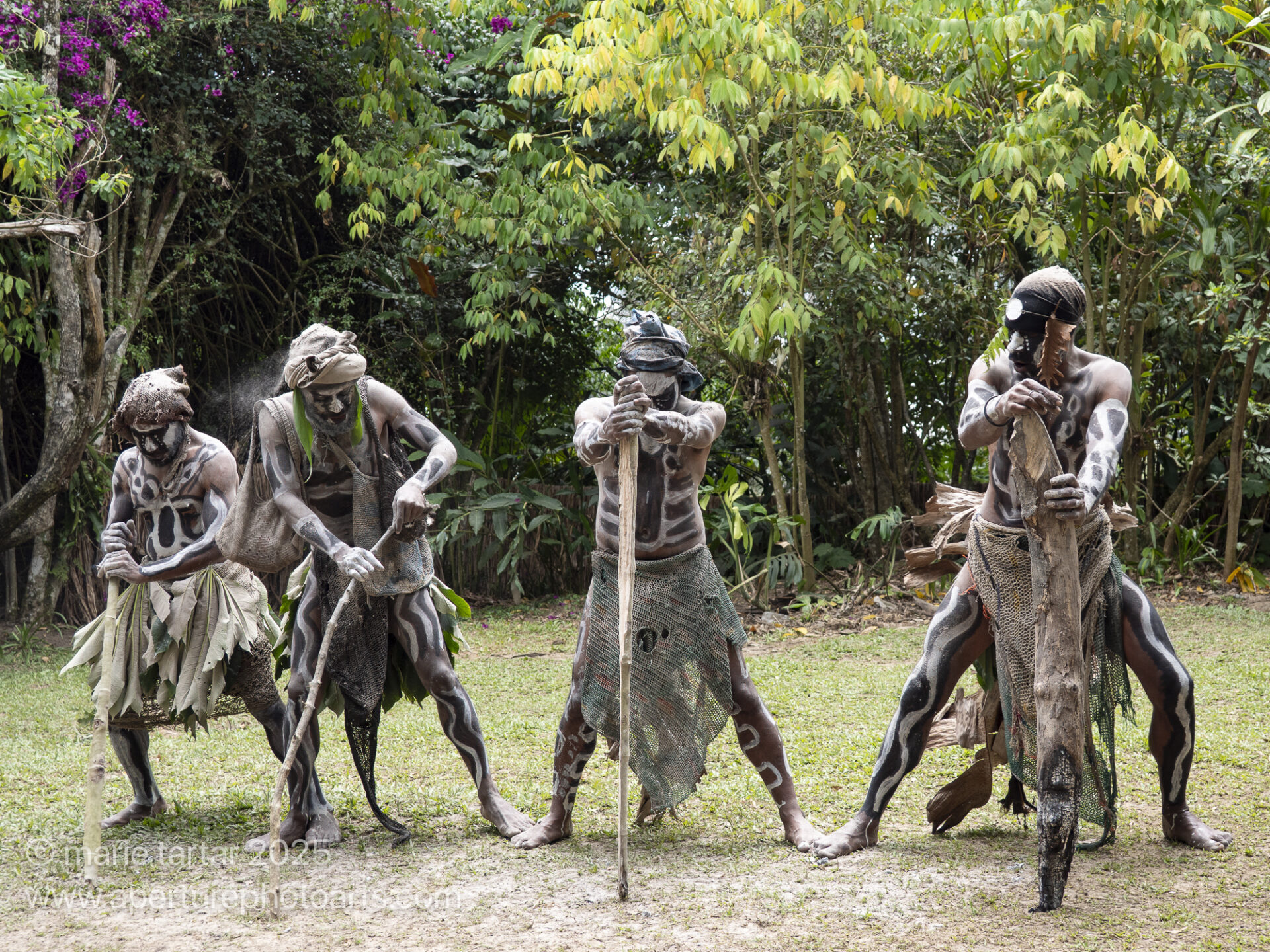
Swaying to and fro, the Dustmen…

suddenly cloak themselves in a cloud of dust.

Even before the official Goroka show, we had a chance to see the Huli wigmen adorning themselves on the grounds of the JK McCarthy Museum.
The Goroka show itself was a sensory overload of color, decorations, singing and dancing, with the different tribes doing their best to out-shake, out-dance, and drown out the others.

Huli wigman at the annual Goroka cultural festival. Much of his headdress is his own hair, grown into a distinctive helmet-like shape and then adorned with feathers.
Perhaps one day, I’ll be able to finish the posts on the Goroka show and the Kimbe Bay diving on the Oceana, but this will have to suffice for now. Our enjoyment of the diving was definitely impacted by the news from New York of Aaron passing on September 23. Steve and I won the brother-in-law lottery with big-hearted Aaron, who lives on in his deeds and our many wonderful memories over the decades he was in our lives. A week later, while we were still at sea in Kimbe Bay, he was given a hero’s send-off befitting his many identities as a former Marine, Rescue 1 firefighter, bagpiper and mental health advocate for veterans at risk of suicide, with Fifth Avenue closed down and filled with bagpipers, police and firefighters at attention lining the streets, with the funeral procession leading to a memorial service at St. Patrick’s Cathedral.
The diving in Kimbe Bay was enjoyable, but clearly impacted by bleaching. At this writing, I still haven’t completely processed the images from the trip, but here are a few favorites:

Anemone with skunk anemonefish, PNG.

Baby clownfish in anemone, PNG.
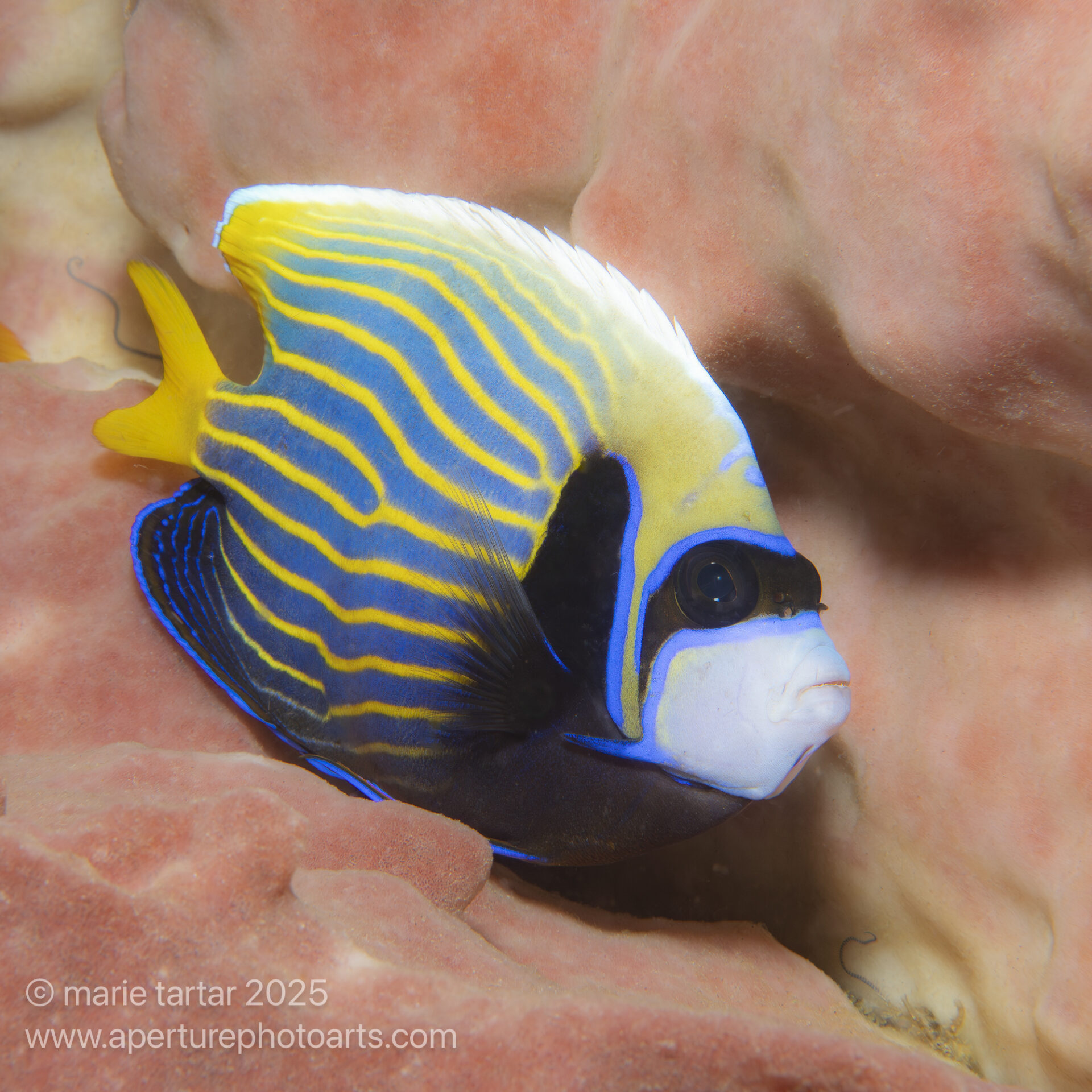
Adult emperor angelfish, PNG.
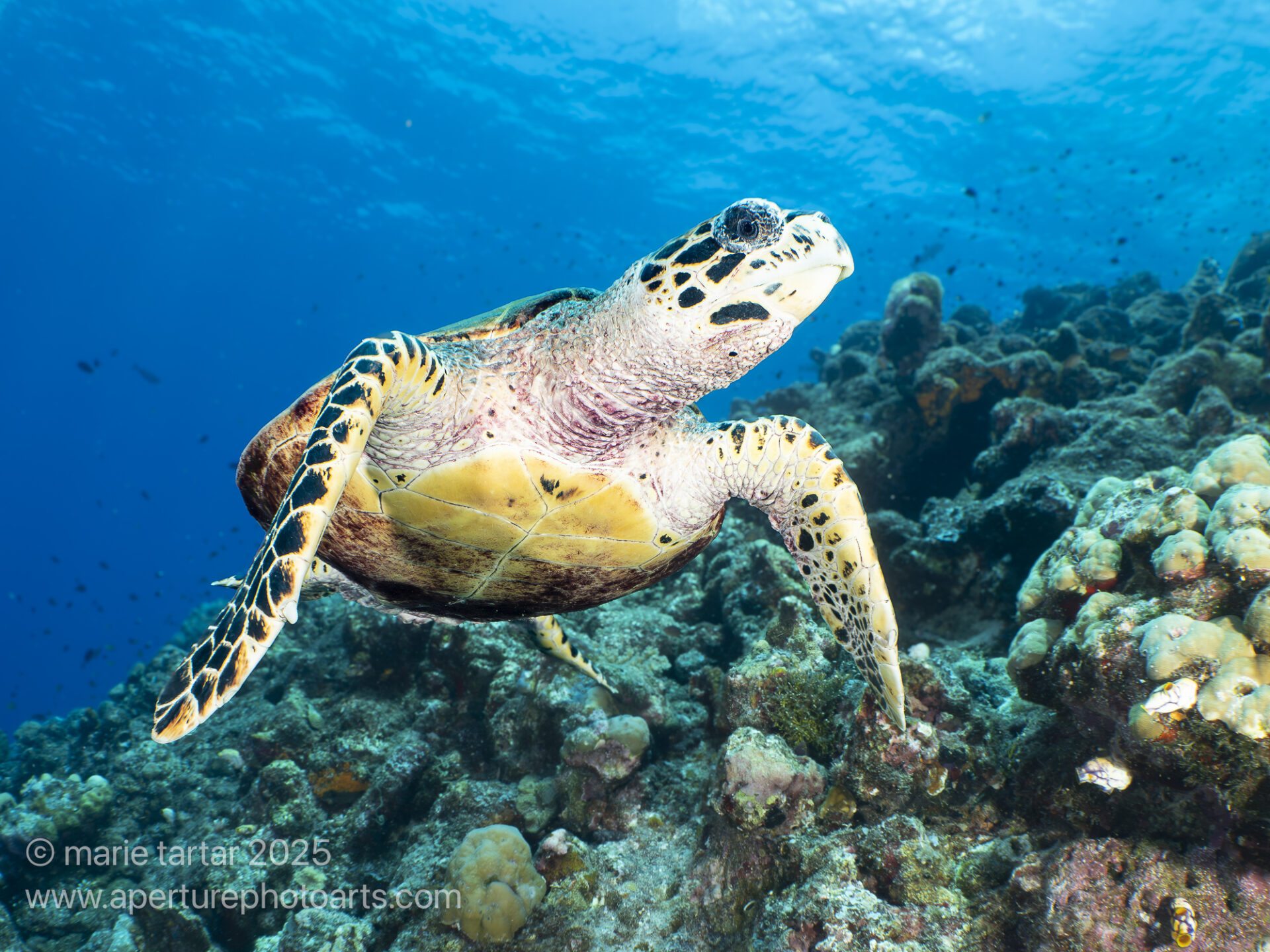
Hawksbill turtle, Kimbe Bay, Bismarck Sea, Papua New Guinea.

Trumpetfish’s elongated shape lends itself to hiding in plain sight between layers of hard coral in Kimbe Bay, Bismarck Sea, Papua New Guinea.
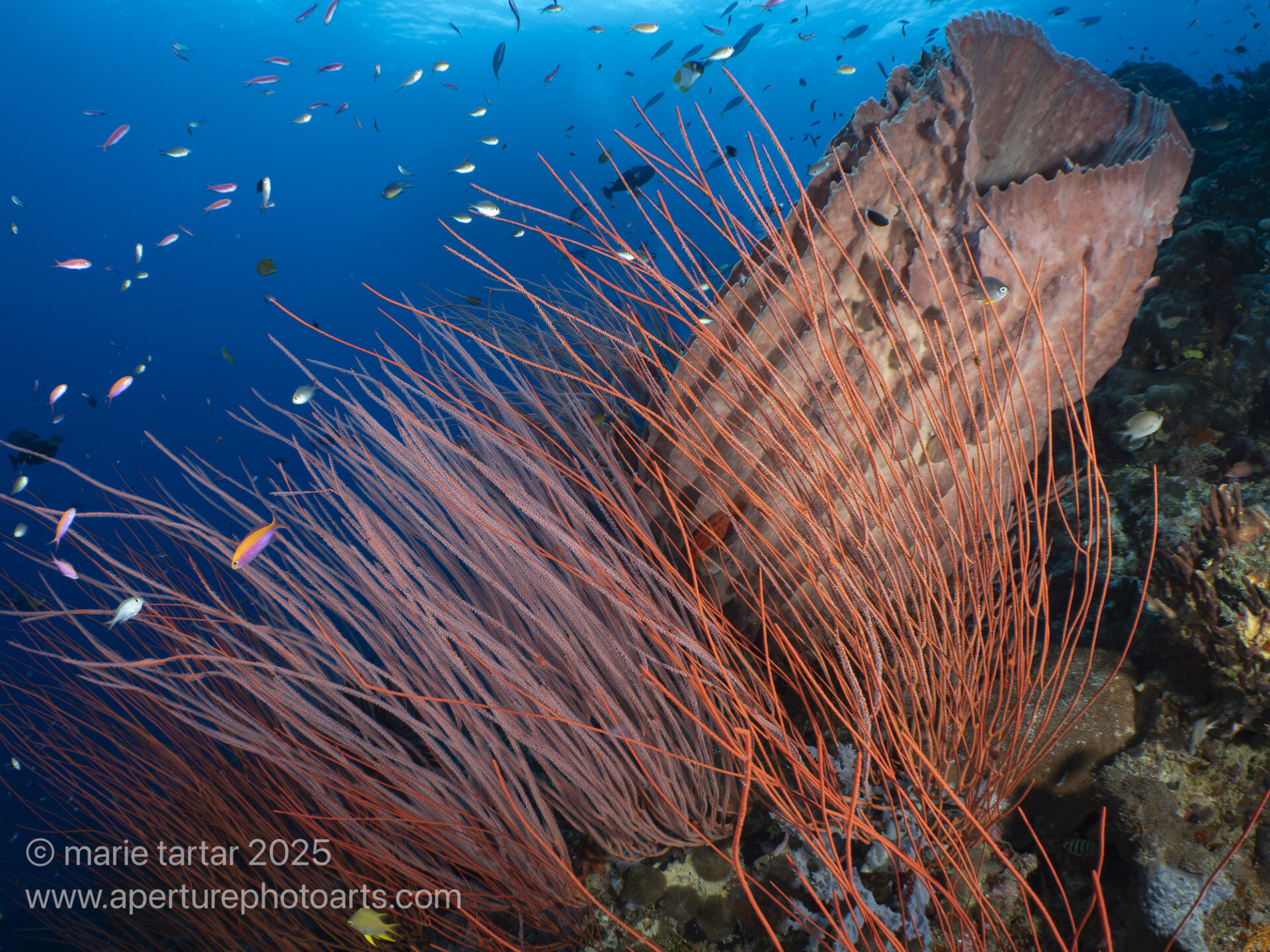
Red gorgonians counterbalance the lean of a large barrel sponge in Kimbe Bay, Bismarck Sea, Papua New Guinea.

This wildly patterned triggerfish hides in the open under a hard coral, with Greg in the background. Kimbe Bay, Bismarck Sea, Papua New Guinea.
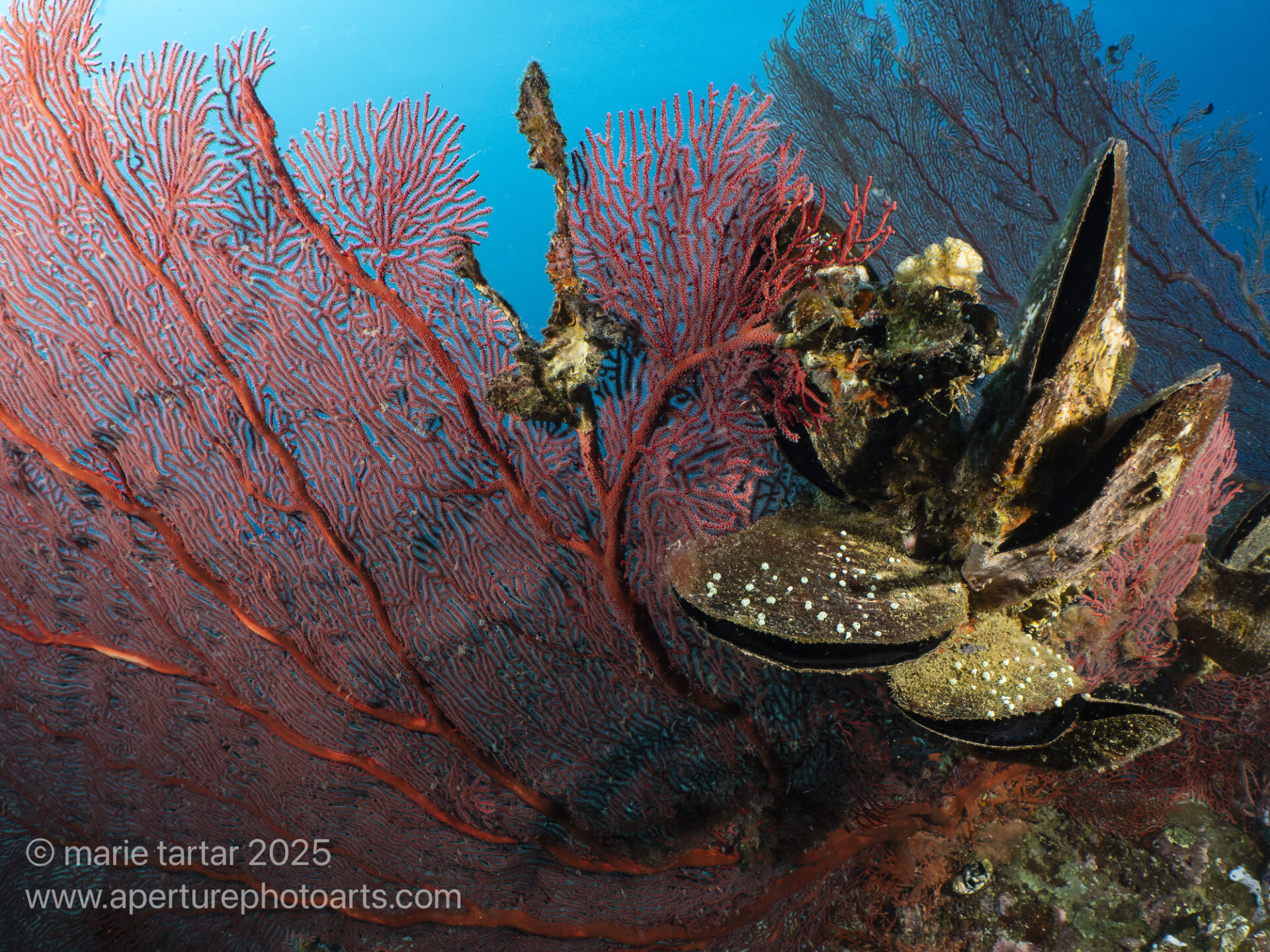
A cluster of clams set off a large red sea fan in Kimbe Bay, Bismarck Sea, Papua New Guinea.
Steve’s 68th birthday was celebrated on board the Oceana, along with Captain Dan’s and Brian’s.
October
We were home long enough to work a few days, have teeth cleaned and arms vaccinated, as well as connect with friends, including catching portions of the La Jolla Modernism weekend events with Ralph and Gail. We were tight enough for time that we travelled directly to Paris via Newark (painful) without stopping off for our customary several days in NYC. The boomerang sleep disturbance effect of travelling back from Down Under and then flying to Europe was profound.
The complete inability to sleep, even in a Premium seat on French Bee from Newark, was partially offset by an excellent selection of French-language films for my own private overnight film festival. It started with a searing 2024 drama set in a public high school in a rough part of Paris, Pas de Vagues (English title The Good Teacher). Julien, an earnest, well-meaning literature teacher (François Civil) is falsely accused by a female student of harrassment, leading to an escalation of accusations and even threats on his life. His life with his partner (Shain Boumedine) is adversely affected as they struggle with the effects of the accusation. The film is based on events experienced by film director Teddy Lussi-Modeste, a former teacher. The film’s French title means No Waves, as in Don’t make waves, which is what the besieged teacher is advised when he seeks support from the administration.
Pas de Vagues reminded me of another French-language film in which a high school literature teacher’s conflict with a student leads to threats and violence. Amal, an excellent 2023 film from Belgium, stars Lubna Azabal. We screened the film and recommended it for the 2025 Sedona International Film Festival. In both films, conflicts between Muslims and non-Muslims are an underlying current.
On Ira, a touching and amusing 2025 film, stars Hélène Vincent as an octogenarian who plans to undergo assisted suicide in Switzerland after her cancer returns, widely metastatic. Under a pretext, she ropes caregiver Pierre Lottin into driving her and her family in a dilapidated camper van. She has trouble telling her ne’er do well son (David Ayala) and granddaughter (Juliet Gasquet) her plans.
The last film in my own private French film festival, 2023’s La Voie Royale (English title The Path of Excellence) is set in a very different segment of the French educational system, an elite scientific prep school. It centers on the travails of a bright girl from a farming family, Sophie (Suzanne Jouannet) who struggles to adapt in the fast-moving new environment, aided by befriending her roommate (Marie Colomb).
Highlights of our stay in Paris were becoming re-acquainted with the reconstructed and gleaming Notre Dame. The towers had just been reopened for climbing the month before our arrival. We went late afternoon and loved the views from the towers, as well as the details of the structure. The bells rang out as we crossed from one tower to the other.
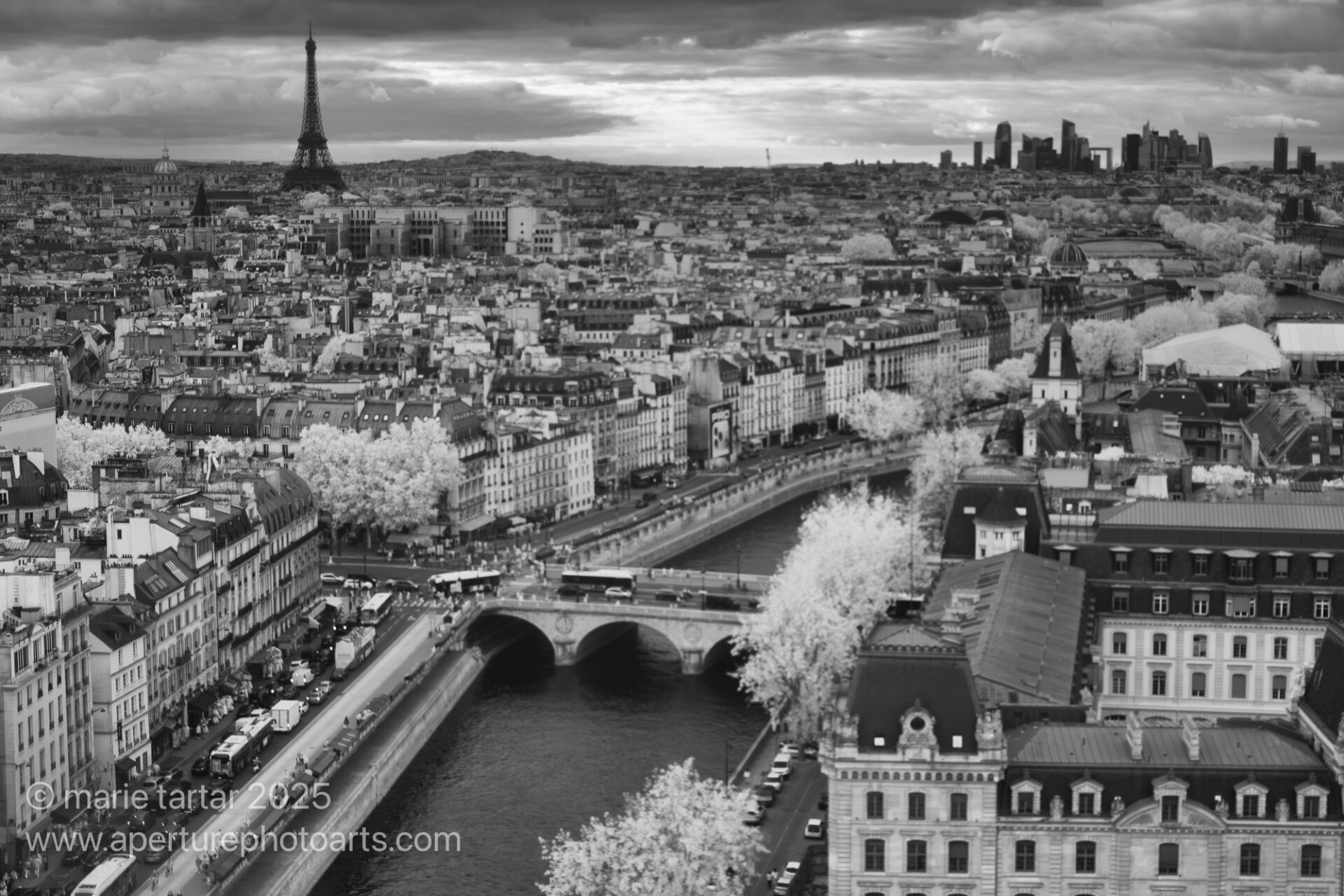
Infrared take on Paris and the Seine, from one of the Notre Dame towers, 424 steps up a spiral staircase.

Notre Dame gargoyles, Infrared.

Notre Dame detail, infrared.
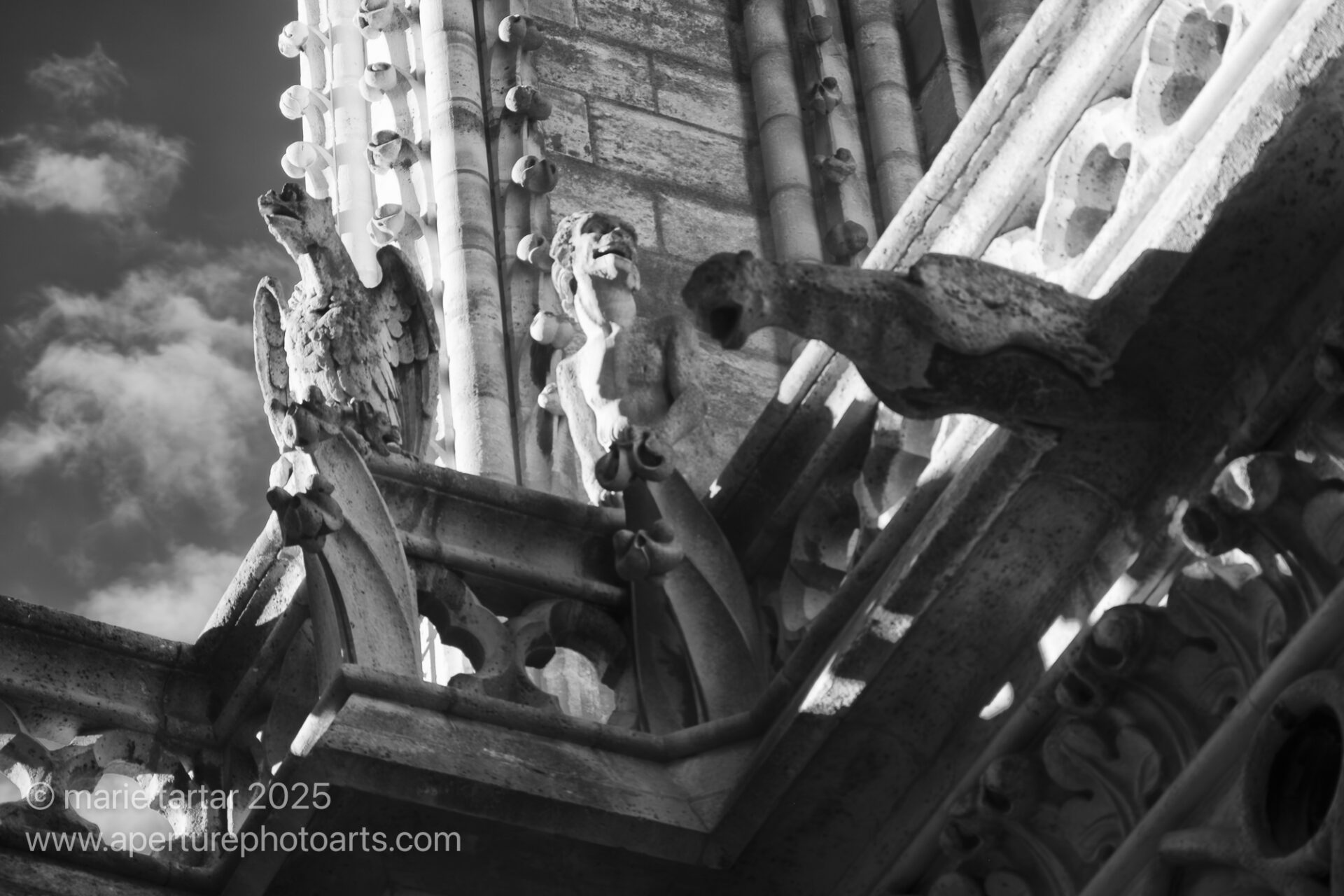
Gargoyles of Notre Dame, detail, infrared.

Tour Saint-Jacques, one of the four starting points of the Way of Saint James (Camino de Santiago) in France. (infrared)

Many Parisian monuments are recently restored, thanks to the Olympics, such as the Fountain of Innocents. It was commissioned in 1550 by King Philippe Auguste. It is one of the city’s first three public fountains to draw water from the Belleville aqueduct. The reliefs decorating it are the work of French Renaissance sculptor Jean Goujon. They depict water nymphs. The original reliefs are in the Louvre.
Our best meal was an excellent lunch at Semilla (157 E), beginning with gougeres and a starter entrée of pointed head cabbage. We both loved Steve’s raviole cepe plat, as well as my truite corry-coco (trout), accompanied by a glass of cider for me and a Reisling for Steve. Chocolat souffle dessert for me and fig cake for Steve were both terrific. We also enjoyed revisiting some favorite restaurants from prior visits, including Frenchie, Le Reminet and Kubri and finally tried a favorite of our partner Rebecca, Ferdi.

Our central Marais location makes crossing the Seine almost a daily occurence. The large letter Ns encircled by laurel wreaths stand for Napoleon (III, ruler of France from 1852-1870) and can be found on several bridges crossing the Seine as a royal monogram.
As usual, there were wonderful exhibitions to view, such as the Georges de la Tour exhibit (Entre Ombre et Lumiere, or From Shadow to Light) at Musée Jacquesmart-Andre and a retrospective of Gerhardt Richter at Fondation Louis Vuitton.
Cleopatra drew us to the Monde d’Arabe. It had been 10 years since my last visit to this Jean Nouvel-designed museum, with an intricate metal screen facade evoking mosiacs. The exhibition entitled Le mystère Cléopâtre traces Cleopatra’s deeds and reputation through the centuries, from being revered as an astute politician and leader of her people, to being reviled as a nymphomaniac. In addition to antique depictions of her likeness on coins and sculpture, the show traces her long arc into modern times, including in advertising and cinema.
Another wonderful show was at the Orangerie of Berthe Weill (1865-1951), entitled galeriste d’avant-guarde. She was an artist supporter par excellence, who opened the first of a series of galleries, called Galerie B. Weill, promoting the new in art in 1901. WW II saw the last of her 4 galleries closed in 1940, due to the Nazi occupation of Paris and persecution of Jews. Her autobiography, published in 1933, Pan! dans l’oeil, is quoted throughout the exhibition as it recalls the many artists she promoted and exhibitions she organized. She got her start at a young age as an apprentice to her cousin in his print and painting enterprise. She seems to have been quite prescient in her choices of young artists to promote, buying 3 paintings from PIcasso in 1900, just after his arrival in Paris from Spain. She also made the first sale of a Matisse painting and was instrumental in promotion of fauvism and cubism. In 1917, she presented an exhibition of the work of Amadeo Modigliani, the only such show during his lifetime. Four nudes included in the show raised the ire of the local authorities.
We revisited favorite haunts from prior visits, walking the Promenade Plantée and attending an evening concert at Saint Chapelle featuring soprano Tatiana Probst, accompanied by Les Solistes Français led by Paul Rouger on violin. The ensemble was rounded out by violinist Christopher Quatremer, David Harlé on cello (violoncelle), Vincent Dormieu on viola (alto) and Gilles Harlé on harpsichord (clavecin). It had been many years since we attended a concert in this soaring and inspiring setting. I was attracted by the program, which for a change did not feature Vivaldi’s Four Seasons or Pachelbel’s Canon, as lovely as those pieces of music are. It did include Vivaldi (Mottet: In Furore and Concerto pour cordes (strings): Alla ristica), as well as Bach, Mozart and Handel. Probst’s lovely voice was shown to particular advantage in the final two pieces, two versions of Ave Maria, by Schubert and Giulio Caccini (1545-1618). I had never heard of Caccini and in looking him up later, it seems this version is actually by Russian composer Vladimir Vavilov and is often misattributed to Caccini. An explanation I found was that religious music was not in line with Soviet doctrine, leading the composer to misattribute his work.
Back in New York, there was plenty on offer for culture vultures and art nerds. We met up with Clarissa and Jason for Vietnamese food before Le Tambour de Soie (The Silk Drum) at the Japan Society. It is based on a Modern Noh Play by Yukio Mishima, which he based on a noh play from the 1500s called Aya no Tsuzumi. Mishima updated the setting to the then contemporary setting of the 1950s. This version is a rework by a group of French artists. The performance centered on a dancer (Kaori Ito), who captivates an older man, a custodian, played by Paul Lazar. The third performer is a musician, Makoto Yabuki. Both Ito and Yabuki live in France and this was presented in conjunction with L’Alliance New York as part of their Crossing the Line festival. Ito initially conceived this work with Yoshi Oida who played the part of the older male admirer but his advanced age prohibited him from traveling to NYC to perform it but worked by video with Lazar and ito to rehearse the piece. Surprisingly, Steve (with a limited appetite for dance) really enjoyed the performance.
An unexpected pleasure at Japan Society was the provocative exhibition of work by Chiharu Shiota called Two Home Countries. She lives in Berlin so Germany is the second home country for this Japanese artist, who does large immersive installations, as well as videos and performance pieces. I found an interesting through line in her work with the knotted wire installations of Ruth Asawa we had just seen that morning at MOMA.
One large gallery was filled with a web of red yarn, knotted and twisted like a disorderly spider web, within which pages drawn from journals were embedded, as if they had been ripped from notebooks and swept along by a great wind to be caught up and suspended. In others, there were glass cell-like bubbles and videos of her performances, in which she is immersed in mud or wrapped up in a maze of tubing through which courses a red, blood-evoking liquid. A huge piece, with a lace-like dress of red tubing unspools into two chairs wrapped in crocheted coils of wire, brought to mind Petah Coyne installations, simultaneously beautiful and eerie. The two chairs are stand-ins for her two home countries, Japan and Germany.
On another evening, the four of us went to Brooklyn (BAM Fisher) for another dance-centered performance, Martha at BAM: 1963, which recreated an appearance and interview by Walter Terry (played by Lisa Kron) of the diva and modern dance pioneer Martha Graham at 92cd Street Y. Afterwards, we had a delicious meal of south American food at lively Colonia Verde, sharing eggplant, peas, butternut squash curry with rice, steelhead trout, cheesy bread, and mushroom arepas.
On a Sunday, we met up with Sarah at NIzza for lunch, sharing socca (chickpea flatbread, a speciality of Nice) and roasted beets with goat crema. My butternut squash and ricotta ravioli with sage brown butter sauce was savory perfection. Steve’s shakshuka was a spicy version he enjoyed and Sarah went for the spinach and goat cheese fritatta.
The day was planned around a 3 pm matinee of Hadestown, for which I had scored TDF tickets. This was my 6th trip to the Underworld with Hadestown (opening night with Clarissa, a few weeks later with Steve, a trip back in 2021 to celebrate the reopening of Broadway after the pandemic closure, by myself more recently and with Clarissa and Alisa in San Diego to see a touring version a year ago). The music of Hadestown is so haunting that it always induces in me a continuous stream of tears and this time was no exception.
Especially these lines:
“Wait for me, I’m coming with you….”
At intermission, knowing how long the line for the ladies’ room would be, I bolted from my seat as soon as the lights came up. I came back to find Sarah sobbing in Steve’s arms, overcome with emotion. It was 5 weeks since Aaron died and his 52cd birthday was the prior week. She left, insisting she wanted to be alone. I hope one day she’ll be able to see the second half.
This was an all-new Hadestown cast and they were simply phenomenal. It sounds like heresy but almost across the board, this slate of performers were better vocalists than the original Broadway cast. Especially strong was young, fresh-faced Brit Jack Wolfe as Orpheus. Equally delightful as Eurydice was Morgan Dudley, a beautiful performer with an angelic voice. I had seen Rebecca Naomi Jones a few years back in Oklahoma! and found her enchanting as Persephone. Hermes was jazz vocalist Kurt Elling, in his Broadway debut. Paulo Szot was a credible Hades, although no one can displace Patrick Page in my affections in this role.
We met up with new and old friends. Steve’s Hebrew school friend Cindy Arlinski came over. It had been 40 years since they last saw each other, at their 10th high school reunion. She just attended Steve’s 50th high school reunion, which was when we were in Paris. During our free-ranging conversation, we somehow learned her cousin is cookbook author Lorna Sass, who we did a New York exchange with years ago.
We went with Les for an evening with André de Shields as Tartuffe at the House of the Redeemer, just off Fifth Avenue on 95th Street, staged inside the fabulous Fabbri Library. It is an intimate space, with 4 rows of chairs on 3 sides. The library dates back to 1609 and was built by the 6th and last Duke of Urbino, Francesco Maria II della Rovere (1549-1631) to celebrate the birth of an heir. The wood shelving was the first design by Nicola Sabbatini (1574-1654), who would go on to author a renowned book on early baroque stage design. The heir died young, before succeeding to the dukedom, enabling the pope to claim the duchy of Urbino. The heir did manage to marry and produce a female heir, Vittoria della Rovere, whose dowry of the Urbino art collection, including works by Raphael, Titian and Piero della Francesca, are in the Uffizi today.
The library once housed collections of manuscripts and books, which were dispersed into the Vatican Library and Biblioteca Alessandrina in Rome. The shelves of the library were removed in 1870 and eventually, on two separate ships, made their way in 1915 to a townhouse under construction for Ernesto and Edith (Shepard Vanderbilt) Fabbri on East 95th Street.
André was campy perfection as duplicitous, scheming Tartuffe, whose religious posturing has completely hoodwinked the patriarch of the family, Orgon (Chris Hahn). Tartuffe was resplendent in regal crimson, floor-sweeping vestments, with a foot-long glittering cross on his neck. The piety of Tartuffe so takes in Orgon that he refuses to believe his family’s protestations and is prepared to marry his daughter off to Tartuffe. Tartuffe even has designs on Orgon’s wife (Amber Iman, regal in a teal gown, last seen as Lempicka’s love interest).
It is amazing that a play as old as Tartuffe, first performed in 1664, is so relevant today. Written in French by Molière in rhyming couplets, its essence is well captured in the English translation by Ranjit Bolt. The play is also known as The Imposter and The Hypocrite.
Afterwards, we savored a Peruvian-Japanese meal at Kansha, which means gratitude in Japanese, sharing pisco sours, Brussels sprouts, vegetable (king trumpet mushrooms and cauliflower) and seco (short rib) gyoza, a spicy tuna maki roll, and fried rice with very tender beef chunks (niku chaufa).
We caught a couple of Broadway shows as well. Punch by James Graham, is powerful, based on the book Right From Wrong by Jacob Dunne. A strung-out young man (Jacob, wonderfully depicted by Will Harrison) wallops a stranger while out with his mates and accidently kills him. After his release from prison, the parents of the slain boy (Victoria Clark and Sam Robards)and he take tentative steps toward mutual redemption via the process of restorative justice. Will Harrison was TJ in the Lincoln Center version of The Coast Starlight and Victoria Clark was wonderful as Kimberly Akimbo. Camila Canó-Flaviá, another veteran of The Coast Starlight at both La Jolla Playhouse and Lincoln Center, plays dual roles as Jacob’s girlfriend Clare and restorative justice facilitator Nicola.
In Little Bear Ridge Road, a play set in author Samuel D. Hunter’s home state of Idaho, Laurie Metcalf incarnates a prickly older nurse with a touchy relationship with her only remaining relative, an estranged nephew (Micah Stock) who returns to Idaho to sell his father’s house. He is adrift professionally and gay. His budding relationship with an astrophysics graduate student (John Drea) suggests the possibility of a happier life for him.
A memorable morning was spent underground. Sarah and Aaron had gifted us a membership to The New York Transit Museum with tickets to tour the Old City Hall subway station, which they had enjoyed previously. The tour group assembled near City Hall park, which was further enhanced with sculpture installations by Thaddeus Mosely. We’d only been here once before, with Sarah and Aaron. The walk was a fascinating stroll back through history and the evolution of New York’s mass transit system, which went through multiple iterations before arriving at its present form, which broke ground in 1900 and opened in 1904. Monumental events, such as the blizzard of 1872, forced seismic and technological changes along the way.
The tour leader teased the group, saying there was a celebrity in our midst and we’d have a chance to meet them later. After pointing out the locations above ground of the abandoned City Hall station, we boarded a 6 train for the very short ride to the station. The station is at a curve, with a wide gap between the train and the platform, with the electrified third rail just below. Another reason it was abandoned, despite the beautiful Guastivino tiled ceiling, was its proximity to the Brooklyn Bridge station.
The celebrity in our midst proved to be a familiar voice of the subway: Bernie Wagenblast. We were all astonished when she suddenly launched into the announcement we’ve heard so many times: “The next uptown train to X station is now approaching. Please stand away from the platform edge.” Thinking she was a voice artist capable of doing both male and female voices, I asked how she selected the particular voice used for the MTA announcements. She responded that the subway voice was the one she used during her professional radio-announcer career and that she had transitioned since then. I later found this article about her in the New York Times. Steve and I enjoyed recording a video with her to thank Sarah for a very memorable morning.
Our artistic excursions were rounded out by shows of artists we love, Man Ray at the Met and Ruth Asawa at MOPA.
November
We made it home in time for double (really triple) birthday parties on the same Saturday evening of friends having milestone birthdays. At Mingei for Dave Hampton’s 60th celebration, The Swingers, a 7-piece band, played standards and fun arrangements, with Dave on a triple set of drums. We caught up with artist and modern design aficionado friends, including artist Tom Driscoll and his wife Elena, architect Hector Perez and Caroline, Mark and Loretta , and Ron and Heather Kerner.
After The Swingers concluded a set, we were off to a double 70th birthday celebration at Miles’ and Tatiana’s. Tatiana and her twin sister Lora were hosting a 140th combined birthday fete. Many mutual friends were there, including Lev and Irina, Nadya, Ellen and David, Ron and Lucille, Gail and Ralph, Julie and Victor and Melody. I learned after a spontaneous tango demonstration that many of Tatiana’s Russian friends had formerly been tango students of the professional dancers who wowed the crowd on a narrow strip of the living room.
A surprise monkey wrench arrived this month from Ohana, that they would not be renewing their lease in Poway. It was hard to believe it had been 5 years since they moved Mama to Poway from Spring Valley during the pandemic. Steve and I stopped in to tour Summerfield, a memory care center down the road from us, on El Camino Real, just north of the juncture with Manchester. We were sufficiently impressed with the staff and facility that I returned two days later with Mama and Joe to introduce Mama to the idea. We had lunch there, which was surprisingly tasty. Mama seemed fine with moving and Clarissa and Jason warmed up to the idea, possibly helped along by the care issues with which they were grappling for Jason’s mother, Claire. They had noticed a steep decline in her performance status between their visits in March and August. She had become so weak she couldn’t make it to the bathroom by herself. Martha and Alec took her in to be evaluated and she was diagnosed with end-stage heart failure, a “hospice situation”. She passed away on November 7, at the age of 94 years, after an active, artistic and admirable life.
Before taking off for a sojourn in Sedona, we spent a friend-filled day in Barrio Logan at a studio visit to The Tao of Clay with Ralph and Gail. We ran into Josh and Rachel Herman a few weeks before at the Mingei. We’d talked before about making a visit to Josh’s ceramics studio but somehow it had never happened. We’d seen examples of Josh’s ceramics at a restaurant in Bird Rock when we did the La Jolla Modernism tour together a month back and Gail had mentioned she admired Josh’s work, of which we have a few small examples.
The Hermans have created a thriving ceramics community at The Tao of Clay. Housed in a former automotive shop, it is an attractive space with work and storage spaces for students and Josh, as well as a gallery for Josh.
We had time for a quick coffee at Moto Cafe nearby before Steve and I headed north for a catch-up lunch with Susan Kanfer, in San Diego for the weekend from Palm Desert.
The same evening was devoted to the opening of Working Girl, as Ralph and Gail’s guests. The program’s cover features Lady Liberty and the orange Staten Island ferry is a prominent location for the heroine, Tess McGill, a secretary with higher aspirations. Tess was played by a powerhouse vocalist, Joanna “Jojo” Levesque. She apparently has been a pop star since her teens and at age 33, is the author of a best-selling memoir of her years in the music industry. That I had never heard of her is further proof just how out of it I am. I later listened to her autobiography, Over the Influence, which details her travails in the music industry as well as her personal demons. It is well written and candid, as well as well read by the author.
The first week in Sedona was glorious, with intense fall color waning but still lovely. We hiked locally and at West Fork of Oak Creek and mountain biked in west Sedona. Barb and Jeff introduced me to a hike new to me, Pyramid, while Steve mountain biked with Francis. Knowing abundant rain was coming the second week, we did a hike centered on Oak Creek, in search of fall color, Huckaby down to the creek. Steve volunteered to let me do the hike as a one-way, so we parted at the first creek crossing. I followed the creek to a second crossing, hooking up with Ghost Town Trail, which zigged and zagged its way up to climb out at Midgely Bridge, from which I hopped onto Wilson Canyon Trail to get to the Jim Thompson Trail home, a 6+ mile hike.
We decided to break up the long trip home by overnighting at the Hotel Valley Ho in Scottsdale. This gave us a chance to stop into Phoenix Art Museum and to catch up over dinner with Threasa and Chris. Phoenix was sunny, a nice break from interminable rain. At the museum, there was an exhibition of large-scale figurative paintings by Eric Fischl. I didn’t realize he had a long-standing relationship with Phoenix dating back to his early art training at Phoenix College and ASU in the late 1960s. The work is cinematic and mysterious in content, albeit intriguing. Scenes from suburbia and backyard pool scenes brought David Hockey’s LA work to mind, although Fischl’s work is much less bucolic and sometimes dark and foreboding.
A pleasant surprise awaited us in a show called Radical Clay: Contemporary Women Artists from Japan. One of the included pieces was by Hiruma Kazuyo, a striking striated construction called Ice Veins, which drew inspiration from the Southwest’s monumental formations. The striations and layering and palette showed clear resonance with the 3 works of hers we acquired in Japan from Robert Yellin’s gallery in Kyoto.
We stopped on our way out of town to check out Lisa Sette Gallery, admiring work by Binh Dahn and Michael Koerner. It rained for several hours on our way to Yuma. Steve introduced me to the Bob-averse series. We dropped the two Finn Juhl Japan chairs off at Lalo’s on the way home, just managing to unload the car before meeting Elena and John and Brad and Lauren at Ki’s for early dinner before a set by the Benedettis, a father on guitar and his two gifted vocalist daughters.
Back in San Diego, I had reams of paperwork to facilitate Mama’s admission to Summerfield. At home, we were confronted with another downed Torrey Pine, a large one, which fell in the yard with the recent heavy rains.
Thanksgiving was celebrated early, the Sunday before, at Doug and Mini’s. Their son Max recently married his long-time girlfriend Lexi and they are expecting. Doug, Mini and Max came over to our house on Thanksgiving for our version of the traditional meal (no turkey but sous vide duck with cherry sauce with brussels sprouts, stuffing and salad, the sides and dessert of apple crumble pie courtesy of Blue Apron).
December
We made two short trips in the first half of this month and spent the holiday season at home, working and making the rounds of holiday parties and dinners.
Vivian made the first trip possible. She offered the use of her 3-bedroom timeshare villa in Cabo San Lucas to us more than a year before but we were too booked to go. Surprisingly, although we’ve done quite a bit of diving in Baja, we’d never actually spent much time in the waters around Cabo, so this was an exploratory trip for us. Greg met us there and Cindi arranged 5 consecutive boat days with Latitude Encounters and joined us from San Jose del Cabo for the first. Rounding out our crew for the week were accomplished father and son free divers, Rob and Josh Blank, all the way from Brisbane, Australia. On other days, we were joined by their friend from Brisbane, Fiona and by Jonathan, hailing from Germany. I was stunned by how far these people had traveled to see what we could access in a 2-hour non-stop flight! We really liked Latitude Encounters as well, a well-organized outfit, appropriately safety-conscious; even the provided lunches (mini burritos) and snacks (mandarins) were a cut above!
Over the week, I came to appreciate just why the Blanks have been coming each year such a tremendous distance. Our first morning out, we had cownose rays over the sand, white-sided dolphins, and spinner dolphins. The highlight of our first day out came at the end: a pair of humpback whales, alternating with tail lobs, whacking the water’s surface with resounding thuds and huge sprays of water, then a series of breaches at close range!
Cindi came back to the villa with us afterwards. While sitting in the hot tub, leaning against a vent, she had an unusual bathing-suit mishap. Apparently, the venturi effect untied her bikini top, drawing the strings into the mechanism, tethering her there (temporarily). After we extricated Cindi from the hot tub, she took off for home, and the three of us walked to one of Pueblo Bonita’s restaurants, Cibola, for Mexican food night.
The following day on our ocean safari, we found a sizable group of mobulas. A free-diver from another boat scared them. Nina from Spain was our guide, with Andres again at the helm of the boat. I was having recurrent problems with nasal enemas while snorkeling, leading me to try a lower profile mask Nina loaned me. Ultimately, I tried Greg’s backup Cressi mask, which solved the issue. Nina directed us to a store in town where I procured the same mask.
A group of common dolphins promptly disappeared. When I went to bathroom on board, I emerged to find a whale pounding its tail down repeatedly. Our last find of the day was a gull feeding on a squid remnant.
We walked to dinner at La Frida, a high-end Mexican restaurant. I shared a Caesar salad with Steve and enjoyed a pibil duck tamal for the main course, with a peach dessert. The cocktails were a cut above, a smoky mescal old-fashioned for Greg, damiana margaritas for Steve and me. These were presented topped with a large bubble, which once popped, dissipated as a puff of smoke.
On our third ocean safari day out, we found rough-toothed dolphins. For me, they were deep, although Josh down below with them, made it appear effortless. This seemed to be shaping up to be a bust of a day until Josh spotted an orca in the distance. Then, the chase was on!
Our boat sped over the surface, trying to get in the path of the orcas’ trajectory.

Orcas! An amazing, unforgettable afternoon with Latitude Encounters out of Cabo San Lucas, Baja, Mexico.
Down below, the orcas were feeding on a dolphin carcass, which was shredded. We were joined by 5 other boats, but most were not going in the water.

Is there a more beautiful marine animal than the orca?! What a privilege to see these creatures at close range! (Near Cabo San Lucas, Mexico)
For our final two days on the water, we’d requested sharks. We were on the cusp of the season, which starts in January, for blue and mako sharks, but it was possible. It was cold and rainy.
The crew chummed for 3.5 hours. At the 11th hour for calling the effort a bust, a fin was spotted waving around the buoy.
Blue sharks! First one, then a second, a third and just as the swim was called, a fourth!

Blue sharks are not randomly encountered underwater but are attracted by a scent trail cultivated by the boat’s crew, who throw scoop after scoop of bloody, fishy water into the ocean for the current to carry the trail away from the boat. We learned from shark expert and guide Katy that sharks being able to smell blood from miles away is a myth. Looking on is Josh Blank from Brisbane, an accomplished free diver and underwater photographer.
This was our first encounter with blue sharks. We’d been instructed not to have our heads out of the water and were given weight belts to keep us vertical. I felt very short of breath with a 6-pound weight belt on, without being able to lie down horizontally on the surface, and felt in danger of overbreathing the snorkel. After returning to the boat to doff the weight belt, I rejoined the others, hanging onto a rope, being jacked up and down by the boat, heads on swivels for the swift-moving and unpredictable sharks.
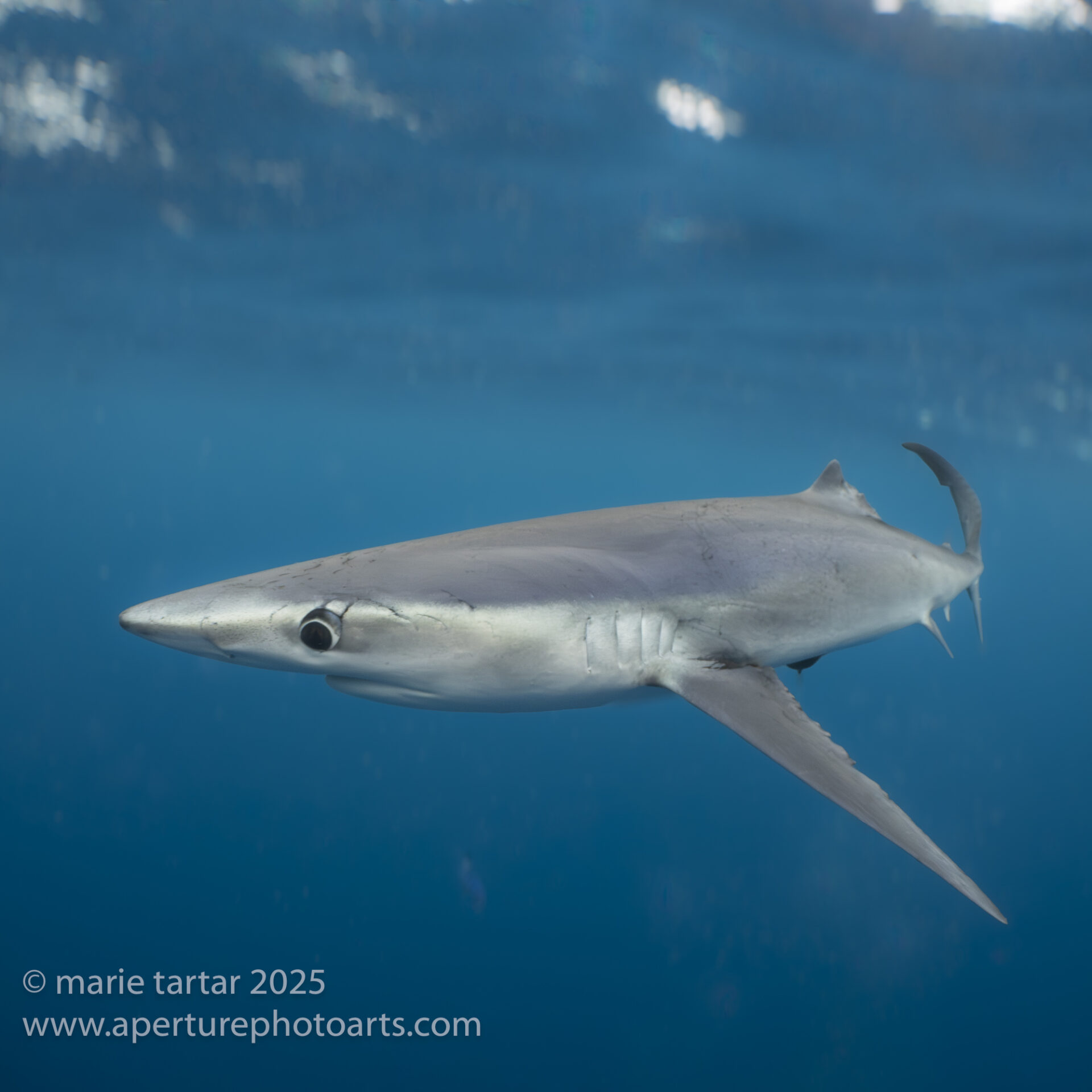
Blue shark! (Prionace gluaca), near Cabo San Lucas, Mexico

Our last day on the water started out promising, with that day-after-a-rain freshness and sun. We were again with the same cast of Josh, Rob and Fiona, with guides Mathias and Katy, with the only change being Miguel at the helm of the Rocinante. We went to the same area where we encountered the blue sharks the prior day. Two hours of chumming (a line with a box of fish pieces, a buoy with a frozen fish carcass and fishy water regularly thrown into the sea to create a long slick to attract sharks) yielded no results. While we were waiting, Mathias mentioned he is not fond of flying. Eventually, the story of why that is was dragged out of him. Apparently, a few years before, he substituted for Latitude owner Fer(nanda) going up in a spotter plane, which ran out of gas and crashed. The plane next to theirs had been refueled in error, but the pilot failed to notice during his systems check that theirs had not been. In the air, they ran out of fuel. The nearest beach was rocky, so the pilot chose to put the plane down in the water. On contact, it flipped upside down, driving the cockpit into the sand. The occupants were disoriented and didn’t realize they were upside down. The cockpit filled with water and there was no airspace. Mathias searched with his hands for any way out, finally finding a small hole, which he somehow clawed with his fingers until it was large enough to accept an arm, and ultimately the rest of him. When he emerged, he found they were in less than 2 feet of water. Reaching back through the hole, he saved the pilot’s life by dragging the nearly unconscious man through.
The phone rang with news of a possible orca sighting, not too far away. Steve and I were inclined to continue hoping for blues, but Fiona had missed out on the orcas with her hammerhead shark dive, and ultimately, we went along, reasoning that orca encounters are overall less reliable. There were a couple of other boats already on the orcas. The orcas were seen from the boat, but too close to jump. And then they disappeared…and never reappeared.
On the way in, a solitary humpback flipped its tail at us as if to say good-bye.
We made it back to San Diego in time for my book club meeting virtually on Zoom at 4 pm, after an easy 2 hour and 20 minute flight. By that time, suitcases were airing in the garage and swimwear was agitating in the washing machine. The meeting had been changed to a virtual one because Sandy fractured her femur falling in her bathroom at home and was convalescing at a facility. The other impetus was that the author of The Doorman, Chris Pavone, joined us online for a lively discussion of his beginnings in publishing and his writing methods and influences. As we had speculated, The Bonfire of the Vanities by Tom Wolfe was a powerful influence. Chris said he read it back in the day without thinking it racist, but in re-reading it 4 years ago, he found it so. So one of his goals was to update it for our era. To this day, The Bonfire of the Vanities takes me back to our cross-country move from Saint Louis to San Diego in 1990, before audiobooks were really big. To pass the many hours and miles, I read the book aloud to Steve.
John Ike’s holiday party at his Pt Loma home is always a highlight of the season, so we were happy to be in town for it this year. Our mid-century enthusiast friends were celebrating as well. We missed Keith and Jessica at Dave Hampton’s birthday party while they were traveling with Mingei in Japan. Marty and Cheryl had just returned from a stay in our Sedona home. This was Marty’s introduction to Sedona, with which he seemed quite enamored.
The day after our return from Cabo was moving day for Mama. After 5.5 years at Ohana, we made the difficult decision not to move her to Spring Valley when the facility moves back there at the end of January. The staff at Ohana seemed more affected by her departure than Mama herself. Her only comment (to Kathy’s mother, who Mama previously batted on the head with a pom-pom for talking too much): “You’re going to miss me.” Sarah arrived from New York while we were in Cabo, so we invited her over for coffee and to break into the Roy’s chocolate panettone Greg had sent that had arrived while we were gone. Sarah joined us to move Mama and was a huge help. We took two cars to load up clothes, books and photo albums, as well as Mama.
After working a week (both at the hospital and fixing up Mama’s room), we were off to the Sonoma wine country trip for a short jaunt with Miles and Tatiana. We left our dirty Volvo at their house and Ubered together to the airport for the quick Alaska flight to Santa Rosa. Miles planned every aspect of this trip. All I had to do was book plane tickets on the same flight. We had just enough time to introduce them to the Chase lounge. While we were waiting, a friend of Tatiana’s (Ilya) appeared, enabling all of us to go into the lounge without paying the $27 guest fee.
Miles and Tatiana were seated one row in front of us, across the aisle. A couple seated behind them, Jeff and Susan, turned out to be former owners of a favorite restaurant of Miles’ from Healdsburg, Zin’s. After we settled into our seats, a flight attendant approached us and said there was room for one of us in First Class. That’s 3 flights in a row with Alaska that I’ve received a free upgrade on! The flight is so short (1 hour and 20 minutes) that it isn’t a big deal, but still, it is a nice perk.
Our hotel, the Inn at Healdsburg, was right on the attractive town square, lit up for the approaching holidays. The trees in the square still showed fall color. It was cold enough that by day’s end, I had acquired a new hat next door and Tatiana a new coat. By the next day, Steve had a new Kuhl sweater.
We had dinner at one of Miles’ favorite restaurants, Cyrus. It is a multi-course procession of tiny, delicious and beautifully prepared dishes. Miles shipped wine ahead of us to the hotel, helping to keep the bill down, despite the $100/bottle corkage fee. After launching with champagne and a delicious, warming Billi Bi broth, we moved to seats at a U-shaped bar, where we were served a quintet of amazing starters, designed to highlight a taste characteristic, progressing from sweet to sour to salty to bitter, and finishing with umami. The most memorable of these was a pink doughnut-shaped “sour” morsel called a blackberry halo. Five more miniature courses followed, including grilled Maine lobster, a corn puree topped with caviar, and a final amazing bite of A5 wagyu. In the actual dining room, more delicious and intricate courses followed. My favorite of these was a scallop with a kohlrabi ribbon and a savory venison dish accented with huckleberry and a chanterelle crepe cake. The meal concluded with a procession of desserts, including another quintet of mignardises highlighting the 5 different tastes. Astoundingly, we were one of only two parties of four that evening.
Breakfast at the hotel featured homemade granola and a very good banana bread, as well as pastries from Costeaux, a local French bakery. After renewing their friendship on the plane the prior day, Jeff and Susan joined us for brunch at Costeaux. Steve and I shared an excellent artichoke sandwich and a beet and goat cheese salad.
In the afternoon, Miles drove us to Peter Michael Winery, a gorgeous 750-acre property in Knights Valley. Johnny (jcalderon@petermichaelwinery.com, (707) 225-2232) took us around in a Rivian, up through the vineyards to the event space and its panoramic views. The tasting was of 5 wines, including a 2012 Cabernet which was superb. We enjoyed two whites: the 2016 Mon Plaisir Chardonnay and the 2021 L’Apres-Midi (Sauvignon Blanc). We also sipped two Cabs, the 2019 Les Pavots estate Cab blend and the 2019 Au Paradis estate Cab Sauvignon. This was the only tasting that charged ($150/person), with proceeds donated to a local charity.
We walked to dinner at a Spanish restaurant, Bravas, where we shared hot and cold tapas, including tiny sandwiches of duck, pork cheek and jamon, an escarole salad, goat cheese toasts, sea scallops, cauliflower and brussels sprouts.
The following day was an all-Kistler day, starting at Kistler Trenton Roadhouse, a historic structure which once housed a bordello upstairs. Marisa Meckstroth (mmeckstroth@kistlervineyards.com) welcomed us. She grew up in the area. We tasted 7 wines, starting with a 2023 Vine Hill Chardonnay. Our Chardonnay flight ranged from the 2016 Trenton Roadhouse to the 2019 Stone Flat to the 2021 Durell Vineyard, culminating in the 2022 Hudson Vineyard, deemed the “burgundy of Napa”. We also swirled two Pinot Noirs, a 2017 Russian River and a 2021 Cuvee Natalie.
In the afternoon, we were welcomed at Occidental by Catherine, the daughter of Steve Kistler and the winemaker (ckistler@occidentalwines.com, (707) 478-9325). The Kistler winery and name were sold and now they devote their efforts to operating Occidental. We tasted not yet released 2023 Pinot Noirs, starting with Bodega Headlands Cuvee Elizabeth and SWK Vineyard, and subsequently compared Running Fence Cuvee Catherine to Bodega Ridge Vineyard.
Dinner was at the nearly empty Montage in Healdsburg. Steve and I shared starters of pumpkin soup and a Hazel HIll salad. I enjoyed my Forbidden Rice dish, with black rice.
Our final morning warmed up enough that Steve and I walked around Healdsburg past a nativity scene at St. John’s, from which the baby Jesus was missing! With Miles, we made for a last stop at Condor and Quail for another of those amazing savory biscuits.
At Aubert, owner Mark greeted us and took us around the facility. Treasures were poured for us, including a golden 2003 Ritchie Vineyard Chardonnay! The procession of increasingly burnished color, from the 2023 CIX Estate Chard to the 2019 Powder House Estate to the 2003 was obvious. Chardonnays are not usually aged so long so this was a rare treat. Our second flight compared two Pinot Noirs, the 2024 Park Avenue estate to the 2010 Reuling Vineyard.
Lunch was next door at Solage. Tati and I both ordered the cod bowls, which were delicious. Steve saved half of his Rueben, later polished off by us at the airport in lieu of dinner.
Our final tasting was at Martinelli, a family of Italian immigrants who trace their roots back to a teenage couple, 19-year-old Giuseppe Martinelli and 16-year-old Luisa Vellutini, who eloped in the 1880s and left their native Tuscany to immigrate to California. Their first vineyard was a 60 degree slope, so inclined it was later dubbed Jackass Hill. It is the steepest non-terraced vineyard in Sonoma County. From there, the family acquired over subsequent generations almost 500 acres, of which they keep 15% of the grapes for their own production and sell the rest. We tasted their Collector’s Flight of wines, which earned scores 95-96 from the Wine Advocate. Starting with a 2022 Lolita Ranch Chardonnay, we proceeded to a trio of Pinot Noirs (2023 Wild Thyme, 2023 Moonshine Ranch, 2023 Bondi Home Ranch), finishing with the 2023 Vellutini Ranch Zinfandel and a bonus 2022 Hop Barn Syrah. These sips were accompanied by a nice spread of local and other cheeses and charcuterie.
It had been possibly 20 years since our last trip to the wine country, which is ridiculous, especially now that Alaska’s non-stop into Sonoma makes it so easy. I feel sure it won’t be so long until our next trip. Of course, our re-introduction was definitely enhanced by being accompanied by wine royalty.
Our first day back included a sad task. Jason’s mother, Claire, passed away the month before. Clarissa and Jason landed in San Diego the prior day and the process of clearing out Claire’s possessions was ongoing. Although we have little additional room for art, we left with the back of the car filled with sacks of books and several of Claire’s metal sculptures clanking together in the back of the car when Steve turned too fast.
This month was dominated with moving, as our remodel, ongoing since May, approached its end, at least enough for us to start moving back upstairs into our bedroom and bathroom. Our closet contents had been displaced into suitcases, into piles on the living room couches (protected by plastic from the fallout from the ongoing railing replacement upstairs) and into plastic boxes in the garage. Reconstruction was slowed by the effort of going through the items, trying to make sure we are not hanging on to clothing or shoes we don’t wear.
One evening was a fun gathering at Ellen and Dave’s called Getting Younger by the Minute. Ralph and Gail, Geri and Don, Victor and Julie and Tatiana and Miles were already enjoying seafood appetizers and champagne by the time we downloaded yet another parking app and made our way to the party. The meal of Costco pork tenderloin, crispy roasted potatoes, haricot verts and sweet potatoes was delicious. Dessert was strawberries and cream, served in a festive coupe.
Crustacean Christmas, now featuring lobster, at Ralph and Gail’s saw a table filled with friends, including Miles and Tatiana, Scott and Janet, Mishel and Ron, Ellen and Dave, Geri and Don, and maybe for the last time, Chris (Ashley) and Ranjit. Chris and Ranjit will soon be moving to NYC full-time, as Chris takes leave of La Jolla Playhouse after 19 years as artistic director and takes up the helm at Roundabout. He seemed delighted with his white elephant present from us, the smallest, lightest and last to be picked, a set of bobble-head kokeshi nesting dolls. Steve is intrigued to try the shrooms Mishel brought.
To see the New Year in, we continued our tradition of spending the night at Miles’ and Tatiana’s, after a dinner party with Victor and Julie, Ellen and Dave and Lora and Bill. Tatiana outdid herself with the meal, beginning with a roasted cashew soup, with caponata served in Japanese eggplant shells and a rabbit ragu with pasta. The featured film was a 1974 Billy Wilder-directed comedy starring Jack Lemmon and Walter Matthau, The Front Page, in which Lemmon plays an ace reporter embarking on a new life with a young Susan Sarandon playing his fiancée. His editor (Matthau) is determined to detain him to cover a looming execution.
Whew! It was an eventful year, saddened by losing Aaron to pancreatic cancer and Claire to advanced age. Both were wonderful people whom we were privileged to know, who are as vibrant and alive in our memories as they were in life. In 2026, we look forward to reclaiming our house from construction and to continued adventures at home and abroad.

Nothing really says “So long!” or “See ya!” with the finality of a whale’s tail! Near Cabo San Lucas, Mexico, in December.
-Marie